
Xia Dynasty History: Erlitou Site and China's First Dynasty
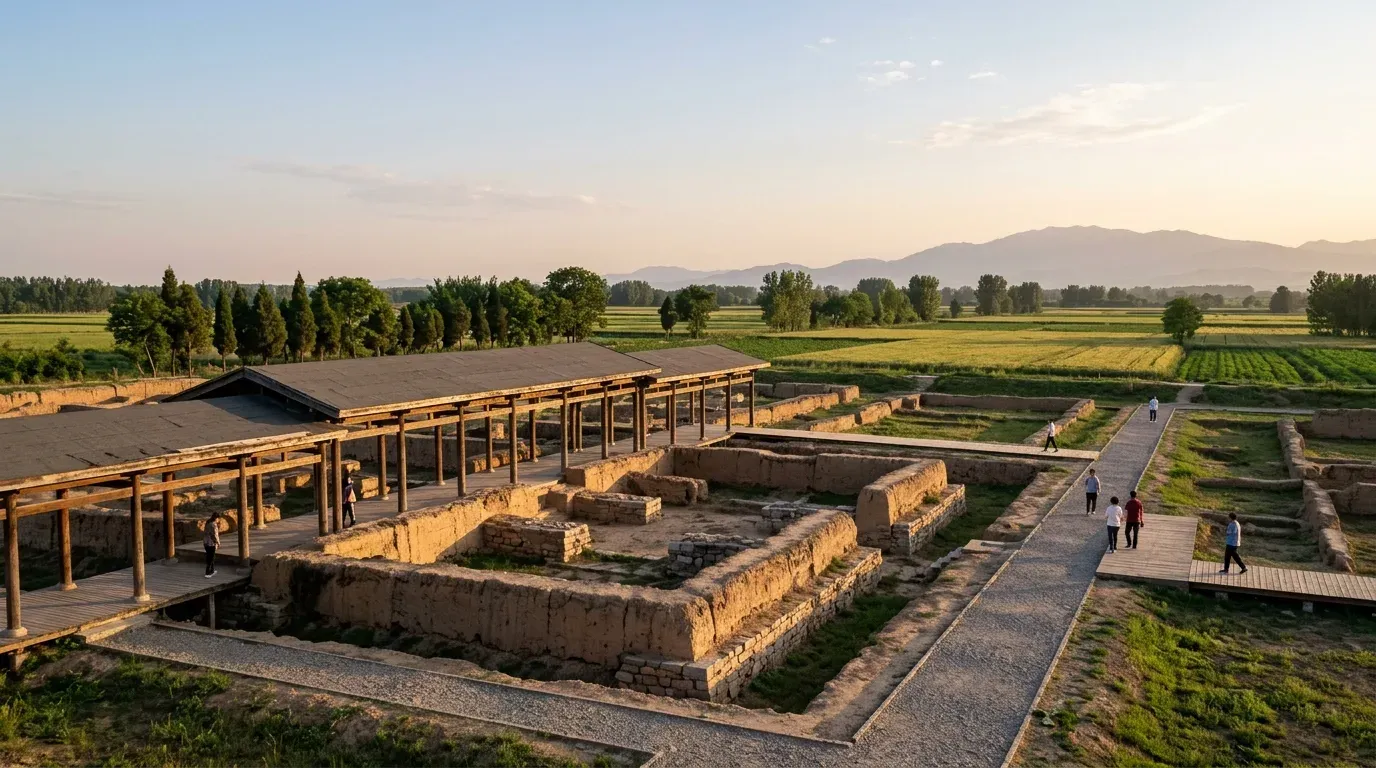
According to the Xia Shang Zhou Chronology Project, the Xia dynasty lasted from around 2070 BC to 1600 BC, spanning about 470 years. Traditional records state that it passed through 14 generations and 17 kings. Qi, son of Yu the Great, ended the tribal tradition of abdication and began hereditary dynastic rule. Located in Yanshi District, Luoyang, Henan Province, the Erlitou site covers an existing area of about 3 square kilometers. Archaeologists identify it as the remains of an early state with regional power, making it a key site for exploring early Chinese history.
What do ancient texts record about the Xia dynasty?
Traditional records state that the Xia rulers bore the surname Si, spanning 14 generations and 17 kings over about 470 years, before being overthrown by the Shang dynasty. Before its founding, the Records of the Grand Historian notes that Yu the Great spent 13 years controlling floods, passing his own door three times without entering. Historical texts record that Yu passed the throne to his son Qi, breaking the tribal tradition of abdication and establishing hereditary succession.
After going through the loss of power under Taikang and the rule of the Youqiong clan from the Dongyi, Shaokang united various tribes to defeat Han Zhuo and restore the state, known in history as the Shaokang Restoration. Later, Tang of Shang defeated King Jie at the Battle of Mingtiao, overthrew the Xia empire, and established the Shang dynasty, completing the first dynastic change in Chinese history. Ancient texts record that the Xia leaders moved and settled across 17 capitals and residences, including Yangcheng, Yangzhai, Zhenxun, Laoqiu, and Xihe.
How was the Erlitou site surveyed and confirmed?
Archaeological work at Erlitou began in 1959. On May 16, 1959, historian Xu Xusheng led a team to investigate the Ruins of Xia and discovered relics at Erlitou Village in Yanshi, Henan, which opened the path for field archaeology.
The Erlitou site lies around Erlitou Village in Yanshi District, Luoyang, Henan Province, covering an existing area of about 3 square kilometers. It was the largest settlement in East Asia from the 18th to the 16th century BC. According to Wikipedia, Luoyang is located in the Central Plains of China, serving as a cradle of Chinese civilization and the earliest established capital among China's Four Great Ancient Capitals.
How are the four phases of Erlitou culture dated?
Radiocarbon dating established the chronological framework of Erlitou culture, spanning from 1750 BC to 1520 BC. Based on published radiocarbon dates, Erlitou culture is divided from earliest to latest into Phase 1 through Phase 4.
| Erlitou Culture Phase | Radiocarbon Dating Range |
|---|---|
| Phase 1 | 1750 to 1680 BC |
| Phase 2 | 1680 to 1610 BC |
| Phase 3 | 1610 to 1560 BC |
| Phase 4 | 1560 to 1520 BC |
The dating of Erlitou Phases 1 through 4 corresponds closely with the timeline determined by the Xia Shang Zhou Chronology Project, and it also covers the transition between the Xia and Shang dynasties.
What urban planning and key artifacts were uncovered at Erlitou?
During Phase 2, four major roads about 20 meters wide formed a grid that divided the settlement into nine sections, with the palace compound located in the center. Archaeologists also discovered two-wheeled cart ruts dating back about 3,700 years on the road south of the palace area.
Palace Foundation No. 1 was built during early Phase 3 as a courtyard complex surrounded by covered corridors, with a west wall 99 meters long and a north wall 90 meters long. The site also yielded a bronze casting workshop covering 15,000 to 20,000 square meters, the earliest known bronze vessel workshop in China.
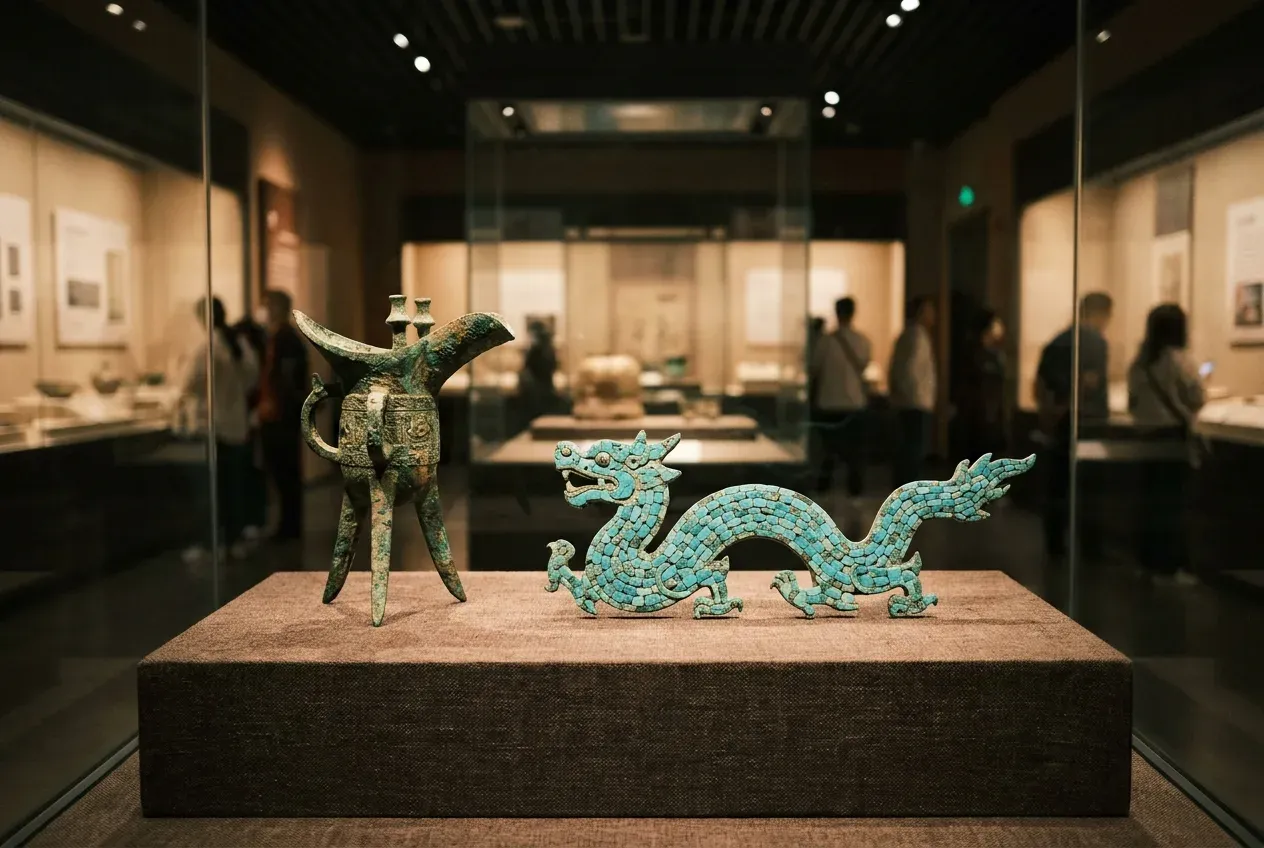
In 2002, a tomb in the palace area yielded a dragon-shaped object inlaid with over 2,000 pieces of turquoise, known as the First Dragon of China. Phase 3 also produced a bronze jue, one of the earliest bronze vessels found in Chinese archaeology.
Why are archaeologists cautious about linking Erlitou to the Xia?
The core reason for caution is the absence of written records that confirm dynastic identity. Because no contemporary texts verifying the dynasty have been found at Erlitou, scholars classify it as the remains of an early state with regional power, while maintaining cautious academic discussion on whether it served as a Xia capital or a Shang capital.
Although textual accounts of the royal lineage and capitals are detailed, whether specific phases of Erlitou correspond to the Xia or early Shang still awaits further written or archaeological evidence. To learn more about early Chinese dynasties and their historical background, read our guide to Chinese history.
What are the visiting details for the Erlitou Site Museum?
Located in Yanshi, Luoyang, the Erlitou Site Museum of the Xia Capital covers about 246 mu with a total floor area of 31,781 square meters, housing five permanent exhibition halls. The museum opened to the public for free on October 20, 2019.
The galleries display pottery, turquoise items, bronzes, and architectural components excavated from the Erlitou site. Visitors can view artifacts and rammed-earth models to understand urban scale and craft techniques from that period. The museum showcases research on the site as an early dynastic capital.
Sources
Luoyang - Wikipedia
Xia dynasty - Wikipedia
Xia dynasty - Wikipedia (Chinese)
Erlitou site - Wikipedia (Chinese)
Erlitou Site Museum of the Xia Capital - Wikipedia (Chinese)
Sources verified on November 16, 2026
FAQ
How many generations of kings ruled during the Xia dynasty?
Traditional records state that the Xia dynasty passed through 14 generations and 17 kings, lasting about 470 years. Yu the Great passed the throne to his son Qi, beginning hereditary rule. Later, Tang of Shang defeated King Jie at the Battle of Mingtiao, overthrowing the dynasty.
What key artifacts were unearthed at the Erlitou site?
Erlitou yielded a bronze casting workshop covering 15,000 to 20,000 square meters, and Phase 3 produced a bronze jue. In 2002, a tomb in the palace area yielded a dragon-shaped object inlaid with over 2,000 pieces of turquoise, known as the First Dragon of China.
Do you need to buy tickets for the Erlitou Site Museum of the Xia Capital?
The museum opened to the public for free on October 20, 2019, so visitors do not need to buy admission tickets. It covers about 246 mu with a total floor area of 31,781 square meters and features five permanent exhibition halls.
Why is Erlitou not definitively identified as the Xia dynasty?
No contemporary written records confirming its dynastic identity have been found at the site. Archaeologists confirm it as the remains of an early state with regional power, but they maintain cautious academic discussion over whether it was a Xia or Shang capital.