
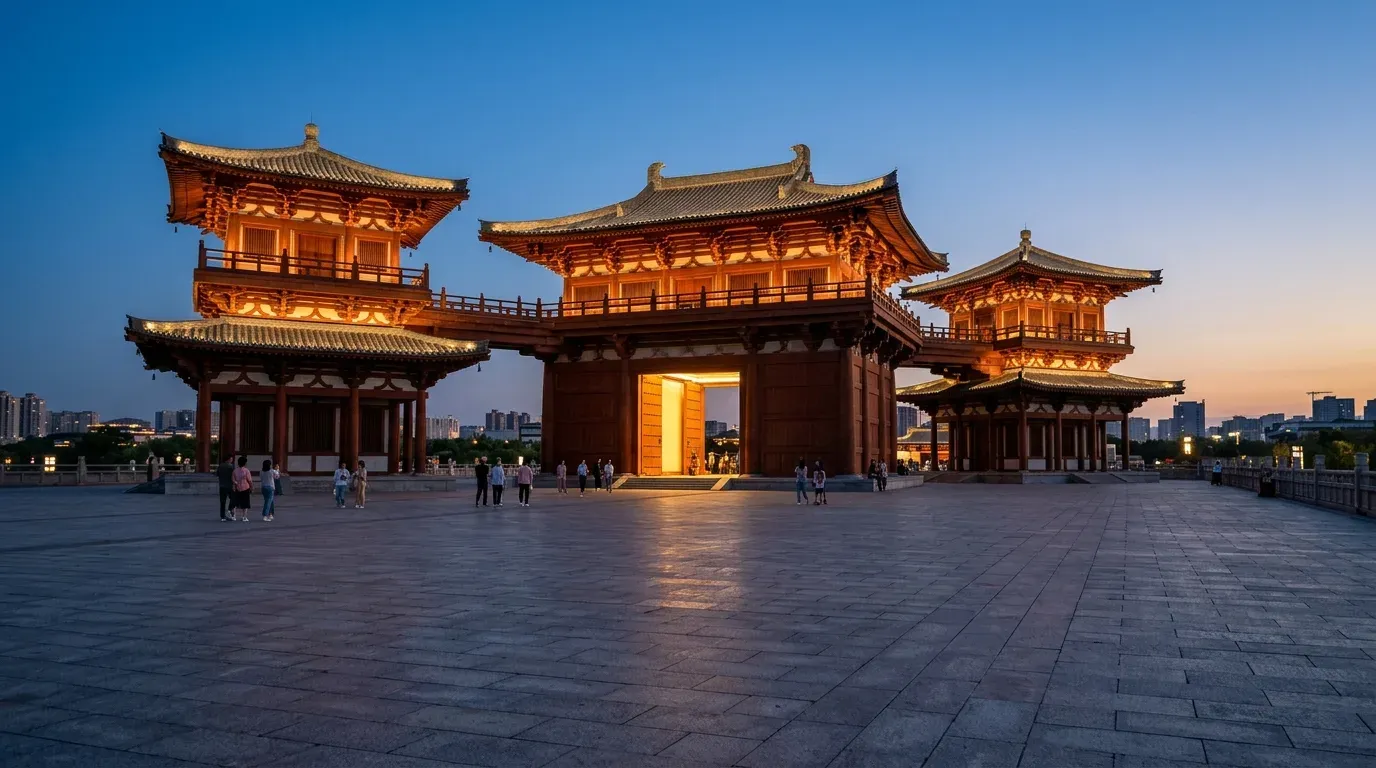
Luoyang
Located in the Central Plains of China, Luoyang is both one of the birthplaces of Chinese civilization and the earliest established capital among China's Four Great Ancient Capitals. It suits travelers interested in ancient stone carving art, capital ruins, and traditional Central Plains culture. It is usually suggested to spend 2 to 3 days here to quietly take in the history and cultural depth of this ancient capital.
Key points
As the earliest established capital among China's Four Great Ancient Capitals, Luoyang is best explored over 2 to 3 days. Spring and autumn bring moderate temperatures suitable for outdoor visits. While Metro Line 2 connects the two main railway stations, your travel designer can arrange a dedicated driver if you travel with older relatives.
Located in the Central Plains of China, Luoyang is both one of the birthplaces of Chinese civilization and the earliest established capital among China's Four Great Ancient Capitals. It suits travelers interested in ancient stone carving art, capital ruins, and traditional Central Plains culture. It is usually suggested to spend 2 to 3 days here to quietly take in the history and cultural depth of this ancient capital.
When is the weather suitable for a visit?
The city has a continental monsoon climate, with an annual average temperature of around 14.86°C and annual average precipitation between 530 and 1,100 millimeters. It has four distinct seasons. Spring and autumn bring moderate temperatures, which are suitable for outdoor visits to stone carvings and walks through local streets.
How to get to Luoyang and navigate local transit?
Among China's main historical capitals, cardinal directions were traditionally used to refer to them: Western Capital Xi'an, the Central Capital here, Southern Capital Nanjing, and Northern Capital Beijing. Today, a convenient high-speed rail network connects the area with surrounding regions. For local transport, Metro Line 2 runs north to south through the urban area, linking the two main passenger railway stations: the central railway station and Longmen Railway Station. If you travel with older relatives or carry plenty of luggage, your travel designer can also arrange a dedicated driver for transfers and chartered car service.
What historical and cultural sites are worth visiting?
Carving at the Longmen Grottoes began in 493 AD during the reign of Emperor Xiaowen of Northern Wei. In 2000, it was inscribed on the UNESCO World Heritage list as an outstanding manifestation of human artistic creativity. The site contains 2,345 caves and up to 100,000 Buddhist statues, with heights ranging from 25 millimeters to 17 meters. Among these caves, 30% were carved during the Northern Wei, 60% during the Tang dynasty, and under 10% during other periods.
Initially built in 1958, the municipal museum displays ancient civilization and excavated relics from the Neolithic Age through the Five Dynasties period.
Walking through the city also reveals the evolution of past dynastic capitals. The Royal City here became the capital of the Eastern Zhou dynasty in 771 BC. On November 27, 25 AD, Emperor Guangwu of Han officially made it the capital, serving as the Eastern Han seat from 25 AD to 190 AD and again in 196 AD. During the Wu Zhou dynasty founded by Wu Zetian, the only female emperor in Chinese history, it was established as the imperial capital and known as the Divine Capital.
How to experience local culinary specialties?
Visitors can sample the traditional local water banquet. Its first main hot dish is yan cai (Peony Swallow Dish), prepared with shredded radish to mimic the flavor and texture of bird's nest. If you want to learn about dining customs and ordering food, you can check our guide to Chinese dining and ordering.
How should you pace your travel itinerary?
The city currently administers 7 urban districts and 7 counties, with a permanent population of 7.079 million at the end of 2022. The terrain slopes from west to east, with mountainous areas accounting for 45.51%, hills 40.73%, and plains 13.8%. A 2 to 3 day itinerary is suggested: spend the first day at the Longmen Grottoes and the municipal museum to view Northern Wei and Tang stone carvings along with museum collections; spend the second day exploring historic districts and tasting a water banquet that includes yan cai; on the third day, head out to the surrounding hills and mountains to take in the local topography and natural scenery at an unhurried pace.
Sources
Historical capitals of China - Wikipedia
Luoyang - Wikipedia
Longmen Grottoes - Wikipedia
City Subway - Wikipedia
City Profile - Wikipedia
Water Banquet - Wikipedia
Museum Relics - Wikipedia
The above sources were verified on November 14, 2026.
Related travel tips
Replies 08:30–22:00 your time · Free to ask.