Famous Chinese Emperors: From Qin Shi Huang to Puyi
China's imperial monarchy lasted 2,132 years, from its founding by Qin Shi Huang in 221 BC until Puyi abdicated in 1912. According to counts such as the Encyclopedia of China, there were 422 rulers who held the title. About 158 of these Chinese emperors are widely recognized in the official orthodox lineage. When including self-declared monarchs from rival or regional regimes, the total reaches 557. On Feb 12, 1912, the Xuantong Emperor, Puyi, issued an abdication edict, ending Qing rule and more than 2,100 years of imperial monarchy in China.
Who Were the Most Representative Chinese Emperors in History?
From the unification under the Qin dynasty to the end of the Qing, several rulers who established key systems became representative figures of ancient China's imperial era. According to official imperial records and historical texts, these rulers left distinct records regarding their reign lengths, political institutions, and surviving historical sites.
| Ruler and Title | Dynasty | Reign or Rule Period | Core Historical Achievements and Relics |
|---|---|---|---|
| Qin Shi Huang (Ying Zheng) | Qin dynasty | 221 BC to 210 BC | Created the title of emperor, standardized weights, measures, script, and axle widths, built the Great Wall and national courier road network, and built his imperial tomb with the Terracotta Army in Lintong, Xi'an |
| Emperor Wu of Han (Liu Che) | Han dynasty | 141 BC to 87 BC | Reigned for 54 years, established Confucianism as the orthodox state doctrine, created the reign era system, and sent Zhang Qian to the Western Regions to open early official routes |
| Emperor Wen of Sui (Yang Jian) | Sui dynasty | Enthroned in AD 581 | Established the Three Departments and Six Ministries system, set up imperial examinations to replace the nine-rank system, and ordered Yuwen Kai to build Daxing City |
| Emperor Taizong of Tang (Li Shimin) | Tang dynasty | AD 626 to 649 | Created the Reign of Zhenguan, and was honored as Heavenly Qaghan by northern and western peoples after defeating the Eastern Turkic Khaganate |
| Wu Zetian | Wu Zhou | Reigned as emperor from AD 690 to 705 | Only recognized legitimate female emperor in Chinese history, buried alongside Emperor Gaozong of Tang in Qianling Mausoleum in Shaanxi |
| Kublai Khan (Emperor Shizu of Yuan) | Yuan dynasty | Established Great Yuan state title in 1271 | Completely unified China after conquering the Southern Song in 1279, made Dadu his capital, and was the first non-Han emperor to rule all of China |
| Yongle Emperor (Zhu Di) of Ming | Ming dynasty | 1402 to 1424 | Moved capital to Beijing, oversaw construction of the Forbidden City, dredged and restored the Grand Canal, and dispatched Zheng He on seven maritime voyages |
| Kangxi Emperor of Qing | Qing dynasty | 1661 to 1722 | Reigned for 61 years and 318 days setting the longest reign record, and initiated the High Qing era (Kang-Qian Flourishing Age) |
| Xuantong Emperor (Puyi) | Qing dynasty | Enthroned in 1908 and abdicated in 1912 | Issued the abdication edict on Feb 12, 1912 to end the imperial system, left the Forbidden City in 1924, and later served as a member of the CPPCC |
What Foundational Systems Were Created by Qin Shi Huang and Emperor Wu of Han?
Qin Shi Huang introduced the standardization of weights, measures, script, and axle widths, while Emperor Wu of Han established Confucianism as the orthodox state ideology and created the reign title system. In 221 BC, after conquering the six Warring States, King Ying Zheng of Qin created the title of huangdi (emperor), combining huang and di from pre-Qin legends to establish the supreme title for imperial rulers. After Qin Shi Huang established this title, as China's emperor, the monarch served as the supreme ruler of the imperial system.
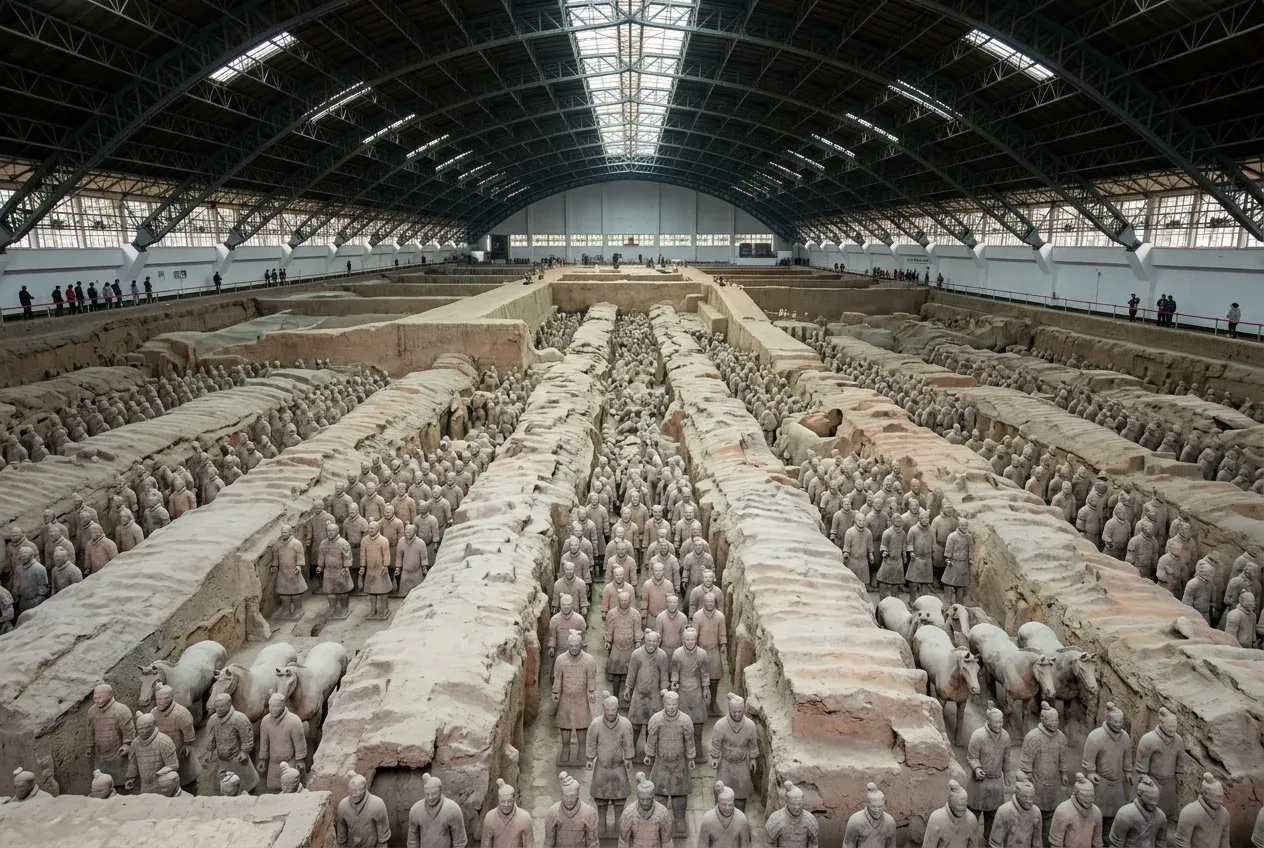
During his reign from 221 BC to 210 BC, Qin Shi Huang standardized weights, measures, writing, and cart axle widths. He built the Great Wall and a national road network, and constructed his imperial mausoleum in modern Lintong, Xi'an, guarded by a massive Terracotta Army. The Mausoleum of the First Qin Emperor and its terracotta pits were inscribed on the UNESCO World Heritage List in 1987. Today, excavation sites for Pit 1, Pit 2, and Pit 3 and their unearthed terracotta figures are open to the public.
Emperor Wu of Han, Liu Che, reigned for 54 years from 141 BC to 87 BC, holding the record for the longest reign among Han rulers. He established Confucianism as the official state learning and pioneered the imperial era name system, starting with Jianyuan. Between 139 BC and 138 BC, he sent Zhang Qian on a mission to the Western Regions to contact the Yuezhi. Zhang Qian was captured and detained for 13 years before escaping back to the Han court, and was dispatched again in 119 BC, officially opening China's early formal routes connecting to Central Asia.
How Did Famous Emperors of the Sui and Tang Dynasties Drive Institutional Reforms and Prosperity?
Emperor Wen of Sui reunited northern and southern China and established the Three Departments and Six Ministries system, Emperor Taizong of Tang ushered in the Reign of Zhenguan, and Wu Zetian became the only legitimate female emperor. On Mar 4, 581, Emperor Jing of Northern Zhou abdicated the throne to imperial in-law Yang Jian, who founded the Sui dynasty as Emperor Wen. According to Britannica, the short-lived Sui dynasty (581 to 618) reunited northern and southern China after centuries of division, laying the political and cultural foundations for the golden age of the Tang dynasty.

Emperor Wen abolished the Northern Zhou six-ministry system and officially established the Three Departments and Six Ministries, dividing central power among the Secretariat, Chancellery, and Department of State Affairs overseeing six ministries, which shaped future central administrative systems. In 587, he created the imperial examination system to select talent by subject, replacing the nine-rank system. In 606, Emperor Yang of Sui added the jinshi examination, breaking aristocratic monopolies on official careers. In addition, Emperor Wen ordered the prominent architect Yuwen Kai to build Daxing City, the precursor to Tang Chang'an, which was one of the grandest designed cities in the world at the time.
During his reign from AD 626 to 649, Emperor Taizong of Tang (Li Shimin) created the Reign of Zhenguan, marked by good governance and economic prosperity, and was honored as Heavenly Qaghan by northern and western peoples after defeating the Eastern Turks. Wu Zetian (624 to 705) is the only widely recognized legitimate female emperor in Chinese history. She ruled as emperor of the Wu Zhou dynasty from 690 to 705 and was buried alongside Emperor Gaozong of Tang at Qianling Mausoleum in Shaanxi.
What Capital and Architectural Heritage Did Yuan, Ming, and Qing Emperors Leave in Beijing?
Kublai Khan and Zhu Di successively chose Beijing as their capital, building Dadu and the Forbidden City, while the Kangxi Emperor initiated the High Qing era. Kublai Khan adopted the dynastic title Great Yuan in 1271, set Dadu (modern Beijing) as his capital, and fully unified China after defeating the Southern Song in 1279, becoming the first non-Han emperor to rule the entire realm. During his reign from 1402 to 1424, the Yongle Emperor, Zhu Di, relocated the Ming capital to Beijing, oversaw construction of the Forbidden City from 1407 to 1420, dredged and repaired the Grand Canal, and sent Zheng He on seven maritime voyages.
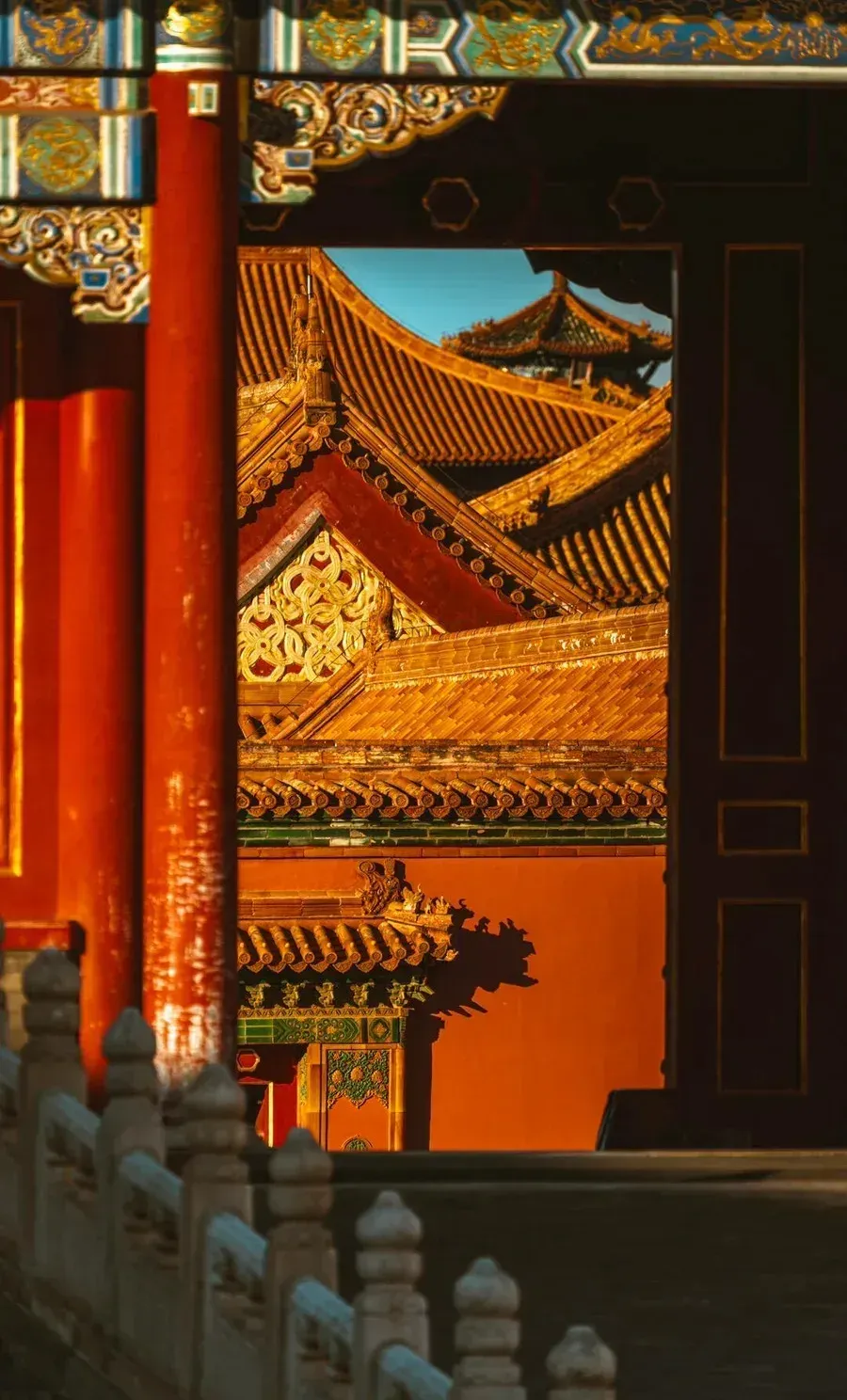
The Forbidden City in Beijing covers 72 hectares, with research confirming 8,886 existing rooms. Between 1420 and 1924, it served as the imperial palace and political center of China for 24 emperors across the Ming and Qing dynasties (14 Ming and 10 Qing rulers). The Kangxi Emperor reigned for 61 years and 318 days from 1661 to 1722, making him the longest-reigning Chinese emperor in history, and began the High Qing era of economic prosperity and border stability that lasted over a century.
What Rules Governed Qing Imperial Robes and Palace Screen Walls?
Qing imperial attire was divided into three categories: ritual dress, festive dress, and casual dress, with the dragon robe belonging to festive dress. The dragon robe was worn on ceremonial occasions such as banquets, festivals, and audiences with officials, ranking below formal court dress. According to the Draft History of Qing, the emperor's dragon robe was embroidered with nine golden dragons alongside the Twelve Ornaments, with front-facing dragons on the front and back of the collar, running dragons on both shoulders and overlapping lapels, front-facing dragons at sleeve cuffs, and Eight Treasures with standing water patterns along the lower hem.
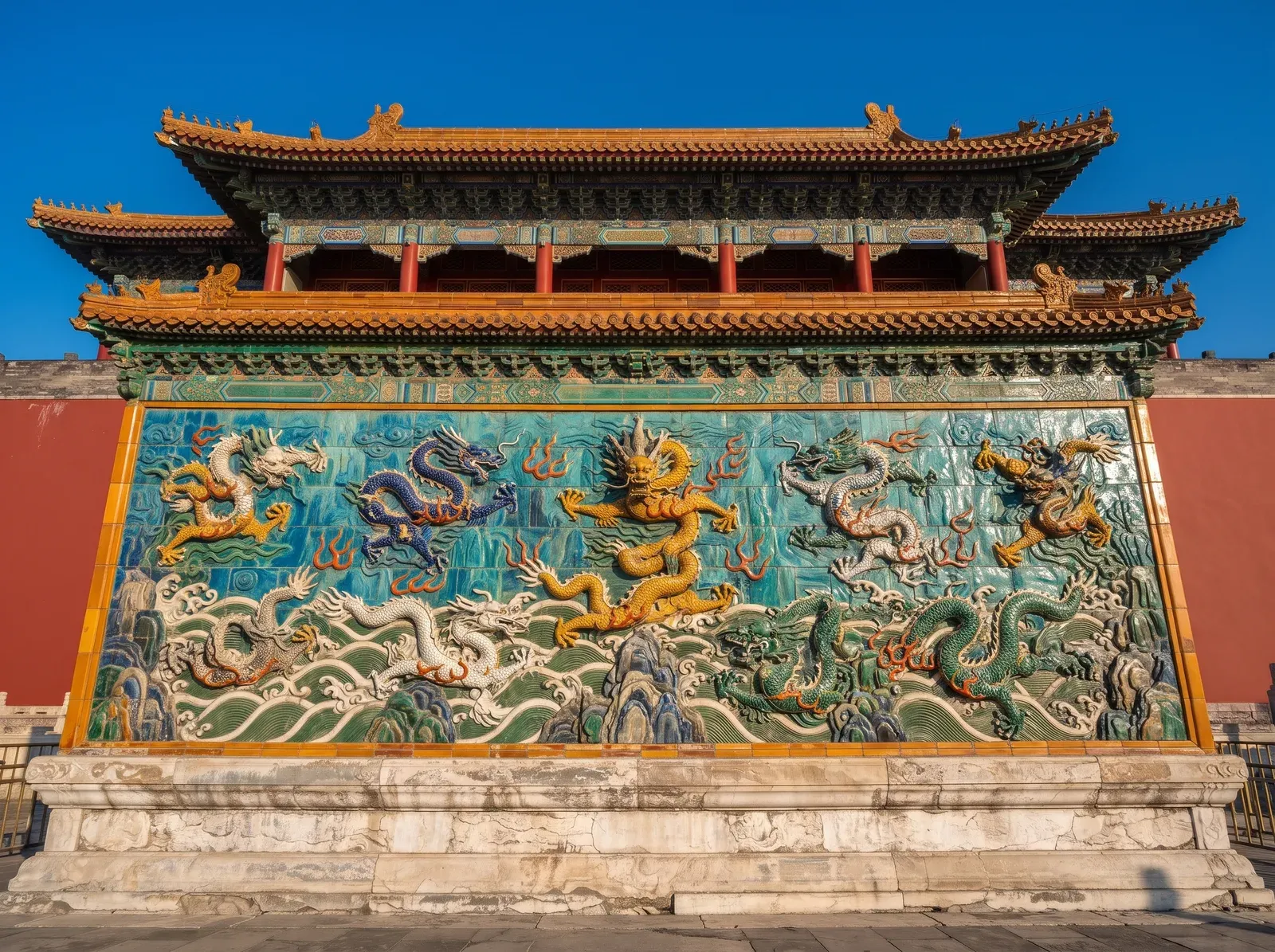
The Qing dragon robe had nine dragons in total, with one hidden inside the inner flap, revealing eight when worn. When viewed from either front or back, five dragons were visible, matching the symbolic imperial concept of Nine-Five supremacy. The Nine-Dragon Screen in the Forbidden City was fired in 1772 during Qianlong's renovation of the Palace of Tranquil Longevity. Facing north directly toward the Gate of Imperial Supremacy, it measures 29.4 meters long, 3.5 meters high, and 0.45 meters thick as a single-sided glazed screen wall.
What Role Changes Did Puyi, the Last Emperor, Experience?
The Xuantong Emperor, Puyi, issued an abdication edict in 1912 to end the imperial system, and later served as a member of the CPPCC. Puyi took the throne in 1908 at the age of two years and ten months. On Feb 12, 1912, he issued his abdication edict, ending Qing rule and more than 2,100 years of imperial monarchy in China.
Puyi was expelled from the Forbidden City in 1924. After receiving a special pardon in 1959, he worked as a gardener at the Beijing Botanical Garden and as a specialist at the Institute of Culture and History, before being elected to the National Committee of the Chinese People's Political Consultative Conference (CPPCC) in 1964.
What Background Should You Keep in Mind When Studying Chinese Emperors?
Historical counts of China's emperors differ depending on the criteria used. Reference works like the Encyclopedia of China count 422 rulers over two millennia of imperial rule. Around 158 are widely accepted in the orthodox lineage, while including self-proclaimed rulers of regional or rival regimes raises the number to 557. The idea that nine dragons on a robe symbolize Nine-Five supremacy reflects traditional cultural beliefs and ancient ritual texts rather than a scientific conclusion.
Sources
Sui Dynasty - Wikipedia
Sui dynasty | Chinese Imperial Dynasty, Reunification of China | Britannica
About the Silk Roads | UNESCO
Silk Road - Facts, History & Location | HISTORY
Terracotta Army - Wikipedia
Qing Dynasty Clothing - Wikipedia
Dragon Robe - Baidu Baike
Nine-Dragon Screen (Forbidden City) - Wikipedia
Emperor of China - Wikipedia
Chinese Emperors - Baidu Baike
Qin Shi Huang - Wikipedia
Emperor Wu of Han - Wikipedia
Emperor Taizong of Tang - Wikipedia
Wu Zetian - Wikipedia
Kublai Khan - Wikipedia
Yongle Emperor - Wikipedia
Kangxi Emperor - Wikipedia
Forbidden City - Wikipedia
Puyi - Wikipedia
Sources verified on Nov 14, 2026.
FAQ
Which Chinese emperors lived to age 80 or older?
Across more than 2,000 years of imperial history, only 5 emperors lived to age 80 or older. They were the Qianlong Emperor of Qing (89), Emperor Wu of Liang (Xiao Yan, 86), Empress Wu Zetian (82), Emperor Gaozong of Song (Zhao Gou, 81), and Kublai Khan (80).
Who holds the records for the longest reign overall and among Han Chinese emperors?
The Kangxi Emperor of Qing was the longest-reigning ruler, serving for 61 years and 318 days (1661 to 1722). Emperor Wu of Han (Liu Che) reigned for 54 years (141 BC to 87 BC), holding the longest reign record among Han Chinese emperors.
Who was the only legitimate female emperor in Chinese history?
Wu Zetian is the only widely recognized legitimate female emperor in Chinese history. She ruled as emperor of the Wu Zhou dynasty from AD 690 to 705 and was buried with Emperor Gaozong of Tang at Qianling Mausoleum in Shaanxi.
How many emperors lived in the Forbidden City in Beijing?
Between 1420 and 1924, the Forbidden City served as the imperial palace and political center for 24 emperors across the Ming and Qing dynasties (14 from Ming and 10 from Qing). Specialists have confirmed it contains 8,886 existing rooms.