
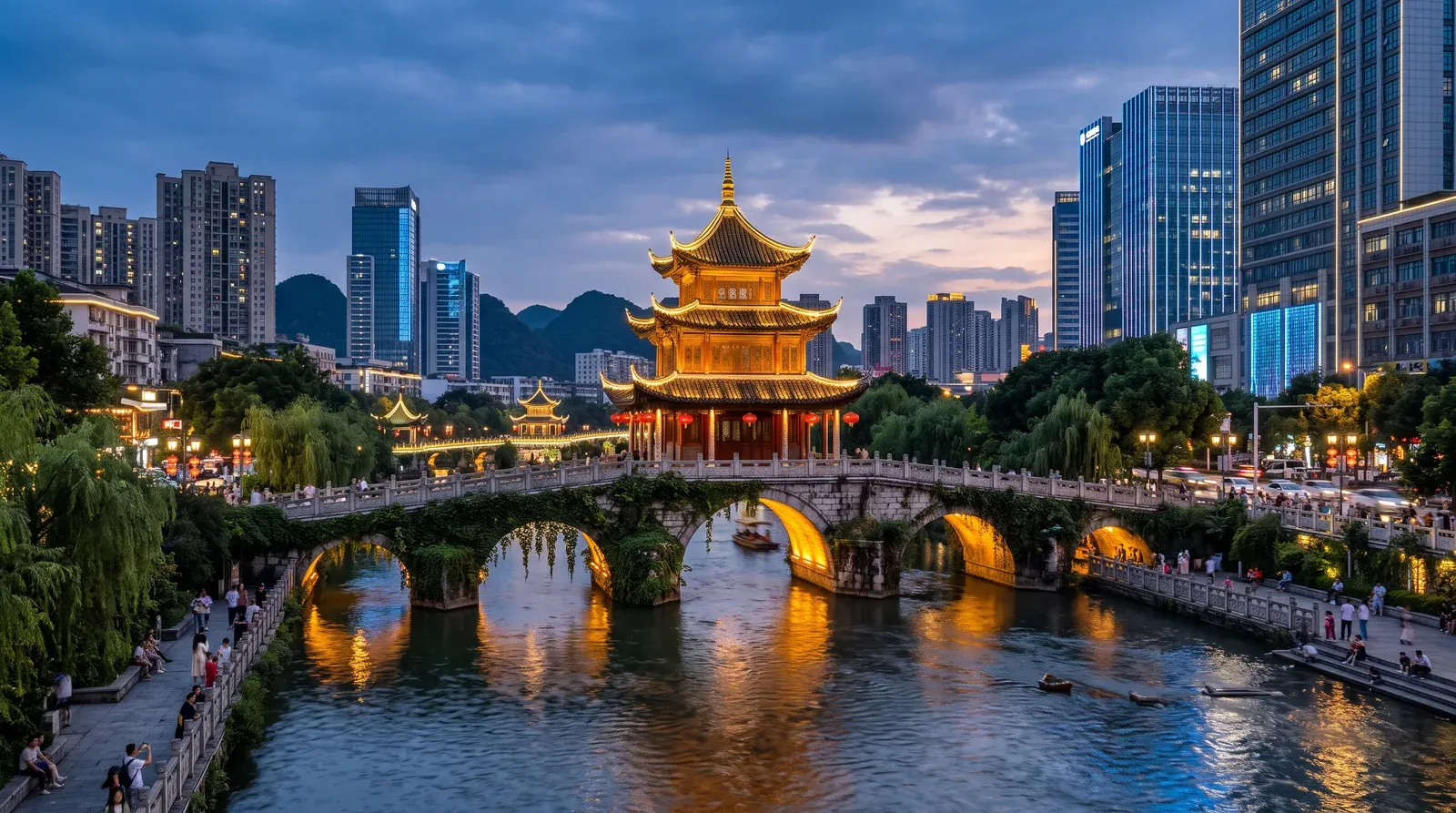
Guiyang
Guiyang is the capital of Guizhou Province, located on the eastern Yunnan-Guizhou Plateau along the north bank of the Nanming River at an average elevation of around 1,100 meters. With a cool climate, it serves as a transit hub for exploring Guizhou's karst landscapes and diverse cultures. First-time visitors are usually recommended to spend 2 to 3 days here.
Key points
First-time visitors to Guiyang are recommended to spend 2 to 3 days exploring highlights like Jiaxiu Tower and Qianling Mountain Park. With an average July temperature of 23.8°C, the city stays cool in summer, though rainfall concentrates between May and July, so carrying rain gear is advisable. Urban metro lines provide convenient transit starting at 2 RMB.
Guiyang is the capital of Guizhou Province, located on the eastern Yunnan-Guizhou Plateau along the north bank of the Nanming River at an average elevation of around 1,100 meters. With a cool climate, it serves as a transit hub for exploring Guizhou's karst landscapes and diverse cultures. First-time visitors are usually recommended to spend 2 to 3 days here.
What Is the Weather and Travel Season Like in Guiyang?
The city has a subtropical monsoon climate with an annual average temperature of 15.2°C. The coldest month, January, averages 4.6°C, while the hottest month, July, averages only 23.8°C. Thanks to its mild, cool summers, it ranks second among China's Top 10 Summer Capitals. Annual precipitation is about 1,149 mm, mostly concentrated from May to July. Monthly average relative humidity stays above 75% year-round, and annual sunshine reaches only around 1,150 hours. Bringing rain gear is suggested when traveling in summer.
How to Arrive and Travel Around the City?
Longdongbao International Airport (KWE) is situated 11 kilometers southeast of the city center. Its terminal basement is directly connected to Metro Line 2 and Longdongbao High-Speed Railway Station. The North Railway Station serves major high-speed routes connecting Shanghai, Kunming, and Chengdu, with direct access via Metro Line 1; for more details, you can refer to the China high-speed train guide. The urban metro network currently operates Lines 1, 2, 3, and Line S1. Fares are calculated according to distance traveled, starting at 2 RMB with a maximum one-way ticket price of 8 RMB. Children under 1.3 meters in height and seniors aged 70 and above ride free of charge, making it very convenient to travel around the city by metro.
What Are the Highlights and Local Specialties?
Local attractions cover both historic architecture and scenic natural landscapes. Jiaxiu Tower was first built in 1598 during the 26th year of the Wanli reign of the Ming Dynasty, with the current structure rebuilt in 1909, standing on the Aoji Stone in the Nanming River. The free-admission Qianling Mountain Park houses Hongfu Temple and Qianling Lake, as well as a troop of wild macaques. Qingyan Ancient Town, originally founded in 1378 during the 10th year of the Hongwu reign of the Ming Dynasty, retains dense Ming and Qing stone buildings and was the hometown of Zhao Yijiong, Guizhou's first top scholar in the imperial civil examination. Tianhetan, located about 24 kilometers from the downtown area, showcases distinctive karst scenery. In the urban area, there are also the 335-meter-high Huaguoyuan Twin Towers and the white French-style Art Center.
Local cuisine centers on sour and spicy flavors, as reflected in the folk saying, "Without sour food for three days, your legs will wobble." The iconic sour soup originates from traditional Miao fermented broth and is widely used to prepare sour soup fish. Classic local snacks include changwang noodles, Huaxi beef rice noodles, siwawa (silk doll wraps), Qingyan braised pig trotter, and deep-fried tofu balls that are crispy on the outside and tender on the inside. An essential part of daily dining is the dipping sauce (zhanshui), whose soul ingredient is zheergen (fish mint); if you are not accustomed to its taste, you can consult the China dining guide to explain your dietary preferences. As of 2025, there are more than 3,000 cafes operating across the city.
How to Pace Your Visit?
A 2 to 3 day itinerary works well here: on day one, visit Jiaxiu Tower in the urban core, stroll through Qianling Mountain Park, and savor sour soup fish; on day two, head out to Tianhetan Scenic Area and Qingyan Ancient Town to appreciate Ming and Qing architecture alongside local specialty snacks. As a regional transport hub, the city allows you to continue conveniently by high-speed rail to nearby destinations like Zunyi. Your travel designer can tailor a specific itinerary and arrange a private vehicle with your driver to serve you throughout the trip.
Sources
City Overview - Wikipedia
Jiaxiu Tower - Wikipedia
Qianling Mountain Park - Wikipedia
Qingyan Town - Wikipedia
Huaguoyuan - Wikipedia
Tianhetan - Wikipedia
Guizhou Cuisine - Wikipedia
Longdongbao International Airport - Wikipedia
North Railway Station - Wikipedia
Metro System - Wikipedia
Sources verified on November 16, 2026
Related travel tips
Replies 08:30–22:00 your time · Free to ask.