
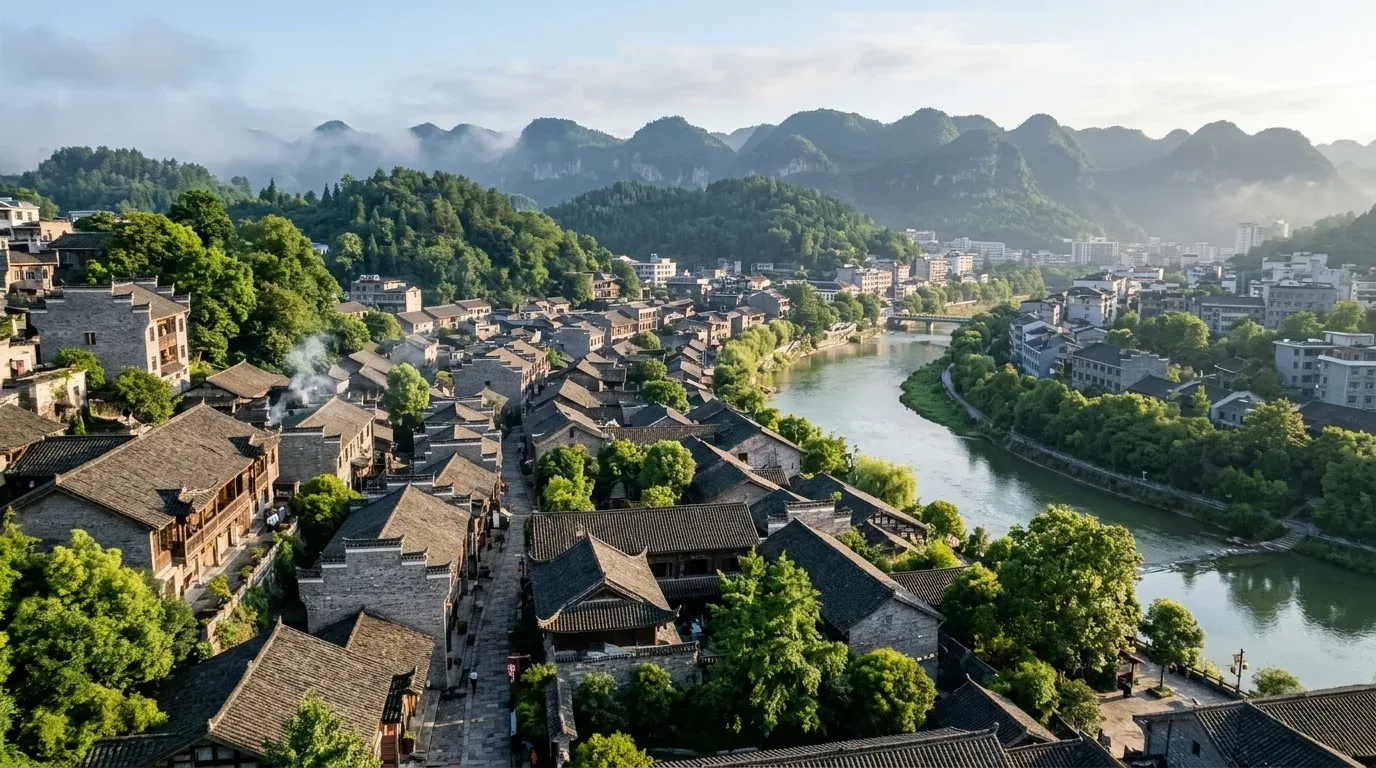
Zunyi
Historically known as Bozhou, Zunyi is located in northern Guizhou on the northeastern Yunnan-Guizhou Plateau. It borders Chongqing to the north and Guiyang to the south. As a prefecture-level city, it is a provincial sub-center and the second-largest city in Guizhou Province. Zunyi covers a total area of 30,767 square kilometers with a permanent resident population of about 6.58 million. It is one of China's first National Historical and Cultural Cities. According to tradition, the name Zunyi comes from a line in the Book of Documents: "Without partiality, without bias, follow the king's justice." The area suits visits to historical heritage and natural landforms. Travelers usually spend 3 to 4 days exploring Zunyi.
Key points
Travelers usually need 3 to 4 days to explore Zunyi. Because key sights like Hailongtun and Chishui Danxia are scattered across different districts and counties, you can travel between them by car with your driver. Plan 1 day for Hailongtun and Loushanguan Pass, and 1 to 2 days for Chishui Danxia and the nature reserve.
Historically known as Bozhou, Zunyi is located in northern Guizhou on the northeastern Yunnan-Guizhou Plateau. It borders Chongqing to the north and Guiyang to the south. As a prefecture-level city, it is a provincial sub-center and the second-largest city in Guizhou Province. Zunyi covers a total area of 30,767 square kilometers with a permanent resident population of about 6.58 million. It is one of China's first National Historical and Cultural Cities. According to tradition, the name Zunyi comes from a line in the Book of Documents: "Without partiality, without bias, follow the king's justice." The area suits visits to historical heritage and natural landforms. Travelers usually spend 3 to 4 days exploring Zunyi.
When to Visit Zunyi?
Zunyi has a plateau subtropical monsoon climate. Its annual average temperature is about 15.1°C to 15.3°C, and annual precipitation is about 1,074.4 mm. The weather is mild and pleasant, with neither severe cold in winter nor extreme heat in summer.
How to Get to Zunyi and Travel Between Counties?
Zunyi has two 4C-grade civil airports. Zunyi Xinzhou Airport is located in Xinzhou Town, Honghuagang District, about 35 kilometers from the city center, and opened to commercial flights on August 28, 2012. The other airport, Zunyi Maotai Airport, is in Gaodaping Town, Renhuai City.
In terms of rail transit, the Chongqing-Guiyang Railway opened in January 2018, with stops in Zunyi including Zunyi Station. High-speed trains connect Zunyi to Guiyang and Chongqing within 1 hour, to Chengdu in about 3 hours, and to Guangzhou in about 6 hours (for train regulations, see the China High-Speed Train Guide). Zunyi oversees 3 municipal districts (Honghuagang, Huichuan, and Bozhou), 7 counties (Tongzi, Suiyang, Zheng'an, Fenggang, Meitan, Yuqing, and Xishui), 2 autonomous counties (Daozhen and Wuchuan), and administers 2 county-level cities (Chishui and Renhuai). Because the main sights are scattered across different districts and counties, you can travel by car with your driver.
What Are the Main Places to Visit in Zunyi?
Hailongtun: Located on Longyan Mountain in Huichuan District, it was first built in the late Southern Song Dynasty. It is China's best-preserved medieval castle site. In 2015, it was inscribed on the UNESCO World Heritage List as part of the Tusi Sites, becoming Zunyi's first World Cultural Heritage site. It covers a total area of 1.59 square kilometers, with nearly 5.6 kilometers of surviving walls. Surrounded by sheer cliffs on all four sides, it features multiple military passes including Tiezhu Pass, Tongzhu Pass, Feihu Pass, Feilong Pass, and Chaotian Pass, as well as the ruins of new and old royal palaces.
Chishui Scenic Area: A national-level scenic area. Chishui Danxia was inscribed on the World Heritage List in 2010 as part of China Danxia, featuring large areas of young Danxia landforms and numerous waterfalls. Within the area, the Chishui Alsophila National Nature Reserve is home to 47,000 spinulose tree ferns (Alsophila spinulosa), a first-class protected plant in China and a Jurassic relict. It is the most densely populated area for this species in the world.
Suiyang Shuanghe Cave: Located in Suiyang County, the Shuanghe Cave National Geopark has an explored length of 439.7 kilometers and a depth of about 917 meters. It is the longest cave in Asia and the longest dolomite cave in the world. Fossil remains of more than 50 giant pandas have been unearthed inside, making it the cave with the largest number of complete giant panda fossils found in the world so far.
Loushanguan Pass: Located at the border between Huichuan District and Tongzi County, it stands at an elevation of 1,576 meters. It is a Major Historical and Cultural Site Protected at the National Level and a national 4A-level tourist attraction, long regarded as the key gateway between Sichuan and Guizhou.
Moutai Town, Renhuai: The baijiu liquor industry is one of Zunyi's core pillar industries. The famous spirit Guizhou Moutai comes from Maotai Town in Renhuai City, which is administered by Zunyi. It is a sauce-aroma Daqu baijiu distilled from sorghum, known for its rich aroma, and is one of China's representative liquors.
How to Pace Your Visit to Zunyi?
Zunyi's natural and cultural sights are spread across different districts and counties, so it is recommended to pace your trip by geographic area: You can spend 1 day in Huichuan District visiting Hailongtun and Loushanguan Pass; spend 1 to 2 days in Chishui City exploring the Chishui Danxia and the alsophila nature reserve; and set aside time to visit Shuanghe Cave in Suiyang County or Maotai Town in Renhuai City. You can contact your travel designer to help plan smooth routes between these county-level sights.
Sources
Moutai - Wikipedia
Zunyi - Wikipedia
Hailongtun - Wikipedia
Chishui - Wikipedia
Loushanguan - Wikipedia
Shuanghe Cave - Wikipedia
Zunyi Xinzhou Airport - Wikipedia
Zunyi Maotai Airport - Wikipedia
The sources above were verified on November 14, 2026.
Related travel tips
Replies 08:30–22:00 your time · Free to ask.