
Yellow Emperor Huangdi: Life, History, and His Mausoleum
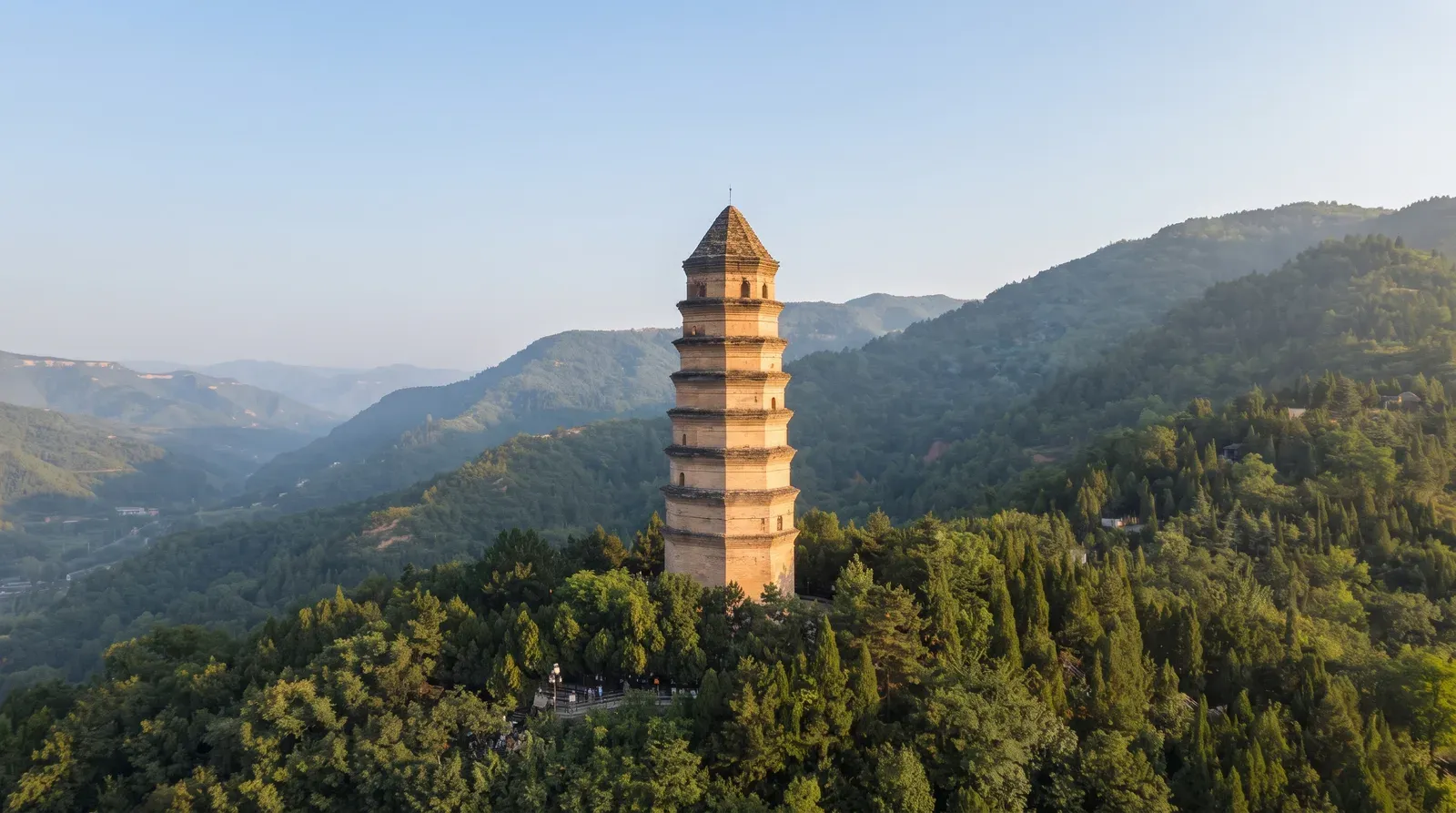
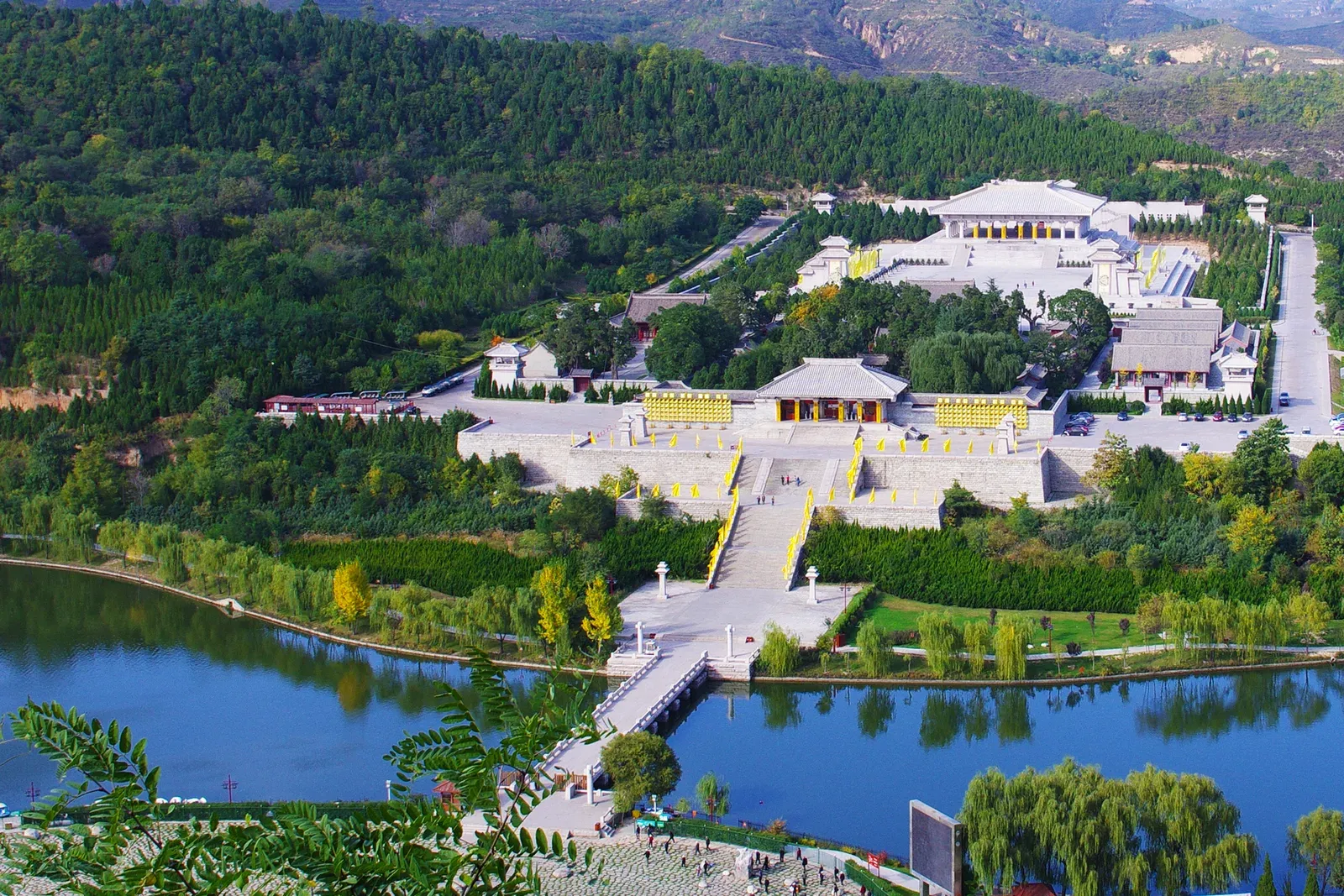
In the Records of the Grand Historian, Huangdi, the Yellow Emperor, is listed first among the Five Emperors. He is a ruler and culture hero in ancient Chinese legend. His tomb sits on Qiao Shan in Huangling County, Shaanxi. In 1961 the State Council named it a national key cultural relic in the first batch, listed as "ancient tomb No. 1". The scenic area covers about 333 hectares and has two parts: the tomb area and Xuanyuan Temple.
| Item | Details |
|---|---|
| Location | Qiao Shan in Huangling County, on the Loess Plateau, about 200 km north of Xi'an city and 170 km south of Yan'an |
| Tickets | 75 yuan for adults, 37.5 yuan half price, 20 yuan for the shuttle |
| Booking | Real-name booking, up to 2 days ahead, bring a passport or ID card |
| Main sights | The tomb mound, the Hanwu Immortal Terrace and the stele corridor in the tomb area; Xuanyuan Hall, the cypress said to have been planted by him, and the Chinese Ancestors Hall in Xuanyuan Temple |
| Rating | First batch of national 5A scenic areas, a national scenic area |
Who was the Yellow Emperor, and what does the Records of the Grand Historian say?
In the Basic Annals of the Five Emperors in Sima Qian's Records of the Grand Historian, the Yellow Emperor, Huangdi, is the son of Shaodian, surname Gongsun, given name Xuanyuan, and he lived at Xuanyuan Hill. Sima Qian gave him the opening chapter of the whole book. If dates help you more, Jesuit missionaries worked out from Chinese histories that his traditional reign began in 2698 or 2697 BC and lasted exactly 100 years. If you would rather keep to the stories, the next thing to read is the two battles, at Banquan and at Zhuolu.
It describes two great wars he fought: first he defeated the Yan Emperor at Banquan, then he beat and captured Chiyou at Zhuolu.
His principal wife was Leizu, a woman of the Xiling clan. The chapter says he had 25 sons, 14 of whom were given surnames.
Where does the name "Yellow Emperor" come from, and what about the inventions?
The title Huangdi is traditionally explained by the theory of the five powers: yellow is the color of the earth phase. If you want to follow the names, the calendar, pitch pipes and arithmetic are credited in old texts to four separate men, Linglun, Darao, Lishou and Rongcheng. If you would rather keep one running account, those sit alongside Daoism, wooden houses, boats, carts, the compass and cuju, the old kickball game, all under his name.
Later ancient texts credit the calendar, pitch pipes and arithmetic to him and his officials: Ling Lun made the pitch standards, Darao created the sexagenary cycle, Lishou devised arithmetic, and Rong Cheng combined six methods to set the calendar.

Tradition also puts Daoism, wooden houses, boats, carts, the compass, "the earliest form of writing" and cuju, an early ball game, under his name.
Folk tradition gives the third day of the third lunar month as his birthday. A saying goes: "On the second day of the second month the dragon lifts its head; on the third day of the third month Xuanyuan is born." If you want to mark the traditional date, it is the third of the third month; if you want to see a ceremony on the ground, it is the state ceremony at Qingming.
Is this history or legend?
The earliest surviving material that clearly names him is the inscription on the Chen Hou Yin Qi dun, a bronze vessel of the state of Qi from the Warring States period, which says "our distant ancestor the Yellow Emperor." If you want to remember one object, it is this Qi bronze. If you want the text, it is the Basic Annals of the Five Emperors in the Records of the Grand Historian, where Sima Qian opens with him and lists him first among the Five Emperors.
From the 1920s, scholars of the Doubting Antiquity school began to question whether he was a historical figure. Most researchers today think he started as a god and was later described as a person.
| Material or claim | Content |
|---|---|
| Chen Hou Yin Qi dun inscription | Earliest surviving material that clearly mentions him; the inscription says "our distant ancestor the Yellow Emperor" |
| Records of the Grand Historian, Basic Annals of the Five Emperors | Sima Qian opens the book with him and lists him first among the Five Emperors |
| Doubting Antiquity scholars | From the 1920s they questioned whether he was historical |
| Jesuit missionaries' reckoning | The traditional reign begins in 2698 or 2697 BC and lasts exactly 100 years |
What is actually buried in the tomb?
The chapter on the Feng and Shan sacrifices in the Records of the Grand Historian tells of Huangdi, the Yellow Emperor, casting a tripod and riding a dragon up to heaven, and says: "the Yellow Emperor has gone up to heaven as an immortal; his ministers buried his clothes and cap."
Tip: At Qiaoshan (桥山) you see the burial mound inside the tomb area; Xuanyuan Temple sits in another part of the site. If you want to know what lies in the tomb, the line from the Records of the Grand Historian answers it: his ministers buried his clothes and cap.
Legend has it that he went up to heaven right here on Qiao Shan and left only his clothes and cap in the tomb, so what lies buried there is clothing, not a body. The tomb is called the first tomb under heaven and is also in the first batch of national 5A scenic areas.
Inside the tomb area, where do you start?
Once you reach the tomb area, start with the dismount stone on the right side of the stone path. It is carved with the words: civil and military officials dismount here.
Tip: Keep walking along this path and you come to the Hanwu Immortal Terrace, closer to the burial mound. See the dismount stone first, then walk on to the terrace, and come to the mound last.
Closer to the mound is the Hanwu Immortal Terrace. In October 110 BC, Emperor Wu of Han came to sacrifice with 180,000 soldiers and set up the terrace.
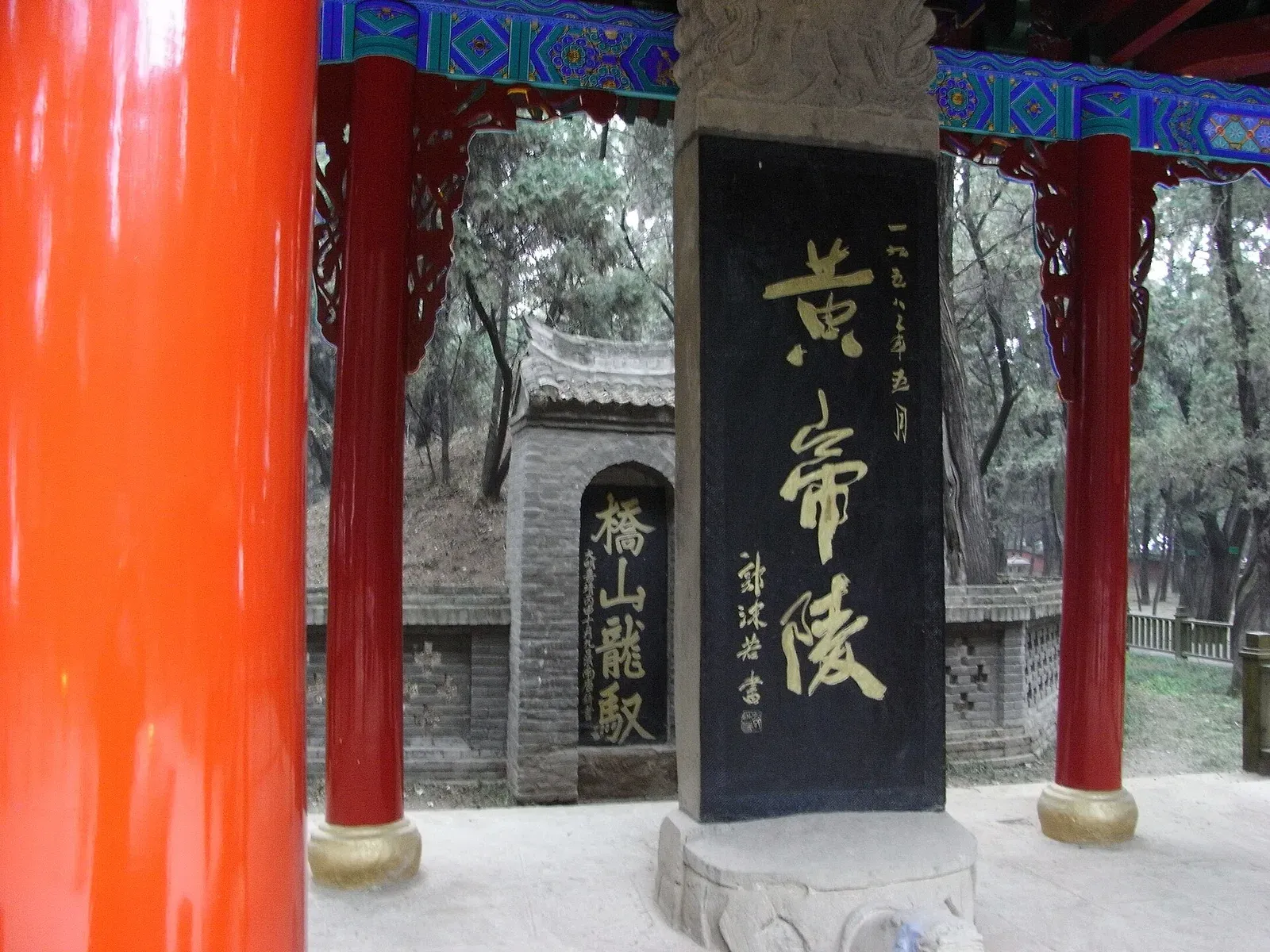
The mound today is 3.6 m high, 48 m around, and ringed by a brick wall. On its south side stands a Ming dynasty stele reading "Qiao Shan, the dragon chariot"; the stele corridor on the east side keeps 57 steles made for emperors of different dynasties.
What to see in Xuanyuan Temple and the old cypress grove?
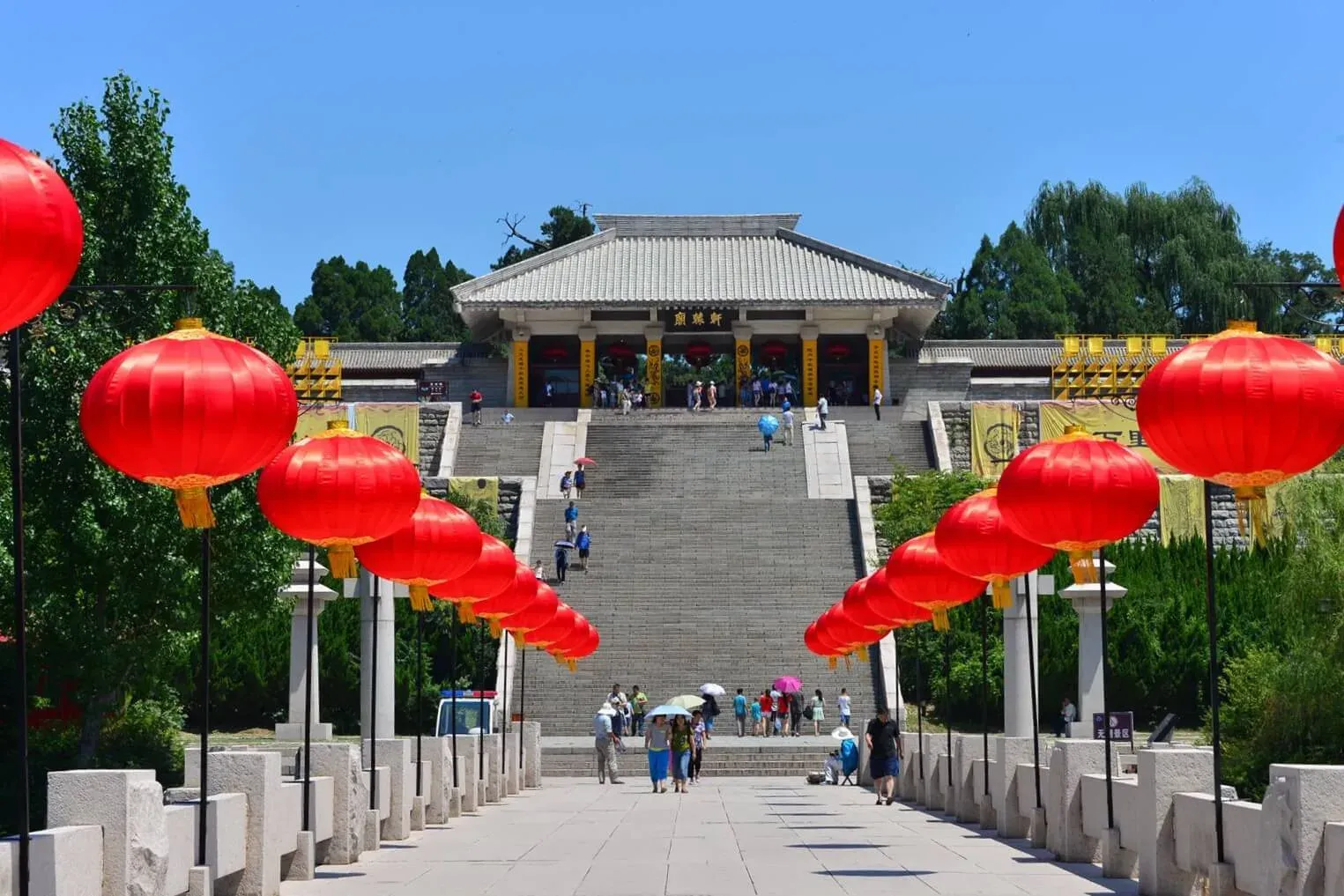
Xuanyuan Hall in the temple is about 8,000 square meters and built entirely of granite.
Tip: Xuanyuan Temple and the tomb area are two separate parts of the site. After seeing Xuanyuan Hall and the old cypresses in the courtyard, walk to the west side of the temple exit and take the shuttle bus to the tomb area.
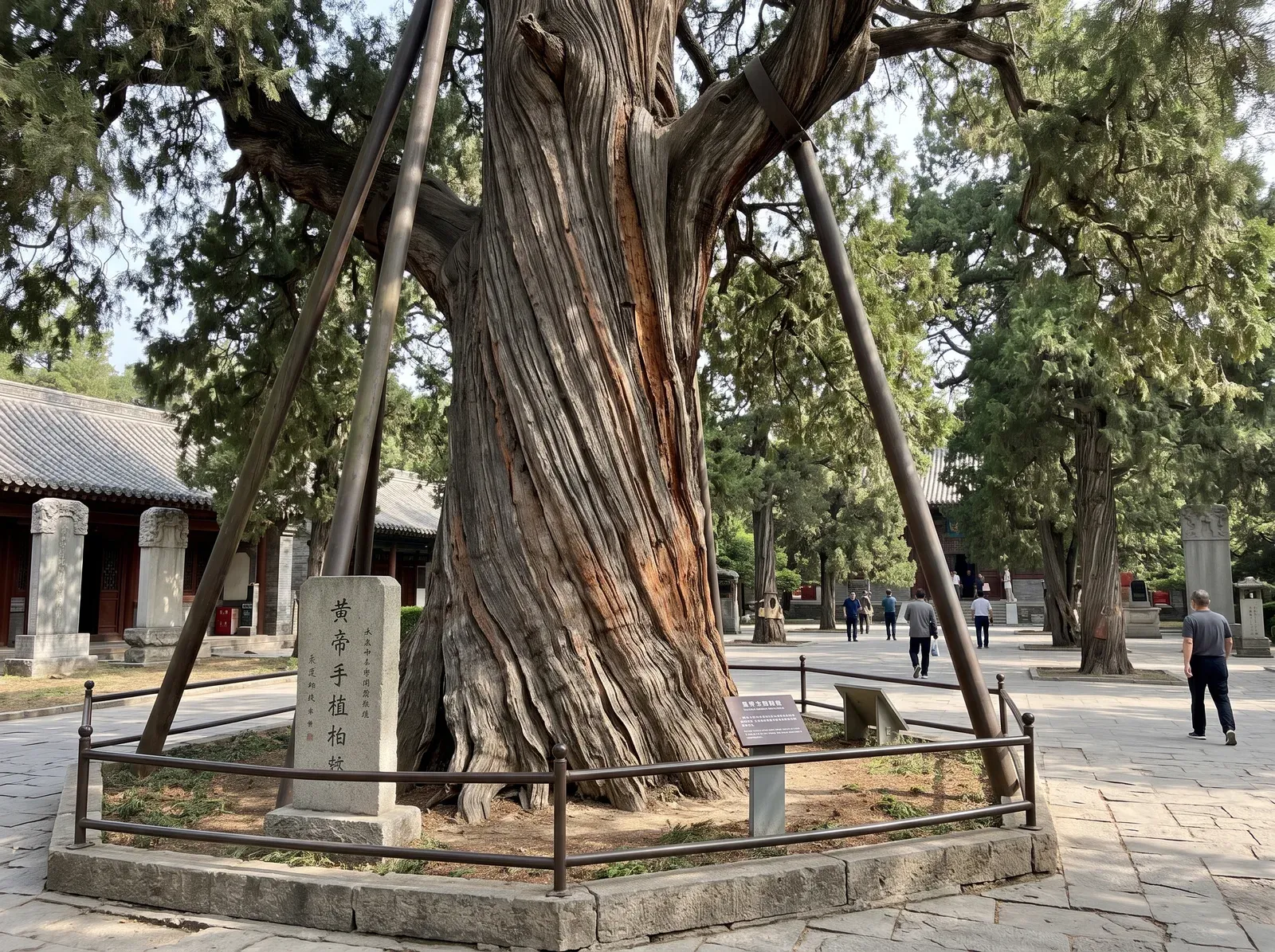
The cypress in the courtyard said to have been planted by him is an oriental arborvitae. Tradition says he planted it after settling on Qiao Shan, which would make it more than 5,000 years old; it stands 19 m tall today. In 1998 a committee that selects and cares for famous Chinese trees ranked it first among 100 famous trees and called it the king of cypresses in the world.
Measurements show the thickest part of the trunk is underground, with a girth of 11.6 m. A local rhyme says "seven armfuls, eight spans and a half, not counting the knobs", meaning that seven people with arms joined still cannot reach around it.
The Chinese Ancestors Hall in the scenic area is a modern exhibition building that uses multimedia and objects to show the history, culture and daily life of his era.
The scenic area has more than 60,000 mature cypresses, 30,000 of them over 1,000 years old. The old cypress group on Qiao Shan holds more than 83,000 ancient trees. They did not grow there by themselves: they were planted by generations of Chinese people who came to sacrifice.
How much are tickets, and should you book ahead?
| Item | Price | Notes |
|---|---|---|
| Adult ticket | 75 yuan | Price information updated in March 2026 |
| Half-price ticket | 37.5 yuan | Full-time school, college and university students (including Hong Kong, Macao and Taiwan), with a student card or the equivalent travel document |
| Children free | Free | Age 6 or under, or under 1.2 m tall |
| Seniors free | Free | Age 65 or over, with an ID card |
| Shuttle bus | 20 yuan per person per ride | West side of the temple exit, operating 8:00 to 17:30, round trip |
Tickets are booked under your real name, up to 2 days ahead. Bring a passport or ID card to enter. Booking runs through the WeChat official account and similar channels.
If anyone in your group is a full-time school, college or university student, buy the half-price ticket with a student card or the equivalent document. If you are travelling with a child under 6 or a family member aged 65 or over, use the free-entry rules in the table above.
Getting there from Xi'an: train, bus or car
| Option | From and to | Fare or time |
|---|---|---|
| Train | Xi'an North Station to Huangling Station | 52 minutes (the fastest service on the timetable is C9330, departing 18:26) |
| Train | Huangling South Station to the scenic area | Bus 3 or a taxi from the station, about 20 minutes |
| Bus | Xi'an Chengbei Bus Station to Huangling | 53 yuan |
| Bus | Yan'an South Bus Station to Huangling | 47 yuan |
| Car | Huangling exit on the G6522 Yanxi Expressway, or Huangling West exit on the G65 Baomao Expressway | Large car park at the scenic area, charged by vehicle, free for the first 20 minutes |
Coming from Xi'an, the fastest train to Huangling Station takes 52 minutes. If your trip runs south from Yan'an, there is a 47 yuan bus from Yan'an South Bus Station to Huangling.
How long does a visit take, and can you return to Xi'an the same day?
The one-day itinerary on the official ceremony website puts the visit in the afternoon and returns the same day.
| Time | Plan |
|---|---|
| 08:30 | Leave Xi'an or Yan'an |
| 11:30 | Arrive at Xuanyuan Hotel |
| 13:00 to 16:00 | Visit the scenic area |
| After the visit | Start back about 3 hours later |
What happens if you go on the Qingming ceremony day?
On April 5, 2026, the Qingming ceremony for the Yellow Emperor in the Bingwu year was held at the tomb in Huangling County, Shaanxi. A 56 m long "Chinese dragon" rose and circled in the air.
The ceremony began at 9:50 with 34 drum beats and 9 bell tolls.
According to documents, sacrifice to him at this site began in 442 BC. In 770 AD the Tang dynasty built a temple here, and from then on it became a regular place for state sacrifice.
The tomb has been rebuilt and repaired many times. The first stage of restoration was finished in August 2001, and from 2004 the annual state sacrifice in front of the tomb resumed.
The public ceremony is a large state-organized event, and folk sacrifice usually follows it. Until the ceremony ends, the scenic area stays closed to ordinary visitors.
Since the 1980s the Qingming ceremony has drawn growing attention, and today close to a million people come each year to pay respects at the tomb.
Is it open in winter, and when do ticket sales stop?
Tickets are sold in winter too, on a different schedule. See the seasonal table below.
| Season | Dates | Ticket sales hours |
|---|---|---|
| Summer | April 1 to September 30 | 07:30 to 17:30 |
| Winter | October 1 to March 31 | 07:50 to 17:00 |
Yan'an has a plateau continental monsoon climate: four distinct seasons, plenty of sunshine, and a wide gap between day and night temperatures. The average annual temperature is 7.7 °C to 10.6 °C and average yearly rainfall about 500 mm. Huangling County lies south of Yan'an.
What to eat in Huangling after the tomb
Local snacks include yougao, a fried cake of glutinous rice flour and brown sugar, crisp outside and soft inside. There is also a noodle dish called "ear wraps", named for pieces shaped like ears, served with saozi or other seasoning.
The one-day itinerary on the official ceremony website reaches Xuanyuan Hotel at 11:30 and enters the scenic area at 13:00, so look for food around there.
What do first-time visitors most often get wrong?
| Common mistake | What to do |
|---|---|
| Expecting to buy a ticket at the gate | Tickets are booked under your real name up to 2 days ahead; bring a passport or ID card and book through the WeChat official account or similar channels |
| Going straight in on Qingming day | The scenic area stays closed to ordinary visitors until the ceremony ends |
| Spending all your time at Xuanyuan Temple | The site has two parts, the tomb area and the temple; take the shuttle from the west side of the temple exit to the tomb area |
| Following old ticket prices and hours online | The prices and hours here come from a March 2026 update; older guides give different numbers |
When could this information change?
Prices and ticket sales hours follow the notice posted at the site on the day. A travel guide published on the official ceremony website in 2019 gives prices and hours that differ from the March 2026 update here.
The date of the Qingming ceremony changes every year. Before you travel, check the official ceremony website or the scenic area's WeChat account.
The life of the Yellow Emperor here follows the Records of the Grand Historian and other texts and traditional accounts. It is not an archaeological conclusion.
Sources
Yan'an - Wikipedia
Yellow Emperor - Wikipedia (Chinese)
Yellow Emperor - Wikipedia
Huangling County - Wikipedia
Mausoleum of the Yellow Emperor - Wikipedia
The cypress planted by the Yellow Emperor: a 5,000-year-old tree that has seen Chinese civilization - Shaanxi Forestry Administration
Yellow Emperor Mausoleum travel guide - official ceremony website
Sources checked on Nov 18, 2026.
FAQ
How many days ahead do I need to book, and can I buy a ticket at the gate?
Tickets are booked under your real name, up to 2 days ahead, through the WeChat official account and similar channels. Bring a passport or ID card to enter.
Is the cypress said to have been planted by the Yellow Emperor really more than 5,000 years old?
Tradition says he planted it himself after settling on Qiao Shan, which makes it more than 5,000 years old. The second national survey of ancient and notable trees found only 5 trees in China over 5,000 years old, all in Shaanxi; 3 of them are in Huangling County, namely the cypress planted by the Yellow Emperor, the Baosheng cypress and the Laojun cypress.
Can I go from Xi'an and back in one day?
The one-day itinerary on the official ceremony website leaves Xi'an or Yan'an at 8:30, arrives at Xuanyuan Hotel at 11:30, visits the scenic area from 13:00 to 16:00, and starts back about 3 hours later. The fastest train from Xi'an North Station to Huangling Station takes 52 minutes.
Do seniors and children need tickets?
Children aged 6 or under, or under 1.2 m tall, get in free; visitors aged 65 or over get in free with an ID card; full-time school, college and university students pay the half price of 37.5 yuan with a student card.
Is there a shuttle inside the scenic area?
Yes. It stops on the west side of the temple exit, runs from 8:00 to 17:30, and costs 20 yuan per person per ride for the round trip.
Where is the tomb?
On Qiao Shan in Huangling County, on the Loess Plateau, about 200 km north of Xi'an city and 170 km south of Yan'an.