
Shanghai Yuyuan and the Old Town: A Visiting Guide
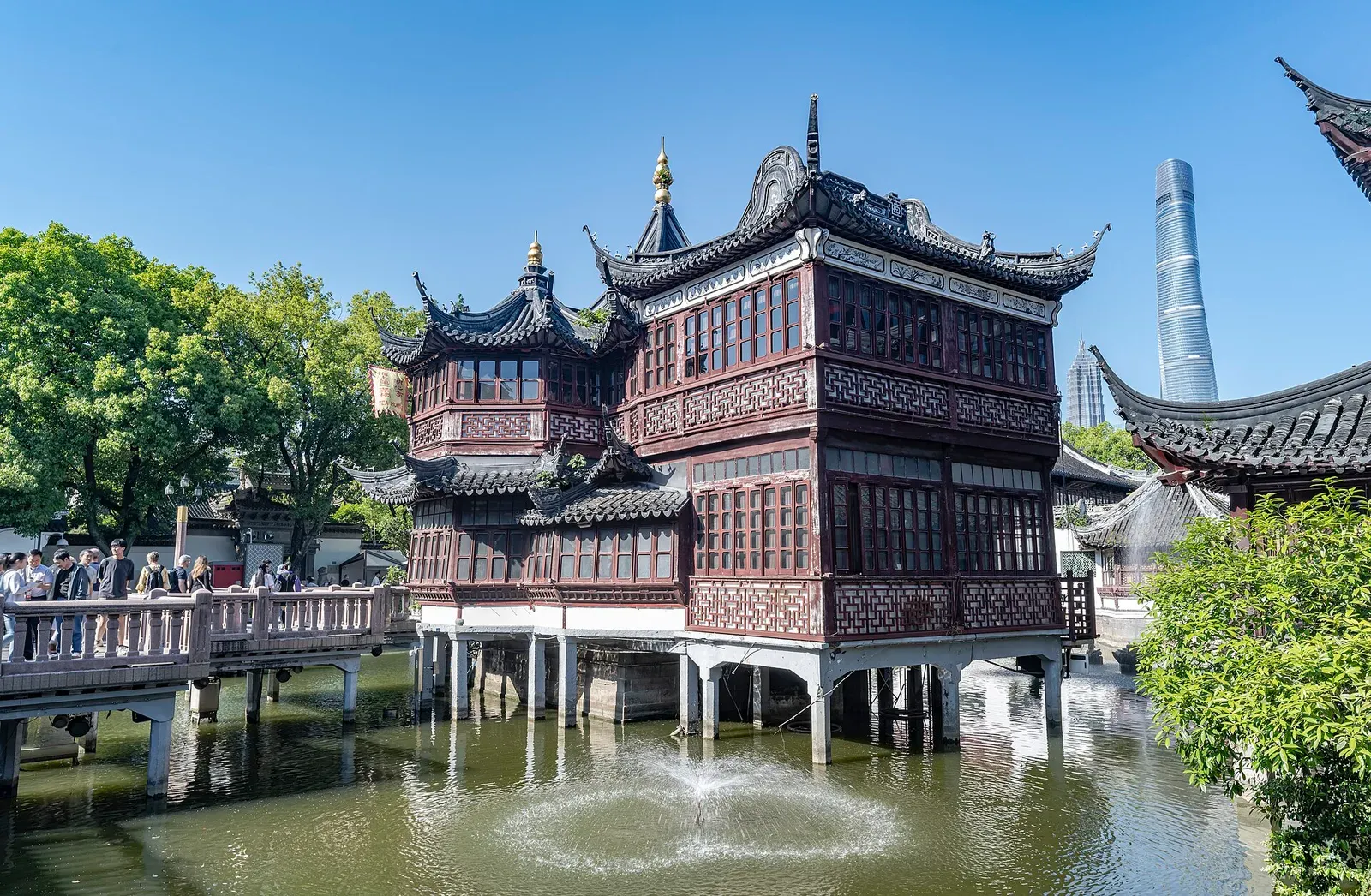
Photo: ScareCriterion12 / Wikimedia Commons, CC0
Shanghai Yuyuan is a Ming dynasty garden in the Jiangnan style. Tickets are 40 yuan per person in high season and 30 yuan in low season, and it closes every Monday except on national public holidays. Outside the garden gate, the Nine-Turn Bridge, Mid-Lake Pavilion, Shanghai City God Temple, and the streets around Fangbang Middle Road in the old town of Shanghai are easy to walk to next.
| Item | Details |
|---|---|
| Opening hours | 9:00 to 16:30, last entry at 16:00 |
| Closed | Every Monday except national public holidays |
| Entrances | North gate at 168 Fuyou Road, for groups and individual visitors; South gate at 279 Yuyuan Old Street, individual visitors only |
| Metro | Yuyuan Station on Lines 10 and 14, Exit 1 or 7, 6 to 10 minutes on foot |
| Suggested time | 2 to 3 hours for the garden and Yuyuan Bazaar |
Is Shanghai Yuyuan the same as the old town?
No. Shanghai Yuyuan (豫园) is a private garden that Pan Yunduan built in 1559, during the Ming dynasty, for his father Pan En. It covers 2 hectares today and follows the Jiangnan garden style of the Ming and Qing. If you only have half a day, see the garden first and then walk the old town of Shanghai outside its walls. With more time, you can also walk a stretch of Zhonghua Road and Renmin Road, the ring road built on the line of the old city wall.
The 3.3-meter Taihu stone in the garden, called Yulinglong (Exquisite Jade Rock), weighs 5 tons and is the garden's centerpiece.
The ring outside the garden is what people call the old town of Shanghai. A city wall built in 1554 during the Ming dynasty enclosed this old district. The wall was torn down in 1912, leaving only two short sections, and a ring road was built on its line. The southern half is Zhonghua Road and the northern half is Renmin Road.
In 2006 the Shanghai municipal government issued the Conservation Plan for the Historic and Cultural Landscape Area of the Old Town. It protects the whole old town as a historic and cultural landscape area, and lists 34 streets, including Dajing Road and Fangbang West Road, as protected lanes.
The Mid-Lake Pavilion stands beside Yuyuan and is the oldest surviving teahouse in Shanghai. Shanghai City God Temple is next to Yuyuan at 249 Fangbang Middle Road. The stretch of Fangbang Middle Road in front of Yuyuan and the temple is Shanghai Old Street.

Half a day: garden first or streets first?
Our Shanghai city guide's quick-reference table gives 2 to 3 hours for Yuyuan and Yuyuan Bazaar together. That fills a morning, and you can walk the old town in the afternoon.
| Time | Where to go | How to get there, time needed |
|---|---|---|
| Morning | Yuyuan Garden | From Exit 1 or 7 of Yuyuan metro station, walk to the garden gate |
| Late morning | Yuyuan Bazaar | The garden and the bazaar together fill a morning |
| Noon | Nanxiang Mantou Dian | Upstairs in Yuyuan Bazaar |
| Afternoon | Nine-Turn Bridge, Mid-Lake Pavilion, Shanghai City God Temple, Fangbang Middle Road (Shanghai Old Street) | The south gate is at the foot of the Nine-Turn Bridge at 279 Yuyuan Old Street; the Mid-Lake Pavilion is beside Yuyuan; the City God Temple is at 249 Fangbang Middle Road |
| Evening | The Bund | About 20 minutes on foot from Yuyuan; a walk along the Bund takes 1 to 2 hours |
If you want to see the garden before the tour groups arrive, go in when the gates open. If you want to start with the streets, walk along Fangbang Middle Road from the City God Temple to Yuyuan and then enter the garden.
Tip: If you still have time after the garden, walk north to Dajing Ge. Part of the building sits on the surviving wall of the old Shanghai county city. It was repaired in 1995 and opened to visitors.
What happens at Chinese New Year and Lantern Festival?
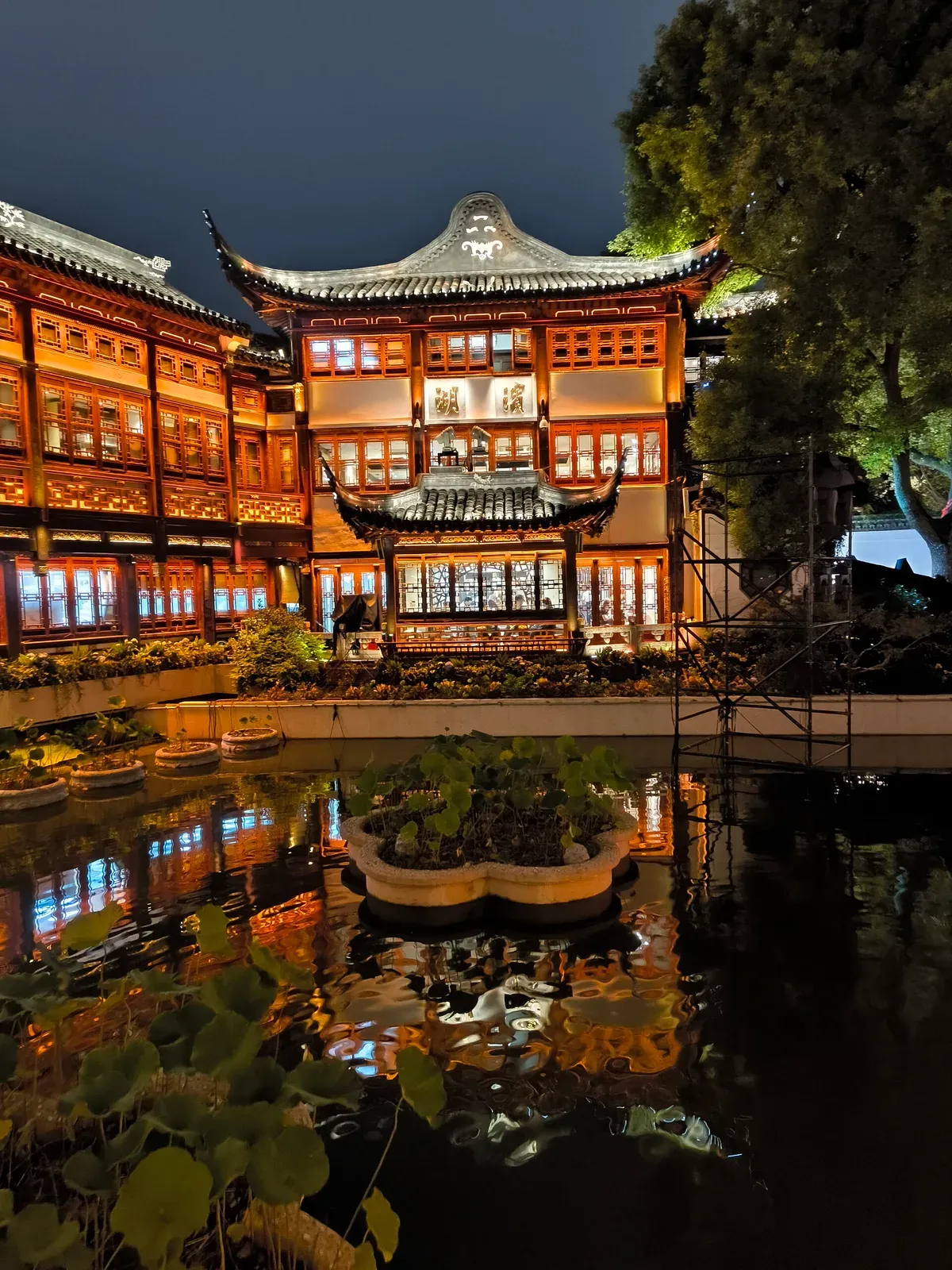
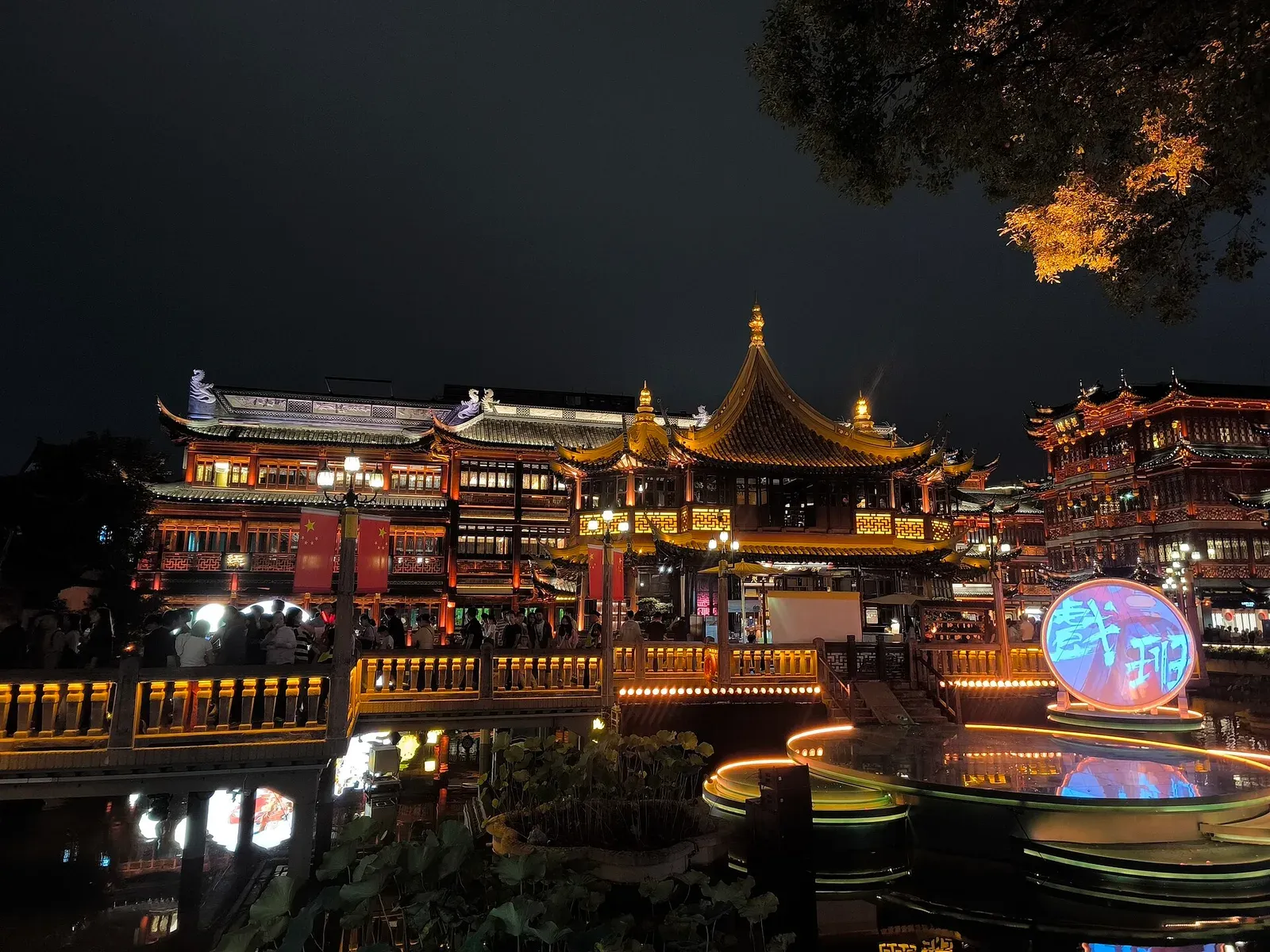
Between Chinese New Year and Lantern Festival, Yuyuan holds a folk art lantern fair. During those weeks you enter by timed ticket, and prices and dates are set again each year. The details below are for the 2025 fair.
| 2025 Yuyuan Lantern Fair | Details |
|---|---|
| Dates | January 1 to February 12; no lights on January 28 |
| Entry | Timed tickets |
| Online tickets | Piao Xingqiu app and mini program |
| Tickets | Adults 80 yuan each and children 50 yuan each during the Spring Festival holiday and Lantern Festival |
| Entry times with a ticket | 14:00 to 22:00 |
During the 2025 fair, Ninghui Road was one of the busiest spots. If you only want the garden, move your visit outside the fair dates. If you are coming for the lanterns, enter in your ticket time slot from 14:00 to 22:00, not at the daytime garden ticket time.
Tickets and who gets half price?
Adult tickets have a high-season and a low-season price. Visitors over 6 and up to 18, full-time students at undergraduate level and below, and visitors 60 and over pay half price with valid ID.
| Ticket type | When it applies, or who it is for | Price | ID to bring |
|---|---|---|---|
| High-season adult | April 1 to June 30 and September 1 to November 30 | 40 yuan | None |
| Low-season adult | July 1 to August 31 and December 1 to March 31 | 30 yuan | None |
| Student | Children over 6 and up to 18, and full-time students at bachelor level or below | Half price | ID card, student card, or other valid ID |
| Senior | Visitors aged 60 or over | Half price | Personal ID card or other valid ID |
Tip: Buy online through the official Shanghai Yuyuan mini program, or at the ticket windows at the south and north gates. Student and senior tickets require a valid ID card or student card.
What else is in the old town besides Yuyuan?
Shanghai City God Temple stands right beside Yuyuan at 249 Fangbang Middle Road. It is the main Zhengyi Taoist temple in Shanghai and was first built in 1403, the first year of the Yongle reign of the Ming dynasty. If you only want to see the main hall, go in, look at it, and come out. With more time, walk on along Fangbang Middle Road toward the Mid-Lake Pavilion, which reopened to the public on July 10, 2025 after restoration work finished.
The main hall was built in 1926 in reinforced concrete, stands 16 meters high, and has a statue of Huo Guang at the center. Behind it, the Yuanchen Hall houses the Sixty Tai Sui. The side buildings are the Sanguan Hall, Yuelao Hall, Caishen Hall, and Cihang Hall.
The Mid-Lake Pavilion sits beside Yuyuan and is the oldest surviving teahouse in Shanghai, with two floors. Cloth merchants funded a six-sided pavilion in 1784, and from 1855 it was rebuilt as a teahouse. It reopened to the public on July 10, 2025 after repairs.
'Shanghai Old Street' is the stretch of Fangbang Middle Road in front of Yuyuan and Shanghai City God Temple. Fangbang Middle Road was built in 1913 by filling in the Fangbang creek. It runs 1,469 meters from Zhonghua Road in the east to Renmin Road in the west.
| Place | Location | What to see |
|---|---|---|
| Shanghai City God Temple | 249 Fangbang Middle Road | Main hall with the Huo Guang statue; Yuanchen Hall behind it with the Sixty Tai Sui |
| Mid-Lake Pavilion | Beside Yuyuan | Oldest surviving teahouse in Shanghai, two floors |
| Shanghai Old Street | The stretch of Fangbang Middle Road in front of Yuyuan and the temple | Fangbang Middle Road is 1,469 meters long |
| Dajing Ge | 259 Dajing Road | Part of the building stands on the old Shanghai county city wall; opened to visitors in 1995 |
What to eat: start with xiaolongbao and shengjian
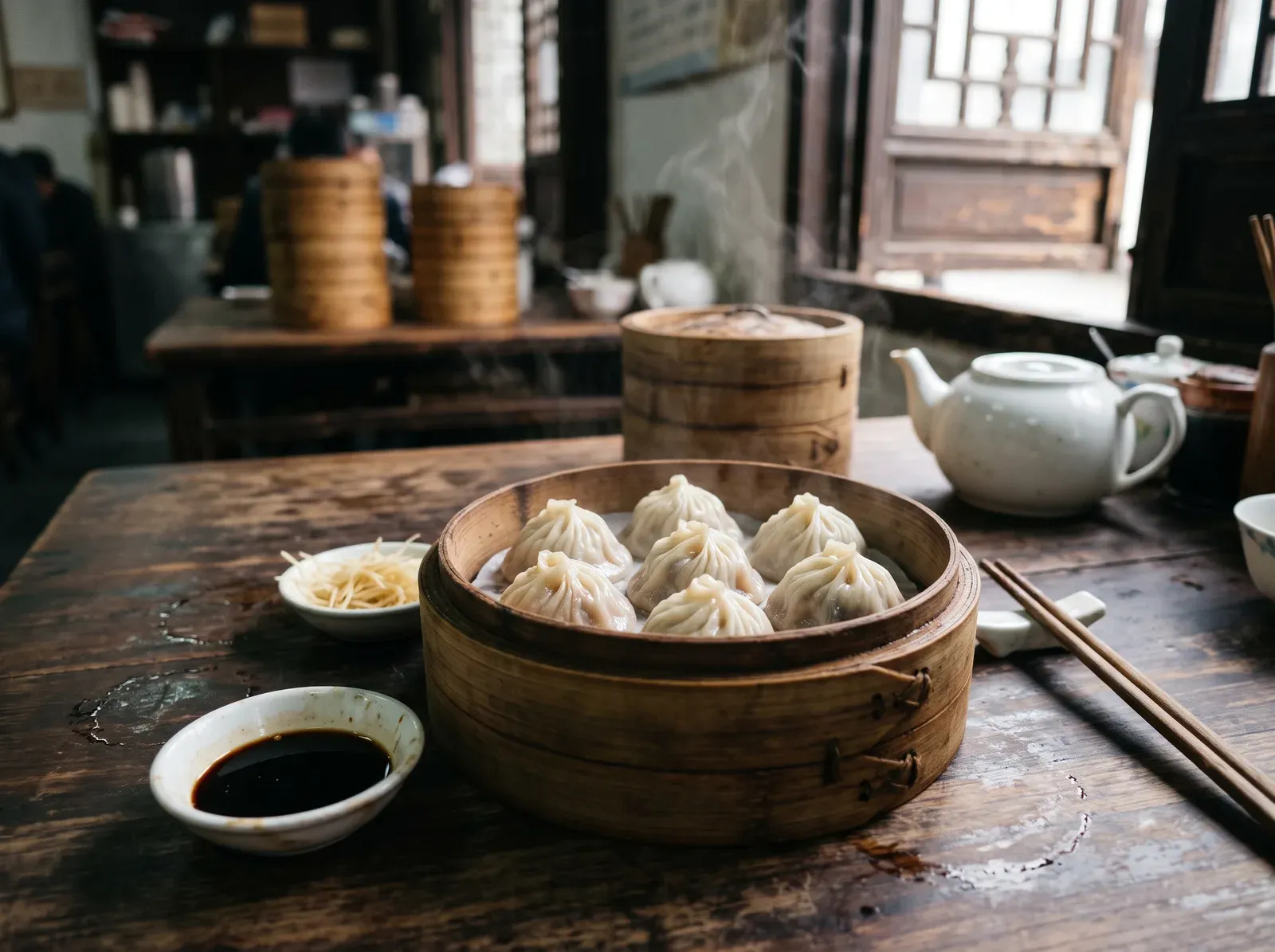
Nanxiang Mantou Dian was founded in 1900. Its main shop is by the Nine-Turn Bridge at the City God Temple, upstairs in Yuyuan Bazaar, and it is known for thin-skinned xiaolong mantou with plenty of soup and for crab roe xiaolong. The traditional way to eat them is to lift one on a spoon, bite a small opening, sip the soup, then eat the whole dumpling with Zhenjiang black vinegar and shredded ginger, so you do not burn your mouth or lose the soup. If you want a thin skin and plenty of soup, order the xiaolong mantou and the crab roe xiaolong. If you prefer a crisp, browned base, go for the plain shengjian at Da Hu Chun instead.
Shengjian mantou use a semi-leavened dough around pork filling and pork skin jelly. They are set in a large flat iron pan, fried with oil, then sprinkled with water and covered to steam. The bottom turns crisp and golden, and the top gets scallions and sesame seeds. Da Huchun was founded in 1932 and is known for its qingshui shengjian.
Shanghai benbang cuisine is summed up as 'thick oil and red sauce.' Cooks often use dark soy sauce for color, light soy sauce for flavor, and sugar. Shanghai Lao Fandian opened in 1875 in the core of the Yuyuan commercial area. Its benbang cooking technique was added to the national intangible cultural heritage list in 2013. Lubolang stands beside the Nine-Turn Bridge and in 1982 introduced the 'rain through snow' banquet format, which alternates dishes and snacks.
The classic Shanghai street breakfast set is called the 'Four Big Kings': flatbread, fried dough sticks, sticky rice rolls, and soy milk.
| What to eat | What it is | Where to eat |
|---|---|---|
| Xiaolongbao | Thin wrapper around pork and pork skin jelly; the jelly melts into soup when steamed | Nanxiang Mantou Dian, founded in 1900, upstairs in Yuyuan Bazaar by the Nine-Turn Bridge at the City God Temple |
| Shengjian mantou | Semi-leavened dough around pork and pork skin jelly; fried in a flat pan, then steamed with a splash of water; crisp bottom | Da Huchun, founded in 1932, known for qingshui shengjian |
| Benbang cuisine | Thick oil and red sauce; dark soy for color, light soy for flavor, often sugar | Shanghai Lao Fandian (1875, core of the Yuyuan commercial area), Lubolang (beside the Nine-Turn Bridge) |
| Breakfast 'Four Big Kings' | Flatbread, fried dough sticks, sticky rice rolls, soy milk | None |
How do you get to Yuyuan?
Yuyuan Station is on Metro Lines 10 and 14. Yuyuan has no dedicated scenic-area parking lot, and the garden advises visitors to use public transport. If you really need to drive, you can only use the paid public parking lots around the area.
If you come from Pudong Airport and arrive late, the last Line 2 train from Pudong Airport leaves at 22:30. If you walk the old town in the evening and then go to the Bund, note that there is no metro station under the Bund. Line 2 passes underneath, and the nearest station is East Nanjing Road, about 5 minutes on foot along Nanjing Road.
| Method | Route | Time | Cost |
|---|---|---|---|
| Metro Lines 10 and 14 | Yuyuan Station | 6 to 10 minutes from the station to the garden gate | 3 yuan within 6 km; maximum 15 yuan one way |
| Bus | Lines 11, 26, 64, 736, 926, 929, 932, 969, 980 | None | None |
| Metro Line 2 | Pudong Airport to People's Square | About 65 minutes | 7 yuan |
| Maglev then Line 2 | Pudong Airport via Longyang Road | Maglev about 8 minutes | Maglev 50 yuan plus 4 to 5 yuan for the metro |
| Taxi | None | None | Flag fall 14 yuan for the first 3 km (16 yuan for an electric taxi), then 2.70 yuan per km, 30% more from 23:00 to 5:00 |
| Walk | The Bund or Nanjing Road area to Yuyuan | About 20 minutes | None |
Tip: If you will take several metro rides in one day, buy an 18 yuan one-day ticket. It allows unlimited rides for 24 hours from first use.
What do first-time visitors most often get wrong?
| Common mistake | What to do |
|---|---|
| Thinking the garden opens on Monday | It closes every Monday except national public holidays; check the official Shanghai Yuyuan mini program before you go |
| Thinking the Nine-Turn Bridge is inside the garden | The south gate is at the foot of the bridge; the bridge, Mid-Lake Pavilion, and City God Temple are all outside the garden |
| Arriving in the afternoon | Last entry is 16:00 and the garden closes at 16:30 |
| Taking a group in through the south gate | The south gate is for individual visitors only; groups and individual visitors both enter through the north gate at 168 Fuyou Road |
| Picking any metro exit | Exit 1 and Exit 7 both lead to the garden entrance |
| Driving and looking for a parking space | Yuyuan has no dedicated scenic-area parking lot; use nearby paid public parking lots |
When should you change your plan?
Opening hours during Chinese New Year follow the garden's notices. Lantern fair dates and ticket prices are set again each year, so check the official Shanghai Yuyuan mini program and Piao Xingqiu again before you travel.
The fastest Beijing to Shanghai high-speed train takes about 4 hours 28 minutes, and the Hangzhou to Shanghai high-speed train takes about 45 minutes. You can fit Yuyuan into the afternoon of your arrival day or the next morning.
Sources
Yu Garden - Wikipedia
Shanghai to Hangzhou high-speed railway - Wikipedia
Shanghai cuisine - Wikipedia
Xiaolongbao - Wikipedia
Nanxiang Mantou Dian - Wikipedia
Shengjian mantou - Wikipedia
Da Huchun - Wikipedia
Shanghai Lao Fandian - Wikipedia
Lubolang Restaurant - Wikipedia
Beijing City Guide: Seasons, Transit, Sights, and Tips
The Bund - Wikipedia
Yu Garden official site (Chinese): Visitor information
Yu Garden official site (Chinese): Transport information
Yu Garden Folk Art Lantern Fair lights up for the 30th time
Old City (Shanghai) - Wikipedia
Shanghai City God Temple - Wikipedia
Mid-Lake Pavilion (Shanghai) - Wikipedia
Fangbang Middle Road - Wikipedia
Dajing Ge - Wikipedia
Sources checked on November 18, 2026.
FAQ
Does Yuyuan open on Mondays?
It closes every Monday except national public holidays, and opens as usual on public holidays. Opening hours during Chinese New Year follow the garden's notices.
How much are tickets to Yuyuan?
40 yuan per person in high season and 30 yuan in low season. Students over 6 and up to 18 and visitors 60 and over pay half price with ID.
What time does Yuyuan open, and when is last entry?
Opening hours are 9:00 to 16:30, with last entry at 16:00. It closes at 16:30.
Are Yuyuan, the City God Temple, and the Nine-Turn Bridge together?
The garden requires a ticket. The Nine-Turn Bridge, Mid-Lake Pavilion, and Shanghai City God Temple are all outside the garden gate, and you can walk to them one after another.
How do you get to Yuyuan from the Bund or Nanjing Road?
You can walk through the old town streets, or take Metro Line 10 or 14 to Yuyuan Station; Exit 1 or 7 leads to the garden gate.