
Major Religions in China: Official Faiths and Folk Traditions

The religion of China officially centers on five recognized faiths: Buddhism, Taoism, Islam, Catholicism, and Protestantism. According to official statistics, mainland China has 144,000 approved and registered venues for religious activities and about 380,000 religious personnel. Outside institutional religions, Chinese spiritual life is also deeply influenced by Confucian thought, the blending of three teachings, and traditional folk practices like heaven worship and ancestor veneration.
What Religions Are Officially Recognized in China?
The Chinese government officially recognizes five religions: Buddhism, Taoism, Islam, Catholicism, and Protestantism, with Catholicism and Protestantism recognized separately. There are five officially recognized national religious groups: the Buddhist Association of China, the Taoist Association of China, the Islamic Association of China, the National Committee of the Three-Self Patriotic Movement of the Protestant Churches in China, and the Chinese Catholic Patriotic Association.
According to official statistics, mainland China has 144,000 approved venues for religious activities, 380,000 religious personnel, about 5,500 religious groups, and 91 religious colleges. Regarding believers, official data shows mainland China has over 44 million Christians (including over 38 million Protestants and about 6 million Catholics) and about 25 million Muslims.
| Religion | Arrival or Founding Period | Core Texts or Main Branches | National Governing Body |
|---|---|---|---|
| Buddhism | 10th year of Yongping in Eastern Han (around 67 AD) | Three traditions: Chinese, Tibetan, and Theravada | Buddhist Association of China |
| Taoism | Late Eastern Han dynasty | Core classics such as the Daodejing | Taoist Association of China |
| Islam | Mid-7th century (during Emperor Gaozong of Tang) | Traditional faith of 10 ethnic minorities | Islamic Association of China |
| Catholicism | Late Ming dynasty (Matteo Ricci arrived in 1583) | Recognized separately from Protestantism | Chinese Catholic Patriotic Association |
| Protestantism | Jiaqing era of Qing dynasty (Robert Morrison arrived in 1807) | Recognized separately from Catholicism | Three-Self Patriotic Movement |
Is Confucianism Considered an Official Religion?
Confucianism is usually not regarded as an institutional religion in the traditional Western sense, but it long held the mainstream ideological position in Chinese history. It profoundly shaped Chinese ethics, morality, and everyday values, emphasizing secular relationships, personal cultivation, and social governance.
Confucianism, Taoism, and Buddhism, which arrived later, together formed the "three teachings" that shaped traditional Chinese culture. Throughout history, the three intertwined without excluding one another, jointly nurturing folk belief systems.
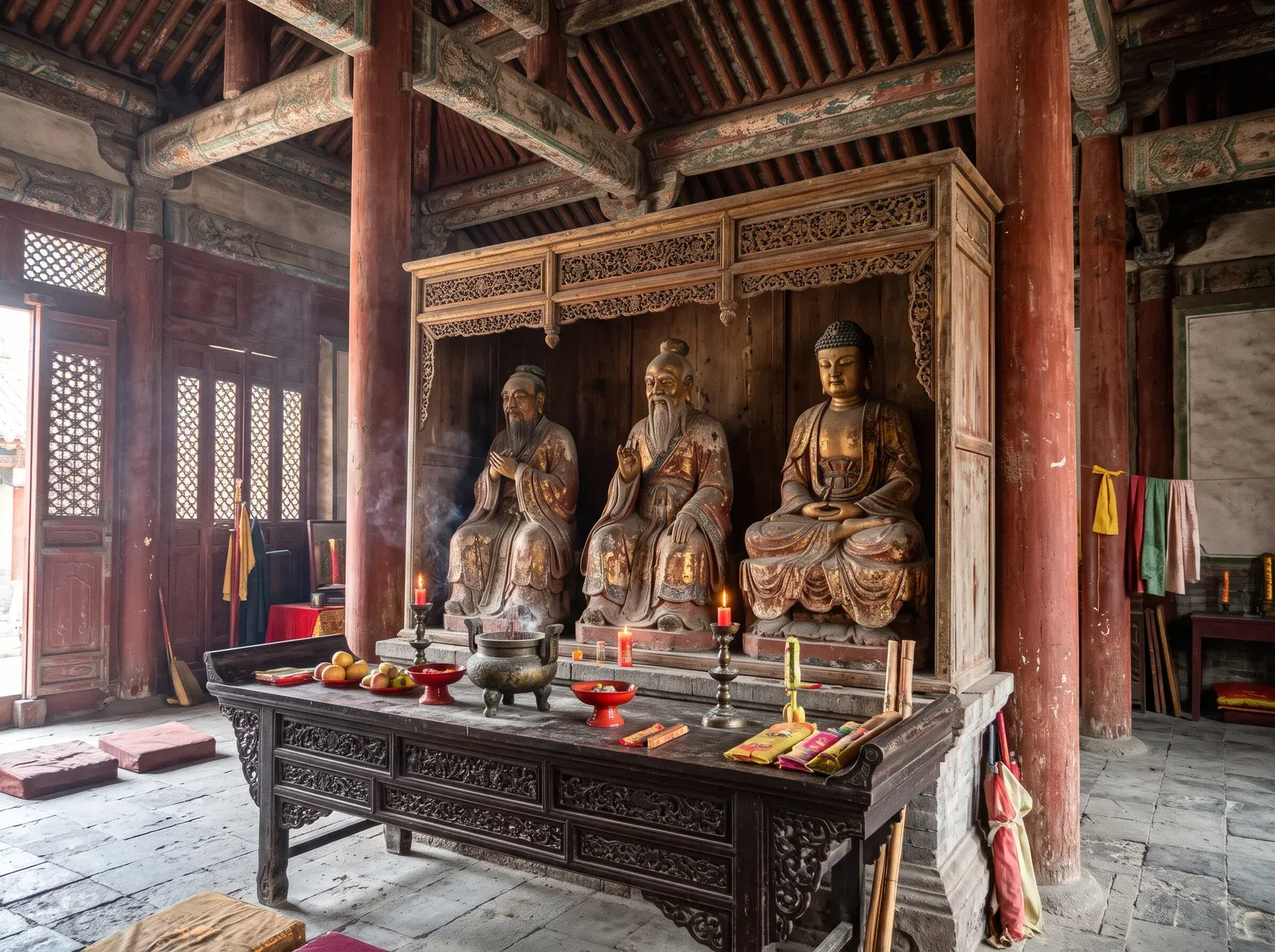
Famous cultural mountains such as Mount Song reflect this typical pattern of "three teachings harmonizing into one." Shaolin Temple (Buddhism), Zhongyue Temple (Taoism), and Songyang Academy (Confucianism) stand together on Mount Song. Inside the main hall of Anyang Palace on Mount Shaoshi, statues of Confucius, Laozi, and Shakyamuni Buddha are enshrined side by side.
What Are the Traditions of Taoism, China's Indigenous Religion?
Taoism is an indigenous religion of China, founded by Zhang Daoling who created the Way of the Five Pecks of Rice in the late Eastern Han dynasty. Taoism honors Laozi as its master, takes classics like the Daodejing as its core scriptures, and seeks longevity and immortality through spiritual cultivation.
The places of religious activity for Taoists are collectively called temples or abbeys (gongguan). According to official statistics, mainland China has more than 9,000 approved and registered Taoist temples, with over 50,000 male and female clergy (qiandao and kundao).
When Did Foreign Religions Arrive in China?
Buddhism entered the Central Plains from the Western Regions via the Silk Road in the 10th year of Yongping in the Eastern Han dynasty (around 67 AD). Early rulers once forbade Han Chinese from becoming monks, but the religion gradually localized. Chinese Buddhism covers three major traditions: Han Buddhism accounts for the vast majority of believers and temples; Tibetan Buddhism is distributed across the Qinghai-Tibet Plateau and Inner Mongolia; and Theravada Buddhism is found mainly among ethnic minority areas in Yunnan bordering Myanmar and Laos.
According to historical records, Islam entered China in the mid-7th century (during Emperor Gaozong of Tang) via overland and maritime Silk Roads, with a history of more than 1,300 years. It is the traditional faith of 10 ethnic minorities in China, including the Hui and Uyghur peoples.
The spread of Christianity in China went through several key stages. In 635, the Syrian missionary Alopen arrived in China and built a cross temple (Jingjiao, or the Church of the East in the Tang dynasty). In 1583, Matteo Ricci arrived to preach, opening the Jesuit Catholic mission in the late Ming dynasty. In 1807, Robert Morrison arrived in Guangdong, starting Protestant missions during the Jiaqing era of the Qing dynasty.
What Are the Core Features of Chinese Folk Religion?
Chinese folk religion has two core hallmarks: venerating heaven and worshiping ancestors. People revere the supreme deity "Heaven" (often called Tiangong or Laotianye, and blended with the Taoist Jade Emperor), while also worshiping deities of nature and all things.
Folk religion is practical and inclusive, focusing on blessings in this life such as peace, wealth, and academic success. People widely worship deified historical figures, including Guan Yu (revered as the Martial Saint and God of Wealth), Mazu the sea goddess, and Zhao Gongming.
Ancestor worship is a widespread semi-religious and customary tradition in Han regions. It does not belong to any single church organization, serving as a cultural practice that expresses filial piety and clan lineage identity. Morality books encouraging good deeds circulated widely in folk belief, with the Treatise of the Exalted One on Response and Retribution (Taishang Ganying Pian), Wenchang Dijun's Treatise on Hidden Virtue (Yinzhiwen), and Lord Guan's Scripture for Awakening the World (Jueshi Zhenjing), collectively known as the "Three Sacred Scriptures", having the deepest influence.
What Does the Chinese Constitution Say About Freedom of Religious Belief?
Under Article 36 of the current Chinese Constitution, citizens enjoy freedom of religious belief, and the state protects normal religious activities. No organization or individual may use religion to disrupt public order, harm citizens' health, or interfere with the state educational system.
The Constitution also stipulates that religious bodies and religious affairs are not subject to any foreign domination. All normal religious activities must be carried out within the scope permitted by law.
Sources
Religion in China - Wikipedia
Religion in China (Chinese) - Wikipedia
Three Teachings - Wikipedia
Buddhism in China - Wikipedia
Chinese Folk Religion - Wikipedia
Sources verified on November 17, 2026
FAQ
Why is Confucianism not among the five official religions?
Confucianism held the mainstream ideological position in Chinese history for a long time. However, it lacks the professional clerical hierarchy and initiation rituals of institutional religions in the West, so it is usually not regarded as an institutional religion.
How many approved venues for religious activities are there in mainland China?
Official statistics show that mainland China has 144,000 approved and registered venues for religious activities, about 380,000 religious personnel, about 5,500 religious groups, and 91 religious colleges.
Does ancestor worship in Han folk culture belong to a single religion?
No. Ancestor worship in Han areas is a widespread semi-religious and customary tradition. It does not belong to any single church organization, and its core is maintaining filial ethics and family identity.
Which system do Guan Yu and Mazu belong to in folk belief?
Guan Yu and Mazu are deified historical figures in folk belief. Folk belief emphasizes practical blessings in this life and remains inclusive, so these deities are also often absorbed and integrated into Taoism and Buddhism.