Visiting Jing'an Temple Shanghai: Tickets and Highlights
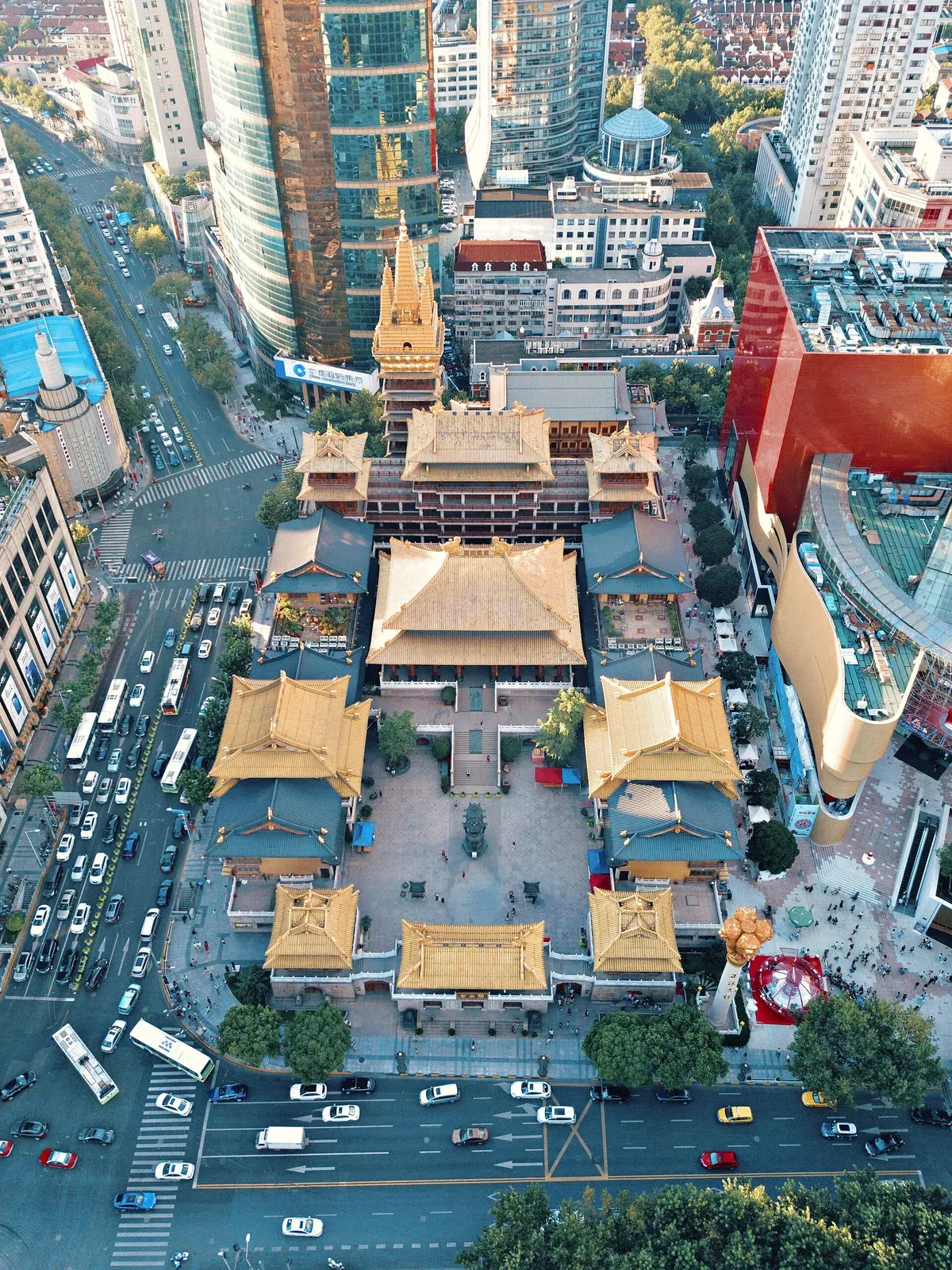
Photo: Legolas1024 / Wikimedia Commons, CC BY-SA 4.0
Standard admission tickets to Jing'an Temple in Shanghai cost 50 yuan each, and opening hours run from 7:30 to 17:00 daily throughout most of the year. You can book tickets online through official channels, including the Shanghai Jing'an Temple (上海静安寺) WeChat official account or the Fuhui Baisi (福慧百寺) WeChat mini-program, or scan a QR code at the temple entrance to buy an electronic ticket on-site. Tickets are non-refundable after purchase, but you can change the visit date once for free if you cannot visit on schedule.
| Item | Details |
|---|---|
| Location | 1686 West Nanjing Road, Jing'an District, Shanghai |
| Opening hours | 7:30 to 17:00 daily (throughout most of the year) |
| Status and titles | Key National Buddhist Temple in the Han Chinese Area, one of Shanghai's four major Buddhist temples |
| Metro access | Exit 1 of Jing'an Temple Station (Lines 2, 7, and 14) leads directly to the main ground entrance |
| Founding and relocation | Founded in 247 AD (the 10th year of Chiwu, Eastern Wu, Three Kingdoms), relocated to the current site in 1216 (the 9th year of Jiading, Southern Song) |
What core statues and cultural relics can you see inside Jing'an Temple?
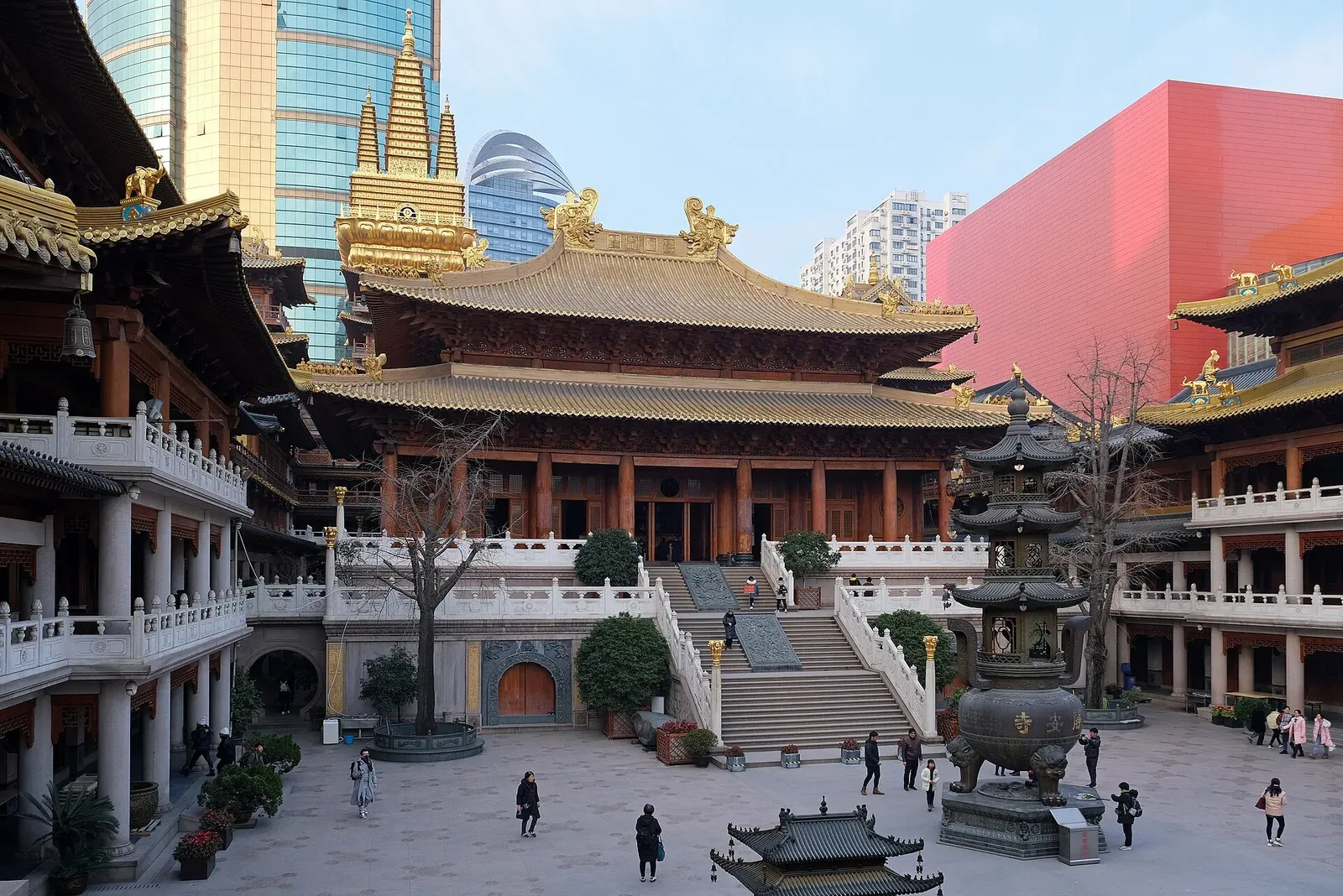
Side halls stand on the east and west flanks of the Mahavira Hall, housing statues with distinct materials and proportions. The Muni Hall in the west wing enshrines a seated Shakyamuni carved from a single piece of pure jade. Standing 3.87 meters high, it is among the largest jade seated Buddha statues in China. In the Guanyin Hall to the east, a standing statue of Guanyin Bodhisattva carved from a single camphor trunk rests on a lotus pedestal.
Inside the main Mahavira Hall, a 15-ton Shakyamuni Buddha cast in pure silver takes center stage, accompanied by more than a dozen silver bodhisattvas and disciple statues. Beyond these large statues, the temple preserves a 3.5-ton Hongwu bronze bell as its foremost treasure, while the finial of the Jing'an Pagoda at the back, completed during an expansion in 2010, is covered in gold leaf. You can check the specific sizes and details of these relics in the table below.
| Structure or relic | Material and form | Dimensions and features |
|---|---|---|
| Mahavira Hall Shakyamuni Buddha | Pure silver seated statue | Weighs 15 tons, with more than ten pure silver bodhisattva and disciple statues weighing 3 tons each |
| Muni Hall (Jade Buddha Hall) Buddha | Seated statue carved from a single piece of pure jade | 3.87 meters tall, one of the largest jade seated Buddha statues in China |
| Guanyin Hall Guanyin Bodhisattva | Standing statue carved from a single camphor trunk | Stands on a lotus pedestal, 6.2 meters tall and weighs 5 tons |
| Ming Dynasty bronze bell (Hongwu Bell) | Cast bronze bell | Cast in 1369 (the 2nd year of Hongwu, Ming Dynasty), weighs 3.5 tons, preserved as a temple treasure |
| Jing'an Pagoda at the rear | Multi-story pagoda expansion | Completed in 2010, its finial covered in gleaming gold leaf, standing as a prominent high-rise structure within the complex |
If you are interested in historical calligraphy and paintings, look out for the stone stele inscribed by Emperor Guangzong of the Southern Song, along with artworks by Su Shi, Wen Zhengming, the Eight Eccentrics of Yangzhou, Wu Changshuo, Zhang Daqian, and Buddhist paintings by Wang Yiting. If modern architecture appeals to you more, head toward the back of the grounds to view the gold-leaf pagoda.
How should you plan your route through the halls and courtyards?
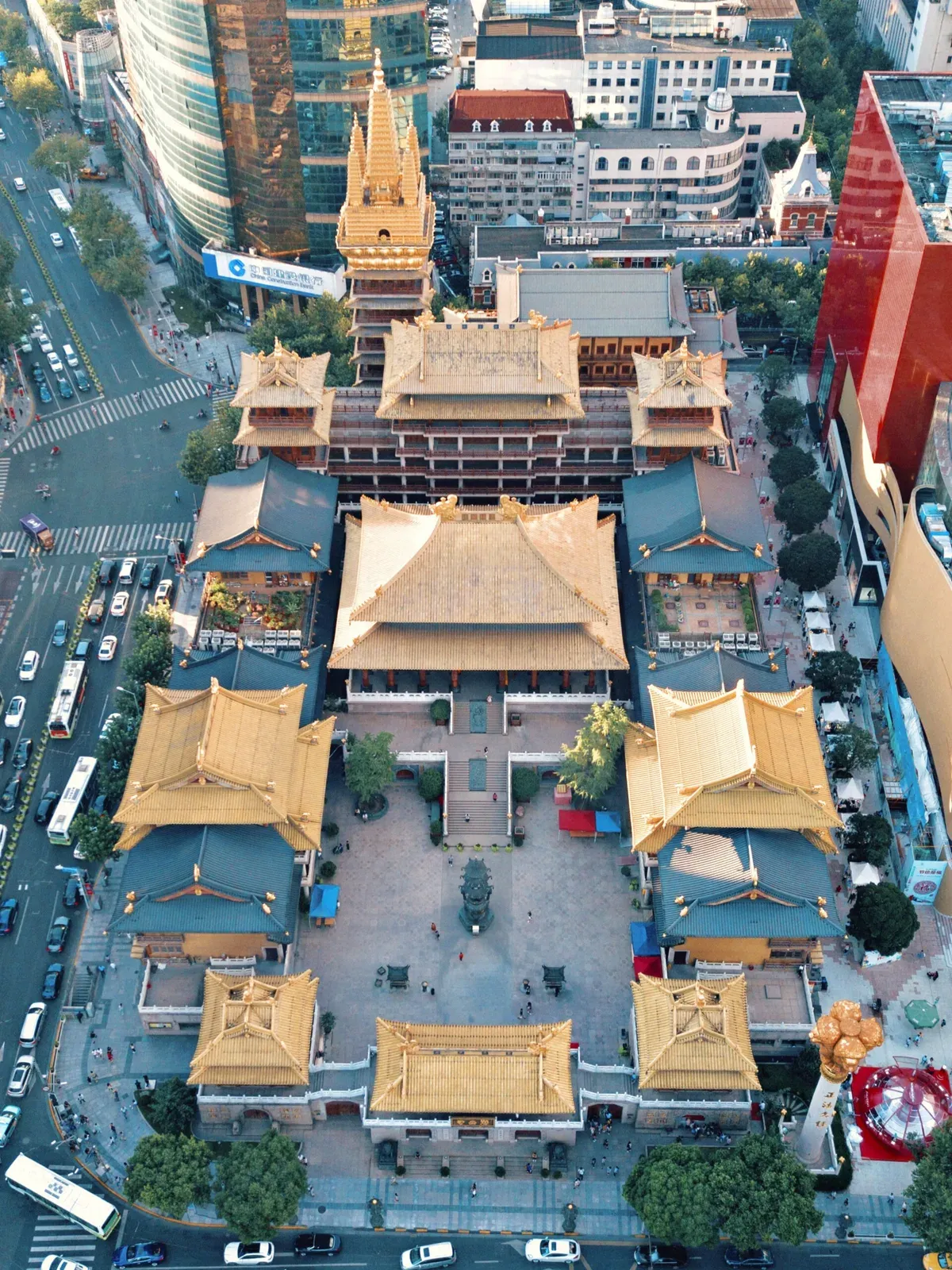
The temple strictly preserves the traditional layout of Jiangnan Chan monasteries, giving every major hall its own courtyard space. Along the central axis from front to back stand the Hall of the Four Heavenly Kings, the Mahavira Hall, the Hall of the Three Saints, and the Hall of Merits, flanked symmetrically by side halls and covered walkways. When visiting, enter through the mountain gate into the front courtyard of the Hall of the Four Heavenly Kings, cross the courtyard, climb the steps to the Mahavira Hall terrace, and then proceed toward the rear halls.
It is designated as a Key National Buddhist Temple in the Han Chinese Area, recognized alongside Jade Buddha Temple, Longhua Temple, and Zhenru Temple as one of Shanghai's four major Buddhist temples. In 1953, Master Chisong established a Shingon altar here, and the site remains an important center officially practicing Tangmi (Chinese Esoteric Buddhism/Shingon) traditions.

Tip: The interiors of the halls are sacred places of worship, so please remain quiet and avoid talking loudly in front of the statues when visiting the Mahavira Hall and side halls.
What is the history behind its founding and relocation?
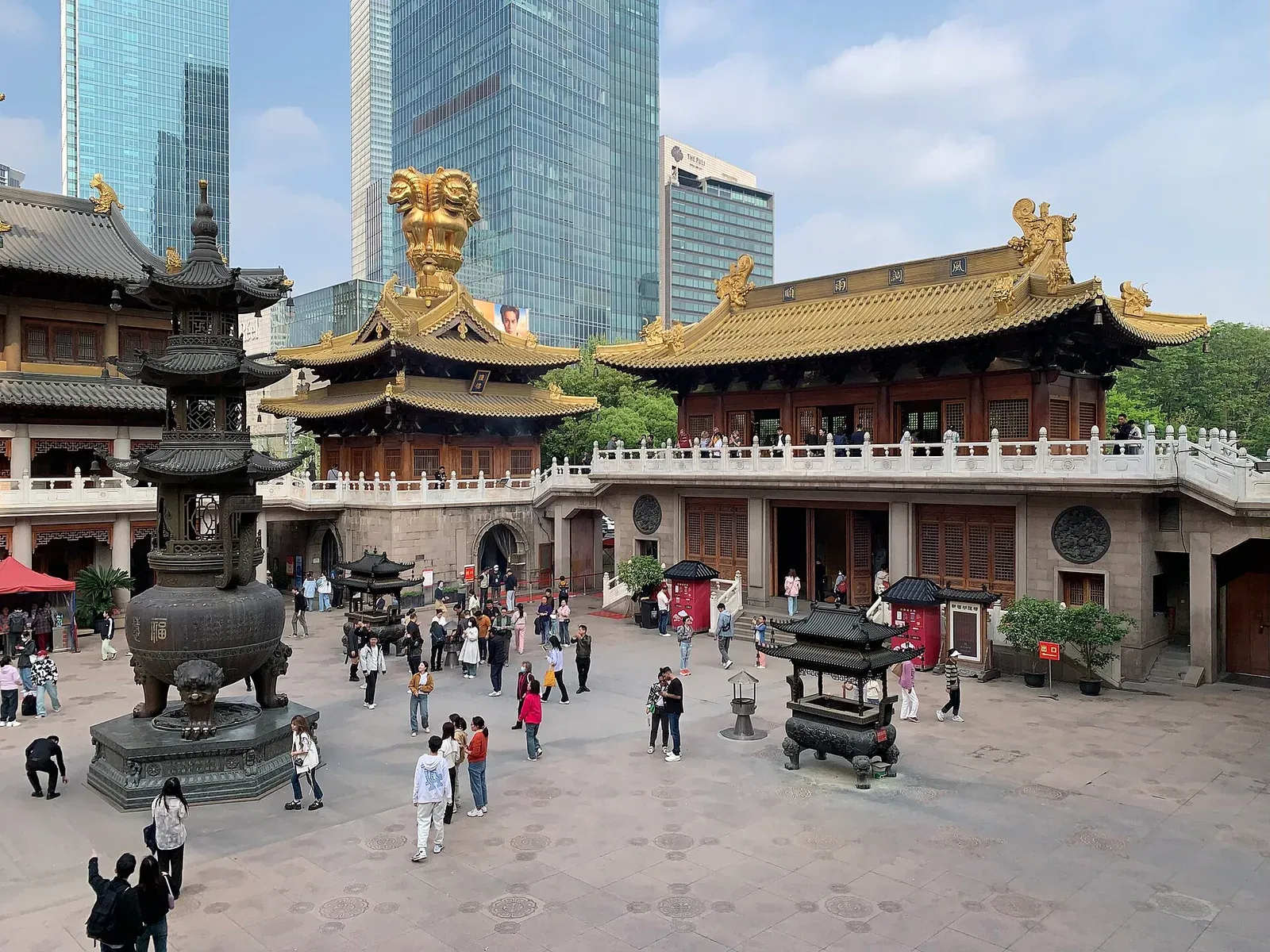
The temple was originally founded in 247 AD (the 10th year of Chiwu, Eastern Wu, Three Kingdoms) as Hudu Chongyuan Temple, giving it a history of more than 1,700 years. In 1216 (the 9th year of Jiading, Southern Song), because river currents threatened the original foundations, Abbot Zhongyi moved the temple to its current site on West Nanjing Road.
Over its long history, the grounds became known for the Eight Scenes of Jing'an, which included the Chiwu Stele, the Chen Dynasty Juniper, and the Bubbling Spring. The natural spring in front of the mountain gate was praised by ancients as the Sixth Spring Under Heaven. Between 1881 and 1963, a traditional temple fair was held here every year on the eighth day of the fourth lunar month for Buddha's Birthday, serving as a major folk event in western Shanghai for over 80 years.
Historical records describe bustling scenes during those Buddha's Birthday fairs, with merchants and residents gathering outside the gates to create a lively marketplace in western Shanghai.
How can you get there by public transit?
Taking the metro is the most convenient way to reach the temple, as Jing'an Temple Station sits directly beneath it as a major three-line interchange hub. You can take Shanghai Metro Line 2, Line 7, or Line 14 and leave from Exit 1 directly in front of the main entrance. If you plan to head to adjacent shopping malls upon arrival, Exit 2 provides an underground passage into Jiuguang Department Store.
Beyond the metro, the surrounding area offers an extensive network of surface buses and direct airport shuttles. The Shanghai City Air Terminal at 1600 West Nanjing Road, right beside the grounds, runs Airport Bus Line 2 straight to and from Shanghai Pudong International Airport. City bus routes 113, 40, 830, 824, 20, 15, 37, and 21 also stop around the temple.
| Transit category | Lines or facilities | Access and transfer details |
|---|---|---|
| Main metro lines | Shanghai Metro Lines 2, 7, and 14 | Exit 1 opens right at the main ground entrance; Exit 2 connects directly underground to Jiuguang Department Store |
| Transfer passageway connection | Midsection of the transfer corridor between Lines 2 and 14 | Connects via an underground link directly to the sunken plaza Apple Jing'an store |
| Airport express bus | Airport Bus Line 2 | Located at Shanghai City Air Terminal at 1600 West Nanjing Road, offering direct service to and from Shanghai Pudong International Airport |
| Surface buses | Routes 113, 40, 830, and 824 | Additional city bus lines including routes 20, 15, 37, and 21 stop at stations around the temple |
What can you see and eat nearby after your visit?
Standing on West Nanjing Road, one of Shanghai's premier commercial strips, the golden roofs of the temple present a striking visual contrast to the sleek glass facades of Jiuguang Department Store, Réel Mall, and Park Place. Across the street to the south lies Jing'an Park, featuring a lake and tree-shaded paths. In its southeast corner, locals often gather to play xiangqi (Chinese chess) or go, making it a peaceful green spot to unwind after exploring the halls.
If you want a meal nearby, the B2 basement level of Réel Mall right next to the metro station houses a large food court serving quick bites like pan-fried pork buns (shengjianbao) and sizzling clay-pot sets. Cashless mobile payments via apps work almost everywhere in China. When international travelers link foreign credit cards to WeChat Pay or Alipay, transactions of 200 RMB or less incur no transaction fee, while purchases over 200 RMB carry a 3% fee.
If you have plenty of energy, walking about 4.5 kilometers east along West Nanjing Road leads through the central Huangpu shopping district to People's Square, and continues down East Nanjing Road Pedestrian Street to the Bund. Shanghai's first tram line, opened in 1908 over a distance of 6.04 kilometers, also ran from Jing'an Temple to the Shanghai Club on the Bund. In our Shanghai travel guide, your travel designer can also weave the temple and the city's classic landmarks into a personalized itinerary, complete with private transfers by your driver.
Sources
Tourists go cashless in China with WeChat Pay and Alipay for all purchases: even drone bubble tea - CNA Lifestyle
Jing'an Temple - Wikipedia (Chinese)
Jing'an Temple - Wikipedia
Jing'an Temple Station - Wikipedia (Chinese)
West Nanjing Road (Shanghai) - Wikipedia (Chinese)
Sources verified on November 19, 2026
FAQ
What are the opening and closing hours for Jing'an Temple?
Jing'an Temple opens daily from 7:30 to 17:00 throughout most of the year, making it easy to visit during the morning or afternoon.
Which metro exit is closest to Jing'an Temple?
Take Shanghai Metro Line 2, Line 7, or Line 14 to Jing'an Temple Station and leave from Exit 1, which brings you right to the main ground entrance.
What makes the Buddha statue in the Mahavira Hall special?
The Mahavira Hall enshrines a Shakyamuni Buddha cast in pure silver weighing 15 tons, accompanied by more than a dozen pure silver bodhisattva and disciple statues weighing 3 tons each.
What are some recommended walking routes around Jing'an Temple?
Directly across West Nanjing Road to the south sits Jing'an Park with its lake and shaded paths. Walking about 4.5 kilometers east along West Nanjing Road takes you through the heart of Huangpu District to People's Square and on toward the Bund.