
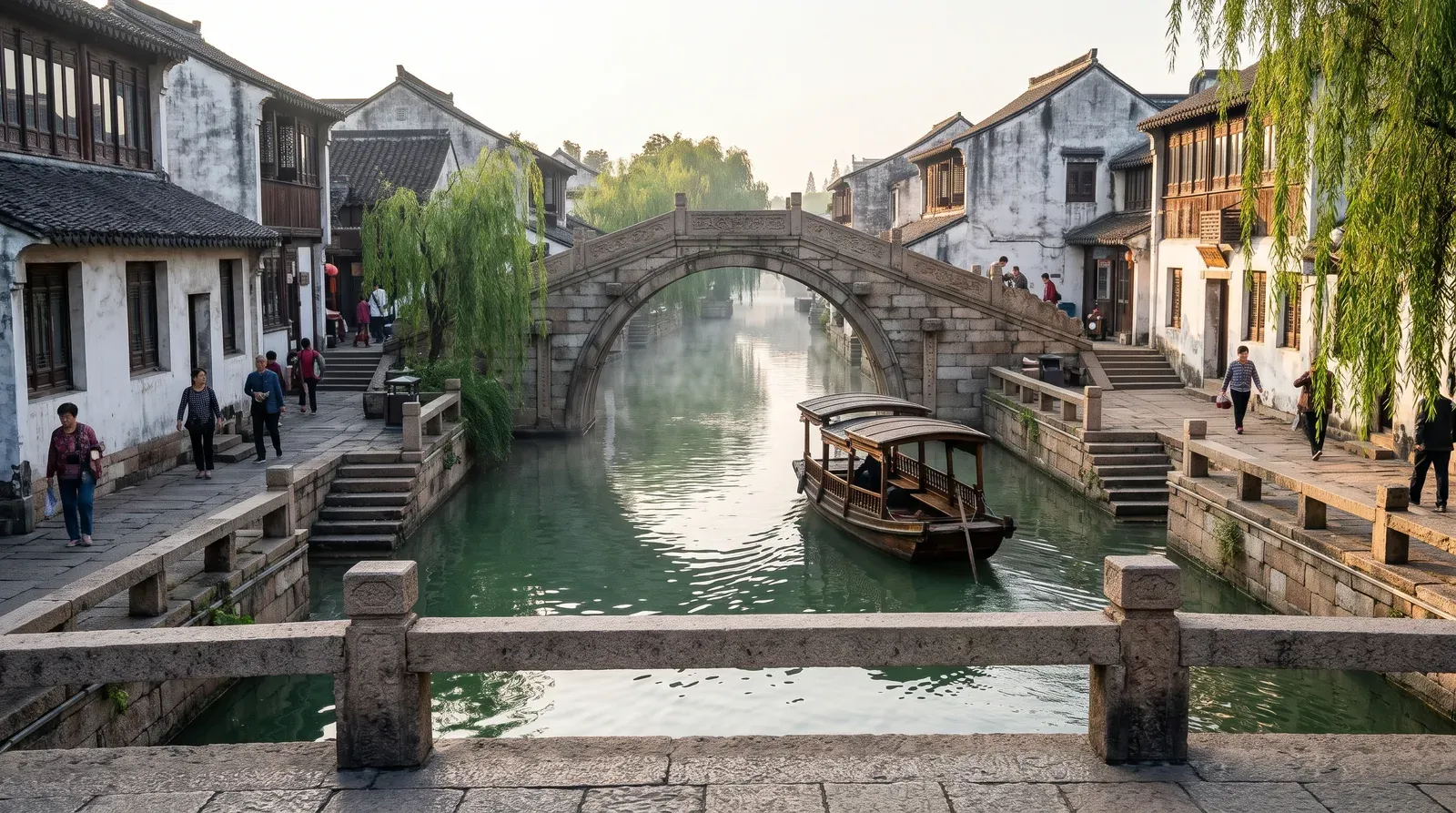
Yangzhou
Yangzhou lies in central Jiangsu Province, where the Yangtze River meets the Beijing-Hangzhou Grand Canal. Its history spans over 2,500 years, dating back to 486 BC when King Fuchai of Wu built the city of Hancheng and dug the Han Canal. As one of China's first National Historical and Cultural Cities and a UNESCO City of Gastronomy, it suits travelers who enjoy canal culture, classic gardens, and leisurely food traditions. The city moves at a relaxed pace, and staying for 2 to 3 days is usually recommended to explore it thoroughly.
Key points
Yangzhou has a history spanning over 2,500 years, and spending 2 to 3 days is recommended to visit Slender West Lake, classic gardens, and the Grand Canal Museum. Spring and autumn offer the most comfortable weather for travel, when you can enjoy local morning tea featuring 64-layer steamed oil cake, and your travel designer can arrange a private car with your driver.
Yangzhou lies in central Jiangsu Province, where the Yangtze River meets the Beijing-Hangzhou Grand Canal. Its history spans over 2,500 years, dating back to 486 BC when King Fuchai of Wu built the city of Hancheng and dug the Han Canal. As one of China's first National Historical and Cultural Cities and a UNESCO City of Gastronomy, it suits travelers who enjoy canal culture, classic gardens, and leisurely food traditions. The city moves at a relaxed pace, and staying for 2 to 3 days is usually recommended to explore it thoroughly.
When Is a Good Time to Visit Yangzhou?
The climate is mild, with an annual average temperature of around 16.2°C. January averages around 2.8°C with cooler winter temperatures, while July averages about 28.4°C and feels relatively humid and hot in midsummer. Spring brings fresh greenery and weeping willows by the Twenty-Four Bridges, making it the traditional peak season for touring gardens and the lake. Autumn is clear and comfortable, offering an equally pleasant time to stroll through old town streets and alleys.
How to Get There and Get Around
Yangzhou Taizhou International Airport is located in Jiangdu District, operating multiple domestic and international routes, with direct airport shuttle buses connecting to downtown. For rail travel, the 305.2-kilometer Lianyungang-Zhenjiang High-Speed Railway, designed for speeds of 250 km/h, connects the city to the southern Jiangsu high-speed rail network. You can refer to the China high-speed train travel guide and take a high-speed train from Shanghai, Nanjing, or Zhenjiang. City sights are relatively concentrated. Aside from public transit, your travel designer can also arrange a private car with your driver, saving you the hassle of transfers and hailing taxis.
What Sights Are Worth Visiting?
The Slender West Lake scenic area covers about 100 hectares, with a water surface of around 700 mu, and was inscribed on the UNESCO World Heritage List in 2014 as part of the Grand Canal. The Five-Pavilion Bridge features 15 openings, celebrated for the sight of each arch framing the moon during a full moon. Built of white marble, the Twenty-Four Bridges is surrounded by Chinese herbaceous peonies and inspired famous poetry by Tang dynasty poet Du Mu. Two historic salt merchant gardens are also distinctive: Geyuan Garden on Dongguan Street is renowned for rockeries representing the four seasons, giving visitors the feeling of walking through spring, summer, autumn, and winter; Heyuan Garden on Xuningmen Street, built in 1862, cleverly connects the entire compound with two-story winding walkways and is regarded as a masterpiece of late Qing dynasty Jiangnan garden architecture.
Located in the Sanwan Ecological and Cultural Park, the China Grand Canal Museum opened on June 16, 2021, featuring around 18,000 square meters of exhibition space and 11 thematic galleries showcasing the hydraulic and cultural history of the canal across eras. For historic temples, Daming Temple was founded during the Daming era of the Liu Song dynasty and once served as the residence and lecture site of the monk Jianzhen. Inside rises the nine-story Qiling Pagoda, originally constructed during the Sui dynasty, while Pingshan Hall, built in front of the temple hall by Ouyang Xiu, offers a distant view where the Jiangnan mountains appear level with your gaze.
How to Experience the Local Food and Relaxed Lifestyle?
A local saying describes the daily tradition as having skin wrap water in the morning and water wrap skin at night, referring to morning tea and evening bathing. In the early morning, visit a teahouse for morning tea to taste crisp Sanding steamed buns with diced fillings, along with Jade shaomai and 64-layer steamed oil cake, celebrated as the city's twin specialties. Huaiyang cuisine is known for meticulous knife work and well-balanced flavors. Authentic Yangzhou fried rice adheres to strict ingredient standards, including top-grade indica rice, fresh eggs, sea cucumber, and dried scallops. After dark, relax along historic streets by trying traditional bathhouses preserved since the Qing dynasty and experiencing the intangible cultural heritage of the Three Knives crafts: the kitchen knife, razor, and pedicure blade.
How to Pace Your Visit
A relaxed 2- to 3-day itinerary is recommended. On the first day, visit Slender West Lake, Daming Temple, and Pingshan Hall. On the morning of the second day, experience the local morning tea, then explore Geyuan Garden, stroll down the 1,122-meter Dongguan Street lined with century-old shops, visit Heyuan Garden in the afternoon, and experience a traditional bath at night. On the third day, head to Sanwan Park to tour the China Grand Canal Museum. Yangzhou can also be paired with Suzhou along the canal, and your travel designer can adjust a custom route for you at any time.
Sources
Jiangsu - Wikipedia
Yangzhou City - Wikipedia
Slender West Lake - Wikipedia
Geyuan Garden - Wikipedia
Heyuan Garden - Wikipedia
Grand Canal Museum of China - Wikipedia
Lianyungang-Zhenjiang high-speed railway - Wikipedia
Yangzhou - Wikipedia
Daming Temple - Wikipedia
Dongguan Street - Wikipedia
Huaiyang cuisine - Wikipedia
Three Knives craft - Wikipedia
Fried rice - Wikipedia
The sources above were verified on November 16, 2026.
Related travel tips
Replies 08:30–22:00 your time · Free to ask.