
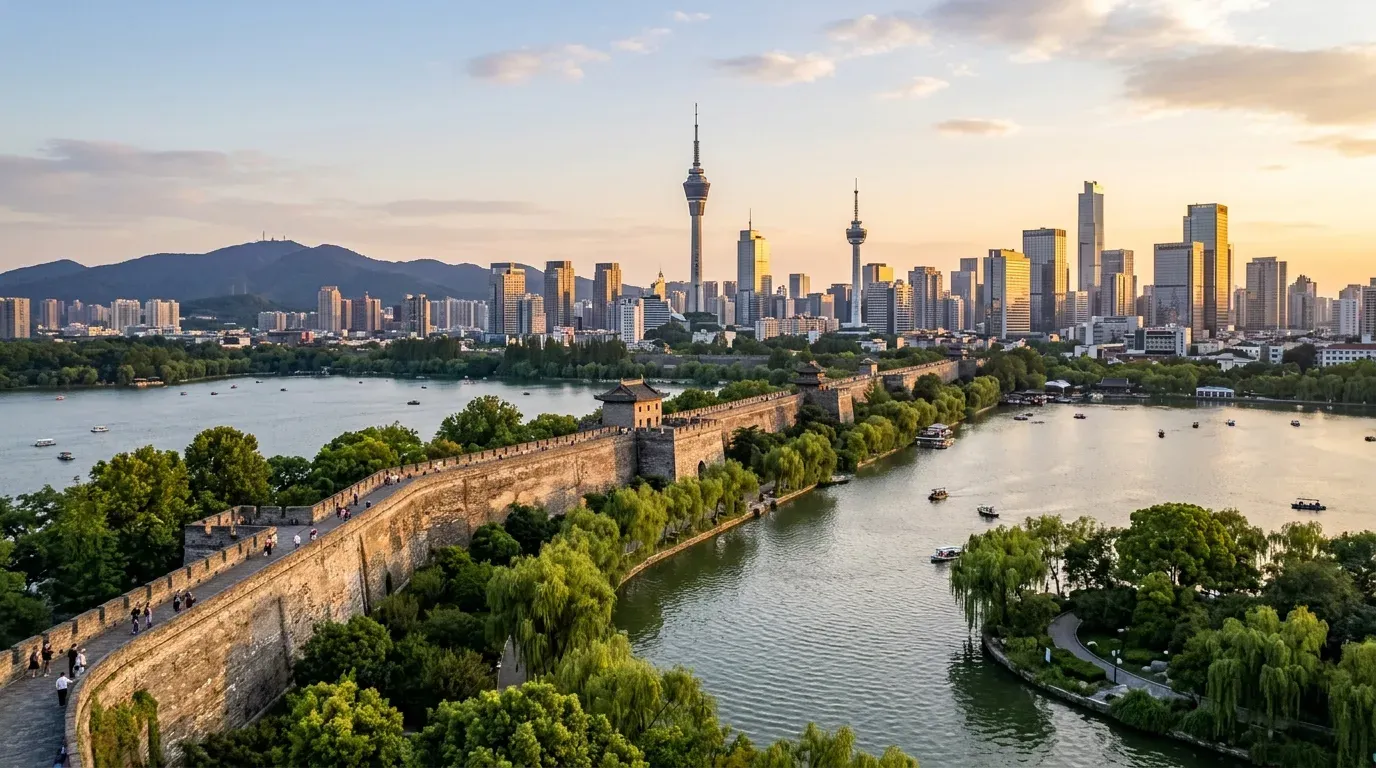
Nanjing
Located in East China and the southwestern part of Jiangsu Province, Nanjing covers a total area of about 6,587.02 square kilometers, with a permanent population of 9.4911 million in 2022. It is a megacity that blends deep cultural heritage with modern vitality. Here, you will find the green forests of Purple Mountain alongside Ming and Qing dynasty architecture along the Qinhuai River. It suits travelers who enjoy historical sites, museum visits, and relaxed city walks. Usually, spending 2 to 3 days here allows you to see the main highlights and experience daily life in this ancient capital.
Key points
A classic trip to Nanjing usually takes 2 to 3 days, with direct intercity trains from Shanghai arriving in 73 minutes. Spring and autumn provide the most comfortable weather, while plum rains fall from mid-June to early July. Sun Yat-sen Mausoleum and Nanjing Museum both require advance reservations, and the museum remains closed on Mondays except on statutory holidays.
Located in East China and the southwestern part of Jiangsu Province, Nanjing covers a total area of about 6,587.02 square kilometers, with a permanent population of 9.4911 million in 2022. It is a megacity that blends deep cultural heritage with modern vitality. Here, you will find the green forests of Purple Mountain alongside Ming and Qing dynasty architecture along the Qinhuai River. It suits travelers who enjoy historical sites, museum visits, and relaxed city walks. Usually, spending 2 to 3 days here allows you to see the main highlights and experience daily life in this ancient capital.
When Is the Best Time to Visit Nanjing?
Nanjing has a northern subtropical monsoon climate with an average annual temperature of 16.4°C. Winters and summers are relatively long, while spring and autumn are shorter. The urban area usually enters spring around March 23, summer around May 19, autumn around September 28, and winter around November 19. Summers are hot, with an average July temperature of 28.4°C, and the city was traditionally known as one of the "Three Furnaces." Continuous plum rains last from mid-June to early July, and precipitation is most concentrated from June to August, so summer visits require preparation for heat and rain. Overall, spring and autumn offer the most comfortable weather. If you visit between Chinese New Year and the Lantern Festival on the lunar calendar, you can also experience the Jinling Lantern Fair around the Confucius Temple. Local food belongs to the Jiangsu cuisine tradition, emphasizing tenderness, soft texture, and fresh original broth. Salted duck made when sweet osmanthus blooms in the eighth lunar month is especially delicious. For dining customs before you go, you can read our guide to food etiquette in China.
How to Get There and Get Around?
Transportation between Nanjing and neighboring cities is very convenient. On the Shanghai-Nanjing intercity railway traveling to and from Shanghai, nonstop train times have been shortened to 73 minutes, and you can board or get off at Nanjing Railway Station or Nanjing South Railway Station. For practical boarding advice, read our China high-speed train guide. Eligible international travelers can also use the 144-hour visa-free transit policy within designated areas. Inside the city, the Nanjing Metro operates 16 lines and 272 stations across 658.1 kilometers, covering the main urban districts. For example, to visit the Zhongshan Scenic Area, take Metro Line 2 to Muxuyuan Station, then walk north about 700 meters to reach the Ming Xiaoling Mausoleum. Taking Line 2 to Yunjinlu Station brings you directly to the Memorial Hall of the Victims in Nanjing Massacre by Japanese Invaders.
What Are the Top Places to Visit for First-Timers?
Purple Mountain (Zhongshan) reaches an elevation of about 448.9 meters at its highest peak and brings together several major historical sites. Ming Xiaoling Mausoleum was inscribed as a World Cultural Heritage site in 2003 as part of the Imperial Tombs of the Ming and Qing Dynasties. Its Sacred Way stretches 2,400 meters, lined with evocative stone statues. Sun Yat-sen Mausoleum is built against the mountainside, its memorial hall architrave inscribed with "Nationalism, Democracy, and People's Livelihood," creating an open, solemn architectural complex. Inside Linggu Temple, the Beamless Hall, built in the 14th year of the Hongwu reign of the Ming dynasty, is constructed entirely of brick and stone without using any wood. Sightseeing bus routes such as Line 4 and Line 5 operate inside Zhongshan Scenic Area to connect the sights. In the old city, Nanjing preserves about 25 kilometers of largely intact Ming city walls, and Zhonghuamen, the main south gate, features three massive barbicans. The "Ten-Mile Qinhuai River," which flows out of Xishuiguan into the Yangtze River, together with the Confucius Temple first built in the first year of the Jingyou reign of the Northern Song dynasty, shows classic ancient city charm. Xuanwu Lake covers 473 hectares today, and the park is free to enter. Travelers who enjoy history and museums can also visit the Memorial Hall of the Victims in Nanjing Massacre by Japanese Invaders, which has an exhibition area of 9,800 square meters, and the relic-rich Nanjing Museum.
How Should You Pace Your Trip?
Touring Nanjing works best by grouping sights by district, planning day by day, and booking visits in advance. Sun Yat-sen Mausoleum requires a free reservation (open from 8:30 to 17:00, with booking closing at 16:30), with tickets released in hourly time slots each day. Nanjing Museum is open Tuesday through Sunday from 9:00 to 17:00 (last entry at 16:00) and closed on Mondays, except on statutory holidays; real-name advance booking via its WeChat mini-program is required. On day one, you can focus on the Zhongshan Scenic Area, linking Sun Yat-sen Mausoleum, Ming Xiaoling Mausoleum, and Linggu Temple. On day two, visit Nanjing Museum in the morning, head to the memorial hall in the afternoon, and take an evening walk around Xuanwu Lake. On day three, explore the Zhonghuamen Barbican and the Confucius Temple Qinhuai scenic belt. If you want seamless connections between stops, you can contact our travel designer to plan your walking routes and arrange private transfers.
Sources
List of Megacities in China - Wikipedia
Jiangsu cuisine - Wikipedia
Purple Mountain (Nanjing) - Wikipedia
Ming Xiaoling Mausoleum - Wikipedia
Sun Yat-sen Mausoleum - Wikipedia
Linggu Temple - Wikipedia
Notice! Opening Hours of Popular Nanjing Attractions and Venues During Holidays
Geographical Regions of China - Wikipedia
Climate of China - Wikipedia
East Asian rainy season - Wikipedia
China Expands 72/144-Hour Visa-Free Transit Policy to 54 Countries - National Immigration Administration
Nanjing - Wikipedia
City Wall of Nanjing - Wikipedia
Fuzimiao (Confucius Temple, Nanjing) - Wikipedia
Nanjing Museum - Wikipedia
The Memorial Hall of the Victims in Nanjing Massacre by Japanese Invaders - Wikipedia
Nanjing Metro - Wikipedia
Shanghai-Nanjing Intercity Railway - Wikipedia
Xuanwu Lake - Wikipedia
Nanjing Salted Duck - Wikipedia
These sources were verified on November 13, 2026.
Related travel tips
Replies 08:30–22:00 your time · Free to ask.