
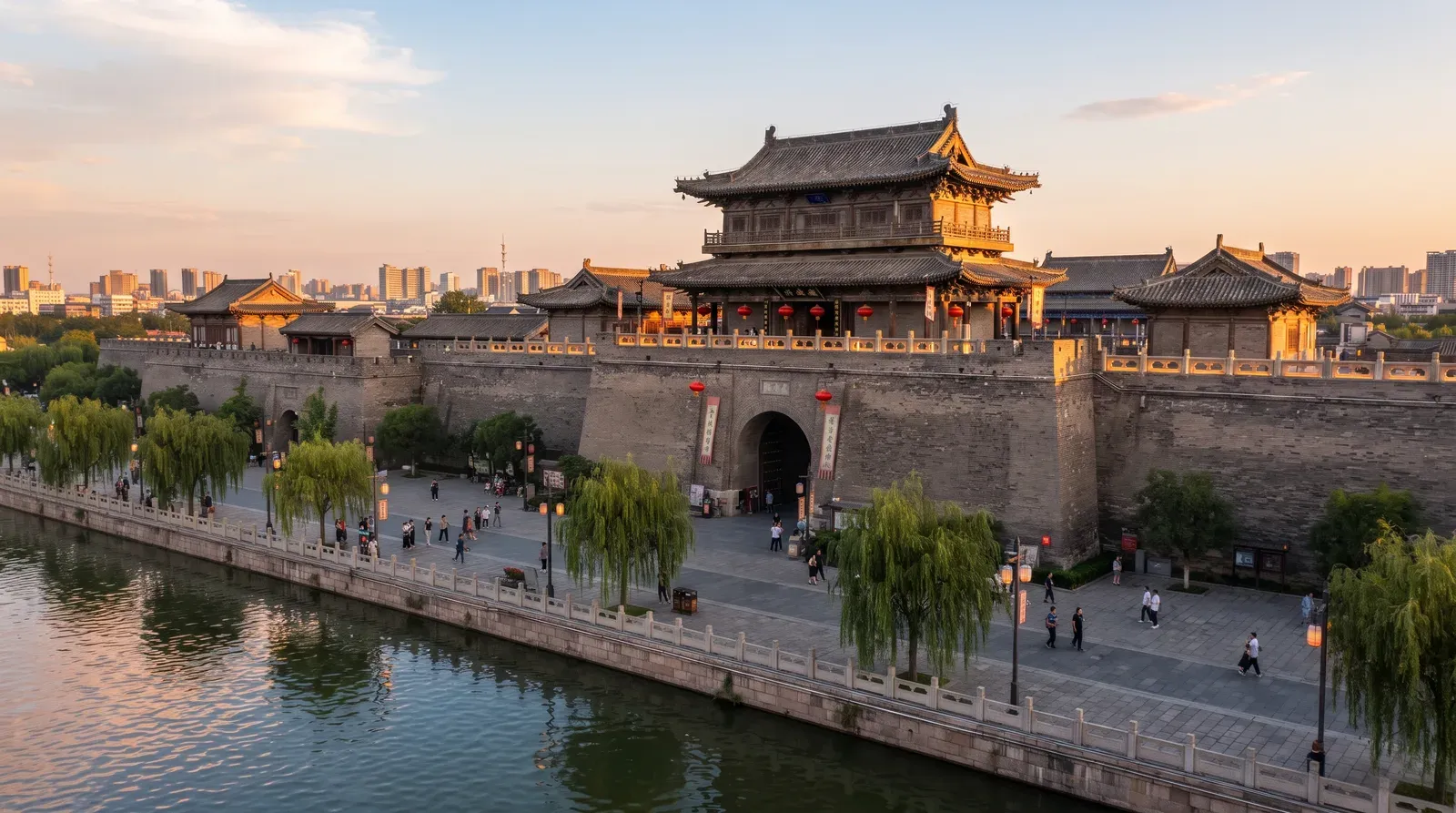
Xuchang
Xuchang is located in central Henan Province, covering a total area of 4,979 square kilometers. It administers Weidu District, Jian'an District, Yuzhou City, Changge City, Yanling County, and Xiangcheng County. It is a Central Plains city with deep Cao Wei history and culture, and is also known as the wig capital with hair products sold worldwide. The city is suitable for travel themed on Three Kingdoms heritage, traditional ceramic crafts, and floral landscapes. To tour downtown Xuchang and surrounding counties and cities, it is generally recommended to stay for 2 to 3 days.
Key points
A trip to explore Xuchang and its surrounding areas typically requires 2 to 3 days, with the city located about 50 kilometers from Zhengzhou Xinzheng International Airport. Because historic Three Kingdoms sites, Shenhou Ancient Town, and other local attractions are fairly spread out, it is best to contact your travel designer to arrange a vehicle with your driver for convenient transfers.
Xuchang is located in central Henan Province, covering a total area of 4,979 square kilometers. It administers Weidu District, Jian'an District, Yuzhou City, Changge City, Yanling County, and Xiangcheng County. It is a Central Plains city with deep Cao Wei history and culture, and is also known as the wig capital with hair products sold worldwide. The city is suitable for travel themed on Three Kingdoms heritage, traditional ceramic crafts, and floral landscapes. To tour downtown Xuchang and surrounding counties and cities, it is generally recommended to stay for 2 to 3 days.
How to get to Xuchang and arrange local transportation?
Xuchang is about 50 kilometers from Zhengzhou Xinzheng International Airport. Both the Beijing-Guangzhou High-Speed Railway and the Zhengzhou-Chongqing High-Speed Railway have stations in the city. Before traveling, you can check the China high-speed rail network guide to plan interstate trips. In terms of highways, eight expressways meet here, including the Beijing-Hong Kong-Macau, Yanluo, and Xuguang expressways. If you travel from Zhengzhou, the Zhengxu Line of the Zhengzhou Metro is open for service, running about 67 kilometers with a top operating speed of 120 km/h. It connects the Zhengzhou Airport Economy Zone with Xuchang East Railway Station across 27 stations, including 11 stations in the Xuchang section. For riding rules, please refer to the guide to using the metro in China. When exploring downtown Xuchang and heading out to Yuzhou and Yanling, attractions are fairly spread out. It is suggested to contact your travel designer to arrange a vehicle with your driver for travel between stops, making it easy to connect the itinerary.
What Three Kingdoms historical sites are in Xuchang?
Xuchang was known in ancient times as Xu. The name comes from the legend of the hermit Xu You during Emperor Yao's reign, who farmed here and washed his ears by the Ying River. In the first year of Jian'an (196), Emperor Xian of Han moved the capital to Xu County and renamed it Xudu. In the second year of Huangchu of Wei (221), Cao Pi renamed Xu County to Xuchang County, meaning that the Han fell in Xu and the Wei foundation prospered in Xu. Historic sites from the Cao Wei period are preserved in the city and surrounding areas:
In the center of the old town in Weidu District, the Cao Prime Minister's Mansion is a Han-style scenic area featuring Qiuxian Hall, Yishi Hall, Fushi Tower, and hidden troop tunnels, presenting the history and culture of Cao Cao, the founder of Cao Wei. On Wenmiao Qian Street, Chunqiu Tower retains its layout honoring heroes in two courtyards, known as the place where Guan Yu read by candlelight until dawn, with Guansheng Hall and the East Courtyard Two Empresses Palace. Baling Bridge is said to be where Cao Cao presented a robe to bid farewell to Guan Yu, and next to the bridge stands a Ming Dynasty stele inscribed by Zuo Liangyu reading Where Lord Guan of Han Picked Up the Robe on His Spear.
In Gucheng Village of Zhangpan Town in Jian'an District, the Han-Wei Ancient City sits 18 kilometers from downtown. Said to have been built by Cao Cao, its surviving rammed-earth wall contours are protected as a provincial-level cultural relic. Yuxiu Platform, built in the third year of Jian'an by Cao Cao for Emperor Xian of Han to offer sacrifices to heaven, is about 15 meters high with 99 steps. Beside Shoushan Platform, which has a remaining platform base over 20 meters high, stands the Three Perfections Stele, composed by Wang Lang, written by Liang Hu, and carved by Zhong Yao, recording the historical transition of Cao Pi replacing the Han Dynasty.
What are the highlights in the surrounding counties and cities?
Beyond the central urban area, Shenhou Town in Yuzhou City sits on the southeastern edge of Jishan Mountain. It is the birthplace of Chinese Jun porcelain and a famous national historic and cultural town, preserving Ming and Qing old streets and historic buildings such as Bolingweng Temple. During the Ming and Qing periods, Yuzhou was one of China's four major distribution centers for traditional Chinese medicinal herbs, producing over 1,000 kinds of herbs, and it hosts Henan Province's only national-level professional market for traditional Chinese medicine. Yanling County is known as the Flower County, celebrated with the saying that Yanling wintersweet ranks top under heaven. Yanling National Flower and Wood Expo Park in the county is a National 4A-level scenic area, covering 1,500 mu with free admission.
How to plan a 2 to 3-day travel itinerary?
For touring Xuchang, a 2 to 3-day itinerary is recommended:
Day 1: Visit the Cao Prime Minister's Mansion, Chunqiu Tower, and Baling Bridge downtown to learn about Three Kingdoms history, and see Wenfeng Pagoda, a 52-meter-tall, 13-story octagonal brick pagoda built in the 42nd year of Wanli in the Ming Dynasty.
Day 2: Go to Jian'an District to visit the rammed-earth ruins of the Han-Wei Ancient City, Yuxiu Platform, and Shoushan Platform, then drive to Shenhou Ancient Town in Yuzhou to explore Ming and Qing old streets, Bolingweng Temple, and Jun porcelain culture.
Day 3: Head to Yanling County to visit the National Flower and Wood Expo Park, then return to Xuchang East Railway Station to depart by high-speed rail or the Zhengxu metro line.
Sources
Cao Cao - Wikipedia
Xuchang City - Wikipedia
Xuchang Municipal People's Government - Walk into Xuchang
Chunqiu Tower (Xuchang) - Wikipedia
Wenfeng Pagoda in Xuchang - Wikipedia
Shenhou Town - Wikipedia
Yuzhou City - Wikipedia
Yanling County - Wikipedia
Zhengzhou Metro Zhengxu Line - Wikipedia
The above sources were verified on November 17, 2026
Related travel tips
Replies 08:30–22:00 your time · Free to ask.