
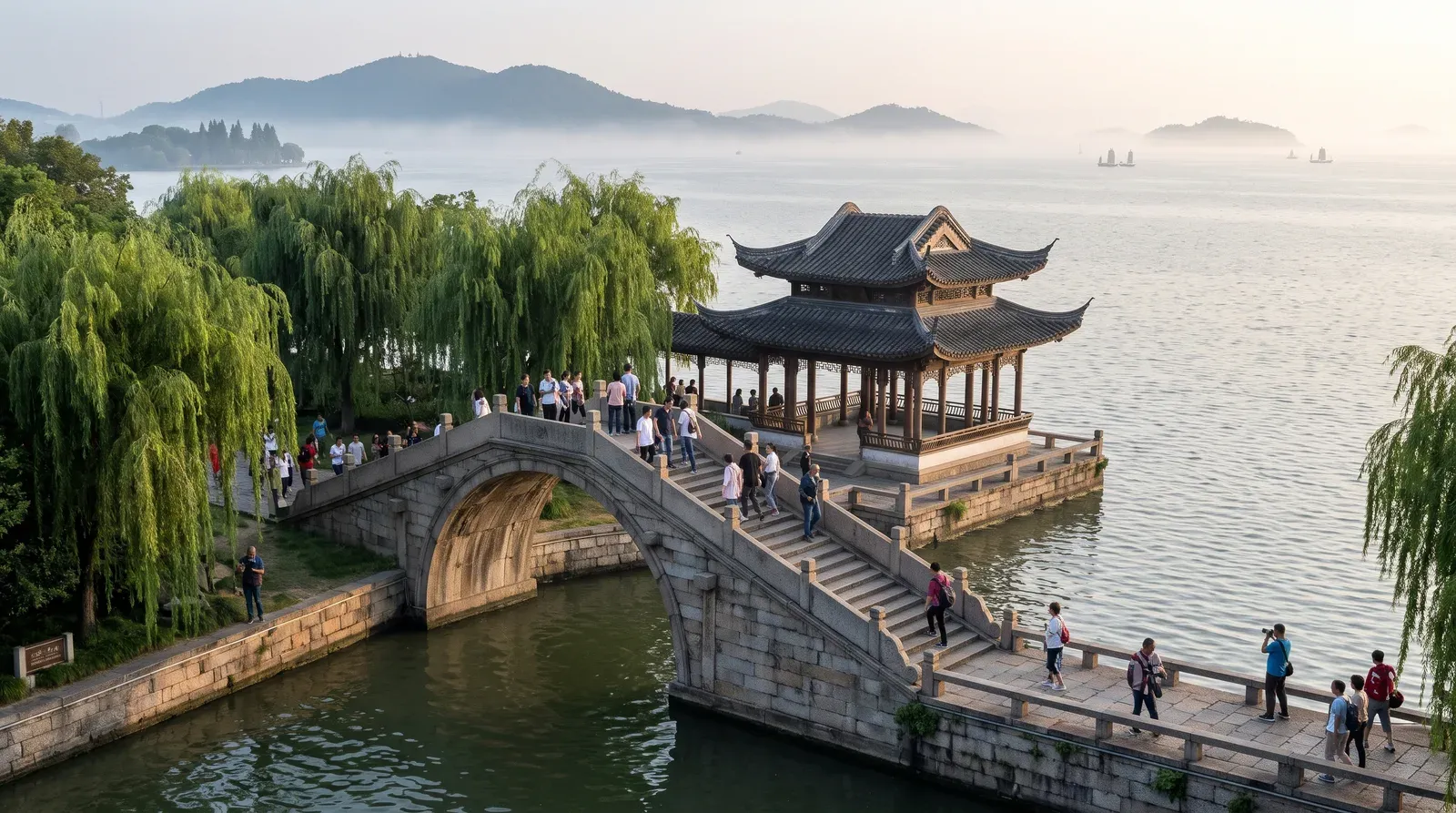
Wuxi
Wuxi is located in southern Jiangsu Province along the shore of Lake Tai. The area was first established as Wuxi County in 202 BC, during the fifth year of Emperor Gaozu of Han. The city covers a total area of 4,627.47 square kilometers, with water surface accounting for 29.0% of the total area. It administers 5 municipal districts: Liangxi, Binhu, Xinwu, Huishan, and Xishan, and oversees 2 county-level cities, Jiangyin and Yixing. As of 2023, its permanent resident population was 7.4908 million. The city combines broad lake views, famous Jiangnan gardens, and the charm of a thousand-year-old canal. It suits travelers who enjoy water town culture and relaxed travel, and staying for 2 to 3 days is usually recommended.
Key points
A visit to Wuxi, China is best planned for 2 to 3 days to explore Lake Tai, Yuantouzhu, and historic sites like Jichang Garden. Non-stop intercity high-speed trains take just 99 minutes along the Shanghai-Nanjing line. Entry to the Qingming Bridge Historic Block is free, and a daytime canal boat cruise costs 60 yuan.
Wuxi is located in southern Jiangsu Province along the shore of Lake Tai. The area was first established as Wuxi County in 202 BC, during the fifth year of Emperor Gaozu of Han. The city covers a total area of 4,627.47 square kilometers, with water surface accounting for 29.0% of the total area. It administers 5 municipal districts: Liangxi, Binhu, Xinwu, Huishan, and Xishan, and oversees 2 county-level cities, Jiangyin and Yixing. As of 2023, its permanent resident population was 7.4908 million. The city combines broad lake views, famous Jiangnan gardens, and the charm of a thousand-year-old canal. It suits travelers who enjoy water town culture and relaxed travel, and staying for 2 to 3 days is usually recommended.
When Is the Best Time to Visit Wuxi, China?
Wuxi has a marine subtropical monsoon climate, with an annual average temperature of 15.5°C and annual average rainfall of 1,048 mm. The four seasons are distinct. July is the hottest month, with an average temperature of 28.0°C, and January is the coldest, with an average temperature of 2.8°C. Spring is the most colorful season along Lake Tai. Yuantouzhu has more than 30,000 cherry trees, which bloom like clouds during peak blossom season. Autumn brings clear skies and crisp air, making it very comfortable to boat along the ancient canal or walk through Huishan Ancient Town.
How to Get to Wuxi and Travel Around the City?
Wuxi has the 4E-grade Wuxi Shuofang Airport. For railways, national lines such as the Beijing-Shanghai High-Speed Railway and the Shanghai-Nanjing Intercity Railway meet here. The Shanghai-Nanjing Intercity Railway connects Shanghai and Nanjing, stopping at Wuxi Station along the way. Non-stop express trains between major stations take only 99 minutes for the entire journey, making travel by high-speed train very convenient. Within the city, as of 2024, Wuxi Metro has opened 5 lines with an operating mileage of 145 kilometers, easily connecting transport hubs and main urban districts. If you prefer a more relaxed trip, you can also contact your travel designer to arrange a private vehicle with your driver to accompany you.
What Are the Main Attractions to Visit in Wuxi?
Wuxi blends Lake Tai scenery with Jiangnan garden culture, making these highlights worth visiting:
- Yuantouzhu (Turtle Head Isle): Located on the shore of Lake Tai, 15 kilometers southwest of Wuxi city center, it got its name because its shape resembles a floating turtle raising its head. It is celebrated as the "Number One Scenic Spot on Lake Tai" and the "Finest Place on Lake Tai." The park has more than 30,000 cherry trees of various types, making it one of China's largest cherry blossom sites and one of the world's three major cherry blossom viewing spots.
- Lingshan Grand Buddha: Located in the national 5A-level Lingshan Scenic Area beside Lake Tai, the Buddha stands 88 meters tall and used more than 700 tons of bronze. On April 27, 2012, the Buddhist Association of China announced Lingshan in Wuxi, Jiangsu as the permanent venue for the World Buddhist Forum.
- Huishan Ancient Town and Jichang Garden: Huishan Ancient Town preserves a cluster of 118 ancestral halls of various family names established from the Tang Dynasty to the Republic of China period, and it is on China's Tentative List for World Heritage. Jichang Garden, located within it, covers 14.85 mu. It cleverly borrows views from Mount Huishan and the Longguang Pagoda on Mount Xishan as its background, and channels the Huishan Spring, known as the "Second Spring Under Heaven," into the garden to create the Eight-Tone Stream, where cascading water sounds like musical strings. The Kangxi and Qianlong emperors of the Qing Dynasty visited this garden on every one of their six southern tours, and Qianlong even replicated its design in the Summer Palace as the Garden of Harmonious Interests (Xiequ Garden).
- Qingming Bridge Historic and Cultural Block: Praised as "Jiangnan Water Alleys, Unique Canal Heritage," it was inscribed as a UNESCO World Heritage site in 2014 as part of the Grand Canal. Entry to the historic area is free. A full-course boat cruise on the ancient canal costs 60 yuan during the day and 80 yuan at night, and tickets for the China Silk Industry Museum within the area cost 20 yuan.
What Classic Flavors Should You Try in Wuxi?
Wuxi cuisine features a clear, sweet, and savory Jiangnan style. Wuxi braised spare ribs (commonly called "meat bones") are listed alongside Huishan clay figurines and fried gluten puffs as the "Three Famous Specialties of Wuxi," and they represent traditional local Wuxi cooking. The China Time-Honored Brand Sanfengqiao cooks spare ribs with a sweet and savory taste, adding sugar equal to about one-tenth of the weight of the ribs during cooking, resulting in rich color and tender meat.
Wuxi xiaolongbao (steamed buns) are known for their large size, generous filling, semi-fermented thin skin, and abundant sweet broth. They mainly come in two types: fresh pork xiaolongbao and crab roe xiaolongbao. When visiting Huishan Ancient Town, you can also taste Huishan crispy shortbread (originally called heavy-oil shaobing). Because its shape resembles the navel of the Four Heavenly Kings statues at Huishan Temple, it is commonly called "Vajra Navel."
Sources
Wuxi - Wikipedia
Shanghai-Nanjing Intercity Railway - Wikipedia
Yuantouzhu - Wikipedia
Grand Buddha at Ling Shan - Wikipedia
Jichang Garden - Wikipedia
Ancestral Halls in Huishan Ancient Town - Wikipedia
Qingming Bridge Ancient Canal District - Wikipedia
Wuxi Spareribs - Wikipedia
Xiaolongbao - Wikipedia
The above sources were verified on Nov 16, 2026
Related travel tips
Replies 08:30–22:00 your time · Free to ask.