
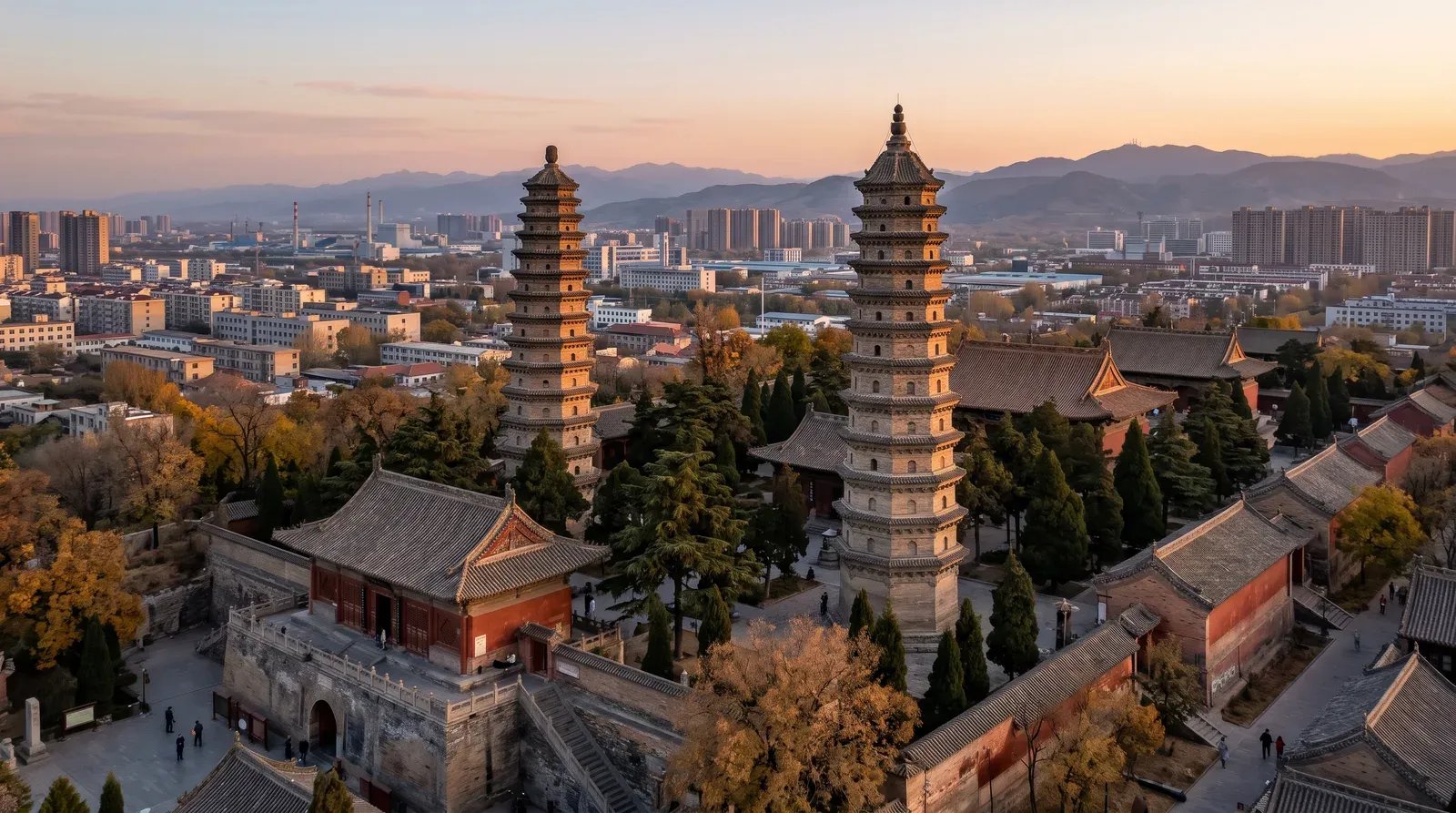
Taiyuan
As the capital of Shanxi Province, Taiyuan, China, sits in the central part of the province, with the Fen River flowing through it from north to south. Its urban history dates back to 497 BC with the construction of the ancient city of Jinyang. It suits travelers interested in historical architecture, museums, and local food, and it often serves as an entry and exit hub for exploring Shanxi from north to south. At a typical pace, spending two to three days here feels comfortable and unhurried.
Key points
With an urban history dating back to 497 BC, Taiyuan serves as Shanxi's central hub for ancient architecture and museums, ideally explored over two to three days. May through October offers the most comfortable climate. You can set aside half a day for Jinci Temple, 25 kilometers southwest of the city, and visit Shanxi Museum, which offers free admission with valid identification.
As the capital of Shanxi Province, Taiyuan, China, sits in the central part of the province, with the Fen River flowing through it from north to south. Its urban history dates back to 497 BC with the construction of the ancient city of Jinyang. It suits travelers interested in historical architecture, museums, and local food, and it often serves as an entry and exit hub for exploring Shanxi from north to south. At a typical pace, spending two to three days here feels comfortable and unhurried.
What kind of city is Taiyuan?
Covering a total area of about 6,988 square kilometers, Taiyuan City had a permanent population of 5.435 million by the end of 2022. In 497 BC, Dong Anyu built the city of Jinyang. Later, it served as a capital or secondary capital for regimes including Zhao, Former Qin, Eastern Wei, and Northern Qi. During the Tang Dynasty, it was designated as the Northern Capital, and in the first year of the Tianbao era, it was elevated to Beijing (Northern Capital), giving it historical names such as the City of Dragons and Bingzhou. Across the wider province, Shanxi preserves more than 28,000 ancient structures, and over 70% of China's surviving timber-frame buildings from the Song Dynasty or earlier stand in Shanxi. This makes the city a convenient stop when traveling along this historic architecture route.
When is a comfortable time to visit?
The city experiences a temperate continental monsoon climate with distinct four seasons and an annual average temperature of about 10.0°C. January is the coldest month with an average temperature of -5.5°C, while July is the hottest at 23.4°C, making summers cooler than on the North China Plain at the same latitude. Annual average precipitation is 425.5 mm, mostly falling in July and August. May through October is the window most travelers find comfortable. July and August see frequent rain, so bring an umbrella when heading out. Winters are cold outdoors, so you can schedule more indoor visits such as the Shanxi Museum.
How do you get here and travel around the city?
Flights arrive at Wusu International Airport, a 4E-grade airfield and the largest airport in Shanxi. For rail transport, the central railway station and South Station serve as the two main passenger hubs, with the latter connecting several major high-speed lines. Metro Line 1 opened on February 22, 2025, connecting the airport to the city center, while Line 2 opened on December 26, 2020, running north-south through the urban area. It was also the first city in the world to fully electrify its cruising taxi fleet. City transit details are available in our China metro guide.
From other provinces, high-speed rail is a common choice. The section between here and Xi'an on the Datong-Xi'an High-Speed Railway began operating on July 1, 2014, reducing the journey between the two cities from 10 hours to about 3 hours. The Shijiazhuang-Taiyuan Passenger Dedicated Line spans 189 kilometers and opened on April 1, 2009. Running through the Taihang Mountain Tunnel across the mountain range, it provides fast rail links connecting the city to Beijing and other destinations in the Beijing-Tianjin-Hebei region. Luggage guidelines for train travel are covered in our China high-speed train guide.
Which places are worth a dedicated visit?
Jinci Temple sits about 25 kilometers southwest of the city center and was first established about 1,400 years ago. Its iconic Hall of the Holy Mother was built during the Northern Song Dynasty between 1023 and 1032. Eight eaves pillars in the front porch are wrapped with carved wooden coiled dragons, and the hall preserves 43 Song Dynasty painted clay maid statues. Regarded as China's earliest surviving royal ancestral garden, it features the "Three Treasures of Jinci": the Hall of the Holy Mother, the Jin Dynasty Offering Hall, and the Flying Bridge across the Fish Pond. The "Three Wonders of Jinci" are the Western Zhou cypress, the Song Dynasty painted clay maid statues, and Nanlao Spring, where the water stays at about 17°C year-round. It is worth setting aside half a day.
Shanxi Museum is the largest museum in Shanxi Province, housing about 400,000 cultural artifacts and 110,000 ancient books. It has offered free admission with valid identification since March 2008, making it well suited for half a day or more. Yongzuo Temple, also known as the Twin Pagoda Temple, was founded in 1597 during the 25th year of the Wanli reign in the Ming Dynasty. Its two octagonal, 13-story brick pagodas, Wenfeng Pagoda and Xuanwen Pagoda, stand 54.76 meters high and 46 meters apart, serving as a symbol of the city. Tianlongshan Grottoes were initially carved from the late Northern Wei to Eastern Wei dynasties and expanded through Northern Qi, Sui, and Tang. Today, 25 caves and more than 500 statues survive, with Tang Dynasty sculptures establishing the "Tianlongshan style"; the Buddha head from the north wall of Cave 8 was repatriated from Japan in 2020. In the urban area, the Fen River stretches north to south for about 100 kilometers, offering an easy evening stroll along the riverside.
What should you eat here?
A traditional specialty in Taiyuan City, China, is "Fu Shan Tou Nao", also called "Eight Treasure Soup". It is brewed from eight ingredients: mutton, mutton bone marrow, fermented grains, roasted flour, lotus root, Chinese yam, astragalus root, and galangal. Eaten for breakfast, it is paired with pickled Chinese chives to brighten the taste, usually accompanied by yellow rice wine and shaomai or baked flatbreads. For noodles, daoxiao mian (knife-cut noodles) uses a curved blade to shave dough directly into a pot of boiling water. The noodles form a willow-leaf shape that is pointed at both ends and wide in the middle, with a triangular cross-section and a firm, smooth texture. Shanxi mature vinegar has a history of about 3,000 years. Qingxu County and the urban district (including Ninghuafu Yiyuanqing) are key production centers, and its brewing technique was listed as national intangible cultural heritage in 2008. For tips on ordering and dietary preferences, consult our guide on dining in China.
How should you pace your visit?
A common two-day plan spends one day heading southwest to Jinci Temple and Tianlongshan Grottoes, and one day exploring Shanxi Museum and the Twin Pagoda Temple in the city, finished with an evening stroll along the Fen River. With a third day, you can head north from the city to Mount Wutai, inscribed as a UNESCO World Heritage site in 2009 with its highest peak, Beitai, rising to 3,061 meters. Alternatively, travel south along the Datong-Xi'an High-Speed Railway to Pingyao, Linfen, and Yuncheng. This rail corridor cuts north to south through Shanxi, connecting Datong, Shuozhou, Xinzhou, the capital, Jinzhong, Linfen, and Yuncheng. To keep things seamless, your travel designer can link city highlights and a regional route tailored to your schedule and energy. Take a look at our tour itineraries and destination guides for initial planning.
Sources
Shanxi - Wikipedia
Datong: Xi'an High-Speed Railway - Wikipedia
Datong-Xi'an High-Speed Railway - Wikipedia
Jinci - Wikipedia
Shanxi Museum - Wikipedia
Mount Wutai - Wikipedia
Taiyuan City - Wikipedia
Taiyuan - Wikipedia
Jinci - Wikipedia
Yongzuo Temple - Wikipedia
Tianlongshan Grottoes - Wikipedia
Fu Shan Tou Nao - Wikipedia
Shanxi Mature Vinegar - Wikipedia
Knife-Cut Noodles - Wikipedia
Shijiazhuang-Taiyuan Passenger Dedicated Line - Wikipedia
The sources above were verified on November 17, 2026.
Related travel tips
Replies 08:30–22:00 your time · Free to ask.