
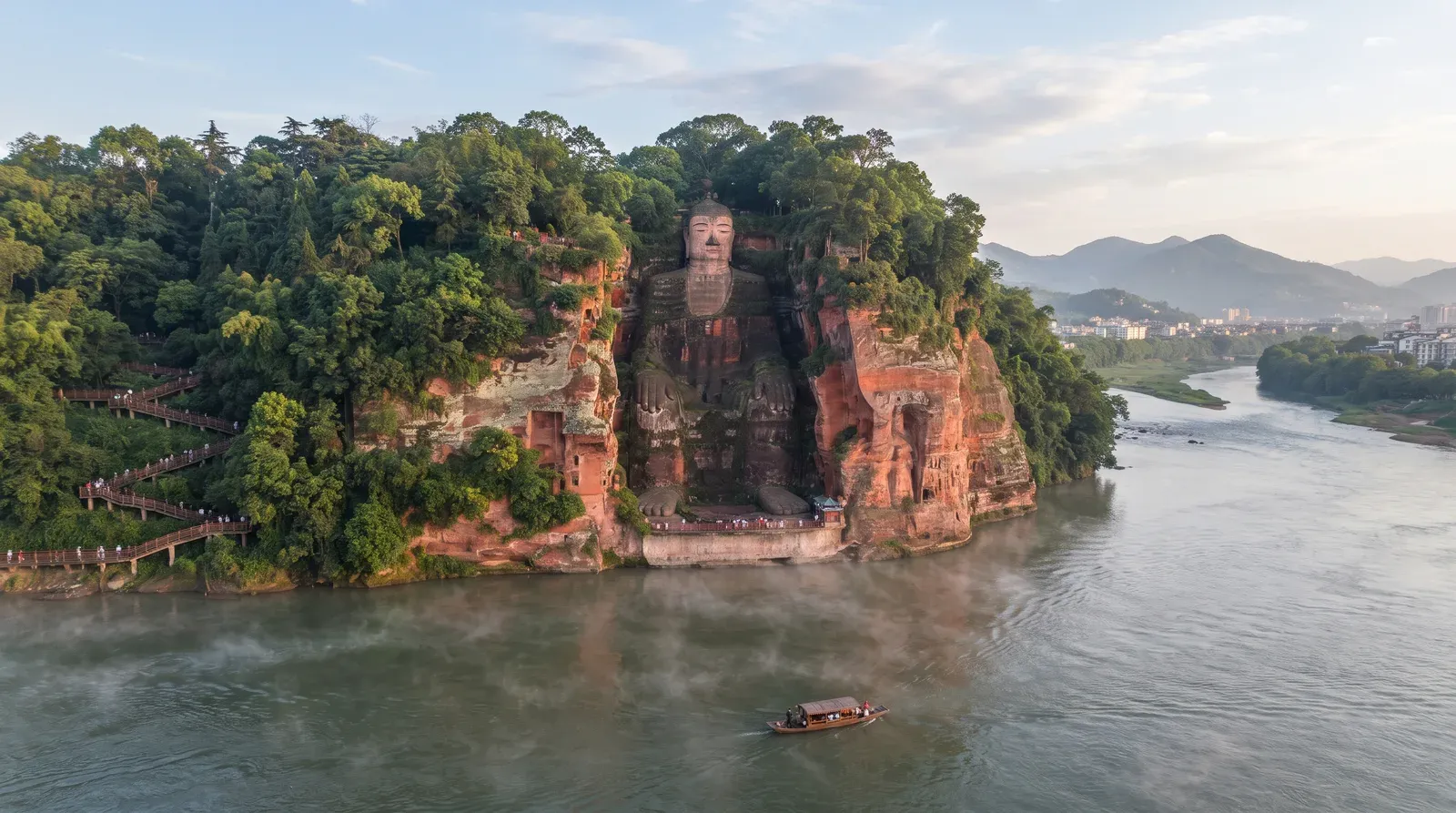
Leshan
Historically known as Jiading or Jiazhou, Leshan sits at the confluence of the Dadu, Min, and Qingyi rivers in Sichuan Province, about 120 kilometers from the provincial capital, Chengdu. The area is home to Mount Emei and the Giant Buddha, which UNESCO inscribed as a dual World Cultural and Natural Heritage site in 1996. The region combines ancient stone carving art, mountain scenery, and popular Sichuan food, making it suitable for cultural visits, forest walks, and relaxing getaways. A stay of 2 to 3 days is generally suggested to explore the Buddha scenic area, head up Mount Emei, and sample local street fare at an easy pace.
Key points
Located about 120 kilometers from Chengdu, Leshan is home to Mount Emei and the 71-meter Giant Buddha, where a 2- to 3-day stay is recommended. Spring and autumn provide the most comfortable weather, while over 70% of annual rainfall occurs from June to September. You will need warm clothing if visiting the freezing summit in winter.
Historically known as Jiading or Jiazhou, Leshan sits at the confluence of the Dadu, Min, and Qingyi rivers in Sichuan Province, about 120 kilometers from the provincial capital, Chengdu. The area is home to Mount Emei and the Giant Buddha, which UNESCO inscribed as a dual World Cultural and Natural Heritage site in 1996. The region combines ancient stone carving art, mountain scenery, and popular Sichuan food, making it suitable for cultural visits, forest walks, and relaxing getaways. A stay of 2 to 3 days is generally suggested to explore the Buddha scenic area, head up Mount Emei, and sample local street fare at an easy pace.
When is a good time to visit?
The urban area of Leshan, China, has a monsoon humid subtropical climate. Winters are mild and moist with very little snow, and the average January temperature is about 7.4°C. Summers are long, humid, and warm, with average daily temperatures in July and August around 26°C. More than 70% of the annual rainfall falls between June and September. If your trip includes Mount Emei, take note of the vertical climate differences. The Golden Summit of Mount Emei, at an elevation of 3,077 meters, has an alpine subarctic climate. Its annual average temperature is 3.07°C, with a January monthly average of -5.7°C and a July monthly average of 11.6°C. It records over 250 precipitation days a year, with most rain also falling from June to September. Spring and autumn are mild and comfortable. In winter, you can view snow scenes at the summit, but the top is freezing, so you need warm winter clothing in advance.
How to get there and arrange local transport?
The 135-kilometer high-speed rail section from Chengdu terminates at the city's main railway station, which connects train, city bus, and long-distance coach services, making travel to and from Chengdu by high-speed train very fast. A dedicated 31-kilometer branch line extends directly to Emeishan Station, providing smooth connections to the mountain area. Between the urban center and surrounding sights, you can take public transit, or arrange private car service with your driver through our travel designer for the entire trip to avoid carrying luggage and switching vehicles.
What are the main places to visit in Leshan?
The area features Buddhist heritage, mountain scenery, and industrial history:
- Giant Buddha: Carved into Cretaceous red sandstone cliffs at the confluence of the Min and Dadu rivers between 712 and 804 AD during the Tang Dynasty, this 71-meter statue is the largest and tallest ancient stone Buddha in the world. The head is 14.7 meters high and 10 meters wide, with 1,021 coiled hair buns. The ears are 7 meters long, the shoulders span 24 meters, and the instep is about 8.5 meters wide, accommodating up to 100 people. Even its smallest toenail can fit a seated person. Hidden drainage channels and flumes run throughout the body, protecting the carving from severe water erosion for over 1,200 years. Admission is 90 RMB per person, including Wuyou Temple and Mahao Cliff Tombs. Opening hours are 7:30 to 18:30 from April to October, and 8:00 to 17:30 from October to March. Boat tickets for a distant panoramic view cost 70 RMB per person.
- Mount Emei: The highest of the four sacred Buddhist mountains in China, traditionally regarded as the bodhimanda of Bodhisattva Samantabhadra. It has rich biodiversity, recording about 3,200 plant species across 242 families (including 31 nationally protected species and over 100 endemics) and about 2,300 animal species. The walking trail across the mountain runs 50 kilometers and takes several days to complete, but visitors can also take a cable car to the temple complex at the Golden Summit at 3,077 meters above sea level. The Mount Emei heritage zone covers 15,400 hectares, forming the dual World Heritage site together with the 17.88-hectare Giant Buddha heritage zone.
- Qianwei Jiayang Narrow-Gauge Railway: Measuring 19.84 kilometers in total length, construction began in 1958, and it opened on July 12, 1959. Converted to a 762-millimeter gauge in 1960, it remains one of the few narrow-gauge steam passenger trains still operating in the world. The train runs 4 round trips daily, taking about 75 minutes one way. It was designated a national cultural heritage site in 2010, and visitor tickets cost 80 RMB.
What local specialties and flavors does the city offer?
The city is known for its Sichuan dishes and street food culture. Local specialties include malatang, bobo chicken, sweet-skinned duck, qiaojiao beef, Xiba tofu, tofu pudding, kabing meat buns, Qianwei thin pancakes, fried skewers, and ye'erba glutinous rice cakes. Beyond food, walking along the streets offers a unique cultural feel. The local dialect stands out among Sichuan dialects by preserving the entering tone from Middle Chinese, which Modern Standard Mandarin and most other Sichuan dialects have lost. This distinct intonation gives the old town its own character.
How should you pace your visit?
If you have only 1 day, you can focus on the Giant Buddha. Spend the morning viewing the statue along the cliff plank path or from a boat, enjoy authentic qiaojiao beef and sweet-skinned duck for lunch, and return to Chengdu in the evening. With 2 to 3 days, spend the first day exploring the Buddha and street snacks in the old town, take the cable car up to the Golden Summit on Mount Emei on the second day, and visit Qianwei on the third day to ride the Jiayang steam train. If you plan a deeper journey across southwest China, your travel designer can also weave the city into itineraries such as the 14-day Xi'an, Chengdu, and Chongqing cultural tour to keep travel comfortable and unhurried.
Sources
Leshan - Wikipedia
Leshan Giant Buddha - Wikipedia
Mount Emei Scenic Area, including Leshan Giant Buddha Scenic Area
Mount Emei - Wikipedia
Chengdu-Guiyang High-Speed Railway - Wikipedia
Jiayang Coal Railway - Wikipedia
Sources verified on November 17, 2026
Our trips that visit Leshan
Related travel tips
Replies 08:30–22:00 your time · Free to ask.