
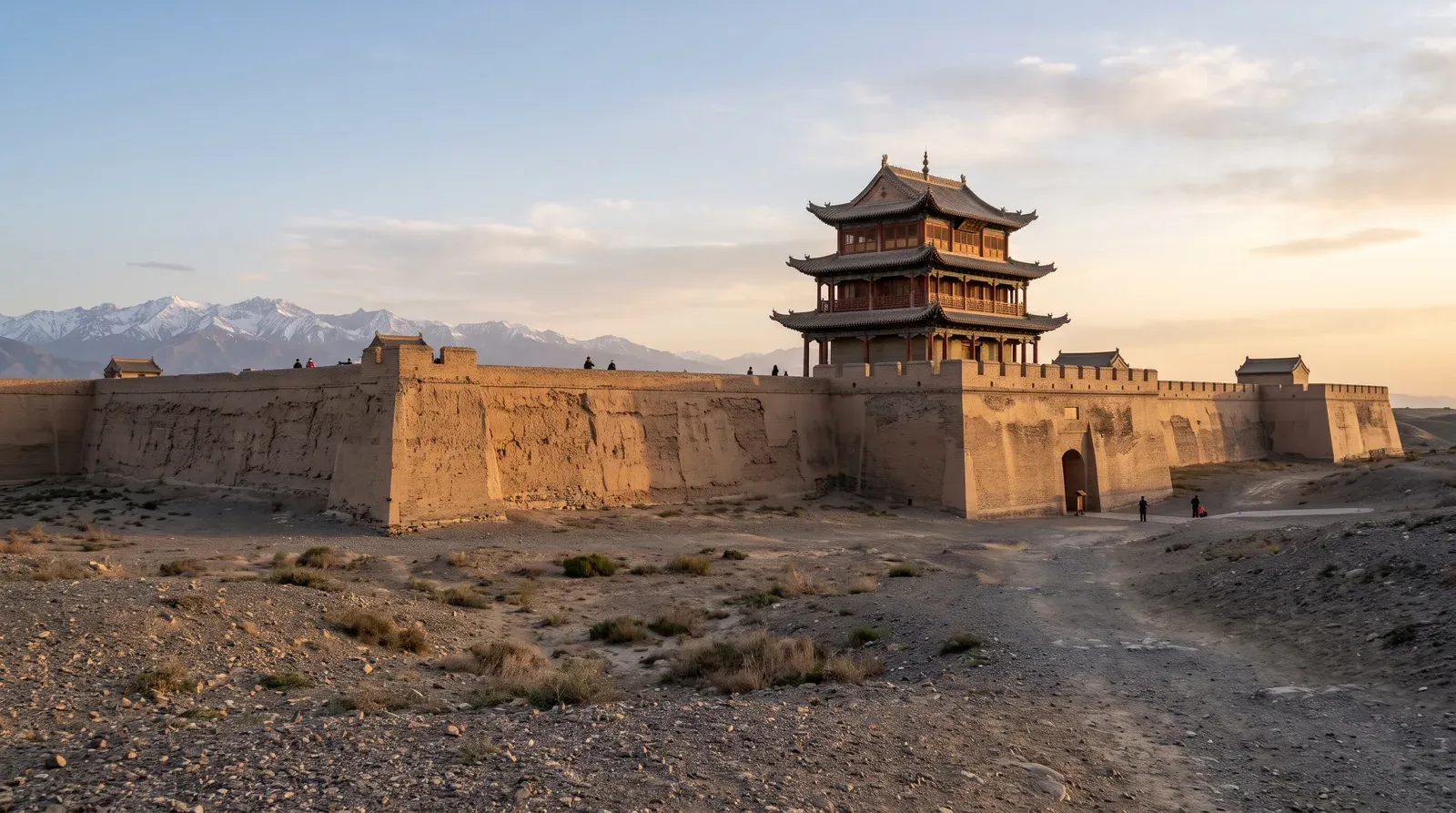
Jiayuguan
Jiayuguan City is located at the throat of the Hexi Corridor in northwestern Gansu Province, covering a total area of about 1,224 square kilometers. It takes its name from the first pass at the western end of the Ming Great Wall. While preserving historical relics such as the Ming pass fortress, it is also an industrial city developed around the Jingtieshan iron mine and Jiuquan Iron and Steel Company, making it well suited for travelers interested in Great Wall and Silk Road culture. Visitors are usually advised to spend 1 to 2 days here to tour the fortress defense line and surrounding ancient sites.
Key points
Plan 1 to 2 days to visit Jiayuguan, exploring the Ming Great Wall fortress built in 1372 alongside its surrounding defensive sites. Because average annual precipitation is under 200 millimeters and temperature swings are large, bring sun protection, moisturizer, and a windproof warm jacket. Since attractions are scattered across the Gobi desert, travel by private car with your driver.
Jiayuguan City is located at the throat of the Hexi Corridor in northwestern Gansu Province, covering a total area of about 1,224 square kilometers. It takes its name from the first pass at the western end of the Ming Great Wall. While preserving historical relics such as the Ming pass fortress, it is also an industrial city developed around the Jingtieshan iron mine and Jiuquan Iron and Steel Company, making it well suited for travelers interested in Great Wall and Silk Road culture. Visitors are usually advised to spend 1 to 2 days here to tour the fortress defense line and surrounding ancient sites.
What is the climate like in Jiayuguan, China, and what should you prepare?
The area has a temperate arid climate, with average annual precipitation under 200 millimeters. Controlled by the Siberian High in winter, the weather is frigid with very little snowfall. Summer mornings are cool, while afternoons are dry and warm. Because of low rainfall, abundant sunshine, and large temperature differences between day and night, you are advised to bring sun protection and moisturizer, along with a windproof, warm jacket.
How do you get to the city and travel around locally?
You can reach the city by train, plane, or highway. The Lanzhou-Xinjiang high-speed railway starts from Lanzhou West railway station and connects Zhangye, Jiuquan, and other stops, with a designed top speed of 250 kilometers per hour. The 42-kilometer local section of the regular Lanzhou-Xinjiang railway includes a first-class station for passenger and freight service. For air travel, Jiayuguan Jiuquan Airport (originally opened in 1953 and renamed in March 2023) operates domestic flights. The Lianyungang-Khorgas Expressway and National Highway 312 run across the territory from west to east. When sightseeing, since the pass and its flanking sites are scattered around the Gobi desert, you can choose to travel by private car with your driver.
Which places are worth visiting?
Jiayuguan Fort was first built in 1372 (the fifth year of the Hongwu era under Emperor Taizu of Ming). The inner city has a perimeter of 640 meters and a wall height of 10.7 meters, featuring Guanghua Gate and Rouyuan Gate, both fortified with barbicans. The walls have 14 pavilion structures, including watchtowers and arrow towers, making it one of the most intact pass fortresses of the Great Wall. On the rear eaves terrace of the west barbican gate tower, a brick known as the "city stabilizing brick" remains, said to be left behind by the Ming craftsman Yi Kaizhan. The wall sections built in the 20th year of the Jiajing era under Emperor Shizong of Ming extend 15 li south to the Taolai River (the First Pier of the Great Wall) and 15 li north to Shiguan'er (the Overhanging Great Wall), totaling 30 li to form a complete defense system. The Guoyuan and Xincheng tombs date from Cao Wei to the Tang Dynasty. The brick murals unearthed from the Xincheng Wei-Jin mural tombs depict everyday scenes like roasting meat, preparing feasts, and herding horses. Of the 18 excavated tombs, one is currently open. In addition, the area features the Heishan rock art dating from the Warring States period to the Ming Dynasty, and the July 1st Glacier on the northern slopes of the Qilian Mountains (with its peak at an elevation of 5,158.8 meters).
How should you plan your travel itinerary?
For a one-day trip, you can visit the pass fortress in the morning, then head to the First Pier of the Great Wall and the Overhanging Great Wall in the afternoon. If you have two days, you can dedicate the second day to visiting the Xincheng Wei-Jin mural tombs. As an important stop on the Silk Road, the city is well suited to combine with Zhangye, Jiuquan, and Dunhuang along the same corridor. You can contact an Uncle Panda travel designer to plan a customized Hexi Corridor itinerary.
Sources
Jiayu Pass - Wikipedia
Lanzhou-Xinjiang High-Speed Railway - Wikipedia
Jiayuguan City - Wikipedia
Great Wall of the Ming Dynasty - Wikipedia
Guoyuan and Xincheng Tombs - Wikipedia
Jiayu Pass - Wikipedia
July 1st Glacier - Wikipedia
Heishan Rock Art - Wikipedia
Jiayuguan City - Wikipedia
Hexi Corridor - Wikipedia
The sources above were verified on November 17, 2026.
Related travel tips
Replies 08:30–22:00 your time · Free to ask.