
Hotan
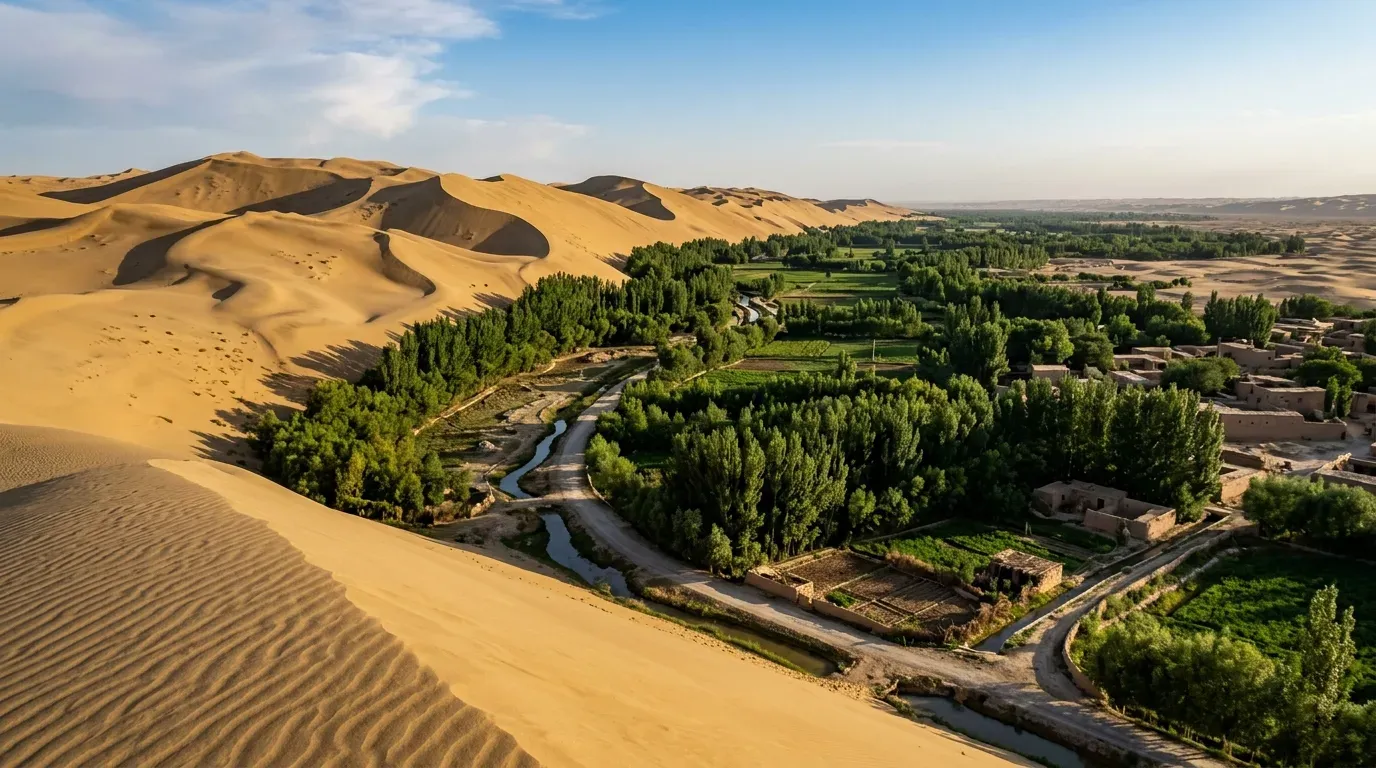
Hotan city sits in an oasis on the south edge of the Taklamakan Desert, in the far southwest of Xinjiang. The Karakash River and the Yurungkash River have long fed the irrigated oasis, and the town was a key stop on the southern route of the ancient Silk Road. It is a good place to learn about Silk Road historic sites, traditional crafts and desert geography, and 2 to 3 days here is the usual suggestion.
Key points
A trip to Hotan is best planned for 2 to 3 days. The region experiences over 220 dusty days a year with frequent spring sandstorms, making cooler autumn months more comfortable for travel. To explore the city and outlying sites like the Rawak Buddhist temple ruins, your travel designer can arrange a car with your driver.
Hotan city sits in an oasis on the south edge of the Taklamakan Desert, in the far southwest of Xinjiang. The Karakash River and the Yurungkash River have long fed the irrigated oasis, and the town was a key stop on the southern route of the ancient Silk Road. It is a good place to learn about Silk Road historic sites, traditional crafts and desert geography, and 2 to 3 days here is the usual suggestion.
When is the weather in the city more pleasant?
The city has a dry desert climate, with average yearly rainfall of about 35 to 38 mm and average yearly evaporation of 2480 mm. There are more than 220 dusty days a year. Spring is the peak season for sandstorms in the Taklamakan Desert, and wind and sand are more frequent in the southern part of the desert. According to records from the Tazhong station in the heart of the desert (1099 m above sea level), the average daily high in July is 36.3 °C, with an extreme high of 45.6 °C; in September the average daily high is 30.4 °C and in October it is 22.2 °C, so autumn gradually turns cooler.
How do you get there, and how do you get around the city?
By air you can fly into Hotan Kungang Airport (IATA code: HTN), about 12 km from the city center. In 2023 the airport handled 1.53 million passengers. Its name comes from a line in the Thousand Character Classic, "jade comes from Kungang." By rail, a loop line now circles the Taklamakan Desert: the Southern Xinjiang Railway through Kashgar and the city links up with the railway to Ruoqiang on the south side, so you can travel by train. By road, the desert highway on National Highway 580 starts at Nankou town in Aral and ends at Yurungkash town in the city, 424 km in all with 407 km of desert road, which halves driving time compared with going around via National Highways 314 and 315. To visit the city and nearby counties, your travel designer can arrange a car with your driver.
What is worth seeing here, and what local products are there?
The area has a long history. In the 7th century the Tang dynasty monk Xuanzang recorded that the old name of the kingdom came from the Sanskrit Kustana, meaning "breast of the earth." In 648 CE Yutian was merged with Shule, Kucha and Yanqi into the Anxi Four Garrisons of the Tang. The Rawak Buddhist temple site in Luopu County is the only fairly well preserved Buddhist site of Gandhara architectural style from the Yutian culture in the prefecture.
Local products include jade, carpets and silk. Hotan jade is a nephrite of the tremolite and actinolite series, with a Mohs hardness of 6.5 to 6.9, very high toughness and a warm, oily luster. By where it is found and how it is collected, it is traditionally divided into mountain material, mountain-and-water material, and seed material from river beds. Atlas silk is a nationally listed intangible cultural heritage silk textile of Xinjiang; in Uyghur the word means tie-dyed silk fabric. Traditional dyeing uses natural plant dyes such as pomegranate flowers and walnut husks, and hand-woven pieces are usually 40 to 60 cm wide. Atlas silk from here and from Luopu traditionally uses black and white as its main colors and aims at a proper balance of solid and open areas, which sets it apart from the brighter colors of Kashgar and Shache.
How should you pace a trip here?
It helps to plan your days by area. On the first day, stay in the city to learn about the mountain material and seed material forms of jade and to watch black and white atlas silk being woven by hand. On the second day, go to Luopu County to visit the Rawak Buddhist temple site and see the Gandhara-style remains on the ground. On the third day, take the desert highway through the heart of the Taklamakan.
Sources
Taklamakan Desert - Wikipedia, the free encyclopedia
Tarim Desert Highway - Wikipedia, the free encyclopedia
Taklamakan Desert - Wikipedia
Hotan - Wikipedia, the free encyclopedia
Hetian jade - Wikipedia, the free encyclopedia
Atlas silk - Wikipedia, the free encyclopedia
Hotan Kungang Airport - Wikipedia, the free encyclopedia
Rawak Buddhist temple site - Wikipedia, the free encyclopedia
Hotan - Wikipedia
All sources checked on Nov 16, 2026.
Related travel tips
Replies 08:30–22:00 your time · Free to ask.