
Dunhuang
Located in northwestern Gansu Province and administered by Jiuquan, Dunhuang, China is a famous national historical city and a key oasis along the ancient Silk Road. It brings together over a thousand years of Buddhist grotto art, Han Dynasty Great Wall fortifications, and desert spring wonders, making it well suited for travellers who enjoy history, culture, and Silk Road heritage. To visit the city's core sights, a stay of 2 to 3 days is usually recommended.
Key points
Visiting the core sights of Dunhuang, China typically requires 2 to 3 days. When visiting the Mogao Caves, your first stop is the Digital Exhibition Center as there is no on-site ticket office, and photography inside is strictly forbidden. With an average daily temperature difference of 16.1°C, pack warm layers and let your travel designer arrange a private vehicle with your driver.
Located in northwestern Gansu Province and administered by Jiuquan, Dunhuang, China is a famous national historical city and a key oasis along the ancient Silk Road. It brings together over a thousand years of Buddhist grotto art, Han Dynasty Great Wall fortifications, and desert spring wonders, making it well suited for travellers who enjoy history, culture, and Silk Road heritage. To visit the city's core sights, a stay of 2 to 3 days is usually recommended.
When is the weather suitable for visiting Dunhuang?
Dunhuang has a temperate arid climate, with an annual average temperature of 9.48°C, annual precipitation of about 67 mm, and very rapid evaporation. The city receives 3,258 hours of sunshine a year with abundant daylight, but the average daily temperature difference reaches 16.1°C. Regardless of the season you visit, it is advisable to pack a warm jacket for mornings and evenings, and take care to stay hydrated and protect against sun exposure during outdoor activities.
How should you plan a visit to the Mogao Caves?
The Mogao Caves are located about 25 kilometers southeast of downtown Dunhuang and were inscribed as a UNESCO World Heritage site in 1987. A total of 735 caves were carved into the cliff, of which 492 caves survive today, preserving about 45,000 square meters of murals and more than 2,000 painted sculptures that span Buddhist art from the 4th to the 14th century AD. In 1900, the Taoist priest Wang Yuanlu discovered the Library Cave (Cave 17) along the corridor of Cave 16, which contained around 50,000 ancient manuscripts, documents, and silk textiles dating from 406 to 1002 AD.
When visiting the Mogao Caves, the Digital Exhibition Center is the first stop, and there is no on-site ticket office in the core cave area. Strict conservation rules apply: large luggage, pets, and drones are strictly prohibited in the grotto area, and taking photographs or touching murals and painted sculptures inside the caves is strictly forbidden. In case of severe weather such as heavy rain or strong sandstorms, the caves will close and tickets will be fully refunded.
What other notable sights are worth visiting beyond the Mogao Caves?
Dunhuang and its surrounding areas feature several other remarkable natural and historic attractions:
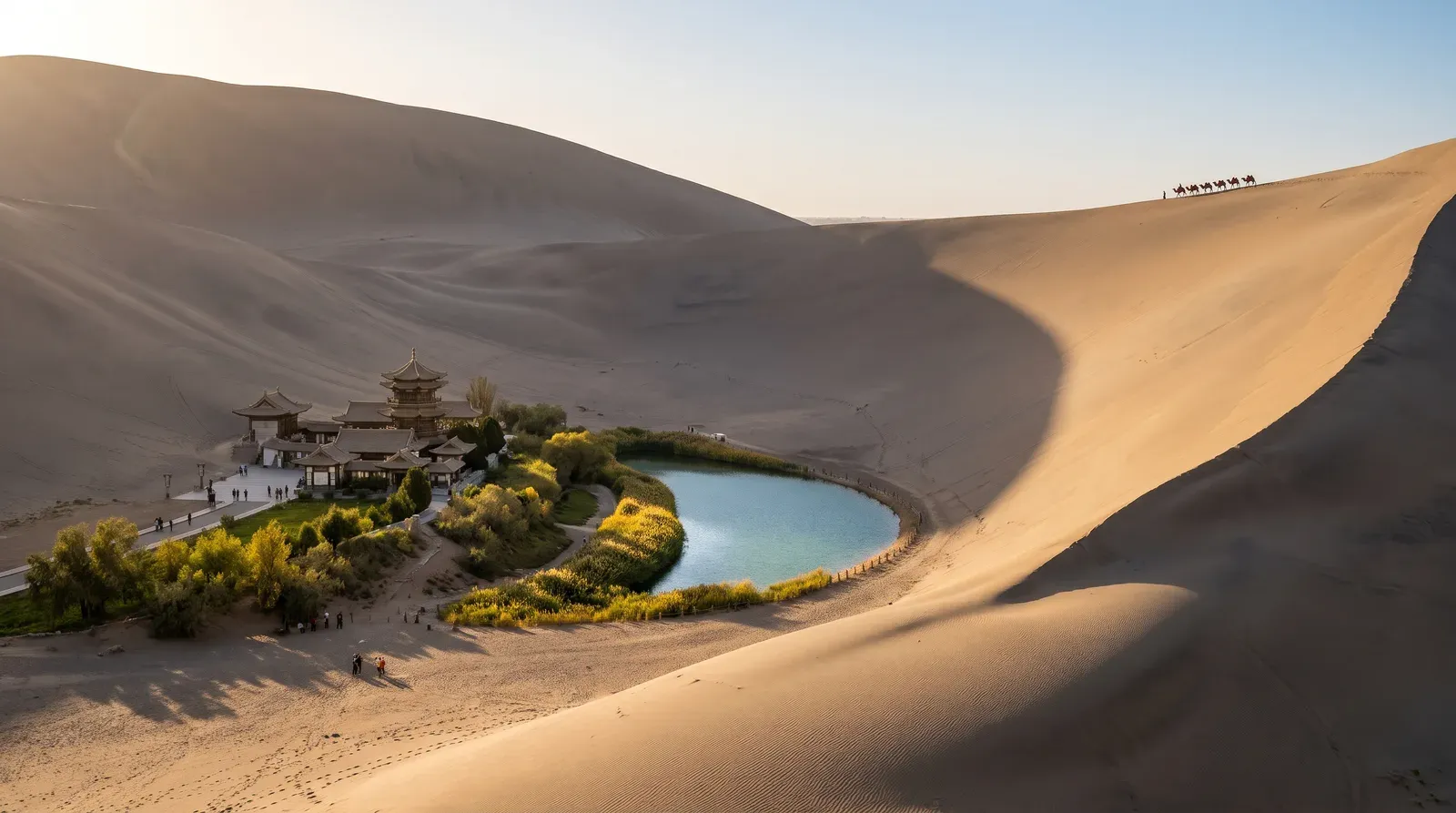
- Mingsha Mountain and Crescent Spring: A national 5A-level scenic area south of the city, where golden sand peaks surround a clear crescent-shaped spring, presenting a rare spectacle of sand and water living side by side.
- Yumen Pass and Yangguan: Military fortifications along the Han Dynasty Great Wall. The Yumen Pass ruins lie in the Gobi desert about 90 kilometers northwest of downtown; the area also preserves the intact Xuanquanzhi relay station site from the Han and Jin periods.
- Western Thousand Buddha Caves: Located about 35 kilometers southwest of the city (near the Danghe Reservoir along National Highway 215), open year-round, with full-price tickets at 30 yuan per person per visit and half-price concession tickets at 15 yuan per person per visit.
- Yulin Caves: Located about 70 kilometers south of Guazhou County seat in Jiuquan, known as the "sister caves" of Mogao. Standard cave admission is 40 yuan per person per visit for domestic visitors and 55 yuan per person per visit for overseas visitors (including a 15-yuan foreign language guide fee).
How can you get to Dunhuang and travel around locally?
Dunhuang is served by Dunhuang Mogao International Airport, Dunhuang Railway Station, and National Highway 215. By rail, northbound routes link with the Lanzhou-Xinjiang line, providing convenient connections to Lanzhou and Xi'an, while southbound routes connect to the Qinghai-Tibet Railway toward Golmud. Because most attractions around Dunhuang are scattered across desert and Gobi terrain with long distances in between, you can contact our travel designer to arrange a private vehicle with your driver to avoid the hassle of public transfers.
What local specialties should you try in Dunhuang?
Located on East Street in the city center, the Dunhuang Shazhou Night Market gathers local handicrafts, souvenirs, and a lively street atmosphere. Here you can sample classic dishes from the famed "Eight Curiosities of Dunhuang", such as smooth and chewy donkey meat with yellow noodles, refreshing and tangy jiangshui noodles, and crispy, sweet paoer yougao (puffed fried cakes).
Sources
Dunhuang City - Wikipedia
Dunhuang - Wikipedia
Mogao Caves
Mogao Caves - Wikipedia
Mogao Caves - Dunhuang Academy
Western Thousand Buddha Caves - Dunhuang Academy
Yulin Caves - Dunhuang Academy
All sources verified on November 17, 2026
Related travel tips
Replies 08:30–22:00 your time · Free to ask.