
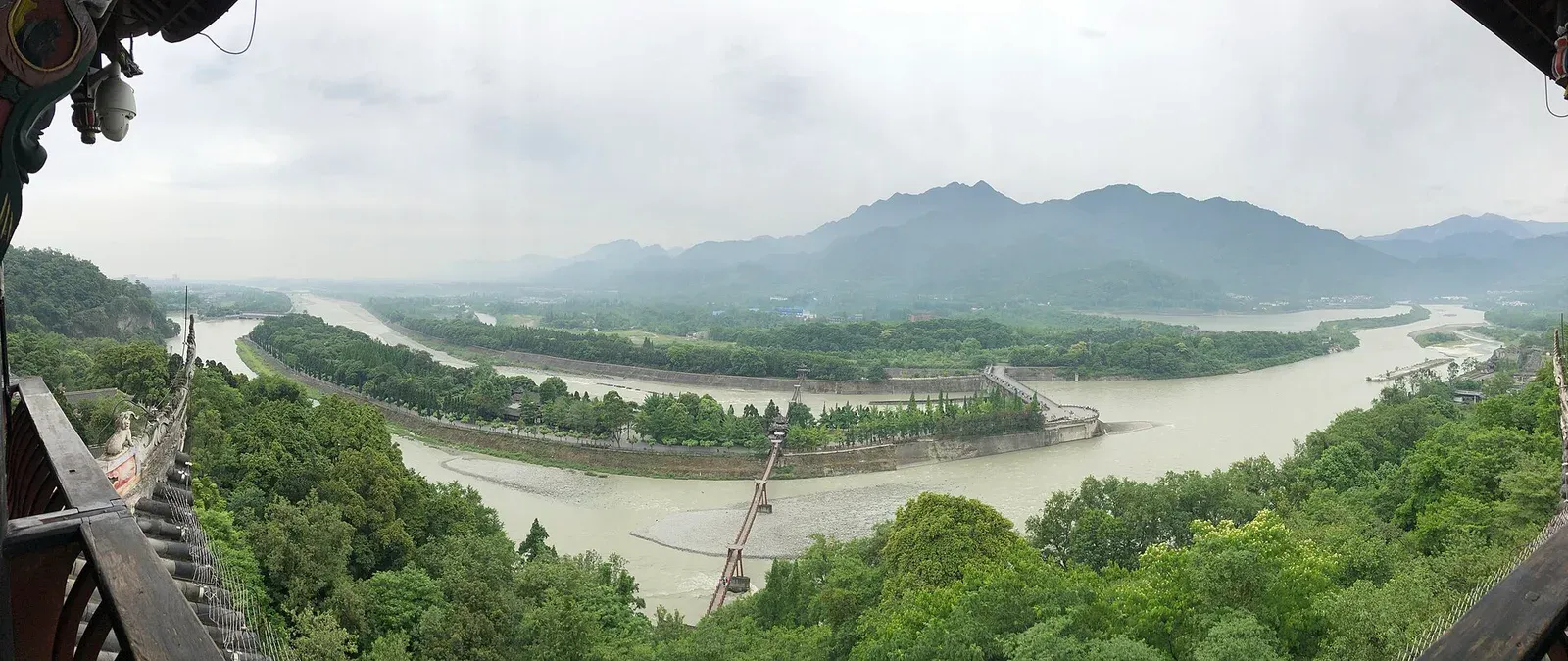
Dujiangyan
Photo: 星星 / Wikimedia Commons, CC BY-SA 4.0
Dujiangyan City lies northwest of Chengdu in Sichuan Province. It is home to an ancient dam-free water diversion project with a history of over 2,000 years, combining water engineering heritage, giant panda habitats, and historic western Sichuan streets. Mount Qingcheng and Dujiangyan were inscribed as a UNESCO World Cultural Heritage site in 2000, and were listed as a World Natural Heritage site in 2006 as an important part of the Sichuan Giant Panda Sanctuaries. For travelers planning to visit the irrigation system, see giant pandas up close, and explore the old town, a stay of 1 to 2 days is usually recommended.
Key points
Visiting Dujiangyan generally takes 1 to 2 days, with high-speed trains reaching Mount Qingcheng from Xipu Station in as fast as 30 minutes, or Lidui Park Station for direct access to the waterworks. The local rainy season runs from late May to mid-September. Note that Panda Valley requires booking morning or afternoon slots, and tapping a Tianfu Tong card requires a balance of at least 15 yuan.
Dujiangyan City lies northwest of Chengdu in Sichuan Province. It is home to an ancient dam-free water diversion project with a history of over 2,000 years, combining water engineering heritage, giant panda habitats, and historic western Sichuan streets. Mount Qingcheng and Dujiangyan were inscribed as a UNESCO World Cultural Heritage site in 2000, and were listed as a World Natural Heritage site in 2006 as an important part of the Sichuan Giant Panda Sanctuaries. For travelers planning to visit the irrigation system, see giant pandas up close, and explore the old town, a stay of 1 to 2 days is usually recommended.
| Item | Details |
|---|---|
| Recommended stay | 1 to 2 days is recommended |
| Recommended climate period | The average temperature of the hottest month is 24.4°C, with the rainy season concentrated from late May to mid-September |
| Main transit | Chengguan high-speed trains reach Mount Qingcheng in as fast as 30 minutes, with cross-platform transfer to Metro Line 2 at Xipu Station |
| Direct station for the scenic area | Take the Lidui branch of the Chengguan Railway to Lidui Park Station, where the exit leads directly to the irrigation system scenic area |
| Entry and booking rules | Panda Valley uses morning and afternoon booking slots; Guanxian Ancient City is a free open neighborhood |
| Tiered transit fares | Chengguan high-speed trains have three tiered fares of 5, 10, and 15 yuan based on distance |
When is a good time to visit Dujiangyan?
The city experiences summers without extreme heat and winters without severe cold, with an average annual rainfall of about 1,243.8 mm. The average temperature in the coldest month is 4.6°C, while the average in the hottest month is 24.4°C. The rainy season is mainly concentrated between late May and mid-September.
Beyond the weather, Dujiangyan hosts the grand Water-Releasing Festival every year during Qingming Festival, showcasing water management traditions passed down for more than 2,000 years. On the 24th day of the seventh lunar month, marking the birthday of Li Bing, a traditional temple fair and Sichuan opera performances take place at Erwang Temple at the foot of Mount Yulei.
Tip: Summer brings lush waterways but frequent rain, so bring rain gear when you travel; if you plan to watch the folk festivals, schedule your trip early around the dates of the Qingming Water-Releasing Festival or the temple fair on the 24th day of the seventh lunar month.
How do you get to Dujiangyan and get around?
Traveling from downtown Chengdu to Dujiangyan is straightforward on the Chengguan Railway. Trains run at top operating speeds of 220 km/h, taking as little as 30 minutes between Chengdu and Mount Qingcheng. The line shares the same platform with Chengdu Metro Line 2 at Xipu Station (犀浦站) with cross-platform transfer and shared security checks. After arriving at Xipu on Metro Line 2 from downtown Chengdu, you can transfer directly to the train for Dujiangyan. For rail travel basics, you can also check High-speed trains in China.
If you are heading straight to the irrigation system scenic area, the 6 km Lidui branch line has three underground stops: Yingbin Road, Libing Square, and Lidui Park. Getting off at Lidui Park Station (离堆公园站) brings you right to the entrance of the irrigation project. Besides buying tickets through 12306, you can tap into the gates with a Railway e-Card or a Tianfu Tong transit card.
Tip: If you tap a Tianfu Tong transit card to enter the station, make sure the card has a balance of at least 15 yuan. Chengguan trains charge tiered fares based on distance, as outlined below:
| Item | Price | Details |
|---|---|---|
| Chengguan train (within 20 km) | 5 yuan | Tiered fare for journeys within 20 km |
| Chengguan train (20 to 50 km) | 10 yuan | Tiered fare for journeys from 20 to 50 km |
| Chengguan train (over 50 km) | 15 yuan | Tiered fare for journeys over 50 km |
| Minimum balance for Tianfu Tong | 15 yuan | Minimum balance required when tapping a Tianfu Tong card at the gates |
What are the main highlights of the Dujiangyan irrigation system?
The city features the Mount Qingcheng and Dujiangyan national 5A scenic area. The headwork of the irrigation system consists of three main projects working in harmony: the Yuzui water-dividing dike, the Feishayan spillway, and the Baopingkou intake. Yuzui divides water by a rule known as splitting four to six to balance flood and drought. During the spring dry season, 40% of the water flows into the Outer River while 60% enters the Inner River to supply spring farming. During high-water flood seasons, 60% rushes into the Outer River for flood release, and 40% goes into the Inner River to prevent flooding.
Feishayan follows the principle of keeping weirs low to discharge sand and floodwaters. According to measurements, when the Inner River flow exceeds 1,000 cubic meters per second, curved flow circulation discharges 40% of floodwaters and 98% of sediment into the Outer River. Downstream, on the cliff of the left bank of Baopingkou, carvers created China's earliest water level gauge, the Shuize. Each mark is spaced one chi apart. Over successive dynasties, twenty-four marks have been carved, with fourteen marks considered the standard level for spring plowing water. The left bank also preserves three horizontal iron bars (Wotie) cast during the Ming Wanli era, the Qing Tongzhi era, and 1927. They mark the required depth for dredging gravel bars since the annual winter and spring maintenance system was established in the Song Dynasty.
Beyond the engineering works, historical sites sit between the hills and the river. Fulong Temple, at the northern end of Lidui, houses a stone statue of Li Bing unearthed from the Min River bed in 1974. Carved in the first year of Jianning during the Eastern Han Dynasty (168 AD), it stands 2.9 meters tall and weighs 4.5 tons, making it China's earliest known freestanding stone statue. Erwang Temple stands at the base of Mount Yulei, dedicated to Li Bing and his son. Anlan Suspension Bridge spans over 500 meters across the Min River; once called Couple's Bridge, it is one of five famous ancient bridges in China. Key details are summarized below:
| Site | Structure or Site Type | Main Highlights |
|---|---|---|
| Yuzui | Water diversion works | Divides water between the Inner and Outer Rivers following the 40/60 rule to balance flood and drought |
| Feishayan | Spillway and sand discharge | Uses low weirs to discharge 40% of floodwaters and 98% of sediment when flow exceeds 1,000 cubic meters per second |
| Baopingkou | Water intake | Cliff carved with 24 Shuize water gauge marks, with three Wotie iron bars from the Ming and Qing eras on the left bank |
| Fulong Temple | Historical site | Houses the stone statue of Li Bing from 168 AD in the Eastern Han Dynasty (2.9 meters tall, 4.5 tons) |
| Erwang Temple | Historical site | Shrine at the foot of Mount Yulei honoring Li Bing and his son, hosting temple fairs and Sichuan opera on the 24th of the seventh lunar month |
| Anlan Suspension Bridge | Ancient bridge | Spans over 500 meters across the Min River, formerly known as Couple's Bridge |
Visiting Panda Valley and Guanxian Ancient City
Dujiangyan Panda Valley (Chengdu Field Research Center for Giant Panda Breeding) covers 2,004 mu and is home to 12 resident giant pandas and 20 red pandas. It features a 34 mu open-range red panda area with a 380-meter circular walking trail along the hillside, where entry is limited to 100 visitors at a time for close-up viewing. For comparisons between the two bases and family planning tips, see Chengdu Panda Base vs Dujiangyan Panda Valley.
Panda Valley uses separate morning and afternoon booking sessions. From May to October, entry runs from 7:30 to 17:00, with closing at 18:00. From November to April, entry runs from 8:00 to 16:30, with closing at 17:30. Giant pandas are most active and feeding during the cooler early morning hours, so entering with the first morning batch at opening (7:30 in summer and autumn, 8:00 in winter and spring) is recommended.
Aside from the waterworks and the panda base, Guanxian Ancient City sits in the center of Dujiangyan. Adjacent to the Lidui Gate of the scenic area and the South Bridge (Nanqiao) over the Inner River, it is a national 4A scenic area and a free pedestrian quarter well suited for exploring western Sichuan streets and evening views. The city also features Hongkou, another national 4A scenic area.
Tip: If you are traveling with children or older relatives, head straight to Panda Valley in the first morning entry slot to see the giant pandas and red pandas, then stroll around Guanxian Ancient City and South Bridge next to the scenic area in the evening.
Common mistakes to avoid on your first visit to Dujiangyan
When traveling to Dujiangyan, train station names, transit card rules, and booking or visitor cap rules at the parks are easy to mix up. Check the table below before you go:
| Common Mistake | What to Do |
|---|---|
| Choosing a train station | Take the Lidui branch to Lidui Park Station for direct access to the irrigation system, or choose Qingchengshan Station for Mount Qingcheng |
| Using a Tianfu Tong card | Ensure your card balance is at least 15 yuan before tapping in to avoid entry gates blocking you |
| Panda Valley bookings | Entry requires booking morning or afternoon slots; choose the earliest morning slot to see active pandas |
| Red panda area capacity | The 34 mu free-range zone limits entry to 100 visitors at a time; follow staff guidance to queue when crowded |
Sources
Chengguan Railway - Wikipedia
Dujiangyan City - Wikipedia
Chengdu Panda Base vs Dujiangyan Panda Valley for Kids
Dujiangyan - Wikipedia
Dujiangyan - Wikipedia
Sichuan Giant Panda Sanctuaries - Wikipedia
Sources verified on November 18, 2026
Our trips that visit Dujiangyan
Related travel tips
Replies 08:30–22:00 your time · Free to ask.