
Emperor Taizong of Tang: His Life and the Zhaoling Site
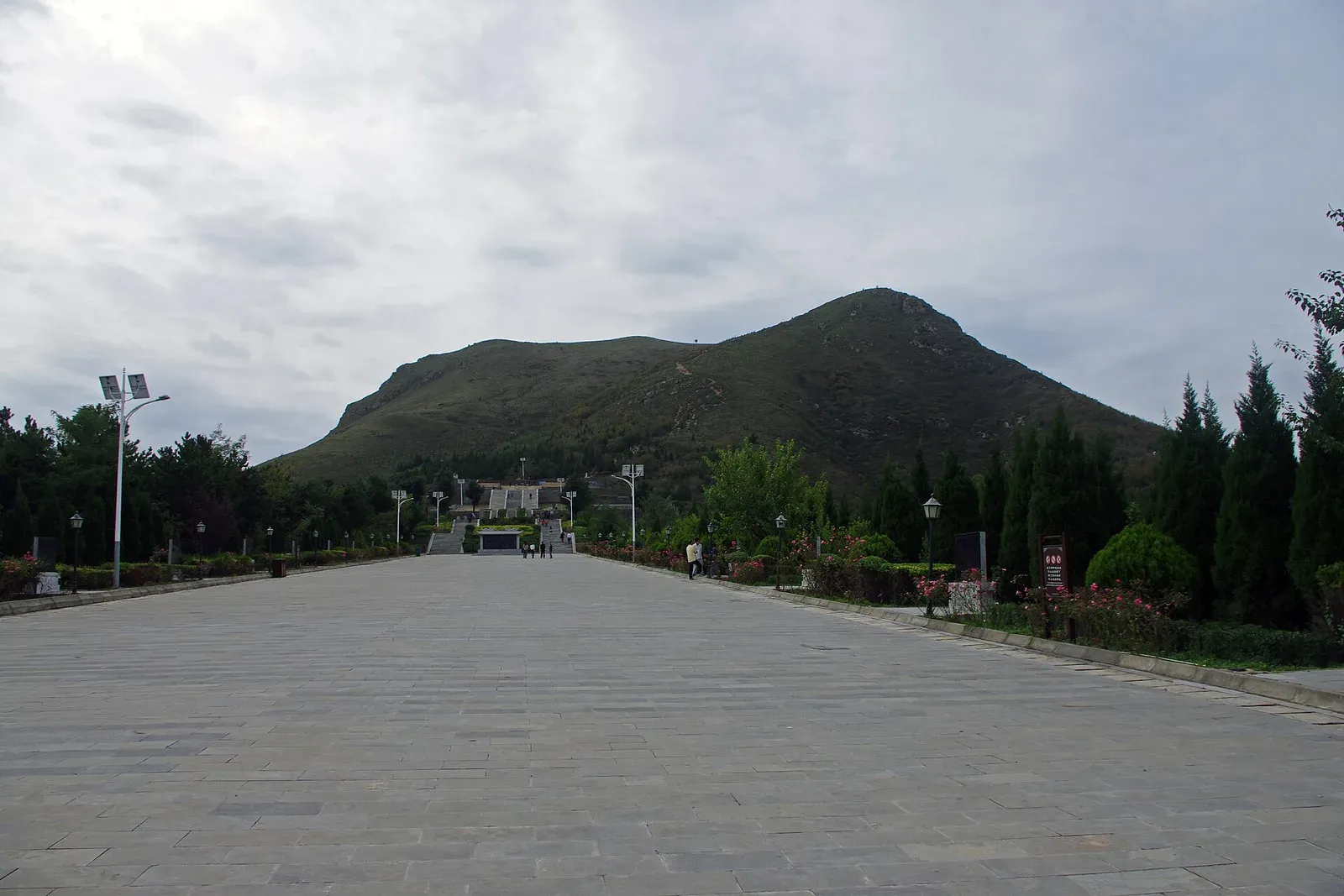
Photo: Acstar / Wikimedia Commons, CC BY-SA 4.0
During his reign from 626 to 649, Taizong of Tang established the peaceful, prosperous Zhenguan era and received the title Heavenly Khagan from northern and western peoples after defeating the Eastern Turks. As the second emperor of the Tang Dynasty, he rests at Zhaoling Mausoleum on Mount Jiuzong in Liquan County, Xianyang, Shaanxi Province. Covering 300,000 mu with a perimeter of 60 kilometers, it is the largest of the eighteen Tang imperial tombs in Guanzhong. A visit mainly covers two areas: the Zhaoling Museum before the tomb of Li Ji and the Mount Jiuzong tomb mountain, with a recommended stay of 2 to 3 hours.
| Item | Practical details |
|---|---|
| Recommended visit time | 2 to 3 hours |
| Zhaoling Museum ticket | From 37 RMB |
| Mount Jiuzong tomb mountain ticket | From 29.9 RMB |
| Opening hours | 08:30 to 18:00 (ticket sales and entry stop at 17:30) |
| Location | Mount Jiuzong, 22 km northeast of Liquan County, Xianyang, Shaanxi Province |
| Inquiry phone | 029-35767009 |
What were the key turning points in the life of Taizong of Tang?
Emperor Taizong, born Li Shimin on January 28, 598, in Wugong (now Wugong County, Xianyang, Shaanxi), died on July 10, 649, as the second emperor of the Tang Dynasty. During the Battle of Luoyang in the reunification wars of the early Tang, he personally led a vanguard force of about 1,000 elite Xuanjia cavalrymen in black robes and iron armor, assisted by generals such as Qin Shubao, Yuchi Jingde, and Cheng Zhijie to break the enemy lines.
On July 2, 626 (the fourth day of the sixth lunar month in the ninth year of the Wude era), Li Shimin, then Prince of Qin, launched the Xuanwu Gate Incident at the north gate of Taiji Palace in Chang'an. Li Shimin personally shot and killed Crown Prince Li Jiancheng, while Yuchi Jingde shot and killed Li Yuanji, Prince of Qi. After ascending the throne, the emperor governed with diligence and vigor. In 643 (the seventeenth year of the Zhenguan era), he commissioned court painter Yan Liben to paint portraits of twenty-four founding contributors to hang in Lingyan Pavilion, remembered in history as the Twenty-Four Meritorious Officials of Lingyan Pavilion.
| Time | Historical event | Key figures and scale |
|---|---|---|
| January 28, 598 | Born in Wugong (now Wugong County, Xianyang, Shaanxi) | Second emperor of the Tang Dynasty |
| During the Battle of Luoyang | Personally led the elite Xuanjia cavalry as the vanguard | About 1,000 soldiers wearing black robes and iron armor, assisted by Qin Shubao, Yuchi Jingde, and Cheng Zhijie |
| July 2, 626 | Launched the Xuanwu Gate Incident at the north gate of Taiji Palace | Li Shimin shot Crown Prince Li Jiancheng; Yuchi Jingde shot Prince of Qi Li Yuanji |
| 626 to 649 | Reigned and ushered in the "Reign of Zhenguan" | Honored as "Heavenly Khagan" by northern and western regions' ethnic groups after defeating the Eastern Turks |
| 643 | Commissioned Yan Liben to paint portraits of twenty-four founding contributors | Hung in Lingyan Pavilion, known in history as the Twenty-Four Meritorious Officials of Lingyan Pavilion |
| July 10, 649 | Passed away | Reign lasted from 626 to 649 |
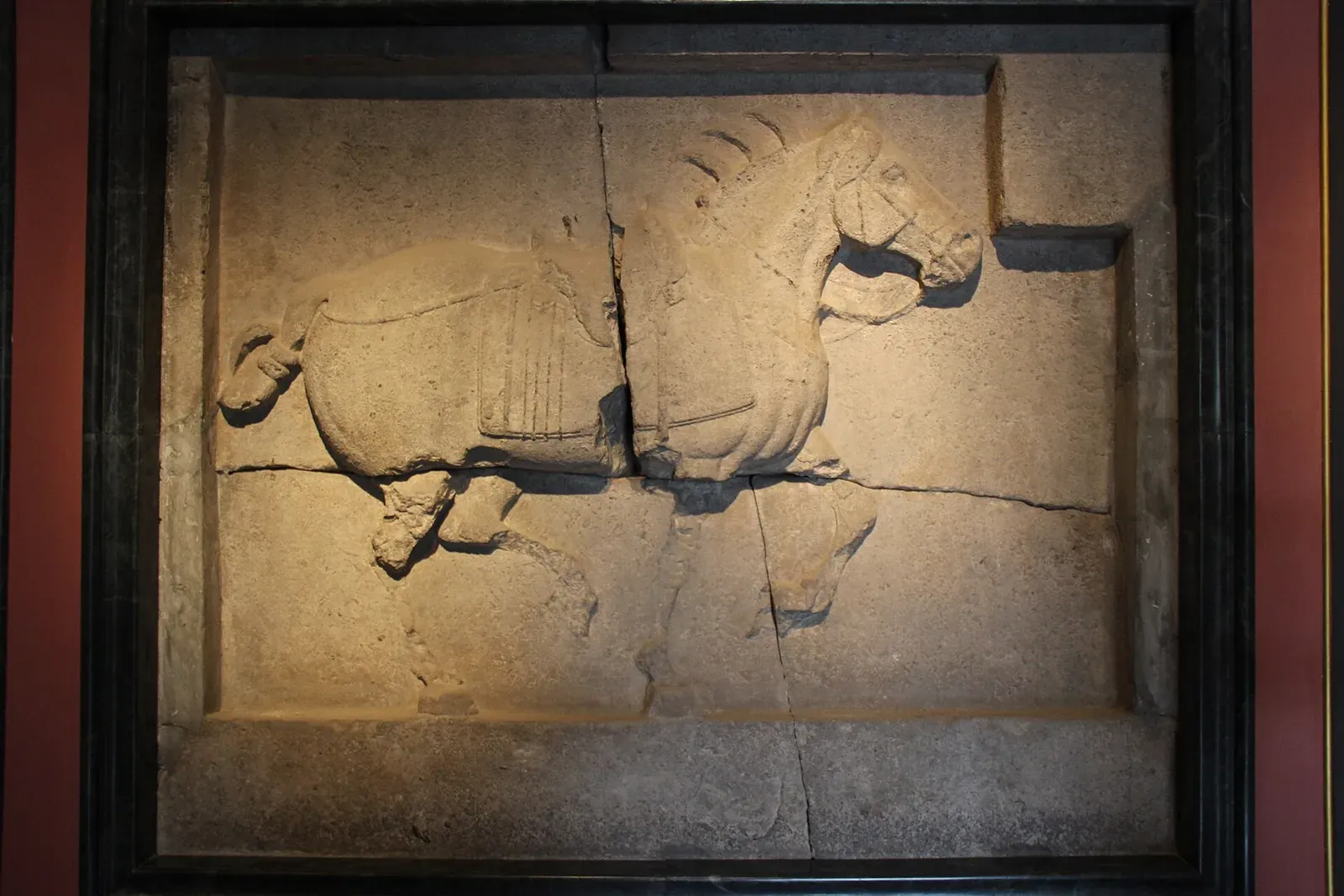
Picture the scene during the Battle of Luoyang: Li Shimin rode at the front of 1,000 black-robed, iron-armored Xuanjia cavalry into enemy ranks. Those harrowing moments when his warhorses took arrows in battle were later carved directly into the stone reliefs at the North Sima Gate altar of Zhaoling.
Why did Zhaoling pioneer the tradition of carving imperial tombs into mountains?
Located 22 kilometers northeast of Liquan County in Xianyang, Zhaoling Mausoleum set a precedent for Tang imperial burials by cutting the tomb directly into a natural mountain. Its main peak stands at an altitude of 1,188 meters, facing the Zhongnan Mountains of the Qinling range across the Guanzhong Plain to the south. The mountain takes its name from nine small ridges evenly arranged around the isolated peak, as the ancient word zong referred to small mountain ridges.
Construction of Zhaoling began in 636 (the tenth year of the Zhenguan era), carved out to bury Empress Zhangsun, who requested on her deathbed to be buried into the mountain without an earthen mound. Renowned Tang craftsmen and brothers Yan Lide and Yan Liben planned and designed the cemetery, mirroring the urban layout of Chang'an with its palace city, imperial city, and outer city. The underground chamber was cut into the southern slope halfway up Mount Jiuzong, initially reached by a 400-meter (230-step) wooden trestle path. The chamber extends 75 zhang deep and was sealed behind five stone gates.

From the burial of Empress Wende in 636 to the twenty-ninth year of the Kaiyuan era under Emperor Xuanzong in 743, construction across Zhaoling lasted 107 years. In March 1961, the State Council of China listed Zhaoling Mausoleum among the first batch of Major Historical and Cultural Sites Protected at the National Level.
Tip: Mount Jiuzong rises 1,188 meters with steep slopes, so wear slip-resistant shoes and carry plenty of water if you plan to hike to the summit ruins.
Where are the Six Steeds of Zhaoling and the statues of foreign rulers today?
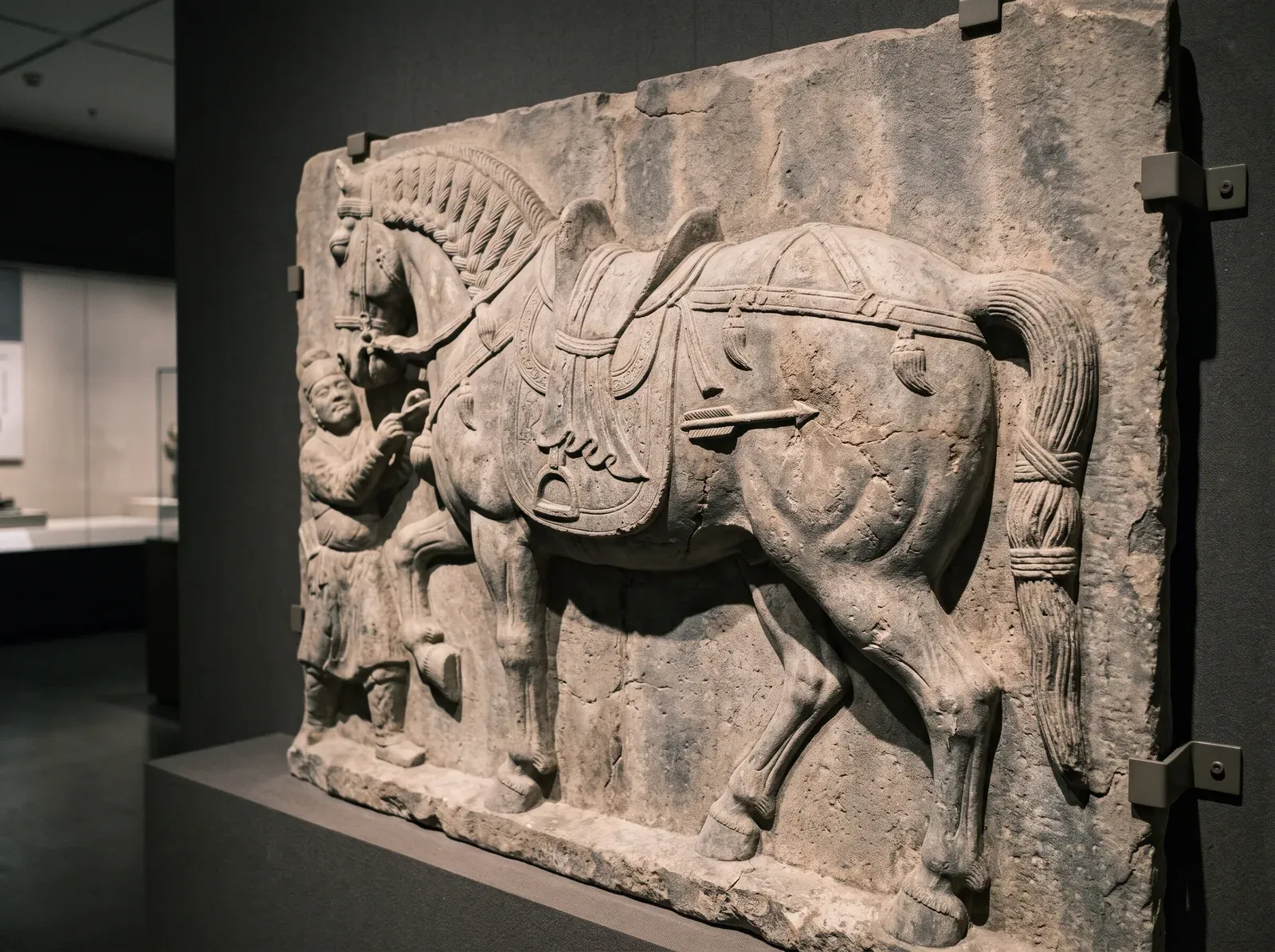
The Six Steeds of Zhaoling are a set of large high-relief stone carvings of warhorses originally set inside the Xuanwu Gate of the mausoleum. Today, two are housed in the Penn Museum in the United States, while the other four originals reside in the Forest of Stone Steles Museum in Xi'an. Each relief was carved from a single slab of rectangular limestone, measuring about 2.04 to 2.07 meters wide and 1.65 to 1.72 meters high.
The reliefs originally stood on an altar inside the northern Xuanwu Gate of Zhaoling. Along the west corridor from south to north stood Saluzi (Autumn Dew), Quanmaogua (Curly), and Baiti'wu (White Hoof). Along the east corridor from south to north stood Teqinbiao (Tegin's Bay), Qingzhui (Green-black Piebald), and Shifachi (Persian Red), with all six horse heads turned south toward the tomb mountain. Saluzi, now in the Penn Museum, measures about 1.69 meters high, 2.06 meters wide, and 0.40 meters thick. It is the only relief in the set featuring a human figure, capturing the moment general Qiu Xinggong pulled an arrow from the wounded steed and offered his own horse to Li Shimin during battle against Wang Shichong.
In the early reign of Emperor Gaozong, stone statues of fourteen foreign rulers were erected inside the Sima Gate at the northern Xuanwu Gate altar, including Turkic Khagans Illig and Tolis, Ashina She'er, Tibetan King Songtsen Gampo, and Queen Jindeok of Silla. In 1089, Northern Song official You Shixiong surveyed Zhaoling and commissioned the Stele of the Six Steeds of Zhaoling, measuring 277 centimeters high and 106 centimeters wide. This stele was moved into the Zhaoling Museum in 1975.
| Relief name | Original altar position at Xuanwu Gate | Current location | Artistic and historical features |
|---|---|---|---|
| Saluzi | First piece from south to north, west corridor | Penn Museum, United States | Only relief with a human figure; Qiu Xinggong pulls arrow and gives his horse |
| Quanmaogua | Second piece from south to north, west corridor | Penn Museum, United States | High relief on single limestone slab, horse head facing south toward the mountain |
| Baiti'wu | Third piece from south to north, west corridor | Forest of Stone Steles Museum, Xi'an | Limestone high relief, about 2.04 to 2.07 meters wide and 1.65 to 1.72 meters high |
| Teqinbiao | First piece from south to north, east corridor | Forest of Stone Steles Museum, Xi'an | Limestone high relief, horse head facing south toward Mount Jiuzong |
| Qingzhui | Second piece from south to north, east corridor | Forest of Stone Steles Museum, Xi'an | High relief of a warhorse carved from a single slab of limestone |
| Shifachi | Third piece from south to north, east corridor | Forest of Stone Steles Museum, Xi'an | High relief of a warhorse carved from a single slab of limestone |
If you want to see the four original horse reliefs remaining in China during a Shaanxi trip, head to the Forest of Stone Steles Museum in Xi'an. If you are on site at the Zhaoling Museum in Liquan, focus on the Stele of the Six Steeds carved under You Shixiong in 1089.
What makes Wei Zheng's tomb and the companion tombs unique?
In the eleventh year of the Zhenguan era, an imperial edict designated Mount Jiuzong as the royal burial site and encouraged meritorious officials and imperial relatives to be buried alongside. Over 200 companion tombs were built around Zhaoling, including those of Wei Zheng, Fang Xuanling, and Li Jing. Among them, the closest consort tomb to Mount Jiuzong is Noble Consort Wei's tomb, and the closest official's tomb is Wei Zheng's tomb. These two are the only companion tombs carved directly into the mountain.
The mounds of several celebrated generals reflect their battlefield feats. Li Jing's burial mound was shaped like Yinshan and Jishishan; Li Ji's mound mirrored Yinshan, Tieshan, and Mount Wudejian (Mount Otukan); Ashina She'er's mound mimicked Congshan (the Pamir Mountains); and Li Simo's mound was shaped like Baidaoshan. Princess Changle's companion tomb lies just across a gully from the main mausoleum. Her underground passage extends 48.18 meters, featuring vertical shafts, corridors, niches, a passageway, the burial chamber, and detailed Tang wall murals on both sides.
| Tomb owner | Mound and tomb structure | Tomb location and highlights |
|---|---|---|
| Wei Zheng | Carved into the mountain | Closest official tomb to the main peak of Mount Jiuzong |
| Noble Consort Wei | Carved into the mountain | Closest consort tomb to the main peak of Mount Jiuzong |
| Li Jing | Modeled after Yinshan and Jishishan | Some companion tombs of meritorious officials had mounds raised according to military feats |
| Li Ji | Modeled after Yinshan, Tieshan, and Mount Wudejian | Zhaoling Museum is built in front of the tomb |
| Ashina She'er | Modeled after Congshan | Some companion tombs of meritorious officials had mounds raised according to military feats |
| Li Simo | Modeled after Mount Baidao | Some companion tombs of meritorious officials had mounds raised according to military feats |
| Princess Changle | Underground tomb passage with a total length of 48.18 meters | Separated from the mausoleum by just a gully, featuring shafts, corridors, niches, a passage, a burial chamber, and murals |
What national treasures and exhibition halls are in Zhaoling Museum?
Zhaoling Museum stands in front of the tomb of founding general Li Ji (also known as Xu Maogong), 15 kilometers east of Liquan County seat and about 11 kilometers south of Mount Jiuzong's main peak. A cultural heritage management office was established at Li Ji's tomb in 1972, which became the museum in 1978.
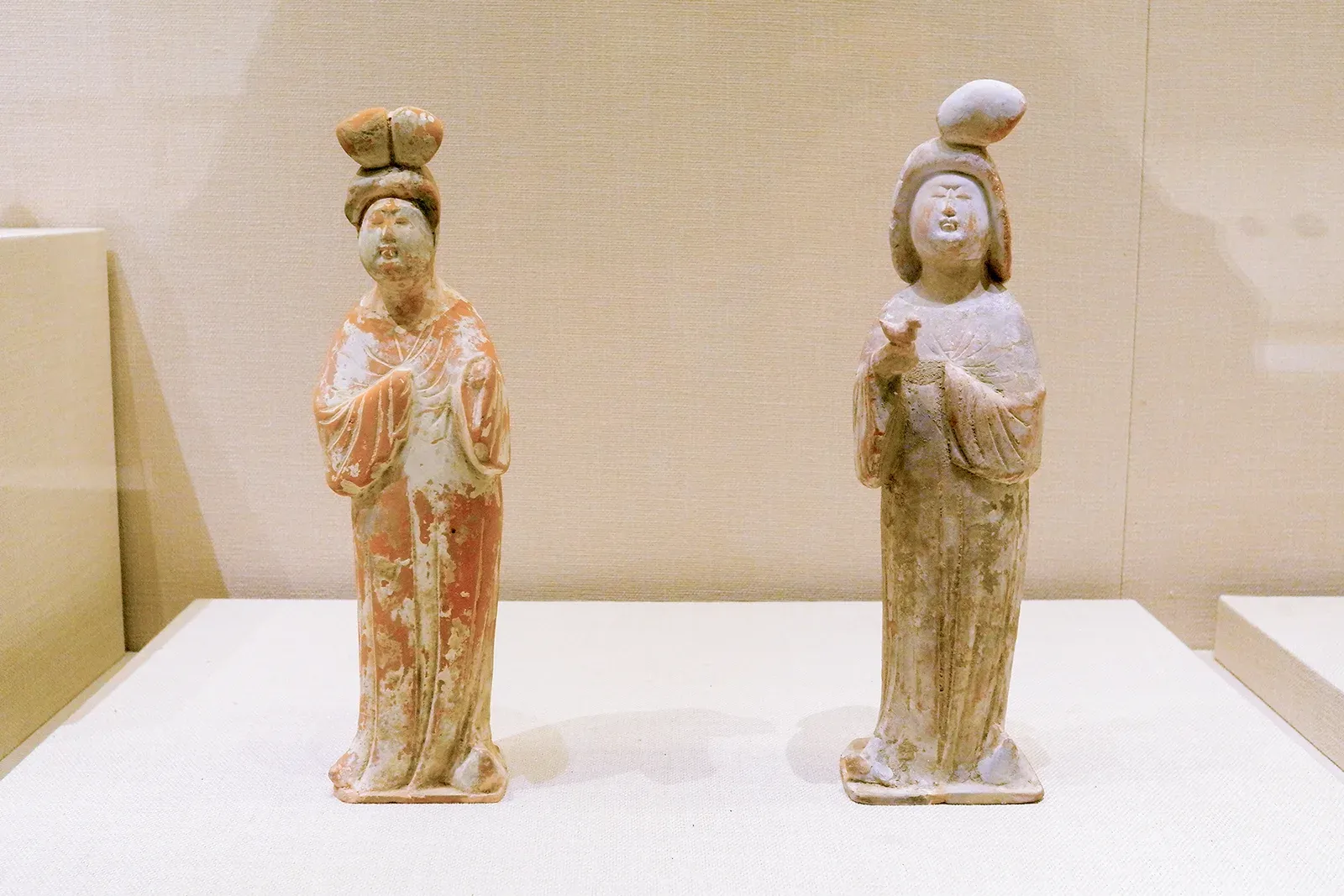
The museum holds over 8,000 cultural relics across four main exhibition areas: the Relics Exhibition Room, the Tang Murals Room, and two Stone Stele Rooms (known as the Zhaoling Forest of Steles). Among its rarest pieces, the gilded, painted pottery figures of civil and military officials unearthed from Zhang Shigui's tomb are designated as national treasures. Official opening hours are 8:30 to 18:00, and the inquiry and ticketing phone number is 029-35767009.
Tip: The two stone stele halls house tombstones and epitaphs of early Tang dignitaries featuring authentic calligraphy by historical masters, so budget at least 1 hour if you want to examine the carvings.
What is easy to mix up on your first visit to Zhaoling?
The most common mistake for first-time visitors is assuming that Zhaoling Museum is where the main underground palace sits. In reality, the museum sits in Yanxia Town before the tomb of Li Ji. The North Sima Gate ruins on the main peak of Mount Jiuzong are about 11 to 14 kilometers away along winding mountain roads. The two locations operate separately and require separate tickets.
To reach Zhaoling Museum by public transit, take an express bus from Xi'an West Bus Station to Liquan (about 1 hour), then transfer at the Li Shimin statue to a local bus heading toward Beitun. To continue to the Mount Jiuzong peak, hiring a local car for a round trip costs around 60 RMB. Because the site spans a vast mountain area with infrequent bus connections, driving yourself or having your travel designer arrange a private car with your driver from downtown Xi'an saves considerable hassle.
| Travel leg | Route and transfer points | Reference time and cost |
|---|---|---|
| Xi'an to Liquan | Take the expressway bus to Liquan from Xi'an West Bus Station | Travel time is about 1 hour |
| Liquan to Zhaoling Museum | Transfer to the Beitun-bound shuttle bus at the Li Shimin statue | Public transport connecting services are limited |
| Zhaoling Museum to Mount Jiuzong mausoleum mountain | About 14 km from Zhaoling Museum to Mount Jiuzong; hire a round-trip car | Reference round-trip cost is about 60 RMB |
Tip: There is no scheduled public bus between Zhaoling Museum and the Mount Jiuzong peak, so if you hire a local driver in front of Li Ji's tomb, agree on pickup times and the return meeting spot before setting off.
Sources
Emperor Taizong of Tang - Wikipedia
Zhaoling (Tang dynasty) - Wikipedia
Six Steeds of Zhao Mausoleum - Wikipedia
Xuanwu Gate Incident - Wikipedia
Mount Jiuzong - Wikipedia
Zhongyuan Guoxue Forum: Li Langtao on the Flourishing Tang and Zhaoling Museum
Sources verified as of November 18, 2026
FAQ
Can you still see the original Six Steeds at the Zhaoling ruins?
No, the original Six Steeds are not kept at the Zhaoling site. Two of the reliefs, Saluzi and Quanmaogua, are in the Penn Museum in the United States, while the other four originals reside in the Forest of Stone Steles Museum in Xi'an. The Zhaoling Museum houses the Stele of the Six Steeds commissioned by Northern Song official You Shixiong in 1089.
Do Zhaoling Museum and the Mount Jiuzong tomb share a single admission ticket?
No, the two sites sell admission separately. Reference ticket prices start from 37 RMB for Zhaoling Museum and from 29.9 RMB for the Mount Jiuzong tomb site. Because the two spots sit about 11 to 14 kilometers apart, you can purchase tickets individually depending on your schedule.
How much time should you plan for a trip from downtown Xi'an to Zhaoling?
Spending 2 to 3 hours at the sites is recommended. An express bus from Xi'an West Bus Station to Liquan County takes about 1 hour, and when you factor in transferring to local buses and traveling between the museum and the mountain, you should set aside most of a day or a full day for the round trip.
Why is Zhaoling considered the largest of the eighteen Tang imperial tombs in Guanzhong?
In 637, an imperial edict designated Mount Jiuzong as the royal burial site and encouraged high officials and imperial kin to build companion tombs nearby. The entire cemetery spans 300,000 mu with a perimeter of 60 kilometers, containing over 200 companion graves including those of Wei Zheng, Fang Xuanling, and Li Jing. With construction lasting 107 years, it ranks as the largest imperial cemetery among the eighteen Tang tombs in Guanzhong.