
Huashan Mountain Day Trip from Xi'an: Cable Car Routes
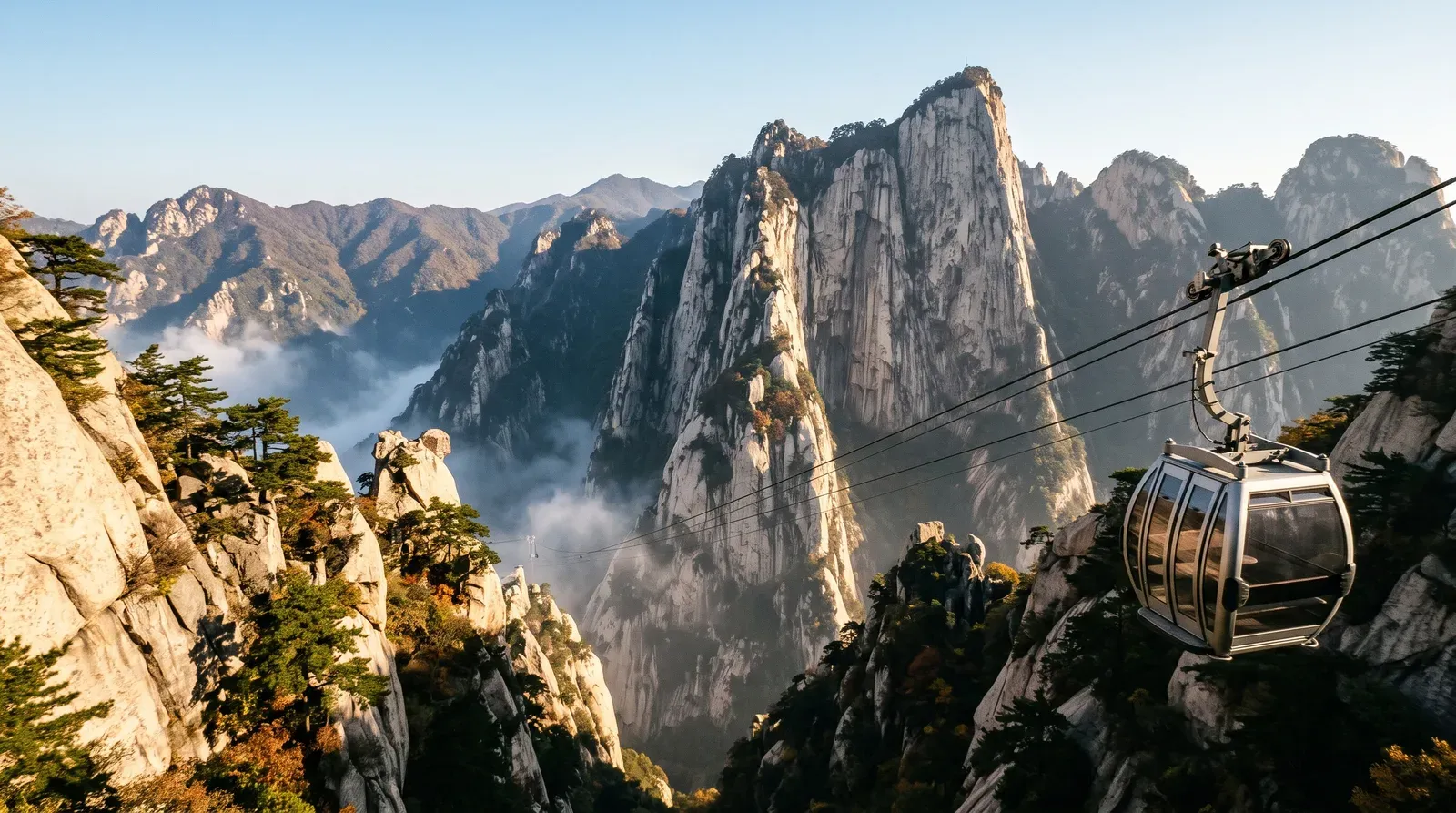
Huashan Mountain sits about 120 kilometers east of downtown Xi'an. Riding the cable cars to explore the main peaks takes 5 to 6 hours, making a round trip in a single day very manageable. Hiking all five peaks on foot usually takes around 24 hours, so taking the cable car up and down is the primary way for day trippers to balance time and physical effort.
How do you connect high-speed trains and local transport from Xi'an?
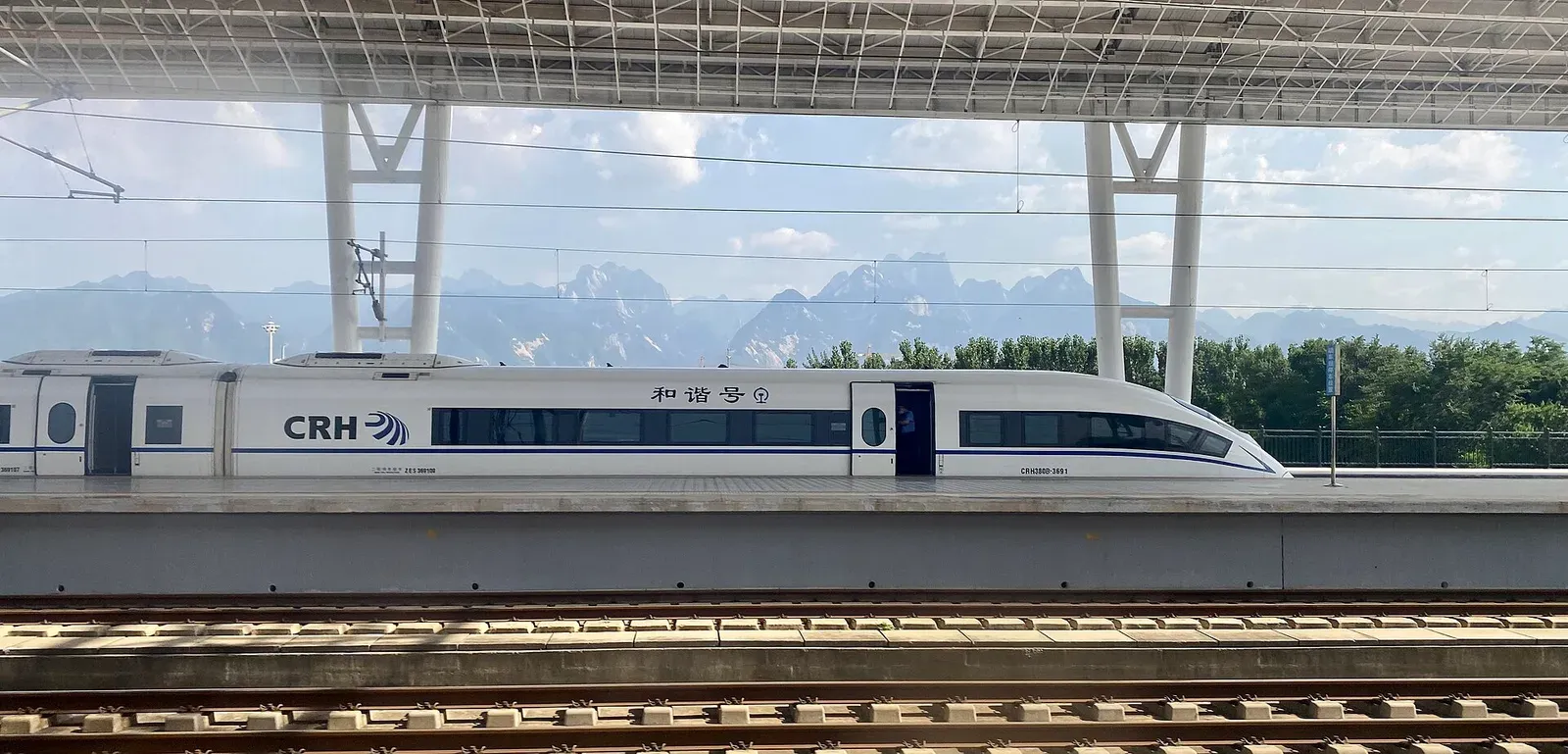
The most convenient way to reach Huashan from downtown Xi'an is taking a high-speed train from Xi'an North Railway Station (西安北站) to Huashan North Railway Station (华山北站). As the largest railway station in Northwest China, Xi'an North has 34 platform faces and connects to Xi'an Metro Lines 2, 4, and 14.
Huashan North Railway Station is located in Huayin City, Shaanxi Province, and operates as a second-class passenger station on the Xuzhou-Lanzhou High-Speed Railway. It sits about 5.3 kilometers from the Huashan Scenic Area. After exiting the station, you can transfer to ground shuttle vehicles to reach the Huashan Visitor Center and enter the mountain.
Tip: Take Metro Line 2, 4, or 14 directly to Xi'an North Station to catch your high-speed train; once you arrive at Huashan North Station, switch to ground transport to travel the 5.3 kilometers to the scenic area and start your visit.
What are the highlights and elevations of Huashan's five main peaks?
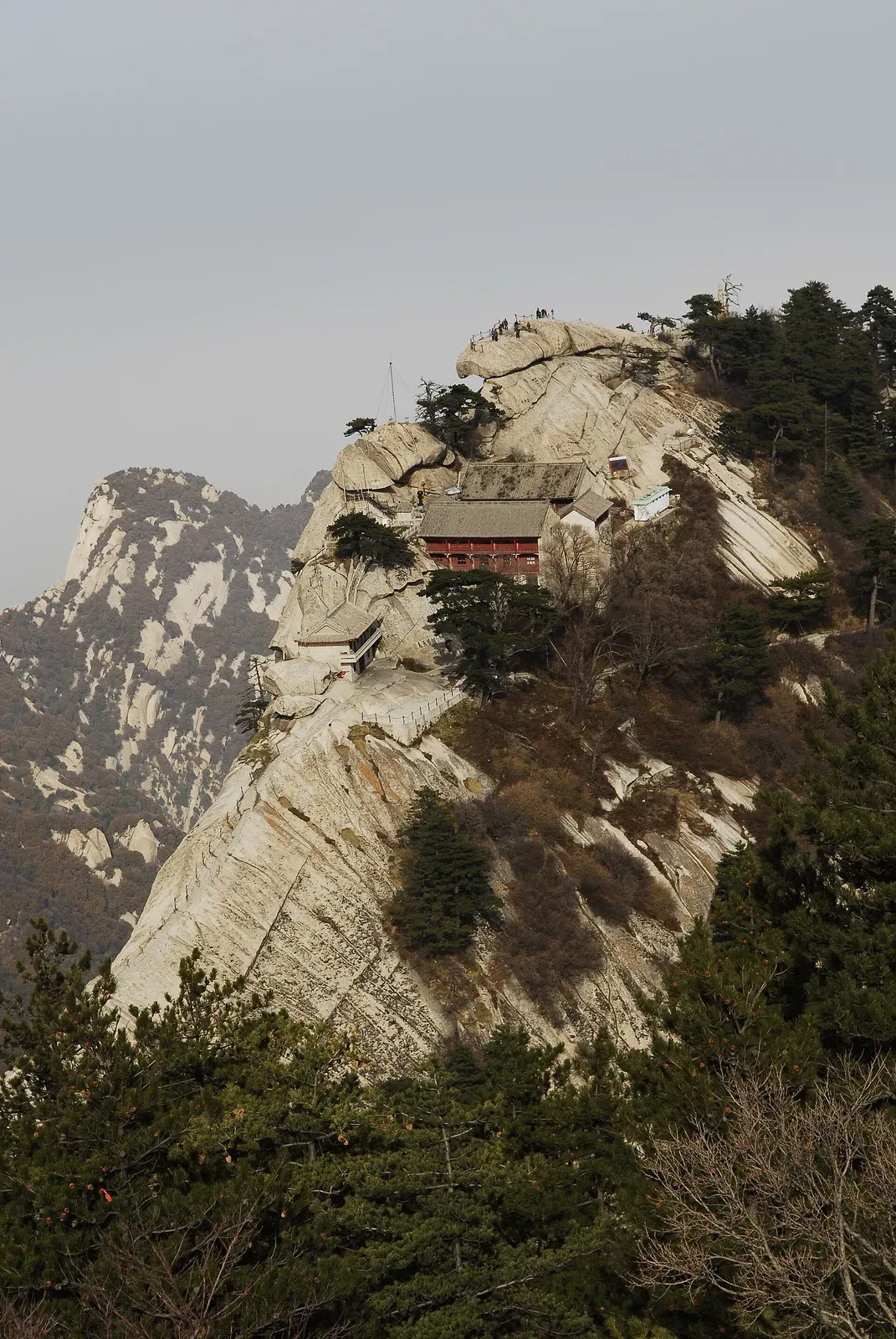
Huashan has five main peaks: East Peak (Chaoyang), West Peak (Lianhua), Middle Peak (Yunu), South Peak (Luoyan), and North Peak (Yuntai). South Peak is the highest summit of Huashan at an elevation of 2,154.9 meters, and an ancient Taoist temple at its top was converted into an alpine teahouse in modern times.
West Peak stands at 2,082 meters and resembles a lotus blossom, making it the most graceful and scenic peak on the mountain. At its summit stands the Axe-Split Rock (Fupi Shi), split into three sections, which folk legend calls the place where Chenxiang cleaved the mountain to rescue his mother. North Peak stands at 1,614.7 meters and serves as an important junction connecting the other peaks. East Peak is the finest spot for watching the sunrise and has a hotel where visitors can stay overnight.
| Peak Name | Alternative Name | Elevation | Key Sights and Highlights |
|---|---|---|---|
| South Peak | Luoyan Peak | 2,154.9 meters | Highest summit of Huashan, ancient Taoist temple on top converted into an alpine teahouse |
| West Peak | Lianhua Peak | 2,082 meters | Lotus-shaped peak with striking scenery, summit features Axe-Split Rock from the Chenxiang legend |
| North Peak | Yuntai Peak | 1,614.7 meters | Key hub connecting to the other four peaks, links with traditional hiking trails |
| East Peak | Chaoyang Peak | / | Premier spot for watching the sunrise, summit features a hotel for overnight guests |
| Middle Peak | Yunu Peak | / | One of Huashan's five main peaks, surrounded by the other summits |
If you want to reach the highest point and admire the most graceful peaks, focus your visit on South Peak at 2,154.9 meters and West Peak at 2,082 meters. If you plan to stay overnight on the mountain to watch the morning sunrise, head to the hotel on East Peak.
Which cable car route saves the most energy on a Huashan Mountain day trip?
Rising on the north side of the Qinling Mountains, the mountain is a massive granite formation measuring about 15 kilometers east to west and about 10 kilometers north to south. Sheer precipices drop thousands of feet, shaped by fault displacement and water erosion into sheer cliff faces on all four sides. Hiking through all five peaks takes around 24 hours on foot, while touring the core peaks by cable car takes only 5 to 6 hours.
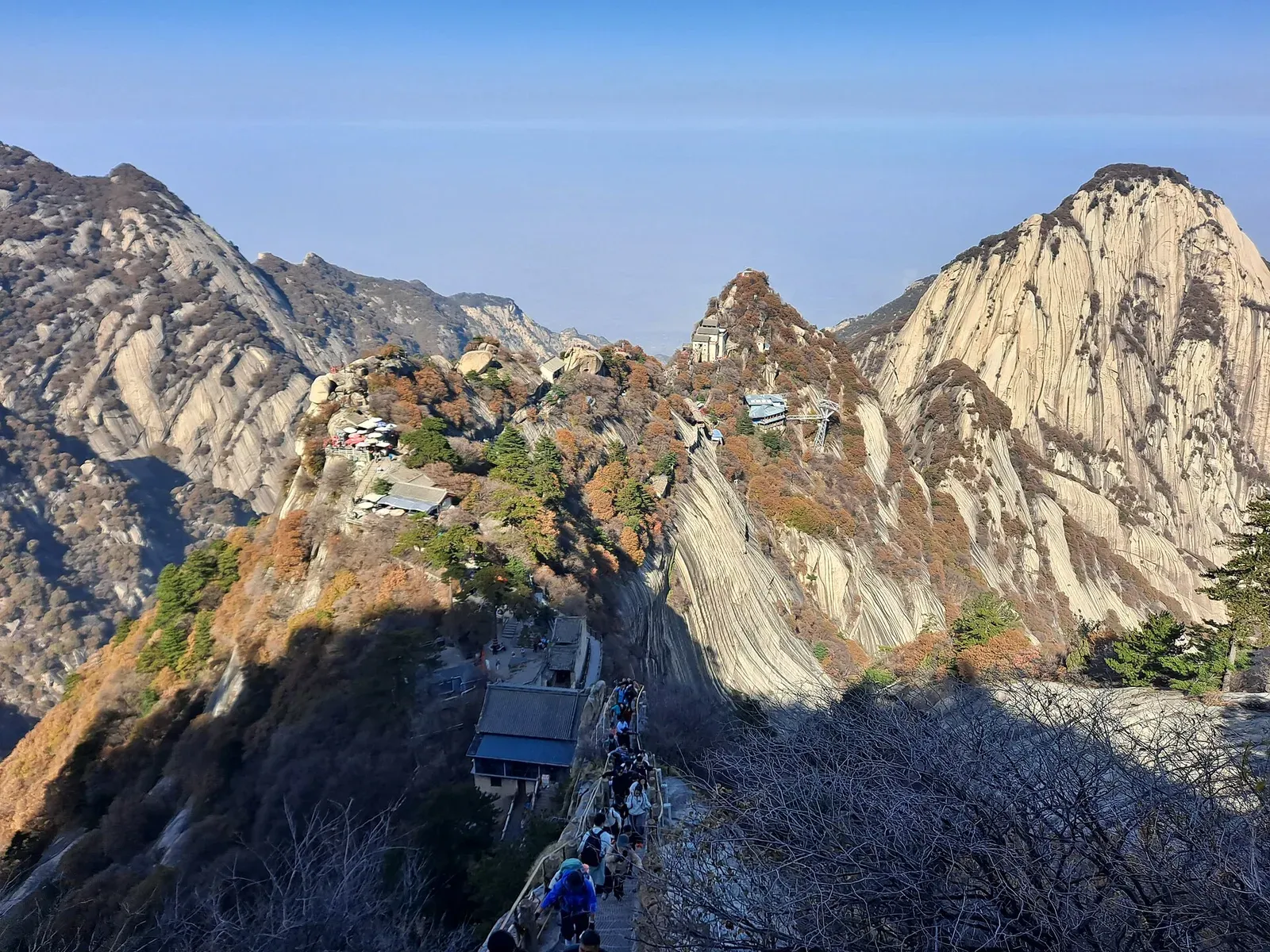
Reaching the other four main peaks from North Peak requires climbing more than 300 meters along the narrow ridge of Canglong Ridge (Black Dragon Ridge). To ease foot-traffic bottlenecks on this perilous ridge, the scenic area built a new bypass trail on the east side of Canglong Ridge in 1998.
If you prefer to minimize continuous uphill climbing, take the West Peak cable car up first to explore West Peak and the South Peak summit, follow the downhill slope to East Peak and Middle Peak, and then descend along Canglong Ridge to take the North Peak cable car down. If you want the thrill of climbing up along the exposed ridge, you can hike upward from North Peak along Canglong Ridge.
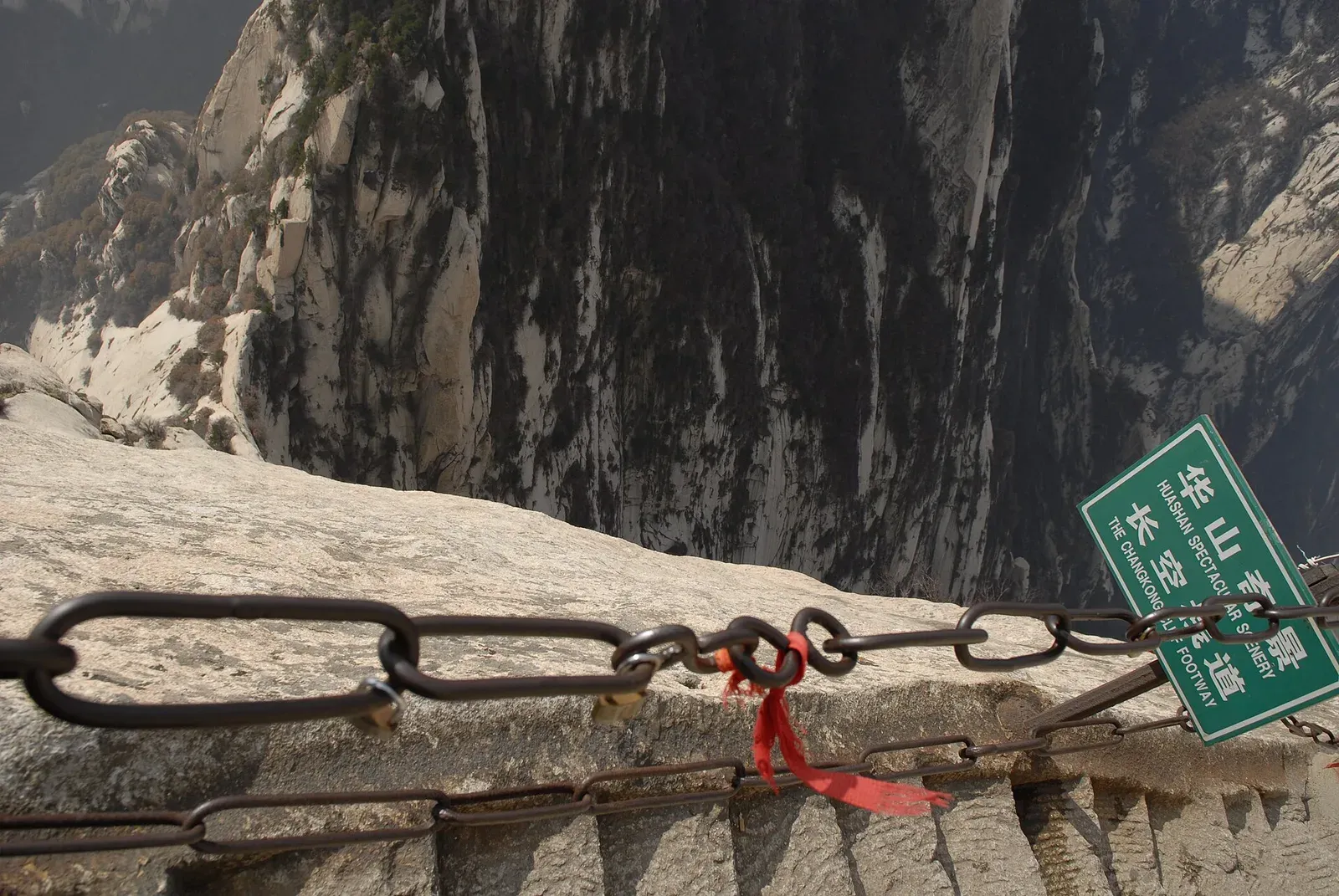
Walking along the narrow knife-edge ridge of Canglong Ridge, you look down at sheer precipices on both sides as hikers grip the metal safety chains with both hands to step down carefully. The eastern bypass trail built in 1998 pairs with the original trail to form a one-way circulation loop, reducing two-way congestion along the narrow ridge.
What safety rules apply when crossing the Plank Walk in the Sky and steep sections?
Huashan is renowned for its precipitous terrain, including Qianchi Chuang (Thousand-Foot Precipice), Baichi Xia (Hundred-Foot Gorge), Canglong Ridge, Yaozi Fanshen (Sparrow Hawk Turning), and the Plank Walk in the Sky (Changkong Zhandao), earning it the reputation as the most perilous mountain under heaven. The traditional trail links key highlights such as Qianchi Chuang, Baichi Xia, the Chaoyang Terrace on East Peak, Yaozi Fanshen, Chess Pavilion, Nantianmen (South Heavenly Gate), the Plank Walk in the Sky, the summit of South Peak, and Axe-Split Rock on West Peak.
To reduce climbing danger, park authorities widened stone stairways, installed protective metal guard chains, and introduced one-way circulation systems on sections with extreme exposure.
Tip: Follow the park's one-way flow rules strictly when passing extreme sections like Canglong Ridge, Yaozi Fanshen, or the Plank Walk in the Sky, and keep both hands on the metal safety chains along steep stone stairs and cliffside paths.
What is the weather like on Huashan, and what clothes do you need for a day trip?
The annual average temperature on Huashan is 6.5°C, and annual average precipitation is about 776.1 millimeters. Due to high elevation, summit temperatures are noticeably cooler than on the Guanzhong Plain. July, the warmest month, averages around 17.8°C, while January, the coldest month, averages about -5.7°C.
If you visit for a day trip in midsummer during July, daytime summit temperatures average around 17.8°C, feeling pleasantly cool. If you go in deep winter during January, temperatures drop to around -5.7°C, and the stone steps along the cliffs often freeze over.
Tip: With an annual average temperature of just 6.5°C, bring a windproof jacket even in midsummer for the summit winds and temperature swings; pack warm winter layers in autumn and winter, along with non-slip gloves to grip cold iron chains.
Which historic sites at the foot of Huashan are worth visiting along the way?
Beyond its dramatic natural landscape, historical and cultural relics stand at the foot of the mountain. Yuquan Courtyard (玉泉院), dedicated to the Taoist sleeping immortal Chen Tuan, sits at the base and serves as the essential starting point for the traditional hiking trail.
Xiyue Temple, located north of the mountain base, was first built in 134 BC during the first year of Yuanguang in the Western Han Dynasty. Covering 186 mu, it was the imperial temple where Chinese emperors worshipped the mountain god of Western Peak Huashan. Huashan was designated among the first batch of National Key Scenic Spots in 1982, covering a sightseeing area of about 150 square kilometers.
Strolling into Xiyue Temple before or after your mountain hike, the grand halls founded in 134 BC display imperial temple architecture across 186 mu, with yellow roof tiles and red walls set against ancient cypresses, while Huashan's main peaks loom in the distance.
When might you need to adjust cable car plans for a Huashan day trip?
Because of Huashan's sheer precipices and thousand-foot cliffs, high-altitude cable cars and exposed trails are vulnerable to changing weather. If the mountain area experiences severe convective winds, thunderstorms, or heavy winter snow, cable car operators may restrict passenger numbers or suspend service for safety.
Since hiking all five peaks takes about 24 hours on foot, day visitors cannot complete a round trip through the core scenic area if cable cars close. Check the local weather forecast for Huayin before setting out, and adjust your schedule promptly if strong winds or thunderstorms arise.
Sources
Xi'an North railway station - Wikipedia
Mount Hua - Wikipedia
Huashan North railway station - Wikipedia
Mount Hua - Wikipedia
Xiyue Temple - Wikipedia
Sources verified on November 17, 2026
FAQ
Can you do a Huashan day trip from Xi'an and return the same day?
Yes, you have plenty of time. Huashan sits about 120 kilometers from downtown Xi'an, and touring the core main peaks by cable car usually takes 5 to 6 hours. Combined with high-speed rail between Xi'an North Station and Huashan North Station, a same-day round trip is very manageable.
What are the benefits of riding the West Peak cable car up and the North Peak cable car down on Huashan?
Taking the West Peak cable car up allows you to directly explore West Peak at 2,082 meters and the South Peak summit at 2,154.9 meters. You can then walk downhill toward East Peak, Middle Peak, and North Peak, avoiding the grueling climb of more than 300 vertical meters along the narrow ridge from North Peak.
What shoes and gear do you need for a Huashan day trip?
Huashan has an annual average temperature of 6.5°C, with July averaging around 17.8°C and January averaging about -5.7°C. For a day trip, wear non-slip, durable sneakers or hiking shoes, bring a windproof and warm jacket, and pack a pair of non-slip gloves for gripping the metal safety chains.
Can you stay overnight on the summit of Huashan to watch the sunrise?
Yes. East Peak (Chaoyang Peak) is the prime location for watching sunrise and has a hotel for overnight guests. If you are on a day trip and not staying overnight, make sure to take the cable car down before it closes to return to Xi'an.
What sacrificial and Taoist heritage sites sit at the foot of Huashan?
At the foot of Huashan stands Yuquan Courtyard, dedicated to the Taoist sleeping immortal Chen Tuan. North of the mountain base lies Xiyue Temple, founded in 134 BC during the first year of Yuanguang in the Western Han Dynasty; covering 186 mu, it served as the national imperial shrine where successive emperors worshipped the sacred Mount Hua.