
Guizhou Travel Guide: Huangguoshu, Fanjingshan, and Miao Villages
When planning a Guizhou travel route, the provincial capital Guiyang usually serves as the main transport hub, linking landmarks such as Huangguoshu Waterfall in Anshun, Fanjingshan in Tongren, and Xijiang Qianhu Miao Village in Qiandongnan. A high-speed train from Guiyang North Station to Anshun West Station takes only about 30 minutes, bringing you to Asia's largest waterfall at 77.8 meters high and 101 meters wide. Supported by the high-speed rail network and regional airports, you can easily connect karst landscapes with ethnic minority villages.
How to Plan a Guizhou Travel Route?
The main scenic spots can be connected smoothly along major high-speed rail lines. Starting from Guiyang, you can take the Shanghai-Kunming High-Speed Railway to Anshun to see Huangguoshu Waterfall, then head to Libo Zhangjiang Scenic Area in Qiannan and Xijiang Qianhu Miao Village in Qiandongnan, before going north to Tongren to visit Fanjingshan. Libo County in Qiannan is served by the Guiyang-Nanning High-Speed Railway, allowing travelers to reach Libo Railway Station directly by train.
If you plan to include northern cities, high-speed trains from Zunyi Railway Station reach Guiyang in less than 1 hour. For the history and climate of northern Guizhou, see the Zunyi city guide. For a loop itinerary, you can choose between Guiyang Longdongbao International Airport and Tongren Fenghuang Airport based on your flights.
| Attraction & Transport Hub | Region & World Heritage Status | Core Geographic & Landscape Data | Transport & Ticket Details |
|---|---|---|---|
| Huangguoshu Waterfall | Anshun City | Waterfall is 77.8 meters high and 101 meters wide (main waterfall is 67 meters high and 83.3 meters wide) | Peak season ticket 160 yuan, off-season 150 yuan; high-speed train from Guiyang North Station to Anshun West Station takes about 30 minutes |
| Fanjingshan | Tongren City (inscribed as a World Natural Heritage Site in July 2018) | Main peak of the Wuling Mountains, with Fenghuang Mountain at a maximum elevation of 2,572 meters, Old Golden Summit at 2,494 meters, and New Golden Summit at 2,336 meters | Accessible via the Shanghai-Kunming High-Speed Railway and Tongren Fenghuang Airport |
| Xijiang Qianhu Miao Village | Foot of Leigong Mountain, Leishan County, Qiandongnan Prefecture | Formed by more than 10 connected natural hamlets, with Miao people accounting for 99.5% of the population | Residences are mainly three-story post-and-tie timber stilt houses, listed as national intangible cultural heritage |
| Libo Zhangjiang Scenic Area | Libo County, Qiannan Prefecture (inscribed as a World Natural Heritage Site in 2007) | Total area of 270 square kilometers (including core scenic areas such as Xiaoqikong and Daqikong) | The Guiyang-Nanning High-Speed Railway serves Libo Railway Station, allowing travelers to arrive directly by train |
| Qianling Park and Jiaxiu Tower | Downtown Guiyang | Qianling Park covers 426 hectares; Jiaxiu Tower was first built in 1598 and rebuilt in 1909 | Qianling Park is free to enter; Guiyang Metro Lines 1 and 2 connect urban hubs |
What Are the Highlights and Ticket Policies for Huangguoshu Waterfall?
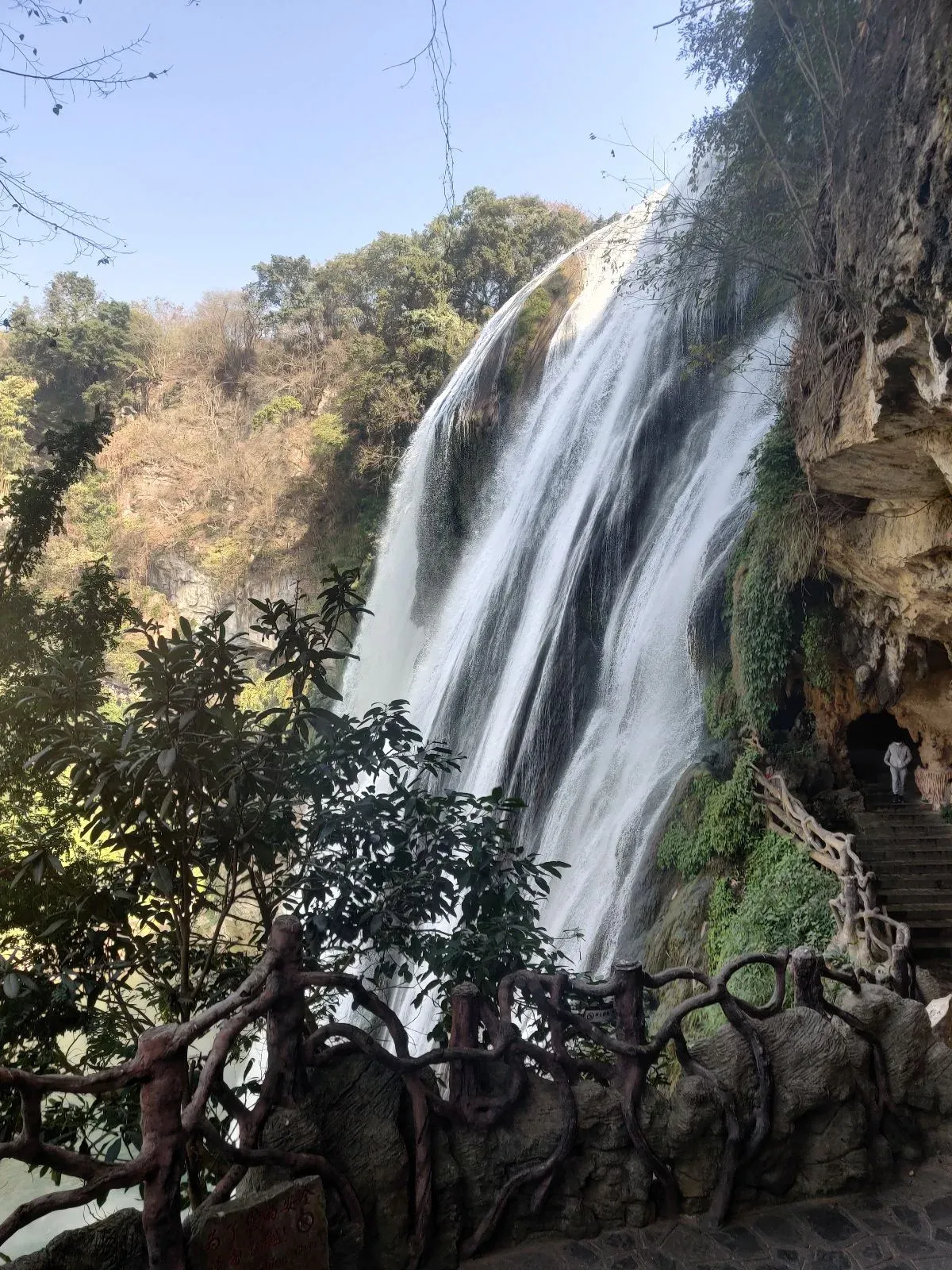
Huangguoshu Waterfall is the largest waterfall in Asia and can be viewed from 360 degrees: above, below, front, back, left, and right. The Water Curtain Cave running behind the waterfall is 134 meters long, with six cave windows for viewing the surging water up close. According to scenic area measurements, a rainbow can be seen above Rhinoceros Pool between 9:00 a.m. and 5:00 p.m. on sunny days.
The scenic area uses seasonal ticket pricing. A peak season ticket for Huangguoshu Waterfall is 160 yuan, while an off-season ticket is 150 yuan. The scenic area sightseeing bus ticket is 50 yuan and remains valid for 3 days. The sightseeing escalator costs 30 yuan one-way and 50 yuan round-trip. For transport, Anshun West Station is an important stop on the Shanghai-Kunming High-Speed Railway, taking about 30 minutes from Guiyang North Station and about 1 hour 40 minutes to 2 hours 15 minutes from Kunming South Station.
What Are the Key Highlights for Summiting and Exploring Fanjingshan?
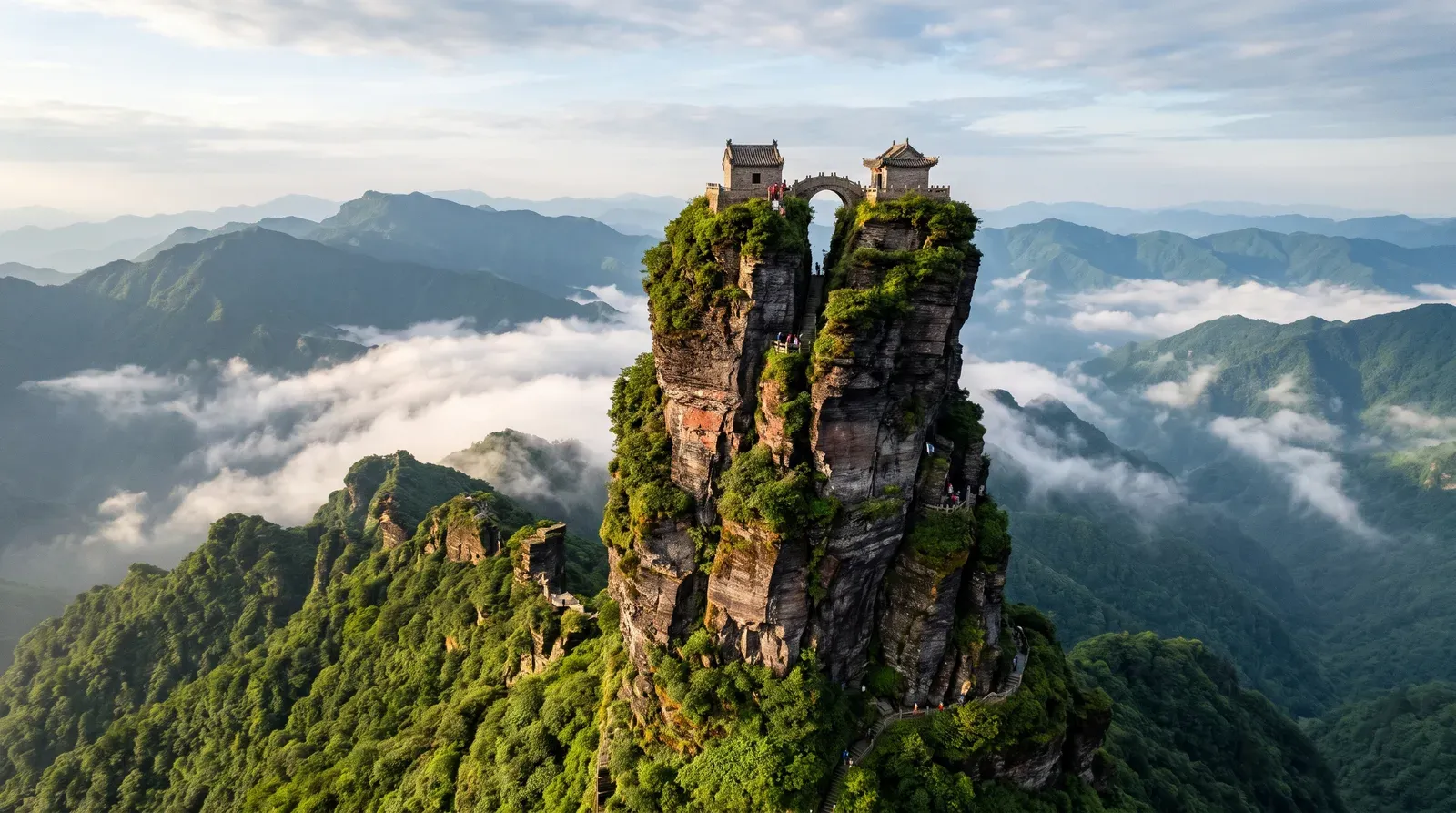
The main attraction of visiting Fanjingshan is the landscape of the primary peak of the Wuling Mountains and ancient geological features. Fanjingshan was inscribed on the World Natural Heritage List in July 2018. Its highest peak, Fenghuang Mountain, reaches an elevation of 2,572 meters. The core sightseeing and pilgrimage areas include Old Golden Summit at 2,494 meters and New Golden Summit at 2,336 meters. Mushroom Stone is about 10 meters tall, composed of sandy slate and quartz sandstone, and has stood with its top-heavy shape for hundreds of millions of years.
Fanjingshan is also an important refuge for endangered wild plants and animals. The Guizhou golden monkey, a first-class protected animal in China, is endemic to Fanjingshan, with a wild population rarer than that of giant pandas, earning it the nickname "only child of the earth." Known as the eastern gateway of the region, Tongren City features both the Shanghai-Kunming High-Speed Railway and Tongren Fenghuang Airport, serving as the main entry point to Fanjingshan.
What Cultural Features Define Xijiang Miao Village and Zhenyuan Ancient Town?
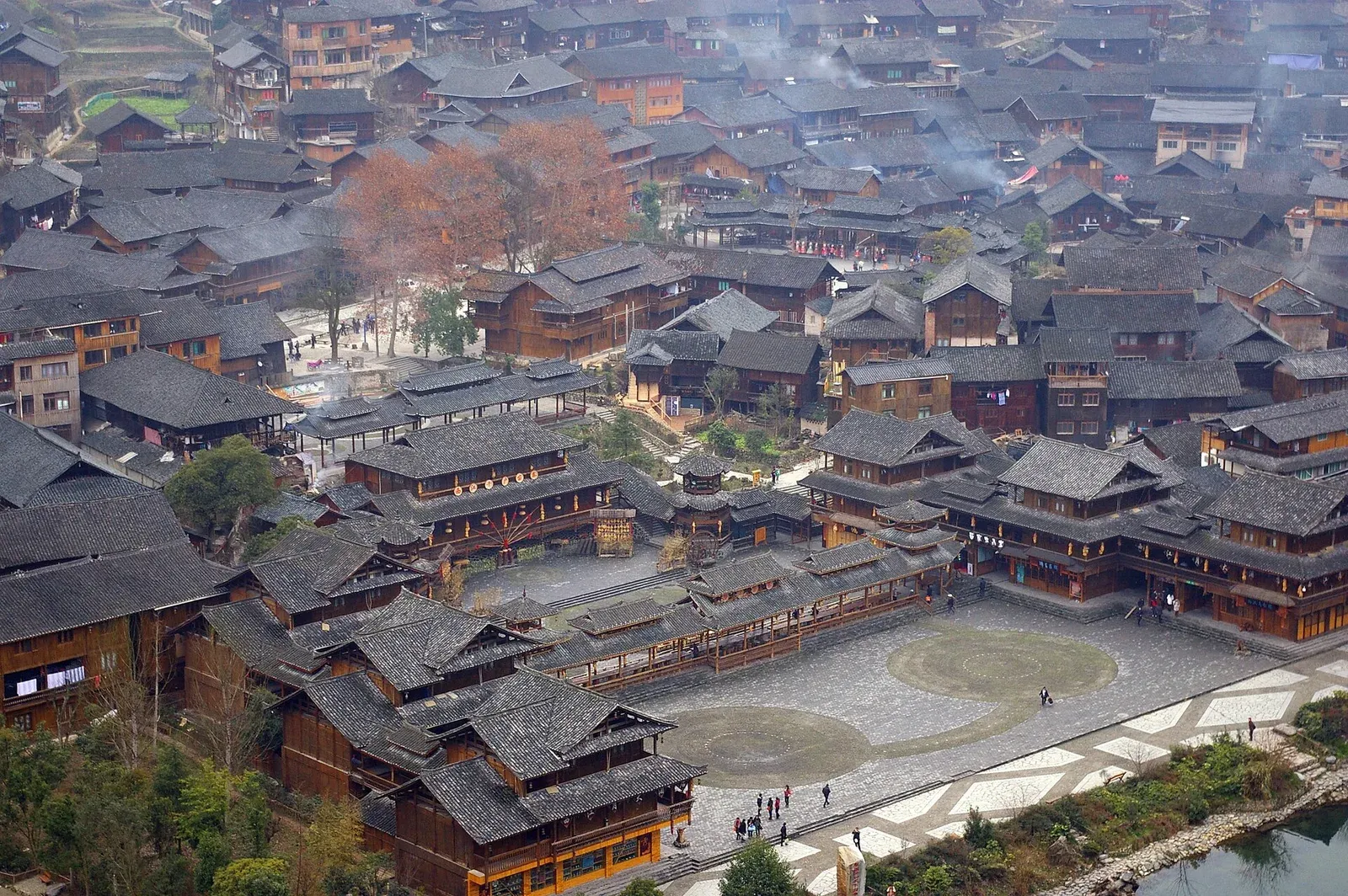
Xijiang Qianhu Miao Village is the largest surviving Miao settlement in China. Located at the foot of Leigong Mountain in Xijiang Town, Leishan County, Qiandongnan Prefecture, it consists of more than 10 hillside hamlets connected together, where Miao people make up 99.5% of the population. The village architecture consists mainly of three-story post-and-tie wooden stilt houses, and the craft of building Miao stilt houses is listed as a national intangible cultural heritage.
Historical towns and natural heritage sites are also spread across Qiandongnan and Qiannan. Zhenyuan Ancient Town sits along the Wuyang River, where the river winds through the town in a Taiji bagua pattern. The town preserves major national historical sites such as the Ming and Qing architectural complex of Dragon Cave (Qinglong Cave) and the Former Site of Peace Village. Libo Zhangjiang Scenic Area, covering a total area of 270 square kilometers, includes Xiaoqikong, Daqikong, Shuichun River, and the Zhangjiang scenic belt. Its karst landscape was officially inscribed on the World Natural Heritage List in 2007.
How Does the Guiyang Hub Connect Regional Transport and Local Food?
Guiyang has an integrated air-rail transit network that makes traveling to scenic spots across the province convenient. Opened on December 26, 2014, Guiyang North Railway Station brings together high-speed lines including Shanghai-Kunming, Guiyang-Guangzhou, Chongqing-Guiyang, and Chengdu-Guiyang, and connects directly to Guiyang Metro Line 1. Guiyang Longdongbao International Airport is located 11 kilometers southeast of the city center. In 2025, passenger throughput reached 30,253,675 trips, with terminal basements connecting directly to Metro Line 2 and Longdongbao High-Speed Railway Station. In the city, Qianling Park covers 426 hectares with free admission, while Jiaxiu Tower, first built in the Ming Dynasty, stands on Aoji Rock in the Nanming River.
Dining in Guiyang is characterized by sour and spicy flavors, reflected in the local saying, "Without sour food for three days, your legs feel weak." The signature sour soup comes from traditional Miao fermentation techniques, brewed from rice broth, rice wine, wild tomatoes, chili, ginger, and garlic, and is commonly used to make sour soup fish. Local specialty snacks include Changwang noodles (pork intestine, pork blood, and crispy pork cracklings with noodles), Huaxi beef noodles, Siwawa (thin pancakes wrapped around shredded vegetables), Qingyan braised pig trotter, and deep-fried tofu balls.
Sources
Zunyi - Wikipedia
Jiaxiu Tower - Wikipedia
Qianling Park - Wikipedia
Guizhou cuisine - Wikipedia
Guiyang - Wikipedia
Qingyan Town - Wikipedia
Guiyang Longdongbao International Airport - Wikipedia
Guiyang North railway station - Wikipedia
Huangguoshu Waterfall - Wikipedia
Introduction to Anshun City
Anshun - Wikipedia
Mount Fanjingshan - Wikipedia
Xijiang Qianhu Miao Village - Wikipedia
Libo County - Wikipedia
Zhangjiang River - Wikipedia
Huangguoshu Waterfall - Wikipedia
Zhenyuan County - Wikipedia
Tongren - Wikipedia
The above sources were verified on November 16, 2026.
FAQ
How long does the high-speed train take from Guiyang to Zunyi?
The Chongqing-Guiyang Railway opened in January 2018 with a stop at Zunyi Railway Station. High-speed trains from Zunyi reach Guiyang or Chongqing within 1 hour, Chengdu in about 3 hours, and Guangzhou in about 6 hours.
What are the weather and time requirements to see a rainbow at Huangguoshu Waterfall?
The rainbow over Rhinoceros Pool at Huangguoshu Waterfall is not visible all day. According to scenic area observation records, a rainbow can usually be seen rising in the mist above Rhinoceros Pool between 9:00 a.m. and 5:00 p.m. on sunny days.
What kind of rock forms the Mushroom Stone on Fanjingshan?
The iconic Mushroom Stone on Fanjingshan is composed of sandy slate and quartz sandstone. Standing about 10 meters tall, its top-heavy shape has stood in the Wuling Mountains for hundreds of millions of years.
In what year was the Libo Karst listed as a World Natural Heritage Site?
The karst in Libo County, Qiannan Prefecture was officially inscribed on the World Natural Heritage List in 2007 as the province's first World Natural Heritage Site. Travelers can take the Guiyang-Nanning High-Speed Railway directly to Libo Railway Station.