
Liurong Temple Guangzhou: History and How to Get There
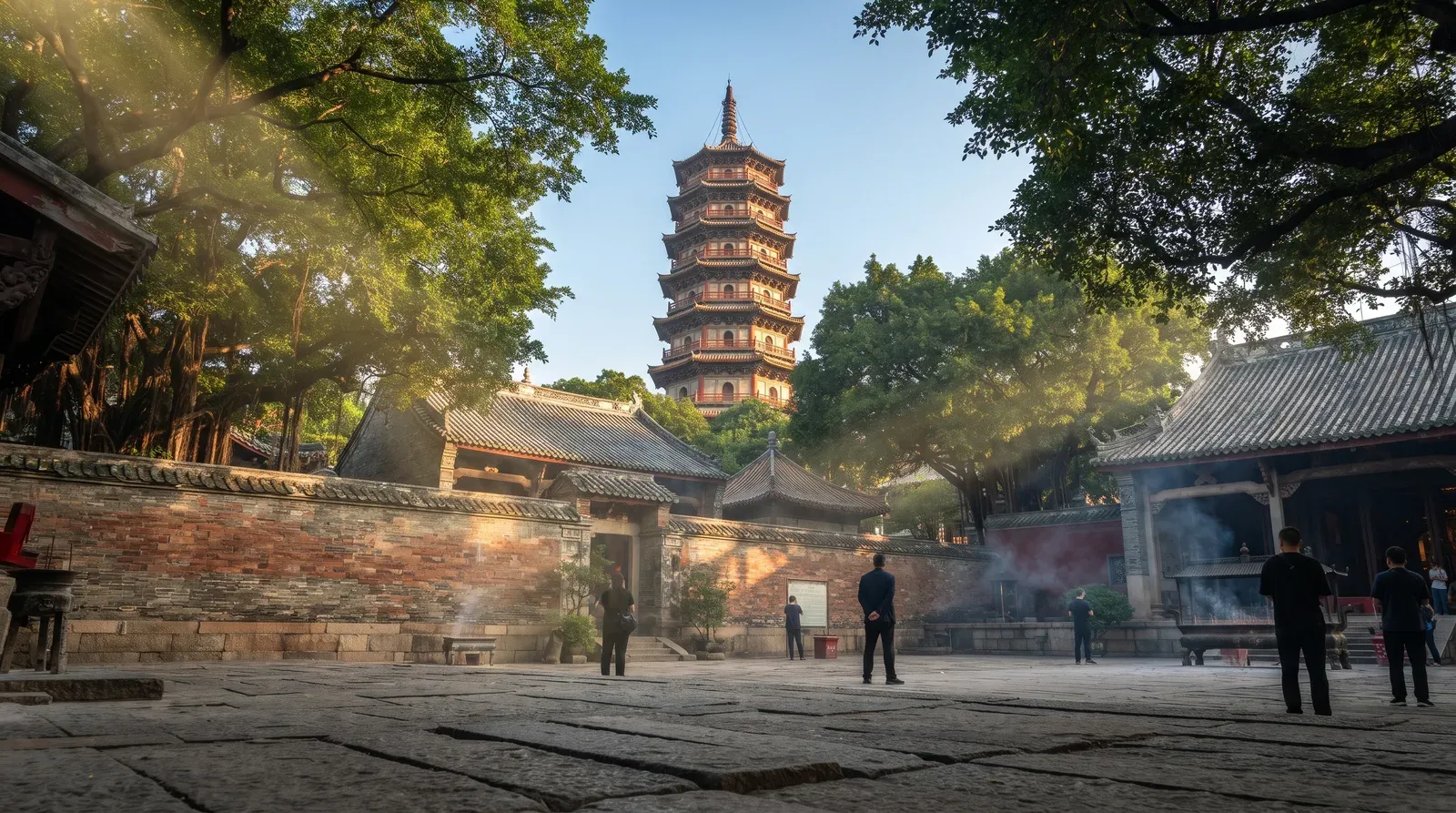
Liurong Temple in Guangzhou, also known as the Temple of the Six Banyan Trees or the Banyan Tree Temple in Guangzhou, stands at 87 Liurong Road in Yuexiu District. First built in 537 AD during the Liang dynasty, it opens daily from 8:00 to 16:30 with free admission. As one of the four major Buddhist monasteries in Guangzhou, the grounds feature the 57.6-meter Flower Pagoda, a Major Historical and Cultural Site Protected at the National Level. If you plan to visit, you can take Guangzhou Metro Line 1 or Line 2 to Gongyuanqian station and walk to the temple.
How do you reach the Temple of Six Banyan Trees in Guangzhou by public transit?
To travel by metro, take Guangzhou Metro Line 1 or Line 2 to Gongyuanqian station. Leave through Exit I2 and walk north along Liurong Road to reach the temple.
If you travel by bus, you can ride Route 29, 215, 253, Guang 12, or Tourist Bus Line 1. Get off at the Liurong Road stop, then walk north for about 3 minutes to reach the temple gate.
Guangxiao Temple is located at 109 Guangxiao Road in the Liurong Subdistrict of Yuexiu District, with an admission fee of 5 yuan per person. Guangxiao Temple and this temple, several hundred meters apart, are both among the four major Buddhist monasteries in Guangzhou. The two sites are often combined into a one-day visit.
What historical changes and literary inscriptions shaped the temple?
The monk Tanyu first built the temple in 537 AD under an edict from Emperor Wu of Liang. Originally named Baozhuangyan Temple, it was constructed to enshrine Buddhist relics brought from Chenla (present-day Cambodia) to Panyu (present-day Guangzhou).
In 675 AD, during the reign of Emperor Gaozong of Tang, early Tang poet Wang Bo passed through Guangzhou while traveling south to visit his father. At the request of the monks at Baozhuangyan Temple, he composed the stele inscription for the pagoda, which contains more than 3,000 Chinese characters.
In 1100 AD, during the Northern Song dynasty, Su Shi visited Jinghui Temple while traveling through Guangzhou. Seeing six ancient banyans on the grounds, he wrote calligraphy of the two characters 'Liu Rong' (Six Banyans). Along with Guangxiao Temple, Hualin Temple, and Haichuang Temple, it is regarded as one of Guangzhou's four major Buddhist monasteries. A local saying observes that Guangxiao is famous for its trees, while Jinghui is noted for its pagoda.
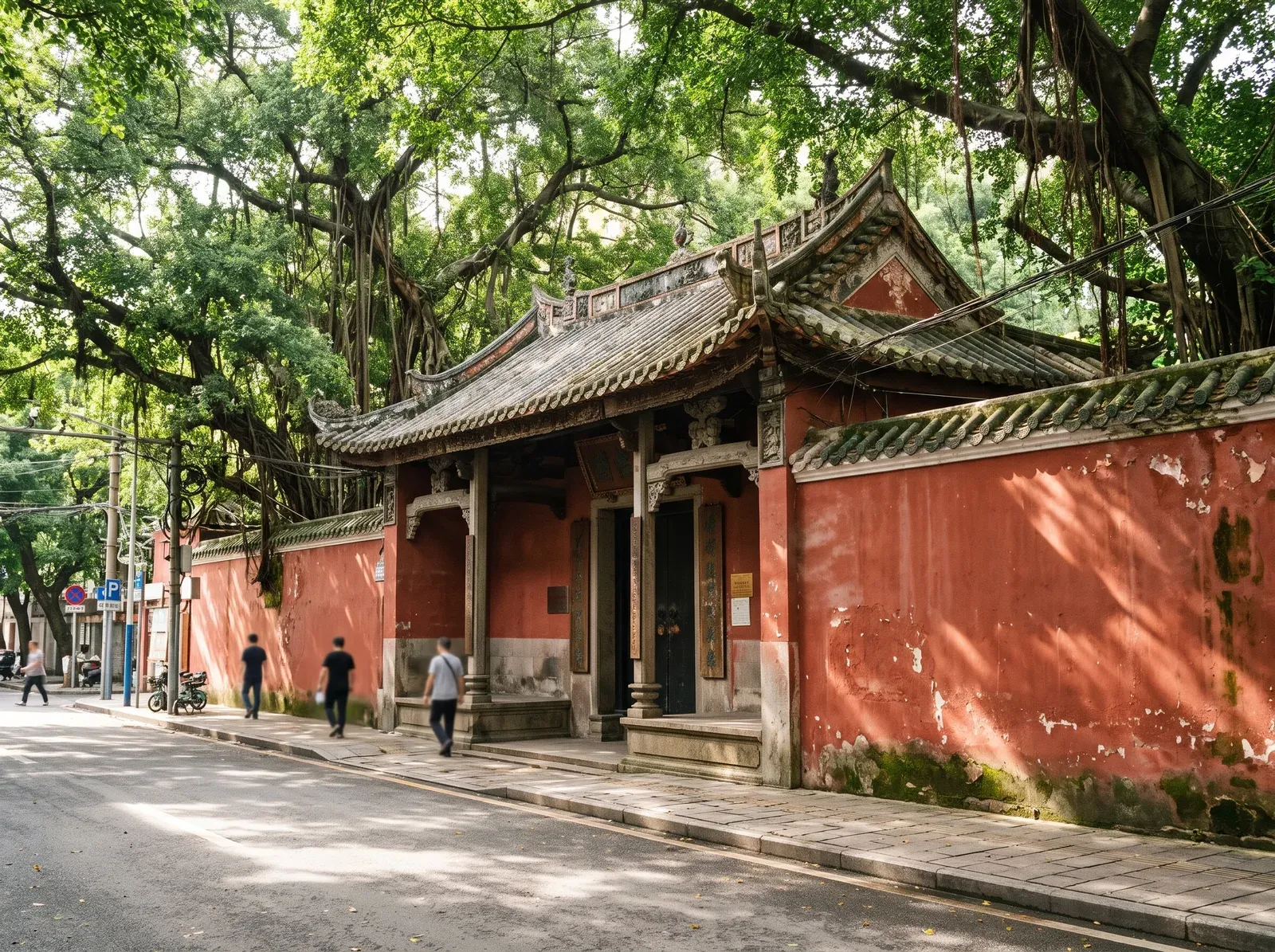
In 1411, during the Yongle reign of the Ming dynasty, Jinghui Temple was renovated. The monks carved Su Dongpo's calligraphy 'Liu Rong' onto a wooden plaque and hung it over the gate, officially renaming the monastery Liurong Temple. A couplet by early Republic of China scholar Cen Xuelü hangs at the main gate: 'One pagoda has a stele preserving the Erudite; six banyans have no trees remembering Dongpo.' Here, 'Erudite' refers to Wang Bo, and 'Dongpo' refers to Su Shi. In 1913, the temple replanted 4 banyan trees and built the Burong Pavilion and Dongpo Jingshe to commemorate Su Dongpo's naming of the site.
What highlights feature in the Flower Pagoda and ancient Buddhist statues?
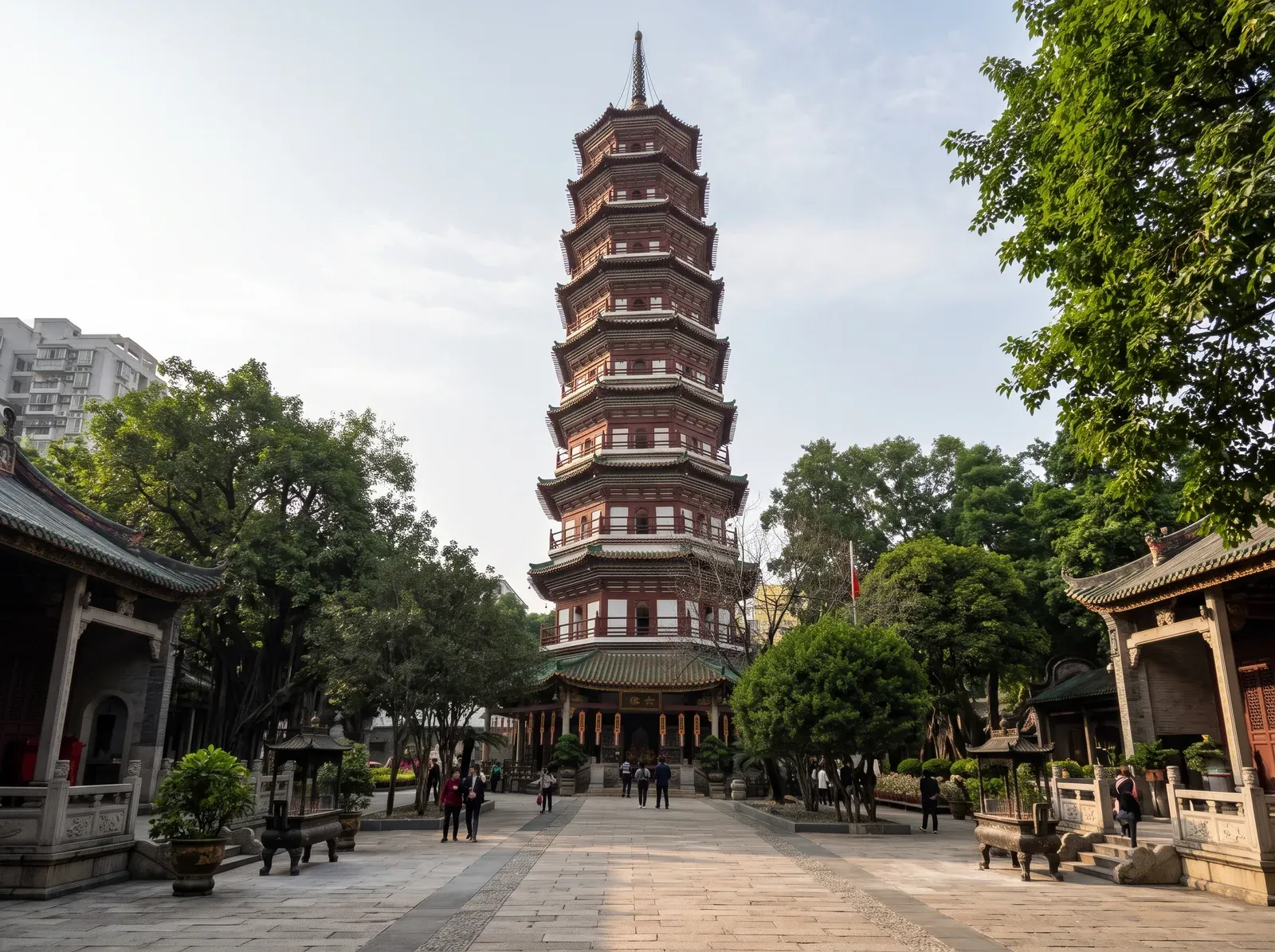
The Flower Pagoda of the temple has an octagonal base and stands 57.6 meters tall including the spire. From the outside, it appears to have 9 stories, but hidden stories below the eighth tier bring the total to 17 levels. Glazed tiles cover the eaves and spire, making the structure resemble carved floral layers from a distance, which gave rise to its name, the Flower Pagoda. In May 2006, the State Council listed it in the sixth batch of Major Historical and Cultural Sites Protected at the National Level. While admission to the temple grounds is free, climbing the pagoda is currently not open to the public.
Because the pagoda was built close to the Pearl River where groundwater was high, its foundation used solid granite blocks to construct 9 interlocking well-shaped structures, forming a ring foundation of nine wells. The pagoda once tilted by 1.7 meters with visible cracks. In 2001, Guangzhou allocated more than 4 million yuan to reinforce and repair the tower using carbon fiber cloth and other modern materials.
During a renovation in 1358 under the Yuan dynasty, a 9.14-meter bronze Thousand Buddha Pillar was cast. Its surface is carved with 1,023 relief Buddha images. Together with components such as the precious pearl, plates, and iron chains, the finial weighs 5 tons in total. In the Mahavira Hall, the three large bronze statues of Shakyamuni, Amitabha, and Bhaisajyaguru (Medicine Buddha) each stand 6 meters tall and weigh 10 tons. In Guanyin Hall, the bronze statue stands 4 meters tall and weighs about 5 tons. All were cast in 1663 during the Kangxi reign of the Qing dynasty and represent the largest surviving ancient brass castings in Guangdong Province.
Inside the Sixth Patriarch Hall, a bronze statue of Huineng, the sixth patriarch of Chinese Zen Buddhism, stands 1.8 meters tall and weighs 1 ton. To the left of the Mahavira Hall, the Friendship Buddha Hall houses a bronze Shakyamuni Buddha statue gifted by the Ministry of Education of Thailand in 1985, measuring 2.6 meters high and weighing 1 ton.
| Structure or Relic | Period and Origin | Dimensions and Weight | Architectural and Artistic Features |
|---|---|---|---|
| Flower Pagoda | First built in 537 AD | 57.6 meters tall to the tip | Octagonal layout, 9 exterior stories, 17 interior and exterior levels, foundation of nine linked wells |
| Thousand Buddha Pillar and Finial | Cast in 1358 | Pillar 9.14 meters high, finial total weight 5 tons | Carved with 1,023 relief Buddha images, equipped with components including a pearl and iron chains |
| Three Bronze Buddhas in Mahavira Hall | Cast in 1663 | Each 6 meters tall, 10 tons | Enshrines Shakyamuni, Amitabha, and the Medicine Buddha; largest surviving ancient brass castings in Guangdong |
| Guanyin Hall Bronze Statue | Cast in 1663 | 4 meters tall, about 5 tons | One of the largest surviving ancient brass castings in Guangdong Province |
| Sixth Patriarch Hall Huineng Statue | Enshrines the sixth patriarch of Zen Buddhism | 1.8 meters tall, 1 ton | Bronze statue of the Zen patriarch enshrined in the Sixth Patriarch Hall |
| Friendship Buddha Hall Shakyamuni Statue | Gifted by Thailand's Ministry of Education in 1985 | 2.6 meters tall, 1 ton | Thai-gifted bronze statue enshrined in Friendship Buddha Hall beside the Mahavira Hall |
Why did foreign adoptive families often visit the temple for blessings?
Located near foreign consulates general in Guangzhou, the temple was for years a traditional stop for international families adopting children in China, where parents brought newly adopted children to receive blessings before the Guanyin statue.
If you plan to visit Guangzhou, your travel designer can arrange your itinerary, and your driver can provide pickup and transfer services.
Sources
Liurong Temple - Yuexiu District People's Government of Guangzhou Municipality
Liurong Temple - Baidu Baike
Gongyuanqian Station - Wikipedia
Temple of the Six Banyan Trees - Wikipedia
Liurong Temple - Wikipedia
Guangxiao Temple (Guangzhou) - Wikipedia
Sources verified on November 6, 2026
FAQ
Do you need tickets for the Temple of the Six Banyan Trees? What are the opening hours?
General admission to the temple is free, and the site is open daily from 8:00 to 16:30.
Can visitors climb the Flower Pagoda right now?
Climbing the Flower Pagoda inside the temple is currently closed to visitors, but you can view its 9-tier octagonal exterior from the courtyard.
Which metro station is closest to Liurong Temple in Guangzhou?
Take Guangzhou Metro Line 1 or Line 2 to Gongyuanqian station, leave from Exit I2, and walk north to arrive.
Why is it called Liurong Temple, and what is its connection to Su Dongpo?
In 1100, Su Shi visited Jinghui Temple and wrote the calligraphy for 'Six Banyans' after seeing 6 old banyan trees; in 1411, during renovations under the Yongle reign of the Ming dynasty, the monks carved his calligraphy onto a wooden plaque above the gate, officially renaming the monastery Liurong Temple.