
Zhongwei
Photo: Windmemories / Wikimedia Commons, CC BY-SA 4.0
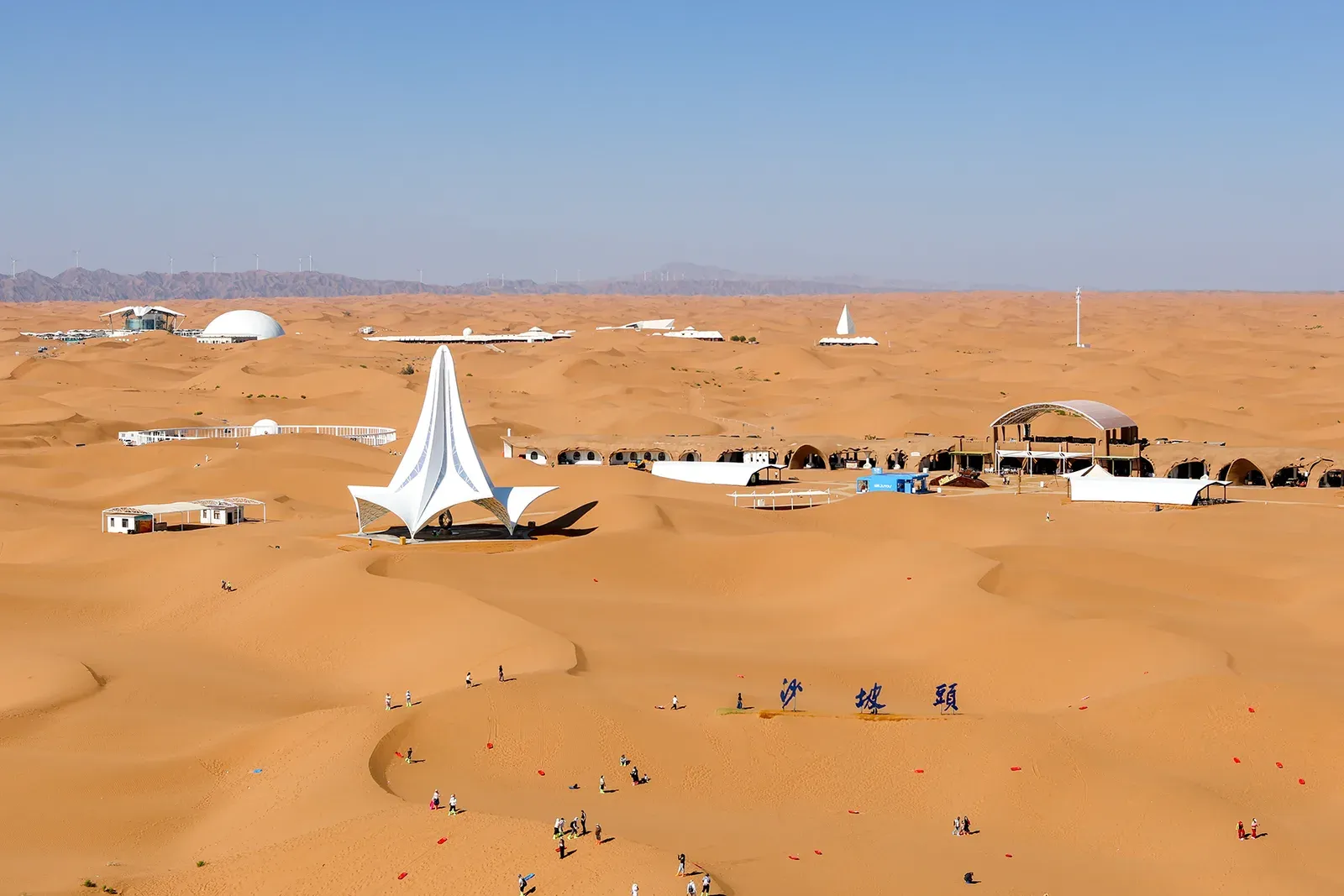
Located in west-central Ningxia Hui Autonomous Region, Zhongwei sits where the southern edge of the Tengger Desert meets the Yellow River, at an average urban elevation of 1,225 meters. The area features five landform types, including desert, alluvial plains, and rolling hills. It suits travelers looking to experience the desert and learn about life along the Yellow River, with typical itineraries usually lasting 2 to 3 days.
Key points
A trip to Zhongwei typically takes 2 to 3 days to explore the Yellow River desert scenery at Shapotou and the historic Gaomiao Temple. Late spring through autumn offers a good travel window, though you should pack shoe covers, sun protection, and a light jacket for sharp day-night temperature swings. Shapotou Airport sits about 9 kilometers from downtown, and high-speed trains arrive at Zhongwei South Railway Station.
Located in west-central Ningxia Hui Autonomous Region, Zhongwei sits where the southern edge of the Tengger Desert meets the Yellow River, at an average urban elevation of 1,225 meters. The area features five landform types, including desert, alluvial plains, and rolling hills. It suits travelers looking to experience the desert and learn about life along the Yellow River, with typical itineraries usually lasting 2 to 3 days.
| Item | Details |
|---|---|
| Location | West-central Ningxia, where the southern Tengger Desert meets the Yellow River |
| Suggested Stay | 2 to 3 days |
| Key Highlights | Shapotou, Yellow River sheepskin raft drifting, Gaomiao Temple |
| Getting There | Yinchuan-Lanzhou High-Speed Railway connecting Lanzhou, Shapotou Airport |
| Climate | Temperate arid to semiarid climate, abundant sunshine, large day-night temperature difference |
How to Get to Zhongwei
Taking high-speed rail is a common way to travel here. The railway section between here and Lanzhou on the Yinchuan-Lanzhou High-Speed Railway stretches about 220 kilometers with a designed speed of 250 km/h. It opened on December 29, 2022, connecting the city directly to Lanzhou, the provincial capital of Gansu. If you plan to travel by train, check our China train travel tips for boarding procedures. In addition, the 990-kilometer Baotou-Lanzhou Railway opened in 1958, crossing the desert between the city and Gantang as China's first desert railway.
By air, Shapotou Airport is a 4C-class regional airport with a runway 2,800 meters long and 45 meters wide. It sits about 9 kilometers from the downtown area and around 15 kilometers from the 5A-rated Shapotou Scenic Area.
Tip: When arriving by high-speed rail, look for Zhongwei South Railway Station (中卫南站). After arriving at Shapotou Airport, your driver can assist with transfers to the city or scenic areas.
What to Experience at Shapotou and the Yellow River
Shapotou, one of China's first national 5A scenic areas, sits northwest of the city where the Yellow River meets the southern edge of the Tengger Desert, which covers about 36,700 square kilometers. It hosts the Shapotou Desert Research and Experiment Station of the Chinese Academy of Sciences. The site is famous for straw checkerboard sand barriers that kept the Baotou-Lanzhou Railway running smoothly through shifting dunes, a sand-control system that won a special national science and technology progress award.
Drifting down the Yellow River on a sheepskin raft is the signature activity here. Locally known as huntuo, these rafts are an ancient river-crossing tool along the Yellow River basin. Today, floating on one has become an intangible cultural heritage experience for visitors drifting along this river stretch.
Tip: Follow the on-site staff's safety instructions and wear a life jacket when rafting on the Yellow River. The desert sand is fine, so bringing shoe covers can help keep sand out.
What Makes Gaomiao Temple a Notable Landmark?
Located in the city center, Gaomiao Temple (also known as Bao'an Temple) dates back to before the Ming Dynasty and was listed as a Major Historical and Cultural Site Protected at the National Level in 2013. Built in three ascending tiers, this complex combines Buddhist, Taoist, and Confucian halls into a single architectural ensemble.
The complex features a 29-meter-tall three-story main temple. Below it lies the Hell Reincarnation Cave, an underground tunnel connecting the East and West Heavenly Pools that displays traditional statues of karmic retribution along its passages.
Tip: Climb step by step through the temple levels. The underground Hell Reincarnation Cave is dimly lit, so watch your footing when visiting with elders or children.
Quick Guide to Key Sights in the Area
Beyond Shapotou and Gaomiao Temple, the area also features lake oases and desert parks. Below is a quick-reference table of the main sights, their ratings, and locations:
| Scenic Area | Level | Landscape & Key Highlights | Location |
|---|---|---|---|
| Shapotou Scenic Area | National 5A | Desert meeting the Yellow River, straw checkerboards, sheepskin raft drifting | About 15 km from Shapotou Airport, southern edge of Tengger Desert |
| Jinshadao Scenic Area | National 4A | Desert wetlands and ecological oasis scenery | Around downtown |
| Gaomiao Temple (Bao'an Temple) | National 3A (Major National Historical Site) | Blend of Confucianism, Buddhism, and Taoism, 29-meter main temple, Hell Reincarnation Cave underground tunnel | Downtown |
| Sikou | National 3A | Canyon scenery and historical cultural sites | Local municipal area |
| Jinshahai Scenic Area | National 3A | Desert scenery and leisure along the Tengger Desert edge | Desert edge |
When to Visit: Local Climate and Desert Tips
The city has a temperate arid to semiarid climate, with an annual average temperature between 7.3 and 9.5 degrees Celsius, abundant sunshine, large temperature swings between day and night, and annual precipitation between 180 and 367 millimeters. Late spring through autumn is a good window to visit, offering bright daytime sunshine and cooler evenings.
Relying on its dry climate and ample sunshine, the area has built a large photovoltaic base in the Tengger Desert and attracted cloud computing firms such as Amazon AWS to set up the Western Cloud Computing Base.
Tip: UV rays are strong in the desert, so bring a sun hat, sunglasses, and sunscreen. A jacket is also recommended for cooler mornings and evenings.
Local Food and Specialties to Try
The Yellow River flows for 182 kilometers through the region, with a maximum natural drop of 144 meters, an average annual runoff of 24 billion cubic meters, and an irrigation district covering 1.11 million mu. This has given rise to the local saying that the Yellow River enriches Ningxia, and Zhongwei benefits most.
Well-known local dishes include Haozi noodles (蒿子面) and cold skin noodles (凉皮). To learn more about northwest dining customs, take a look at our China dining etiquette tips.
As for local produce, Zhongning County, administered by the city, lies about 140 kilometers from Yinchuan. It is the birthplace and origin of goji berries, named China's Home of Goji Berries by the State Council in 1995. Other local specialties include Xiangshan selenium sweet watermelons and Nanchangtan soft pears.
Tip: You can find Haozi noodles and cold skin noodles at local night markets and downtown restaurants. When buying goji berries, look for packages originating in Zhongning.
History and Demographics
In 1403, during the second year of the Yongle reign in the Ming Dynasty, Ningxia Zhongwei was established with 6,000 garrison troops, giving the area its name. It became a county in 1724 during the Qing Dynasty and was designated a prefecture-level city in 2004. According to the seventh national population census, the city has a permanent resident population of 1,067,336, with Hui people accounting for 36.54% and Han people making up 63.18%.
In 1920, an earthquake with a moment magnitude of 8.25 struck Haiyuan County in the area. Today, the Haiyuan Earthquake Geological Park preserves these seismic ruins.
Frequently Asked Questions
Sources
Zhongwei - Wikipedia
Zhongwei Shapotou Airport - Wikipedia
Yinchuan-Lanzhou High-Speed Railway - Wikipedia
Zhongwei Gaomiao - Wikipedia
Shapotou, Zhongwei - Wikipedia
Skin Raft - Wikipedia
Baotou-Lanzhou Railway - Wikipedia
Tengger Desert - Wikipedia
Zhongning County - Wikipedia
Haiyuan Earthquake - Wikipedia
Zhongwei - Wikipedia
Sources verified on November 17, 2026
Related travel tips
Replies 08:30–22:00 your time · Free to ask.