
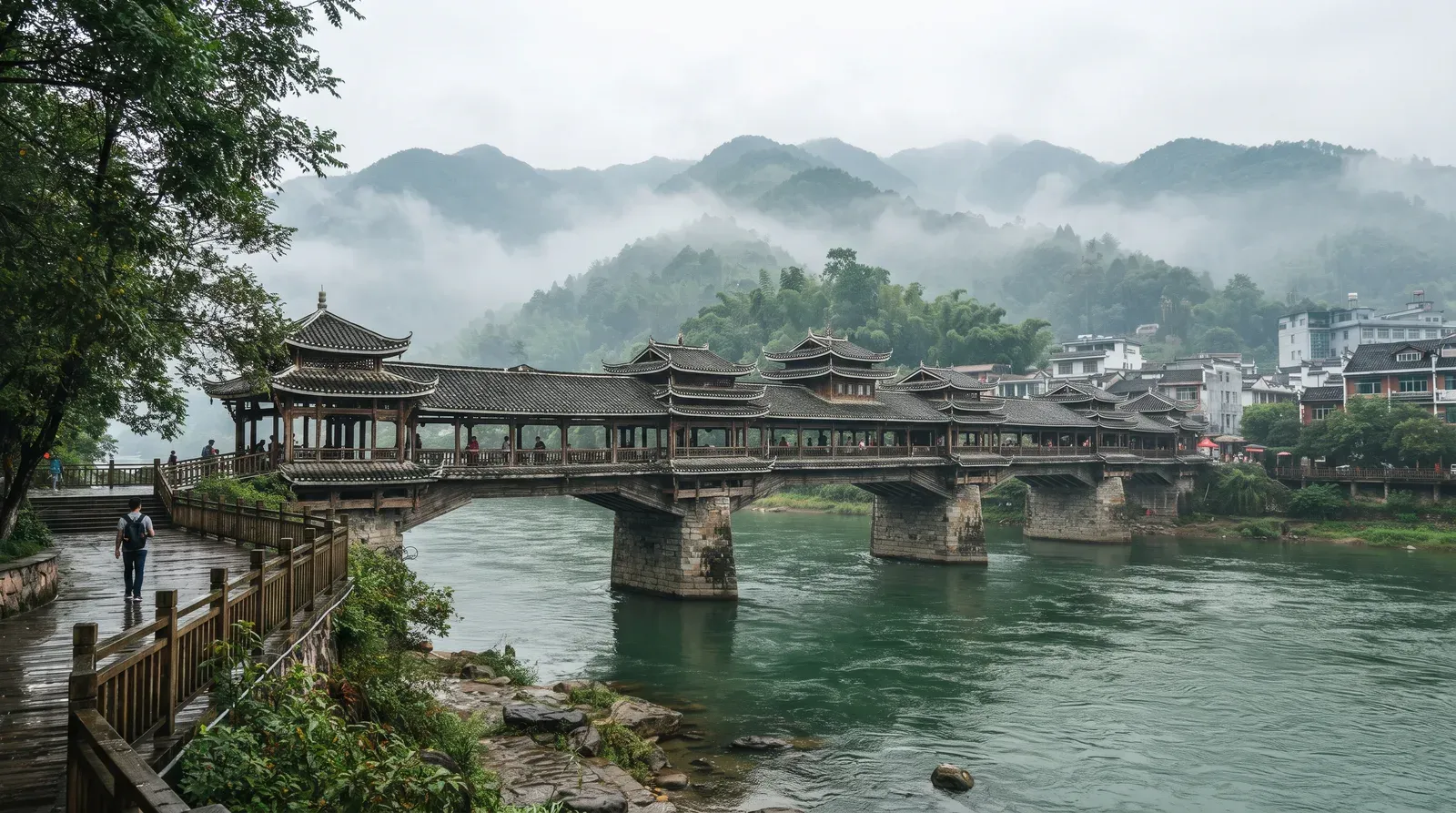
Ya'an
Ya'an City lies in the transition zone between the southwestern rim of the Sichuan Basin and the Tibetan Plateau, about 140 kilometers from Chengdu. Known as the Rain City, the Throat of Western Sichuan, and the Ethnic Corridor, it brings together giant panda conservation research and the thousand-year birthplace of tea culture. The area suits nature-focused leisure and slow-paced road trips. To explore its main sights, a stay of 2 to 3 days is usually recommended.
Key points
Located about 140 kilometers from Chengdu, Ya'an is best explored over 2 to 3 days to cover key highlights like Bifengxia and Mount Mengding. While the city records 213 rainy days a year, most precipitation falls at night, making spring and autumn the most pleasant seasons to visit. When traveling into nearby mountain areas, your travel designer can arrange your driver for the trip.
Ya'an City lies in the transition zone between the southwestern rim of the Sichuan Basin and the Tibetan Plateau, about 140 kilometers from Chengdu. Known as the Rain City, the Throat of Western Sichuan, and the Ethnic Corridor, it brings together giant panda conservation research and the thousand-year birthplace of tea culture. The area suits nature-focused leisure and slow-paced road trips. To explore its main sights, a stay of 2 to 3 days is usually recommended.
When Is the Best Time to Visit?
The city receives an average annual rainfall close to 1,700 millimeters, with 213 rainy days a year. Because most rain falls at night, carrying a folding umbrella makes getting around easy. The Daxiangling Mountain range running across the center creates a clear north-south climate split. Northern districts and counties are humid and rainy, with annual rainfall between 1,000 and 1,750 millimeters, while Shangqing Peak on Mount Mengding receives over 2,000 millimeters year-round. Southern Hanyuan County and Shimian County have a dry, warm river valley climate, with plenty of sunshine and an annual rainfall of only around 750 millimeters. Temperatures are pleasant in spring and autumn. Spring is good for tasting new spring tea on Mount Mengding, while autumn is great for viewing red leaves and snow peaks in the distance.
How to Get There and Travel Around
Getting here from Chengdu is straightforward. The 140-kilometer railway section from Chengdu on the Sichuan-Tibet line, designed for speeds of 200 kilometers per hour, opened on December 28, 2018, so you can arrive directly by China's high-speed train. For road travel, expressways connecting to Chengdu, Xichang, and Kangding meet here, alongside National Highways 108 and 318. Driving from the city center to Chengdu Shuangliu International Airport takes about 1 hour and 40 minutes. When visiting mountain attractions nearby, your travel designer can arrange an experienced driver for the entire trip, keeping mountain driving comfortable and worry-free.
Key Attractions to Visit in Ya'an
The region is home to many ecological and historical sites, each with unique appeal:
- Bifengxia: A national 5A-level scenic area framed by green mountains. It houses the Bifengxia Base of the China Conservation and Research Center for the Giant Panda, covering 1,074 mu, where visitors can observe giant pandas in natural surroundings.
- Mount Mengding: Its highest peak, Shangqing Peak, rises to an elevation of 1,456 meters. Historical records show tea cultivation began here before 65 BC, making it the world's earliest recorded site of artificial tea planting. The mountain features ancient sites like Tiangai Temple and Yongxing Temple, and produces famous teas such as Mengding Ganlu and Mengding Huangya.
- Shangli Ancient Town: A historic Sichuan town in Yucheng District that preserves peaceful stone-paved alleys and a rustic waterside layout.
- Mount Niubei: Located at the border of Yingjing and Luding counties, its summit reaches 3,600 meters above sea level. Named for cliffs that resemble a bull's head and a ridge that looks like a bull's back, it serves as the watershed between the Qingyi River and the Dadu River.
- Dengchigou in Baoxing: In 1869, French missionary Armand David scientifically documented the giant panda here, making Baoxing County the place where the giant panda was first scientifically discovered and the origin of its type specimen.
How to Plan Your Pace and Local Experiences
The area is famous for its Three Wonders: the rain, the river fish, and the local women. Historically, it was the eastern starting point of the Sichuan-Tibet Tea Horse Road (over 1,000 kilometers long) and a key production center for Tibetan tea. A 2- to 3-day pace works well: on day one, visit Mount Mengding to experience the roots of tea culture, then spend the afternoon tasting tribute tea and local specialties in town. On day two, visit the Bifengxia Panda Base, followed by an afternoon stroll through Shangli Ancient Town. If you enjoy mountain scenery, day three can take you to Tianquan County on the eastern slopes of Mount Erlang or to Mount Niubei for broader views of western Sichuan. Along the way, try local dishes such as casserole fish, Yingjing bangbang chicken, handmade tata noodles, and zhazha noodles. In southern Hanyuan County, Hanyuan Sichuan pepper has been cultivated for over 2,100 years as a National Geographical Indication product, prized for its rich aroma and tingling flavor.
Sources
China Conservation and Research Center for the Giant Panda - Wikipedia
Bifengxia Panda Base - Wikipedia
Ya'an City - Wikipedia
Ya'an - Wikipedia
Baoxing County - Wikipedia
Bifeng Gorge Scenic Area - Wikipedia
Tea Horse Road - Wikipedia
Mount Mengding - Wikipedia
Yingjing County - Wikipedia
Shangli Town - Wikipedia
Hanyuan County - Wikipedia
Sichuan-Tibet Railway - Wikipedia
Tianquan County - Wikipedia
The sources above were verified on November 17, 2026.
Related travel tips
Replies 08:30–22:00 your time · Free to ask.