
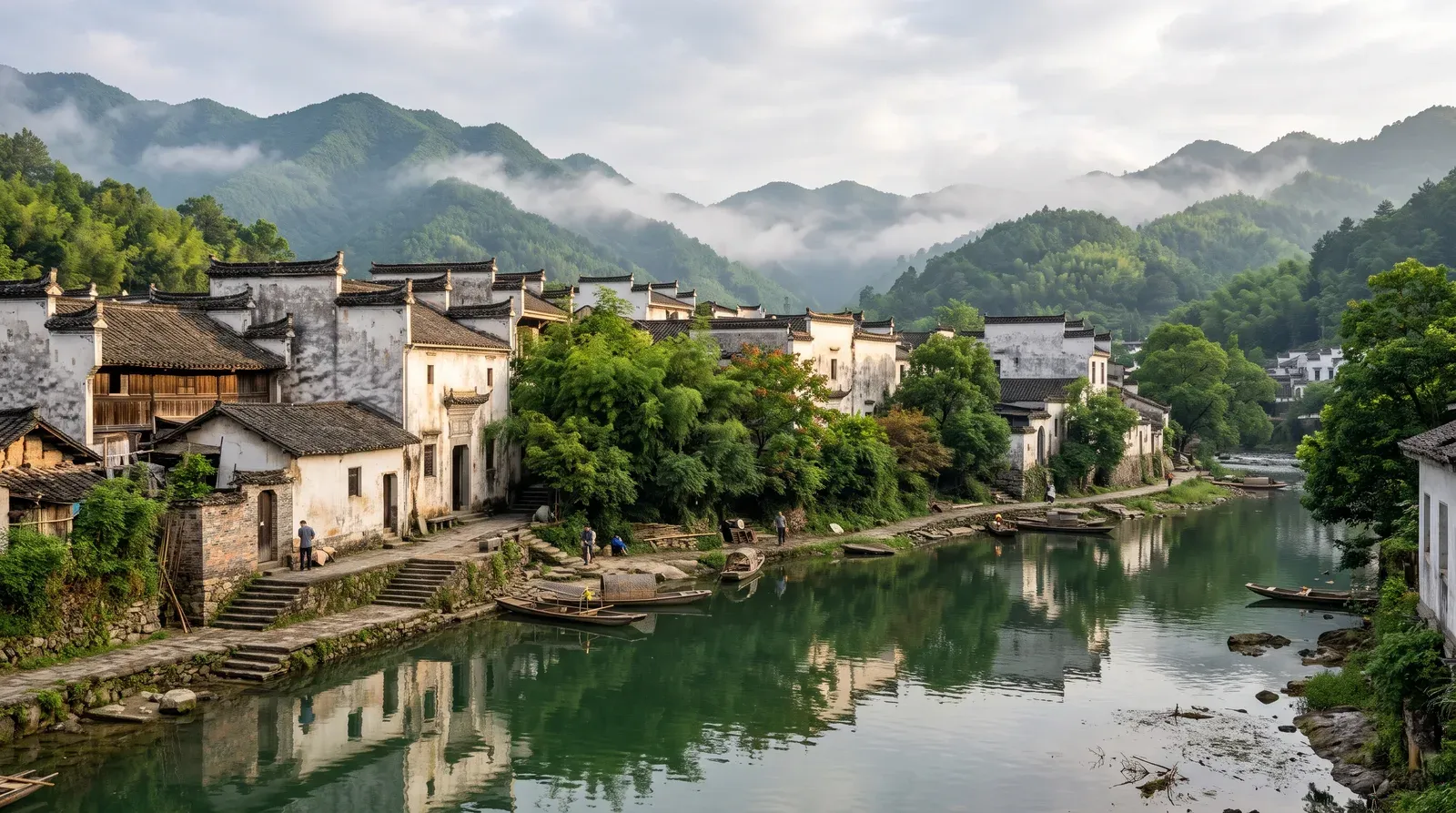
Xuancheng
Xuancheng is located in southeastern Anhui Province. It covers a total area of 12,313 square kilometers, administering one municipal district (Xuanzhou), four counties (Langxi, Jingxian, Jixi, and Jingde), and overseeing two county-level cities (Ningguo and Guangde). In 2004, the city was officially recognized as the Hometown of the Four Treasures of the Study in China. With poetic scenery and rich Huizhou cultural heritage, it is well suited for travelers who enjoy cultural exploration and walks in the countryside. Spending 3 to 4 days here is usually recommended to experience its scholar arts and southern Anhui villages at an unhurried pace.
Key points
A visit to Xuancheng typically takes 3 to 4 days, allowing you to cover highlights like Mount Jingting, traditional villages in Jingxian, and Longchuan Hu Ancestral Hall in Jixi. Spring and autumn are mild and suitable for exploring villages, while Taiji Cave maintains a steady 18°C for summer visits. Because attractions are dispersed, having your travel designer arrange private transport with your driver is recommended.
Xuancheng is located in southeastern Anhui Province. It covers a total area of 12,313 square kilometers, administering one municipal district (Xuanzhou), four counties (Langxi, Jingxian, Jixi, and Jingde), and overseeing two county-level cities (Ningguo and Guangde). In 2004, the city was officially recognized as the Hometown of the Four Treasures of the Study in China. With poetic scenery and rich Huizhou cultural heritage, it is well suited for travelers who enjoy cultural exploration and walks in the countryside. Spending 3 to 4 days here is usually recommended to experience its scholar arts and southern Anhui villages at an unhurried pace.
When is the best time to visit Xuancheng?
Xuancheng has a subtropical monsoon climate, with an annual average temperature of 15.6°C. The average temperature in the coldest month is 2.7°C, while the hottest month averages 28.1°C, and annual precipitation ranges between 1,200 and 1,500 millimeters. Spring and autumn are mild and comfortable, making them well suited for exploring old villages and outdoor wandering. Summer rainfall is relatively concentrated, though visiting Taiji Cave in Guangde provides a cool escape, as its interior maintains a year-round average temperature of 18°C. If you would like to prepare for seasonal travel across the Yangtze River Delta, you can also refer to our trip planning guide.
How to get to Xuancheng and arrange transportation?
Xuancheng's railway routes include the Shangqiu-Hangzhou High-Speed Railway, Hefei-Fuzhou High-Speed Railway, Xuanzhou-Jixi High-Speed Railway, Xuancheng-Hangzhou Railway, and Anhui-Jiangxi Railway. High-speed trains offer fast connections to major cities in the Yangtze River Delta, and you can check our train travel guide for boarding tips. Air travel mainly relies on Wuhu Xuanzhou Airport. Because attractions across the counties and cities are relatively dispersed, it is recommended to have your travel designer arrange a private car with your driver who knows the roads well, avoiding the fatigue of public transit transfers and mountain driving.
What are the top places to visit in Xuancheng?
Mount Jingting sits on the banks of the Shuiyang River on the northern outskirts of Xuancheng's urban center, with Cuiyun Peak reaching an elevation of 324.1 meters. Tang Dynasty poet Li Bai visited seven times and composed 45 poems here, earning the mountain the title Poetry Mountain of Jiangnan. Jingxian County is home to several National 4A-level tourist attractions: Taohuatan is the birthplace of Li Bai's well-known poem To Wang Lun; the ancient village of Chaji has been settled by the Zha clan since the Sui Dynasty and preserves over 200 Ming and Qing dynasty structures, including the Yuan Dynasty Degong Hall and Baogong Ancestral Hall; the China Xuan Paper Cultural Park displays the thousand-year-old craft of Xuan paper, a national geographical indication product whose protected boundary spans the entire county. Xuan paper is divided by raw material ratio into mianliao, jingpi, and tejing, and by ink absorbency into raw, sized, and semi-sized types.
Jixi County is a National Historical and Cultural City, as well as a core birthplace of Huizhou cuisine and Huizhou inksticks, with the famed Qing Dynasty workshop Hu Kaiwen operating continuously since its founding in 1782. Longchuan Hu Ancestral Hall in the county dates back to the Song Dynasty, spans 1,564 square meters, integrates the three traditional Huizhou carving crafts, and features over 600 pieces of woodcarving. First built during the Tang Dynasty, the Hui Hang Ancient Trail extends about 16 kilometers across the Qingliangfeng Nature Reserve, which has an 89% forest cover, making it a classic hiking route. Taiji Cave in Guangde stretches 5,400 meters in total and is the largest natural karst cave in East China, featuring an underground river over 2,000 meters long, with more than 750 meters open for boat tours. Ningguo has a forest cover of over 74.2% and is renowned as a green mountain retreat known as the Hometown of Chinese Hickory and Hometown of Yuan Bamboo.
How to pace your itinerary in Xuancheng?
A 3 to 4 day itinerary provides a fulfilling pace for visiting Xuancheng. Begin by heading up Mount Jingting to trace the footsteps of Li Bai, then journey into Jingxian County to visit the China Xuan Paper Cultural Park, Taohuatan, and the old homes of Chaji. Next, travel to Jixi to see the woodcarvings at Longchuan Hu Ancestral Hall, try traditional Hu Kaiwen inkstick making, or hike along the Hui Hang Ancient Trail. If you have extra time, head to Taiji Cave in Guangde for a boat ride along the underground river, or visit Ningguo to take in its bamboo forests. Your travel designer can tailor an itinerary to your schedule, with your experienced driver accompanying you throughout to ensure a smooth, relaxed journey.
Sources
Xuancheng - Wikipedia
Mount Jingting - Wikipedia
Taohuatan Town - Wikipedia
Chaji Village - Wikipedia
Xuan Paper - Wikipedia
Taiji Cave - Wikipedia
Hui Hang Ancient Trail - Wikipedia
Jixi County - Wikipedia
Longchuan Hu Ancestral Hall - Wikipedia
Jingxian County - Wikipedia
Ningguo - Wikipedia
The sources above were verified on November 17, 2026.
Related travel tips
Replies 08:30–22:00 your time · Free to ask.