
Shangrao
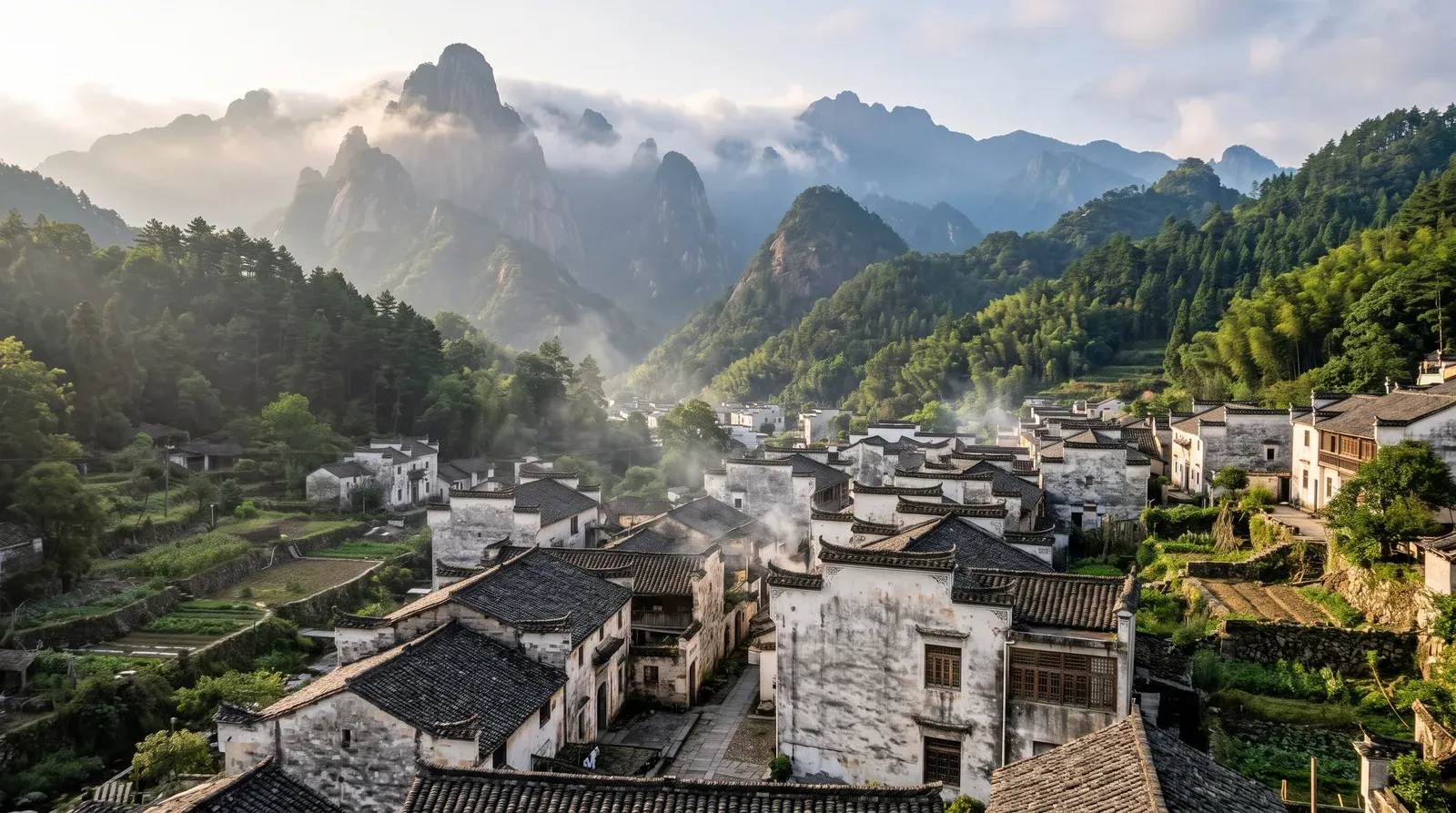
Shangrao is located in northeastern Jiangxi Province, at the junction of Jiangxi, Anhui, Zhejiang, and Fujian. It is home to granite peaks, rural Huizhou-style scenery, and historic academies. The area suits travelers who enjoy hiking and natural scenery as well as those looking to explore traditional villages and local history. Visiting the main sights across Shangrao generally takes 3 to 5 days.
Key points
A trip to Shangrao's main highlights typically takes 3 to 5 days, covering the two World Natural Heritage sites of Mount Sanqing and Guifeng alongside historic villages in Wuyuan. Spring and autumn are the best seasons to visit for viewing rapeseed flowers and autumn harvest sunning. As scenic spots are spread across different counties, having your travel designer arrange a private vehicle with your driver is recommended.
Shangrao is located in northeastern Jiangxi Province, at the junction of Jiangxi, Anhui, Zhejiang, and Fujian. It is home to granite peaks, rural Huizhou-style scenery, and historic academies. The area suits travelers who enjoy hiking and natural scenery as well as those looking to explore traditional villages and local history. Visiting the main sights across Shangrao generally takes 3 to 5 days.
When is the best time to visit Shangrao?
Shangrao has a mid-subtropical monsoon climate. It stays humid throughout the year with a long frost-free period. Temperatures typically range between 2°C and 33°C, with hot, humid, and cloudy summers and shorter, colder winters. Spring and autumn are the best seasons to experience the area's rural landscape. In spring, you can view the terraced rapeseed flowers in Wuyuan. In autumn, you can visit Huangling Village in Wuyuan to see the harvest sunning customs (shaiqiu), while the weather is also comfortably crisp for hiking Mount Sanqing or Guifeng.
How to get to Shangrao and travel locally?
Shangrao has a well-connected transport network. By rail, Shangrao Railway Station is the intersection of the Beijing-Fuzhou Passenger Dedicated Line (Hefei-Fuzhou High-Speed Railway) and the Shanghai-Kunming Passenger Dedicated Line. Its high-speed and regular tracks cross in a vertical, two-level intersection, forming China's first three-dimensional cross-over railway station. Traveling here by high-speed trains is very efficient. For air travel, Shangrao Sanqingshan Airport began operations on May 28, 2017, featuring a 2,400-meter runway, a terminal of 10,496 square meters, and 6 aircraft stands, offering direct flights for travelers coming from farther away. Because major sights like Mount Sanqing, Guifeng, and Wuyuan are distributed across different counties with some driving time between them, having your travel designer arrange a private vehicle and your driver helps connect your journey comfortably.
What are the main places to visit in Shangrao?
- Mount Sanqing: Located at the border of Yushan County and Dexing City, it is named after its three peaks (Yujing, Yuxu, and Yuhua) that resemble three Taoist deities sitting together. Its highest point, Yujing Peak, stands at an elevation of 1,816.9 meters. Inscribed on the World Natural Heritage List in 2008, the mountain has the southern Waishuangxi Cableway and the eastern Jinsha Cableway, and preserves more than 200 historic temples, pavilions, and stone carvings, earning it the nickname of an open-air Taoist museum.
- Yiyang Guifeng: Located south of the Yiyang county seat, it was inscribed on the World Natural Heritage List in 2010 as part of China Danxia, famous for its Danxia landforms shaped like turtles.
- Huangling Village in Wuyuan: Founded in the Ming Dynasty and recognized as a Best Tourism Village by the United Nations World Tourism Organization, it preserves over 100 restored Ming and Qing dynasty Huizhou-style buildings. Its terraced rapeseed flowers and year-round harvest sunning tradition (shaiqiu) are major draws.
- Ehu Academy in Yanshan: Located at the northern foot of Mount Ehu in Yanshan County, this is the historical site of the famous 1175 philosophical debate between Zhu Xi and Lu Jiuyuan during the Southern Song Dynasty. It is currently a Major Historical and Cultural Site Protected at the National Level.
How to plan your travel itinerary?
Shangrao covers a total land area of 22,791 square kilometers, dominated by low-to-medium mountains and hills. Huanggang Peak in the southern Wuyi Mountains reaches an elevation of 2,157.7 meters, making it the highest summit in mainland East China. Given this expansive area, a 3 to 5 day trip offers a balanced pace.
You can spend the first 1 to 2 days discovering World Heritage natural landscapes. Take the Jinsha Cableway or Waishuangxi Cableway up Mount Sanqing to view granite peak forests and ancient Taoist structures, then head to Yiyang to walk among the Danxia rocks of Guifeng. Next, spend 1 to 2 days in Wuyuan, which historically belonged to Huizhou, where rural villages still carry ancient Huizhou dialect and customs, and admire the white walls and gray tiles of Huizhou architecture in Huangling. If you have extra time, you can also visit Ehu Academy in Yanshan to connect with the intellectual history of Song Dynasty philosophy.
Sources
Shangrao City - Wikipedia
Shangrao - Wikipedia
Shangrao Railway Station - Wikipedia
Mount Sanqing - Wikipedia
China Danxia - Wikipedia
Yiyang County - Wikipedia
Huangling Village - Wikipedia
Wuyuan County, Jiangxi - Wikipedia
Ehu Academy - Wikipedia
Sources verified on November 17, 2026
Related travel tips
Replies 08:30–22:00 your time · Free to ask.