
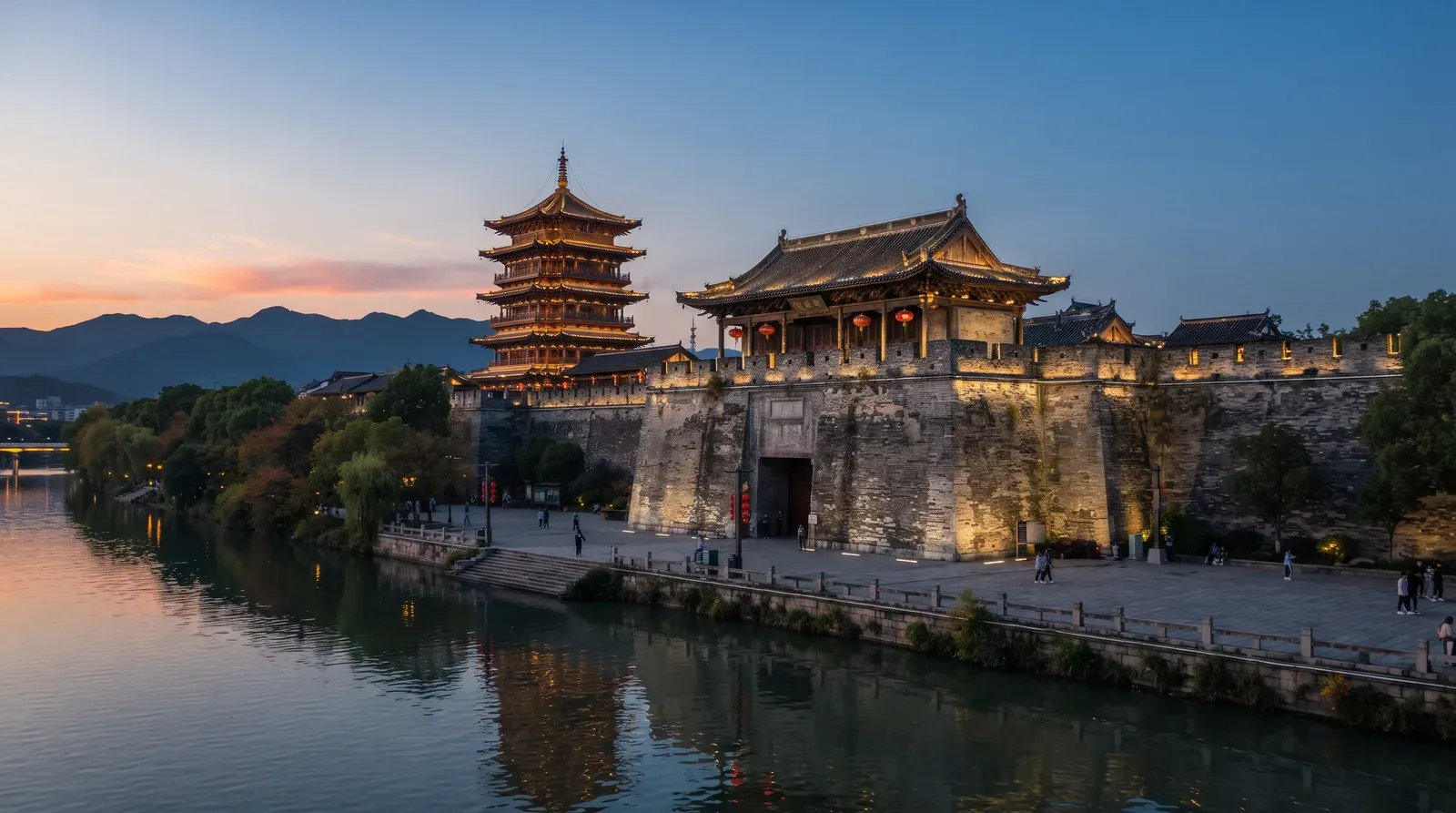
Quzhou
Quzhou is located in western Zhejiang Province, at the source of the Qiantang River and the border area of Zhejiang, Anhui, Fujian, and Jiangxi provinces. Historically, it was known as a thoroughfare connecting four provinces and five routes. The city's official brand emblem features the traditional bow greeting (zuoyi li), and its mascot is Happy Deer. Here, visitors will find rich historical heritage, distinctive Danxia landforms, and the fresh, spicy culinary flavors of western Zhejiang, well suited for travelers who enjoy historical exploration, outdoor hiking, and local food. When touring the urban area and surrounding counties, visitors usually stay 2 to 3 days.
Key points
A trip to Quzhou and its surrounding areas typically takes 2 to 3 days, with spring and autumn offering the most comfortable weather for hiking and walking historic districts. If you carry large luggage or travel with older relatives, a travel designer can arrange a private car and your driver for convenient transfers between the city center and outlying scenic spots.
Quzhou is located in western Zhejiang Province, at the source of the Qiantang River and the border area of Zhejiang, Anhui, Fujian, and Jiangxi provinces. Historically, it was known as a thoroughfare connecting four provinces and five routes. The city's official brand emblem features the traditional bow greeting (zuoyi li), and its mascot is Happy Deer. Here, visitors will find rich historical heritage, distinctive Danxia landforms, and the fresh, spicy culinary flavors of western Zhejiang, well suited for travelers who enjoy historical exploration, outdoor hiking, and local food. When touring the urban area and surrounding counties, visitors usually stay 2 to 3 days.
When Is the Weather Most Comfortable to Visit Quzhou?
Quzhou has a subtropical monsoon climate, with an annual average temperature between 16.3°C and 17.4°C. In winter, the average January temperature ranges from 4.5°C to 5.3°C, while summer temperatures in July average between 27.6°C and 29.2°C. Spring is mild and humid, while autumn is crisp and clear, making both seasons pleasant times for strolling through historic districts and hiking scenic peaks.
How to Get to Quzhou and Travel Around the City?
For intercity transit, the 350 km/h Shanghai-Kunming Passenger Dedicated Line runs through Quzhou with a stop at Quzhou Station, making trips to neighboring provinces and cities via the high-speed rail network very convenient. The Quzhou-Jiujiang Railway also connects stations such as Changshan and Kaihua. Quzhou Airport is a Class 4C civil airport located about 3 kilometers east of the old city center, offering flights to major domestic cities including Beijing, Shenzhen, Xiamen, Qingdao, and Kunming. For getting around the city, local taxis in Quzhou and surrounding areas have a base fare of 10 yuan for the first 2.5 kilometers, followed by 2.5 yuan per kilometer after 2.5 kilometers. A 50% surcharge applies to one-way trips exceeding 8 kilometers, and a 20% surcharge applies at night. If you travel with older relatives or carry large luggage, you can also contact a travel designer to arrange a private car and your driver, making the trip more relaxed.
What Are the Classic Highlights to Visit in Quzhou?
Quzhou's natural scenery and historical heritage each have distinct character, making each site well worth a dedicated visit:
Southern Confucius Ancestral Temple: In 1129 (the third year of the Jianyan era in the Southern Song Dynasty), Emperor Gaozong granted Kong Duanyou, the 48th-generation descendant of Confucius and Duke Yansheng, permission to settle his family in Quzhou. This established the division between the Southern Branch of the Confucius clan and the Northern Branch in Qufu. Located on Xinqiao Street in Kecheng District, the ancestral temple is a Major Historical and Cultural Site Protected at the National Level under the fourth batch.
Quzhou City Wall and Shuitingmen: The city wall was first constructed in 192 (the third year of the Chuping era in the Eastern Han Dynasty), and its overall scale was established during a rebuild in 1121 (the third year of the Xuanhe era in the Northern Song Dynasty). The Great West Gate was named Hangyuan Gate in the Song Dynasty, and later called Shuiting Gate and Chaojing Gate. Because it directly bordered the Qu River, a barbican could not be constructed, so pavilions were built in its place. Today, it serves as a core landmark for experiencing the riverside atmosphere of the old town.
Mount Lanke: Located about 10 kilometers southeast of the city at an elevation of 164 meters, it features a natural Danxia stone bridge and Qingxia Cave. Historically recorded as the 30th blessed land of Taoism, it is also the origin of the legend of Wang Zhi, who encountered immortals playing chess.
Mount Jianglang and Nianbadu: Mount Jianglang features late-stage, high-altitude isolated peak Danxia landforms, with its Langfeng peak reaching an elevation of 816.8 meters among the Three Slabs of Stone. In 2010, it was inscribed on the World Heritage List as part of China Danxia. Nianbadu Ancient Town sits along the ancient Xianxia Road, preserving a 2-kilometer-long street and 36 Ming and Qing dynasty residences, with 142 surnames and 13 local dialects. Together, the two form a national 5A-level scenic area. Nearby sites also include Qingyang Village, the ancestral origin of the Mao clan south of the Yangtze River, and Xianxia Pass, traditionally known as the throat of Fujian.
Longyou Grottoes: Designated as Quzhou's first national 4A-level scenic area in 2003, the site features 24 underground caverns distributed across a 0.38-square-kilometer hill. Currently, 5 caves have been cleared of silt, drained, and opened to the public, with the mystery of their ancient excavation continuing to intrigue visitors.
How to Plan Local Flavors and Travel Itineraries in Quzhou?
Quzhou cuisine stands out among Zhejiang flavors with its signature spicy dishes, headlined by the "Three Heads and One Paw" (duck head, rabbit head, fish head, and duck feet). To cool down, visitors can try mint crystal cake and Shaoyongfeng sesame cakes. Surrounding counties also produce National Geographical Indication products such as Longyou steamed sponge cake (fagao), Changshan huyou citrus, and Changshan camellia oil.
For an itinerary, visitors can spend Day 1 walking through the Southern Confucius Ancestral Temple and the Shuitingmen city wall in Kecheng District, then tasting spicy night-market snacks along the river in the evening. On Day 2, visit the Longyou Grottoes or Mount Lanke. On Day 3, travel to Jiangshan City to climb Mount Jianglang and tour Nianbadu Ancient Town. For those looking to experience the forest ecology at the source of the Qiantang River, Kaihua County, with a countywide forest coverage of 79.2%, makes for a pleasant extension.
Sources
Longyou Caves - Wikipedia
Quzhou - Wikipedia
Longyou County - Wikipedia
Quzhou City Wall - Wikipedia
Southern Confucius Ancestral Temple - Wikipedia
Mount Jianglang - Wikipedia
Nianbadu Town - Wikipedia
Mount Lanke - Wikipedia
Jiangshan City - Wikipedia
Kaihua County - Wikipedia
Changshan County - Wikipedia
The above sources were verified on November 17, 2026.
Related travel tips
Replies 08:30–22:00 your time · Free to ask.