
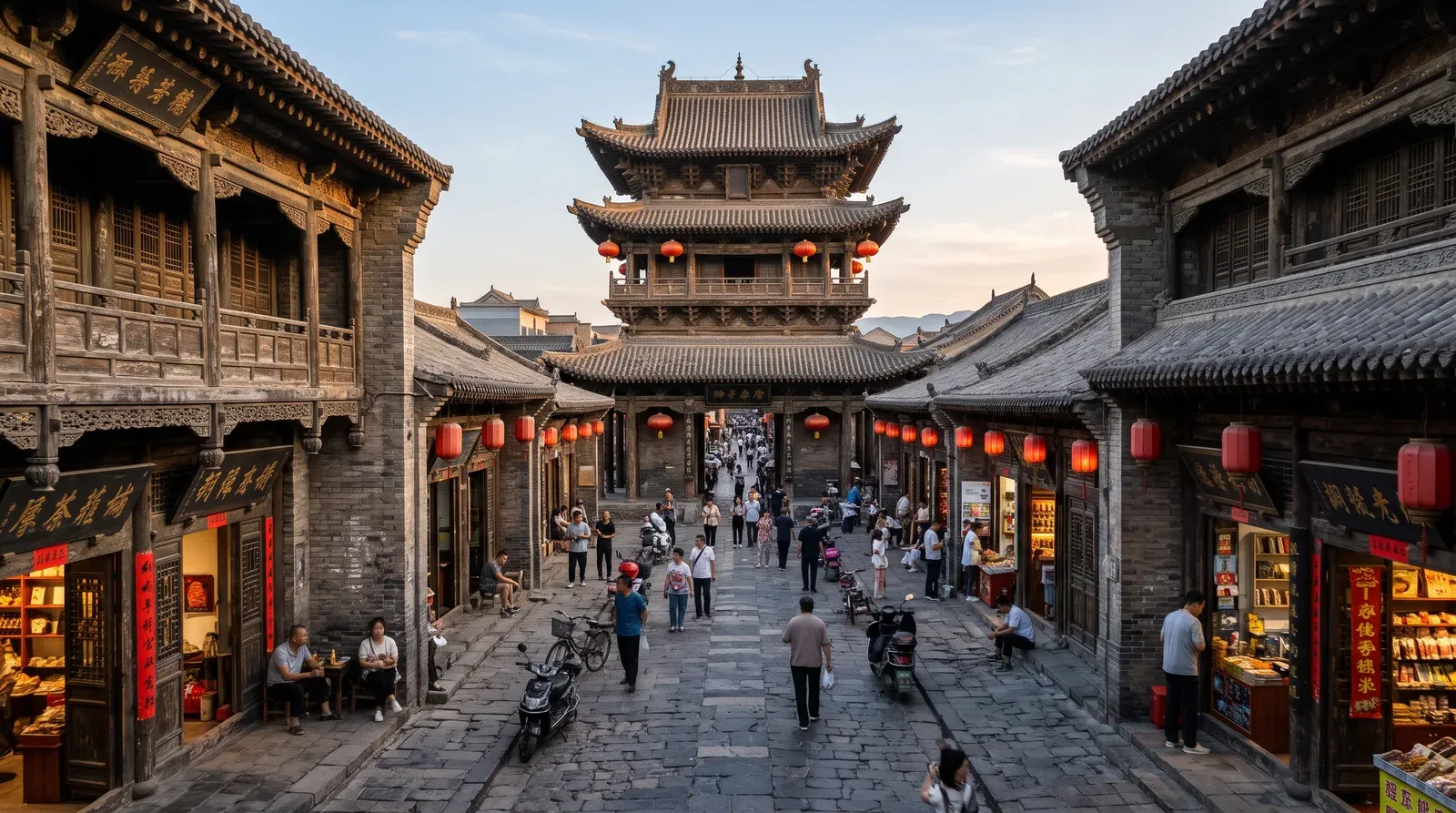
Pingyao
Pingyao sits at the southwest end of the Taiyuan Basin in central Shanxi, about 90 to 100 km from the provincial capital, Taiyuan. The old city has nearly 2,800 years of history, keeps almost 4,000 traditional Ming and Qing houses, and more than 20,000 people still live inside its walls. It is a good place for travelers who love old timber buildings, painted clay sculpture and the financial history of Shanxi merchants. For the World Heritage sights in and around the town, plan on 2 days.
Key points
Plan 2 days to explore Pingyao, where the ancient walled town is free to enter, though climbing the city wall and visiting core sights like Rishengchang Exchange Shop require a combined ticket. Autumn offers cool, clear weather for walking through the historic streets, and your driver can handle transfers to Shuanglin Temple and Zhenguo Temple outside town.
Pingyao sits at the southwest end of the Taiyuan Basin in central Shanxi, about 90 to 100 km from the provincial capital, Taiyuan. The old city has nearly 2,800 years of history, keeps almost 4,000 traditional Ming and Qing houses, and more than 20,000 people still live inside its walls. It is a good place for travelers who love old timber buildings, painted clay sculpture and the financial history of Shanxi merchants. For the World Heritage sights in and around the town, plan on 2 days.
When is the weather in Pingyao most comfortable?
The city has a temperate continental climate, with an average yearly temperature of 10.2°C and about 540 mm of rain, most of it in summer. The four seasons are distinct. Autumn is cool and clear, the easiest time to walk the walls and the old lanes. Winter and spring are dry with wide swings in temperature, and summer brings more rain. Before you go, pack windproof warm layers or rain and sun protection, depending on the season.
How do you get there, and how do you get around?
Getting there is easy. The Datong to Xi'an high-speed line, the Tongpu railway and the Beijing to Kunming expressway all cross the county. You can read our notes on taking high-speed trains in China and ride a train straight into town, linking it smoothly with historic cities such as Beijing or Xi'an. The old streets are open to walkers all day with no entry fee, and the sights inside are close enough to reach on foot. For the old temples a few kilometers outside the walls, your driver can take you there and back, so you skip the transfers.
What is worth a special trip in and around the old city?
The old city joined the World Heritage list in 1997. Its core protected area covers 245.62 hectares and takes in the whole walled town plus two treasured temples outside the walls. You need a combined ticket to climb the wall and to enter the main paid sights inside, such as Rishengchang Exchange Shop, the county government office and the Confucian Temple:
· City wall: the main structure was built in 1370, the third year of the Hongwu reign of the Ming dynasty. It runs 6,163 meters around and stands about 12 meters high, with 6 barbican gates. Because it looks like a crouching turtle, people call it the turtle city. On top are 4 corner towers, 72 watchtowers and 3,000 crenellations, and the streets are laid out in the shape of the Chinese character tu while following the bagua directions.
· Rishengchang Exchange Shop: founded in 1823, the third year of the Daoguang reign of the Qing dynasty, on West Street. It was the first draft bank in Chinese history and started the modern system of paper drafts and remittance. In the late 19th century more than 20 draft banks had their head offices here, making the town an important financial center.
· Confucian Temple and county government office: the temple was first built in the early Zhenguan years of the Tang dynasty, and its Dacheng Hall was rebuilt in 1163, the third year of the Dading reign of the Jin dynasty. It is the only Jin dynasty timber building among China's Confucian temples. The county office was first built in the Yuan dynasty and rebuilt in the early Ming, and it is one of the most complete old county government compounds still standing in China.
· Shuanglin Temple: about 6 to 7 km southwest of the old town. Its ten halls hold 1,650 painted clay figures in good condition (2,052 survive in all), and it is known as a treasure house of painted sculpture in the East.
· Zhenguo Temple: about 10 km northeast of the old town. Its main hall, the Wanfo Hall, was built in 963, the seventh year of the Tianhui reign of the Northern Han. It is one of the oldest timber buildings in China, and the hall still holds 11 rare painted figures from the Five Dynasties.
How should you pace a trip here?
Two days at an easy pace works well. On day one, wander the old town: climb the Ming wall for a view of the layout, visit Rishengchang, the county office and the Confucian Temple, taste the local beef, wantuo, Changshengyuan yellow rice wine and minjian noodles, and look closely at polished lacquerware, one of the first crafts on China's national intangible heritage list. On day two, your driver takes you to Shuanglin Temple for the painted clay figures, then to Zhenguo Temple for the Five Dynasties timber hall and its rare sculptures. If you plan to see this town together with other old cities in north and northwest China, your travel designer can put a route together for you.
Sources
Ancient City of Ping Yao
Pingyao - Wikipedia
The old walled town - Wikipedia
Rishengchang - Wikipedia
Shuanglin Temple - Wikipedia
Zhenguo Temple - Wikipedia
The Confucian Temple - Wikipedia
The county government office - Wikipedia
Pingyao County - Wikipedia
The sources above were checked on Nov 17, 2026
Related travel tips
Replies 08:30–22:00 your time · Free to ask.