
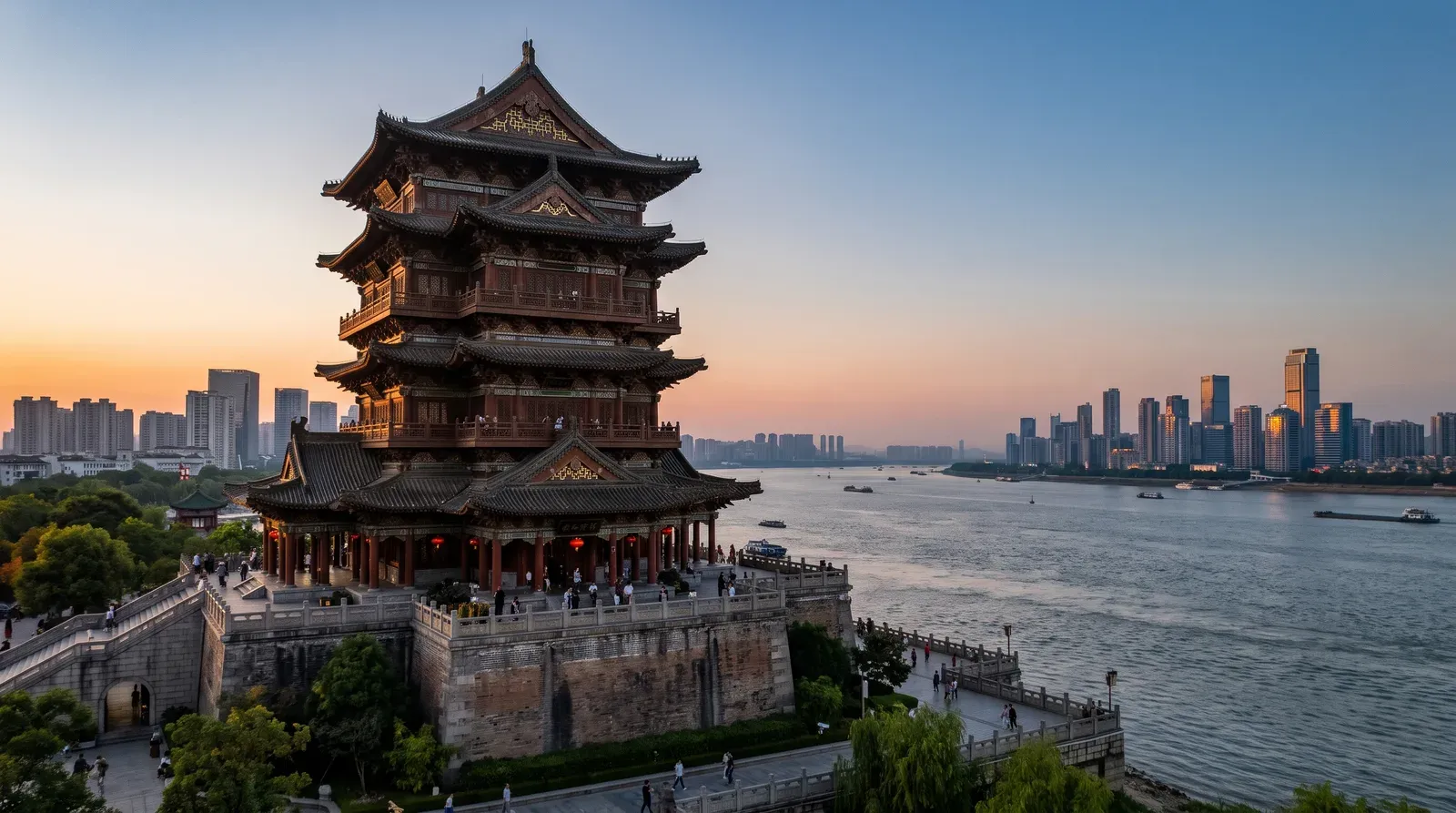
Nanchang
Nanchang is located in north-central Jiangxi Province, China, and serves as the provincial capital. The city's history dates back to 202 BC during the reign of Emperor Gaozu of Han, when the Han general Guan Ying built Guanying City and established Yuzhang Commandery. The name Nanchang came from the aspiration to bring prosperity to the southern territory. According to the 7th National Population Census in 2020, Nanchang had a permanent resident population of 6.255 million. The city features both historical sites and everyday local snacks, making it well suited for visitors interested in cultural heritage and food. A stay of 2 to 3 days is usually recommended to explore its main areas.
Key points
Touring the main areas of Nanchang, China usually takes 2 to 3 days, centered on the 57.5-meter-tall Tengwang Pavilion and the Haihunhou State Site Park. Rainy weather from April to June accounts for nearly 50% of annual precipitation, and July averages 29.6°C with muggy heat. In the morning, you can enjoy Nanchang mixed rice noodles alongside clay jar soup simmered for over 6 hours.
Nanchang is located in north-central Jiangxi Province, China, and serves as the provincial capital. The city's history dates back to 202 BC during the reign of Emperor Gaozu of Han, when the Han general Guan Ying built Guanying City and established Yuzhang Commandery. The name Nanchang came from the aspiration to bring prosperity to the southern territory. According to the 7th National Population Census in 2020, Nanchang had a permanent resident population of 6.255 million. The city features both historical sites and everyday local snacks, making it well suited for visitors interested in cultural heritage and food. A stay of 2 to 3 days is usually recommended to explore its main areas.
When to Visit Nanchang, China?
The city has a humid subtropical monsoon climate with an annual average temperature of 18.2°C. The rainy season falls between April and June, accounting for nearly 50% of the annual rainfall. In July, the average temperature reaches 29.6°C, and summers are muggy. When traveling, you can pack appropriate clothing based on seasonal temperatures and rainfall, and prepare for both summer heat and rain.
How to Get There and Around?
For air and rail travel, Nanchang Changbei International Airport is the largest civil airport in Jiangxi Province, with annual passenger throughput exceeding 10 million in 2017. The railway passenger network forms a hub structure with three primary and three auxiliary stations. Among them, Nanchang West Railway Station, Nanchang Railway Station, and Nanchang East Railway Station serve as the main passenger hubs, where travelers can board China high-speed trains.
For local rail transit, Nanchang Metro charges by distance. The starting fare of 2 yuan covers the first 6 kilometers. From 6 to 12 kilometers, each additional 1 yuan adds 6 kilometers. From 12 to 28 kilometers, each additional 1 yuan adds 8 kilometers. To ride the metro, passengers can use China T-Union cards, UnionPay QuickPass, or scan ride codes via the UnionPay app or the Lulu Xing app.
What Are the Main Places to Visit?
Historical buildings and sights worth visiting in Nanchang include:
Tengwang Pavilion was first built in 653 AD during the fourth year of the Yonghui era of the Tang Dynasty by Li Yuanying, son of Emperor Gaozu of Tang. It gained lasting renown from the Preface to the Tengwang Pavilion by the early Tang poet Wang Bo. The landmark building was reconstructed in 1989 based on draft restoration drawings by Liang Sicheng and others. It has a clear height of 57.5 meters and nine floors (three open and seven hidden levels), designed in a Song-style timber framework.
The Tomb of the Marquis of Haihun in Xinjian District is the tomb of Liu He, the deposed emperor of the Western Han Dynasty. The cemetery covers a total area of about 46,000 square meters, with more than 20,000 unearthed cultural relics. Nanchang Han Dynasty Haihunhou State Site Park officially opened to the public on September 23, 2020.
Nanchang August 1st Uprising Memorial Museum is located on Zhongshan Road in Xihu District. Established on the site of the former uprising headquarters, it is designated as a National First-Class Museum and a National 4A-level Tourist Attraction.
Bada Shanren Memorial Museum in the Meihu Scenic Area of Qingyunpu District was originally the Qingyunpu Daoist Temple. It is a National Key Cultural Relics Protection Unit honoring the late Ming and early Qing painting master Bada Shanren (Zhu Da), commemorating where he lived in seclusion and created his works.
Shengjin Pagoda is an octagonal, seven-story pavilion-style brick pagoda, standing 50.86 meters tall with a base circumference of 33.8 meters, making it one of the best preserved ancient buildings in Nanchang.
The Star of Nanchang Ferris wheel is 160 meters high and has 60 enclosed, air-conditioned cabins. One full rotation takes about 30 minutes, and the adult ticket is 50 yuan.
How to Plan Your Pace
A stay of 2 to 3 days is usually recommended for touring Nanchang. In the morning, you can try the most classic everyday breakfast: Nanchang mixed rice noodles, made by boiling and draining local rice noodles before tossing them with seasonings, and traditional clay jar soup, where small jars filled with ingredients are placed inside a large jar and simmered over charcoal heat for more than 6 hours to avoid harsh direct boiling, producing a rich and flavorful broth.
For your sightseeing route, you can group Tengwang Pavilion, the August 1st Uprising Memorial Museum, and Shengjin Pagoda into one day. Set aside another day for the Han Dynasty Haihunhou State Site Park in Xinjian District, and head up the Star of Nanchang Ferris wheel in the evening for city views. If you would like a more comprehensive route plan, you can consult a travel designer to help create your itinerary.
Sources
Nanchang - Wikipedia
Pavilion of Prince Teng - Wikipedia
Tomb of the Marquis of Haihun - Wikipedia
Nanchang August 1st Uprising Memorial Museum - Wikipedia
Bada Shanren Memorial Museum - Wikipedia
Shengjin Pagoda - Wikipedia
Star of Nanchang - Wikipedia
Cold Mixed Rice Noodles - Wikipedia
Clay Jar Soup - Wikipedia
Nanchang Metro - Wikipedia
Sources verified on November 17, 2026
Related travel tips
Replies 08:30–22:00 your time · Free to ask.