
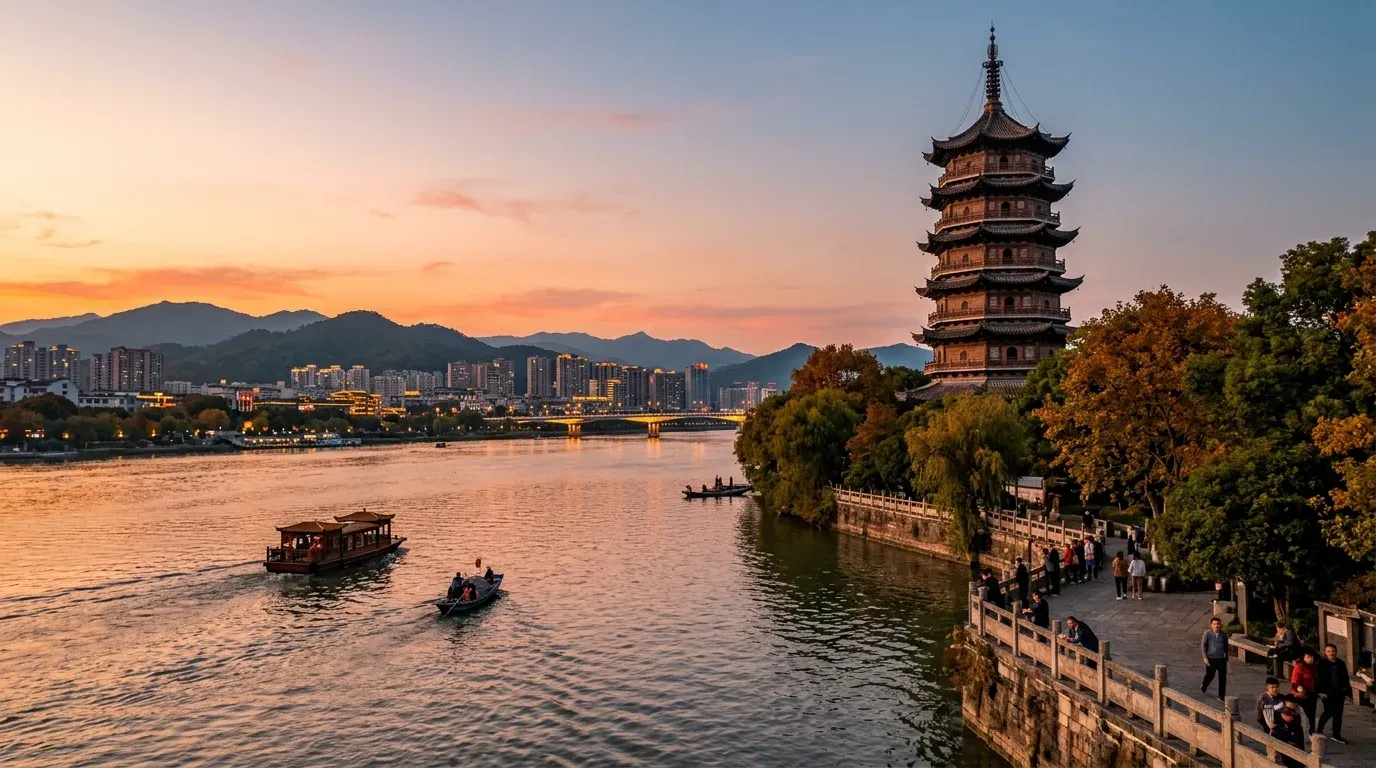
Jinhua
Jinhua is located in central Zhejiang Province. Its history spans over 1,800 years since the establishment of Dongyang Commandery in 266, during the first year of the Baoding era of Eastern Wu in the Three Kingdoms period. Historically known as "Little Zou-Lu", the city took its name from a phrase describing the place where the Venus and Wunü stars contend in brilliance. The area brings together karst cave landscapes, deep cultural heritage, large-scale film studios, and distinct Jiangnan food, making it well suited for travelers interested in historic sights, natural caves, and immersive film culture. A stay of 2 to 3 days is usually recommended to cover historic sites in the city center, nearby mountain caves, and the film studios in Dongyang's Hengdian.
Key points
A stay of 2 to 3 days is recommended to explore Jinhua, covering urban historic sites, the Shuanglong Scenic Area about 8 km from downtown, and Hengdian World Studios. Spring and autumn bring mild weather well suited for outdoor visits. If you travel with seniors or heavy luggage, your travel designer can arrange your driver to simplify transit.
Jinhua is located in central Zhejiang Province. Its history spans over 1,800 years since the establishment of Dongyang Commandery in 266, during the first year of the Baoding era of Eastern Wu in the Three Kingdoms period. Historically known as "Little Zou-Lu", the city took its name from a phrase describing the place where the Venus and Wunü stars contend in brilliance. The area brings together karst cave landscapes, deep cultural heritage, large-scale film studios, and distinct Jiangnan food, making it well suited for travelers interested in historic sights, natural caves, and immersive film culture. A stay of 2 to 3 days is usually recommended to cover historic sites in the city center, nearby mountain caves, and the film studios in Dongyang's Hengdian.
When is the most suitable time to visit Jinhua?
Jinhua has a subtropical monsoon climate, with an annual average temperature of 17.3°C and an annual average precipitation of 1,451.6 mm. The average temperature in January is 5.2°C, and in July it is 29.0°C. Spring and autumn are mild and comfortable, making them well suited for walking among historic sites and touring outdoors. If you choose to travel during the height of summer or in winter, checking the temperature and packing appropriate clothing to stay cool or keep warm is recommended.
How to get to Jinhua and travel around the city?
Jinhua is a railway transportation hub in central Zhejiang. Railway lines including the Shanghai-Kunming Railway, Jinhua-Qiandaohu Railway, Jinhua-Wenzhou Railway, and the Shanghai-Kunming Passenger Dedicated Line converge here, making it very accessible to travel in and out by high-speed train. For local and inter-county transit, the Jinyi line, the first line of the Jinhua Rail Transit Jinyidong Line, opened for trial operation on August 30, 2022, and the first section of the Yidong line began trial operation on December 28, 2022, connecting the urban center with Yiwu and Dongyang. If you are traveling with seniors or heavy luggage, your travel designer can also arrange your driver to spare you the hassle of public transit transfers.
What are the key attractions to visit in Jinhua?
Jinhua features striking natural scenery and rich historic sites, with the following being particularly notable:
Jinhua Shuanglong Scenic Area: Located on the southern foothills of Mount Jinhua in northern Wucheng District, about 8 km from the urban area, it is a national scenic area and was designated a national 5A-level tourist attraction in 2024. The central Shuanglong Cave consists of an outer cave and an inner cave, where folds along the inner rock walls resemble two dragons. Within the scenic area, the Binghu Cave waterfall is the largest karst cave waterfall in China, while the Xianpu Cave waterfall drops 73 meters, making it the highest cave waterfall in the world.
Hengdian World Studios: Located in Dongyang, it is currently the largest film and television shooting base by area in China. The entire complex covers 4,963 mu and includes zones such as the Palace of the Qin King, Ming and Qing Palaces, Along the River During the Qingming Festival, Guangzhou and Hong Kong Streets, and Dream Bund. It was officially designated a national 5A-level tourist attraction by the National Tourism Administration on April 18, 2010, allowing visitors to experience cinema sets across different historical eras.
Bayong Tower and the Taiping Heavenly Kingdom King Shi's Mansion: Located in Wucheng District, Bayong Tower was originally named Xuanchang Tower. It was first built in 494 during the Southern Qi dynasty by Shen Yue, governor of Dongyang Commandery. Southern Song poet Li Qingzhao composed her famous lines here: "Water flows three thousand li across the southern realm, its spirit overpowering fourteen river prefectures." Also located on Gulou Lane in Wucheng District, the King Shi's Mansion of the Taiping Heavenly Kingdom is a Major Historical and Cultural Site Protected at the National Level, standing as the best-preserved, largest, and most mural-rich surviving Taiping architectural complex.
What authentic local flavors should you try in Jinhua?
Jinhua ham is widely renowned. Originating in Jinhua, Zhejiang, it became an imperial tribute starting in the Song dynasty and is recognized alongside Xuanwei ham and Rugao ham as one of China's three famous hams. High-quality Jinhua ham is made from the hind legs of the local "two-end black" (Liangtouwu) pig through a sequence of salting, shaping, turning, washing, sunning, air-drying, and fermenting, which gives it a rich, savory aroma.
Beyond ham, noodles and flatbreads in Jinhua are also distinctive. Traditional noodles include Lanxi beef noodles, Dongyang Wo noodles, Tangxi hand-pulled noodles, and Pujiang single-strand noodles. Traditional baked goods include Jinhua shortcakes (subing), Yongkang meat wheat cakes, Yiwu Donghe meat flatbreads, and Lanxi egg cakes (jiziguo). For tips on exploring authentic specialties and ordering meals across the country, you can read our China dining guide.
Sources
Jinhua - Wikipedia
Jinhua ham - Wikipedia
Shuanglong Scenic Area - Wikipedia
Hengdian World Studios - Wikipedia
Taiping Heavenly Kingdom King Shi's Mansion - Wikipedia
Bayong Tower - Wikipedia
Sources verified on November 13, 2026.
Related travel tips
Replies 08:30–22:00 your time · Free to ask.