
Jilin
Jilin City is located in east-central Jilin Province, covering a total administrative area of 27,700 square kilometers. According to the 2020 Seventh National Population Census, the city's permanent resident population was 3,623,713. As the second-largest city and former provincial capital of Jilin Province, it is also China's only city that shares its name with its province. Jilin City was originally named "Jilin Wula," which means "along the river" in the Manchu language. Shipyards were set up here during the Ming and Qing dynasties, giving it the nickname "Chuanchang" (shipyard). The Kangxi Emperor's poem during his eastern tour gave it the moniker "River City" from the line "masts and ships connect and encamp at the river city." The city now administers 4 municipal districts (Chuanying, Changyi, Longtan, and Fengman), 1 county (Yongji), and 4 county-level cities under its supervision (Shulan, Huadian, Jiaohe, and Panshi). It is a suitable place to experience winter snow and ice along with the history and culture of Northeast China, and a stay of 2 to 3 days is usually recommended.
Key points
A trip to Jilin City typically takes 2 to 3 days to explore Lake Songhua, Beishan Scenic Area, and the 1,770-kilogram meteorite at Jilin City Museum. To see rime along the Songhua River, plan your visit for January or February, when the average temperature is -15.4°C. Arriving travelers can take a high-speed train directly from Longjia Station to Jilin Railway Station.
Jilin City is located in east-central Jilin Province, covering a total administrative area of 27,700 square kilometers. According to the 2020 Seventh National Population Census, the city's permanent resident population was 3,623,713. As the second-largest city and former provincial capital of Jilin Province, it is also China's only city that shares its name with its province. Jilin City was originally named "Jilin Wula," which means "along the river" in the Manchu language. Shipyards were set up here during the Ming and Qing dynasties, giving it the nickname "Chuanchang" (shipyard). The Kangxi Emperor's poem during his eastern tour gave it the moniker "River City" from the line "masts and ships connect and encamp at the river city." The city now administers 4 municipal districts (Chuanying, Changyi, Longtan, and Fengman), 1 county (Yongji), and 4 county-level cities under its supervision (Shulan, Huadian, Jiaohe, and Panshi). It is a suitable place to experience winter snow and ice along with the history and culture of Northeast China, and a stay of 2 to 3 days is usually recommended.
When to Visit Jilin City?
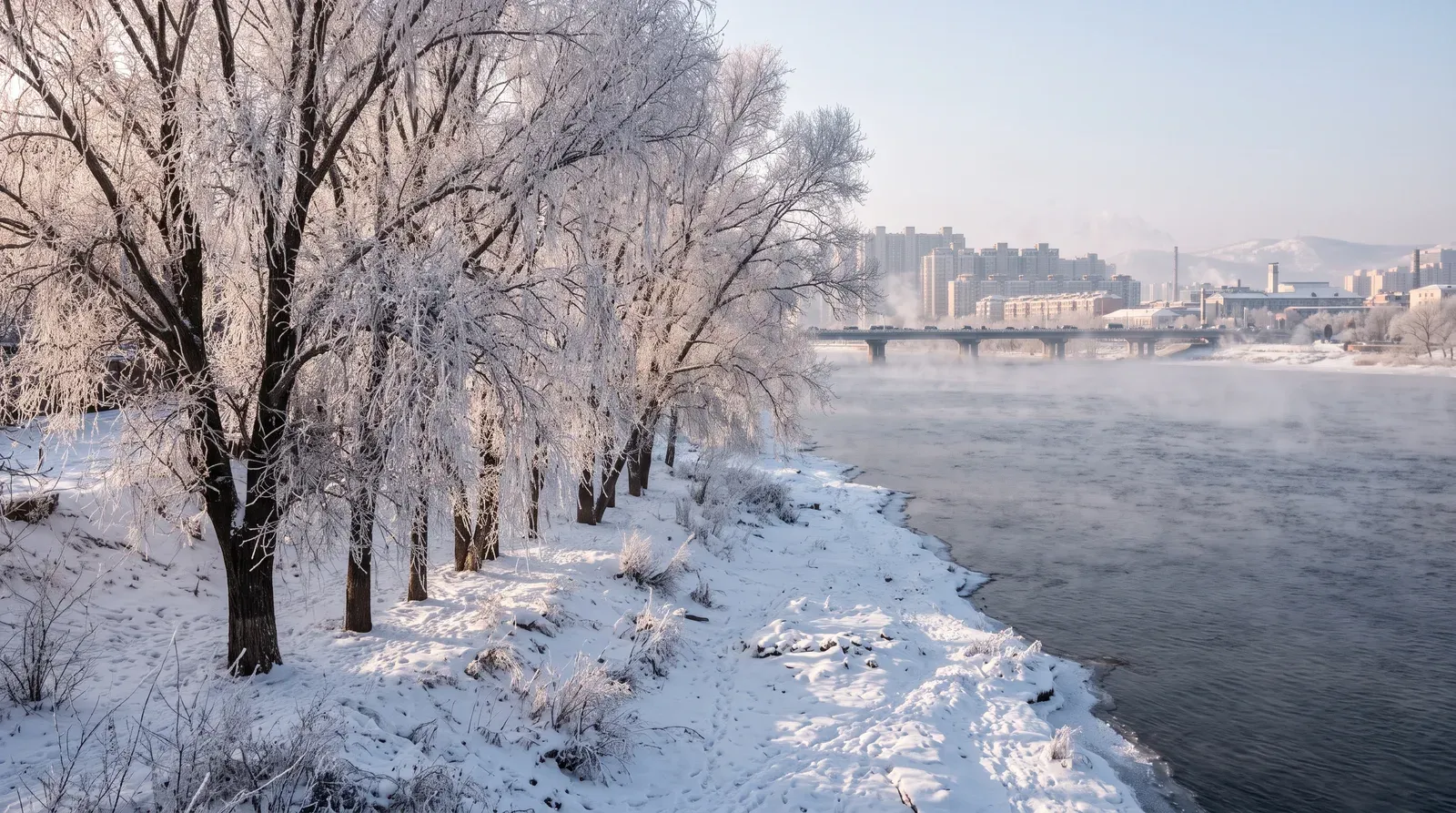
Jilin City has four distinct seasons, with a long, cold, and dry winter lasting from November to March of the following year. The average temperature in January is -15.4°C, while summer is warm and rainy, with an average July temperature of 23.3°C. Jilin rime mostly appears from January to February each year. In winter, the Songhua River does not freeze, releasing warm water vapor that condenses on willow branches along the riverbanks when meeting cold night air of -20°C. If you travel to Northeast China in winter, you can also combine Jilin City with Harbin winter travel in the same itinerary.
How to Get to Jilin City and Plan Transportation?
Changchun Longjia International Airport serves both Changchun and Jilin City. The Changchun-Jilin Intercity Railway includes Longjia Station next to the terminal. After arriving, travelers can take a high-speed train directly from Longjia Station to Jilin Railway Station, experiencing convenient China high-speed train travel. The core sights in Jilin City are mainly distributed around the urban area and along the Songhua River. For getting around the city, you can choose public transit, or your travel designer can arrange a private car and your driver.
What Are the Main Sights in Jilin City?
Sights in Jilin City include rivers, lakes, astronomical geology, and historic architectural complexes. Lake Songhua, also known as the Fengman Reservoir, is an artificial lake formed in 1937 by damming the Songhua River to build the Fengman Hydropower Station. With a surface area of 550 square kilometers and a maximum water storage capacity of 10.8 billion cubic meters, it is the largest lake in Jilin Province and a national scenic area. The Jilin City Museum displays the Jilin meteorite No. 1, which fell during the Jilin meteorite shower on March 8, 1976; weighing 1,770 kilograms, it is the heaviest known stone meteorite in the world. Beishan Scenic Area houses a complex of Buddhist, Taoist, and Confucian temples, including Guandi Temple built in 1701, Yaowang Temple built in 1738, and Yuhuang Pavilion built in 1776; the Beishan Temple Fair was listed as a national intangible cultural heritage item in 2011. The Beishan civil defense shelter was transformed into the Beishan All-Season Cross-Country Ski Resort and began operating in 2019, featuring a 1,308-meter indoor ski trail as Asia's first all-weather standardized ski training venue.
In terms of cultural relics, museums, and alpine skiing: Jilin Confucian Temple was first built in 1736 (the first year of the Qianlong Emperor's reign) and moved to its current site in 1909. It was the first Confucian temple built by the Qing dynasty in Northeast China. Its main Dacheng Hall is eleven bays wide and five bays deep, and it is a Major Historical and Cultural Site Protected at the National Level. The Sacred Heart Church of Jilin was completed in 1926 and sits on the north side of Jilin Bridge along Songjiang Middle Road; it is a Gothic brick-and-stone church with a 45-meter bell tower and is also a national protected historical site. The Longtanshan Mountain City, located inside Longtanshan Park, is an ancient fortress ruin from Goguryeo and the Buyeo Kingdom, measuring 2,396 meters in total length with walls exceeding 10 meters at the highest point, and is listed in the sixth batch of Major Historical and Cultural Sites Protected at the National Level. Beidahu Ski Resort in Yongji County is 56 kilometers from downtown Jilin City, with an elevation of 1,404.8 meters and a maximum vertical drop of 870 meters; it hosted all skiing events of the 2007 Asian Winter Games.
How to Pace Your Trip?
A 2 to 3-day pace is suggested for visiting Jilin City. On day one, stroll along Songjiang Middle Road after arrival to view the Sacred Heart Church of Jilin up close, then visit Jilin Confucian Temple and the Jilin meteorite No. 1 at the Jilin City Museum. On day two, look for rime along the Songhua River in the early morning (January to February), visit the Qing dynasty temple complex or experience the indoor cross-country ski venue at Beishan Scenic Area in the morning, and head to Longtanshan Park in the afternoon to explore the ancient mountain city ruins. On day three, arrange a visit to Lake Songhua Scenic Area; ski enthusiasts can also head to Beidahu Ski Resort in Yongji County to experience professional ski trails. Your travel designer can tailor the travel pace to your needs and help arrange a comfortable vehicle and your driver.
Sources
Jilin City - Wikipedia
Jilin City - Wikipedia
Lake Songhua - Wikipedia
Jilin Meteorite Shower - Wikipedia
Beidahu Ski Resort - Wikipedia
Jilin City Beishan Scenic Area - Wikipedia
Jilin Confucian Temple - Wikipedia
Sacred Heart Church of Jilin - Wikipedia
Longtanshan Mountain City - Wikipedia
All sources verified on November 17, 2026.
Related travel tips
Replies 08:30–22:00 your time · Free to ask.