
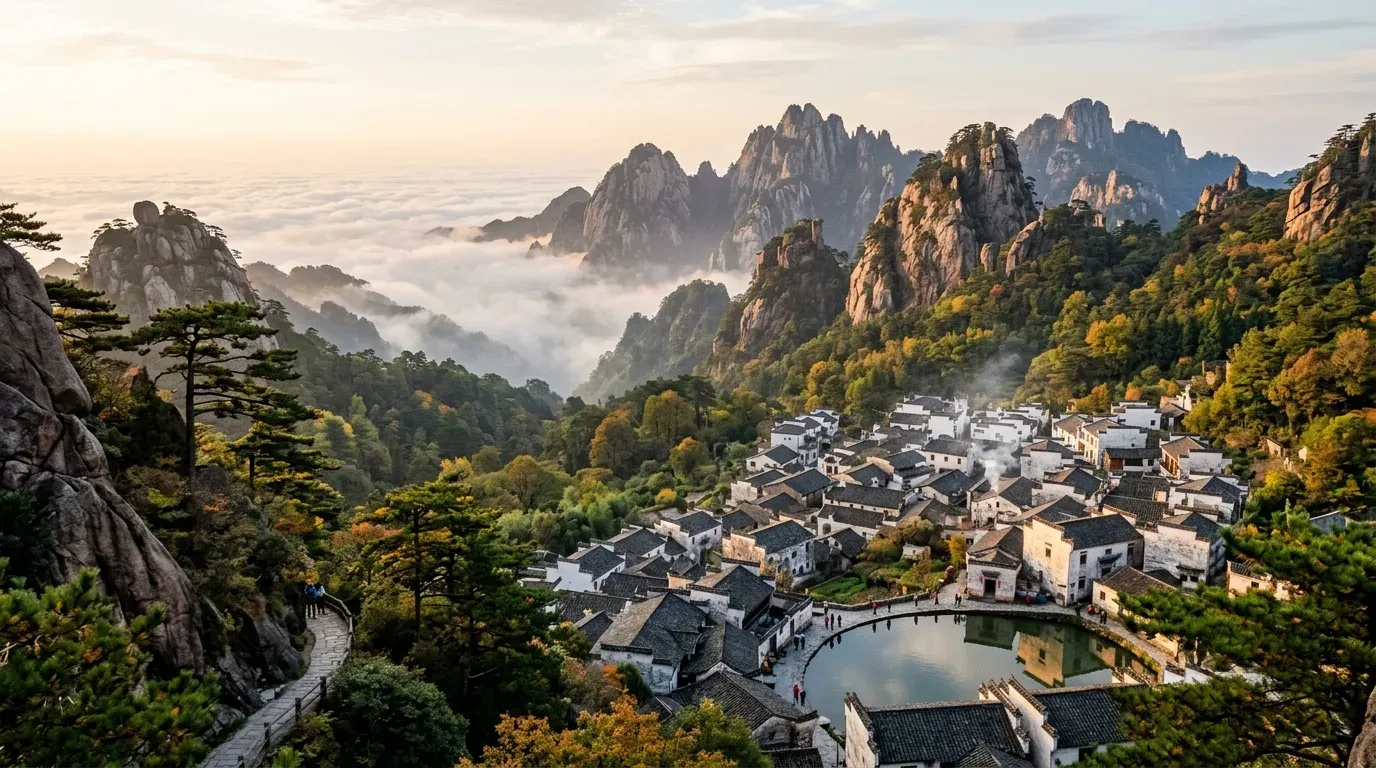
Huangshan
Huangshan City is located in southern Anhui Province. In November 1987, the State Council approved dissolving the Huizhou region and establishing the prefecture-level city. The destination brings together renowned mountain peaks and deep Huizhou heritage, making it well suited for an in-depth trip that combines natural scenery with cultural exploration. Spending 3 to 4 days is usually recommended to tour the mountain scenic area and nearby ancient settlements.
Key points
Touring Huangshan and nearby ancient settlements typically takes 3 to 4 days. You can spend 1 night atop the mountain to split the front and back routes across 2 days, then reserve 1 to 2 days for Hongcun and Xidi. Note that Lotus Peak and Celestial Capital Peak rotate on a 5-year closure cycle for environmental conservation.
Huangshan City is located in southern Anhui Province. In November 1987, the State Council approved dissolving the Huizhou region and establishing the prefecture-level city. The destination brings together renowned mountain peaks and deep Huizhou heritage, making it well suited for an in-depth trip that combines natural scenery with cultural exploration. Spending 3 to 4 days is usually recommended to tour the mountain scenic area and nearby ancient settlements.
When is the weather and scenery best on the mountain?
The scenic area combines a humid subtropical monsoon climate with deep valley terrain. Meteorological data from Bright Summit shows an average daily temperature of about 8.0°C throughout the year, with July being the hottest month at a daily average of 17.5°C and January the coldest at -2.4°C. Annual rainfall peaks in June (458.5 mm) and drops to its lowest in December (50.5 mm). Clouds and mist appear on more than 250 days a year. Driven by humid air currents, stratocumulus clouds gather into five cloud seas: the East Sea, South Sea, West Sea, North Sea, and Sky Sea. Visitors can also encounter Buddha's Light several times a month on average. Spring and autumn bring pleasant temperatures and drifting clouds, midsummer offers a cool retreat, and winter features snowy scenery and hot springs that stay at 42°C year-round.
How do you get to the area and travel locally?
Traveling to Huangshan, China is convenient via China high-speed rail. The high-speed rail line to Hangzhou has shortened travel time to about 1.5 hours, and the Hefei-Fuzhou line connects destinations north and south. For air travel, you can fly directly into Tunxi International Airport. When visiting the mountain scenic area, all travelers must transfer at the South Gate onto an eco-bus costing 19 yuan one way, and then choose between hiking up or taking a cable car for 80 yuan one way. Admission to the scenic area is 230 yuan during the peak season and 120 yuan in the low season. If you are traveling with family, your travel designer can also arrange your driver for door-to-door transfers throughout the trip.
What are the classic sights to see in the region?
As a UNESCO World Cultural and Natural Heritage site, the mountain features over 50 kilometers of walking paths and more than 60,000 carved stone steps. In the core scenic area, the three main summits are Lotus Peak at 1,864 meters, Bright Summit at 1,860 meters, and Celestial Capital Peak at 1,810 meters. The iconic Welcoming Pine stands east of Yuping Pavilion on the front mountain, the Sea-Exploring Pine grows beside Carp's Backbone on Celestial Capital Peak, and the Black Tiger Pine stands at the Beihai trail junction. Cultural sights below the mountains are equally rich. Inscribed as a UNESCO World Heritage site in 2000, Hongcun features an ox-shaped water system where Leigang Hill forms the head, Moon Pond the heart, and South Lake the belly. Built in 1855, Chengzhi Hall contains 9 courtyards and more than 60 rooms. Nearby Xidi Village preserves 124 historic residences and 3 ancestral halls. In addition, Tunxi Ancient Street from the Song Dynasty, spanning about 1 kilometer, and Shexian Ancient City, established as a county during the Qin dynasty, are great places to admire Huizhou woodcarvings and traditional architecture.
How should you pace your visit?
Good trip planning helps make the mountain hiking experience much smoother. The scenic area operates an alternating closure system for Lotus Peak and Celestial Capital Peak, usually opening each peak for 5 years before closing it for conservation. Staying one night at a mountaintop hotel allows you to split the ascent and descent across two days via different routes on the front and back mountains, avoiding the rush of a single-day climb while leaving ample time for sunrises and cloud seas. After descending, you can slow down and spend one to two days wandering Hongcun, Xidi, and Tunxi, tasting classic Chinese food from Huizhou cuisine, known for deep color, generous use of oil, controlled heat, and techniques of braising, stewing, and steaming.
Sources
Mount Huang - Wikipedia
Mount Huang - Wikipedia
Mount Huang City - Wikipedia
Xidi - Wikipedia
Hongcun - Wikipedia
Tunxi Ancient Street - Wikipedia
She County - Wikipedia
Anhui cuisine - Wikipedia
Sources verified on November 16, 2026
Related travel tips
Replies 08:30–22:00 your time · Free to ask.