
Foshan
Foshan sits in the heart of the Pearl River Delta in Guangdong Province, directly neighboring Guangzhou. It administers 5 municipal districts: Chancheng, Shunde, Nanhai, Sanshui, and Gaoming, covering a total area of about 3,797.72 square kilometers. During the Chenghua and Hongzhi reigns of the Ming Dynasty, Foshan flourished in commerce and industry. It was known alongside Hankou in Hubei, Jingdezhen in Jiangxi, and Zhuxianzhen in Henan as one of the "Four Famous Ancient Towns" of China. The city appeals to travelers interested in Lingnan architecture, martial arts, and Cantonese culinary traditions. A stay of 2 to 3 days is usually recommended, or you can combine it with a visit to Guangzhou.
Key points
Foshan sits in the heart of the Pearl River Delta next to Guangzhou and administers 5 municipal districts; 2 to 3 days is usually enough, or you can pair it with Guangzhou. Watch the traditional lion dance at the Ancestral Temple in Chancheng, taste small portions along Huagai Road in Shunde, and travel with your driver to skip public transit transfers.
Foshan sits in the heart of the Pearl River Delta in Guangdong Province, directly neighboring Guangzhou. It administers 5 municipal districts: Chancheng, Shunde, Nanhai, Sanshui, and Gaoming, covering a total area of about 3,797.72 square kilometers. During the Chenghua and Hongzhi reigns of the Ming Dynasty, Foshan flourished in commerce and industry. It was known alongside Hankou in Hubei, Jingdezhen in Jiangxi, and Zhuxianzhen in Henan as one of the "Four Famous Ancient Towns" of China. The city appeals to travelers interested in Lingnan architecture, martial arts, and Cantonese culinary traditions. A stay of 2 to 3 days is usually recommended, or you can combine it with a visit to Guangzhou.
Which places in Foshan are worth a visit?
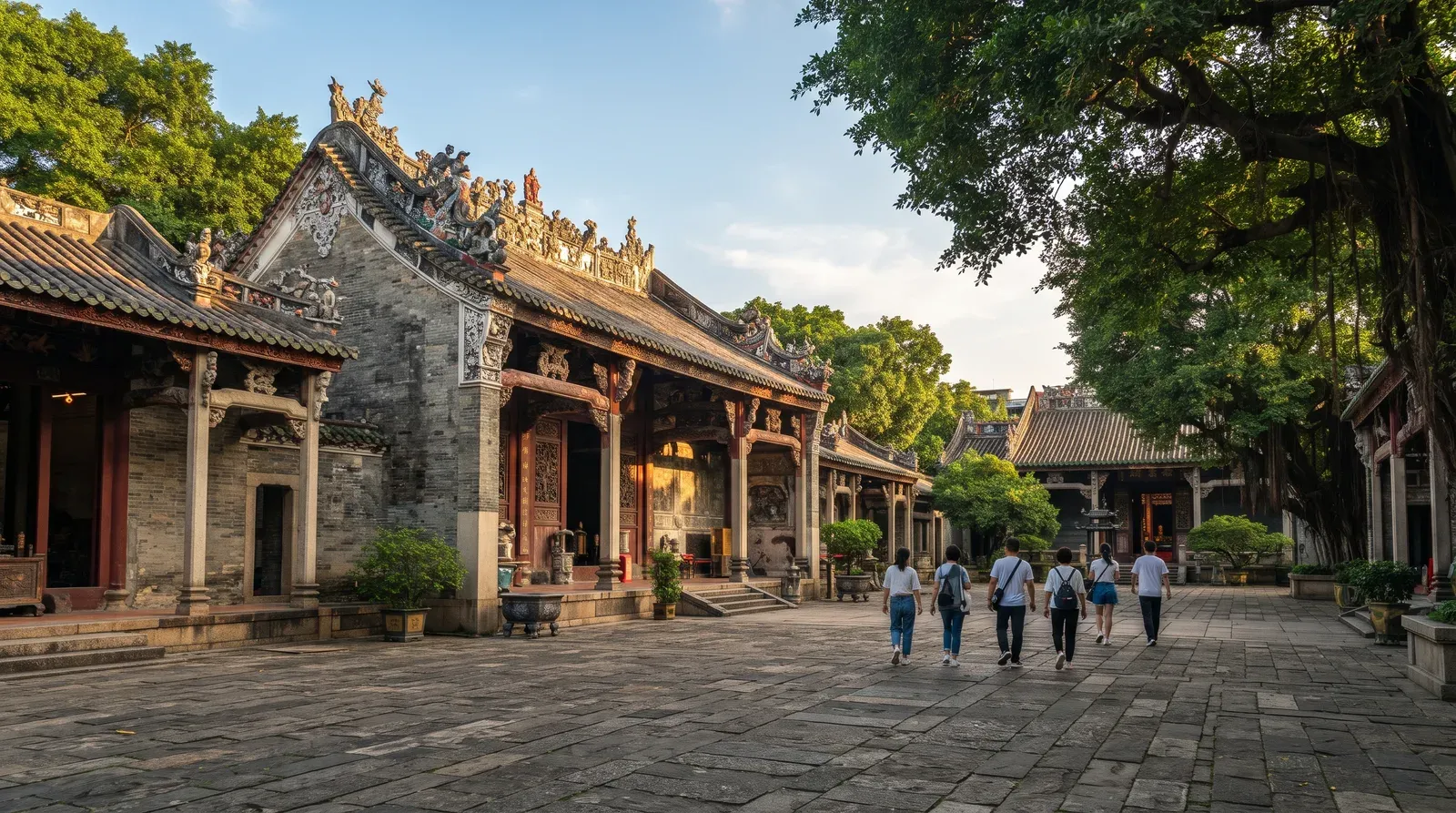
The central urban area of Foshan is also called Chancheng. Its name comes from the second year of the Zhenguan era in the Tang Dynasty, when local villagers unearthed three bronze Buddha statues at Tapogang. The city's major historical site is the Foshan Ancestral Temple, built during the Yuanfeng era of the Northern Song Dynasty. Dedicated to the Taoist deity Xuantian Shangdi, this complex spans 32,000 square meters and is a Major Historical and Cultural Site Protected at the National Level as well as a National First-Grade Museum. Inside, you will find the historic temple complex, a Confucius Temple, the Wong Fei-hung Memorial Hall, and the Ip Man Hall. The Wanfu Platform, built in the fifteenth year of the Shunzhi reign of the Qing Dynasty, is an ornate and finely preserved traditional opera stage in the Lingnan region where you can watch traditional lion dance performances. In Shunde District, Qinghui Garden features water courtyards, while Shunfeng Mountain Park offers open green spaces. In Shiwan, the historic Nanfeng Ancient Kiln introduces visitors to traditional Lingnan pottery traditions.
How can you explore classic Cantonese food in Foshan?
Cantonese cuisine has a longstanding reputation that "skilled chefs come from Fengcheng." In 2014, UNESCO designated Shunde District (historically called Fengcheng) as a City of Gastronomy. Signature dishes include Shunde double-skin milk pudding, made from local rich buffalo milk and steamed twice to form its delicate skins; Chencun flat rice noodles, created by Huang Dan in 1927 and known for being thin, smooth, and tender; and Lunjiao cake, a fermented steamed rice cake dating back to the Ming Dynasty. Other local specialties include salt-and-oil steamed river fish, raw fish salad (lao yusheng), Jun'an steamed pork, and Lecong fish puffs. When sampling snacks along Huagai Road Pedestrian Street in Shunde, order small portions of each item so you can try multiple flavors. Traditional Foshan specialties also include Blind Man cakes created during the Jiaqing reign of the Qing Dynasty, Zhouhou chicken, and Xiqiao big cakes. Blind Man cakes have a long shelf life, making them convenient souvenirs to bring home.
How do you get to Foshan and get around?
Rail transit between Guangzhou and Foshan is convenient. In addition to the Guangfo Metro line connecting both cities, the west extension of Guangzhou Metro Line 7 operates 7 stations within Shunde District. If you prefer a more relaxed pace, driving between central Guangzhou and Shunde or Chancheng takes about 1 hour each way (about 50 kilometers). Traveling privately with your driver avoids the hassle of transferring between public transit lines and suits families traveling with elders and children.
How should you pace your visit to Foshan?
If you plan a 2 to 3 day short trip, consider the Guangzhou & Foshan 3-Day Private Tour. It connects Guangzhou's Xiguan old streets, Shamian Island, and a Pearl River night cruise with Shunde's Qinghui Garden, Huagai Road food street, and the lion dance show at Foshan Ancestral Temple. With more time, the Guangzhou, Shunde & Foshan 5-Day Private Tour allows a slower pace, adding Shunfeng Mountain Park, the Nanfeng Ancient Kiln, and major Guangzhou landmarks. If you visit around the Dragon Boat Festival, you can also watch the Diejiao curve dragon boat race, an intangible cultural heritage tradition dating to the Ming Dynasty. Over 40 crew members and their steersman navigate tight waterway bends at drifting speeds, embodying the local motto: "better to crash than to row slowly."
Sources
Shunde cuisine - Wikipedia
Shunde District - Wikipedia
Double skin milk - Wikipedia
Chencun rice noodles - Wikipedia
Lunjiao cake - Wikipedia
Blind Man Cakes - Wikipedia
Foshan - Wikipedia
Guangzhou & Foshan 3-Day Private Tour: Old Town & Lion Dance
Guangzhou, Shunde & Foshan 5-Day Private Tour: Lingnan Food
Foshan Ancestral Temple - Wikipedia
Pearl River Delta - Wikipedia
Diejiao Dragon Boat Racing Culture - Baidu Baike
Sources verified on November 8, 2026
Related travel tips
Replies 08:30–22:00 your time · Free to ask.