
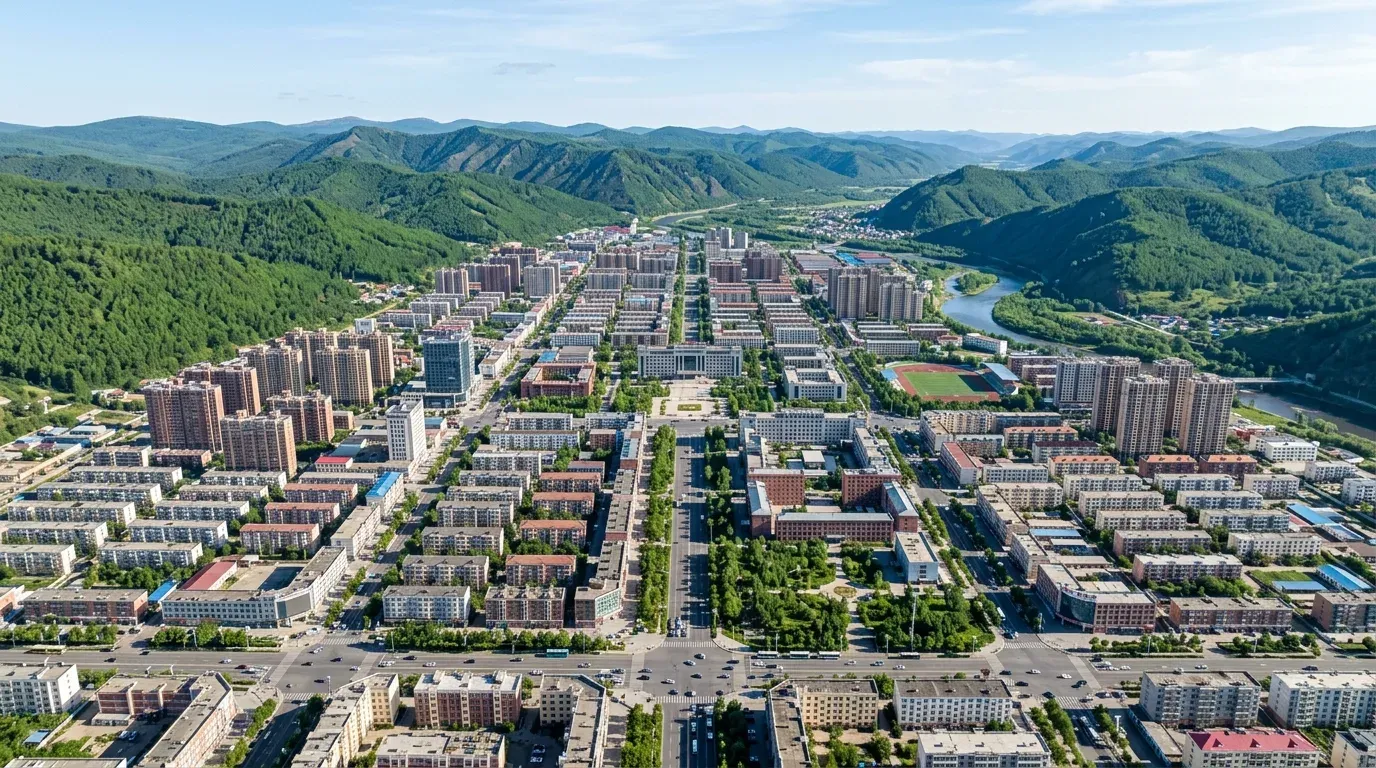
Daxing'anling
Daxing'anling Prefecture is China's northernmost prefecture-level division, with its administrative office at No. 1 Jingguan Avenue, Jiagedaqi District, and a total area of 82,929 square kilometers. The region offers forest exploration, extreme winter snow and ice, and local customs along the northern border. Visiting the core sights in Mohe and neighboring border villages usually takes 3 to 4 days.
Key points
Visiting Daxing'anling's core sights around Mohe and nearby border villages typically requires 3 to 4 days. China's true geographic northernmost point lies at Wusuli Shoal rather than Beiji Village. With the annual frozen period lasting 180 to 200 days, icy winter roads make it advisable to have your travel designer arrange a hired vehicle with your driver.
Daxing'anling Prefecture is China's northernmost prefecture-level division, with its administrative office at No. 1 Jingguan Avenue, Jiagedaqi District, and a total area of 82,929 square kilometers. The region offers forest exploration, extreme winter snow and ice, and local customs along the northern border. Visiting the core sights in Mohe and neighboring border villages usually takes 3 to 4 days.
| Item | Details |
|---|---|
| Administrative seat | No. 1 Jingguan Avenue, Jiagedaqi District (total area 82,929 square kilometers) |
| Average annual temperature | -2.6℃ |
| Coldest and warmest monthly averages | Coldest month January averages -22.2℃, warmest month July averages 19.4℃ |
| Annual frozen period | 180 to 200 days |
| Main civil airports | Mohe Gulian Airport, Daxing'anling Oroqen Airport |
| Long-distance transit | Harbin is about 1,200 kilometers from Mohe, and trains are the main public transit |
When Is the Best Time to Visit Daxing'anling?
Winter in Mohe begins in early to mid-October and lasts until late April or early May of the following year. For nearly 7 months of the year, average temperatures stay below freezing, and the frost-free period is under 90 days. Extreme temperatures range between -53.0℃ and 39.3℃. A low of -50℃ was recorded on January 20, 2023, dropping to -53℃ at 07:00 on January 22. That broke the previous national record of -52.3℃ set in 1969, marking the lowest temperature ever recorded in China.
Visiting in winter lets you see extreme cold in action. Early in the morning at minus 40℃, when travelers throw hot water into the air from a thermos, it freezes instantly into ice crystals, creating an arc of white ice mist known locally as "throwing water into ice." At the Mohe Ice and Snow Culture Festival held around December 21 each year, you can try ice dragon boating, snowmobiles, and traditional sleds, as well as piping-hot iron pot stewed fish and boiled dumplings.
If you prefer cooler weather, the month around the summer solstice (June 21) offers a very different experience. Beiji Village is not inside the Arctic Circle, so true polar day does not occur, but clear nights bring the "white night" phenomenon where twilight never fully fades. According to astronomical observations during these white nights, the sky is darkest at 23:52 Beijing Time, with the faint glow always centered due north.
Tip: Daxing'anling has a frost-free period of only 80 to 110 days each year. Dressing warmly is the top priority for winter travel. Phones and cameras drain power quickly or shut off in subzero temperatures, so bring insulated cases or warming packs for your devices when shooting outdoors.
Common Misconceptions: Auroras and China's Northernmost Point
When planning a trip to Mohe, the two most common misconceptions involve seeing the northern lights and finding China's northernmost point. Promotional materials often confuse the summer solstice white nights with auroras, and popular Beiji Village is not the country's actual northernmost geographical point on land.
| Common misconception | Facts and practical advice |
|---|---|
| Seeing the northern lights at Beiji Village during the summer solstice | Mohe Weather Station recorded auroras only 58 times between 1957 and 2010, making naked-eye sightings rare; short summer nights make viewing even harder, and noctilucent clouds or white nights are often mistaken for auroras |
| Beiji Village is China's northernmost point | The true northernmost point lies near the Heilongjiang channel at Wusuli Shoal in Tuqiang Town, and China's northernmost village is Beihong Village |
| Northernmost land border location | During the low-water season, Wusuli Shoal's northernmost land point nears 53°33′32″ N, while Beiji Village is simply a well-known themed tourist village |
China's true geographic northernmost point lies near the main Heilongjiang navigation channel at Wusuli Shoal on the northern edge of Tuqiang Town, at coordinates 53°33′37″ N, 123°16′12″ E, about 61 kilometers east-northeast of Beiji Village. China's northernmost settlement is Beihong Village, located just 13.5 kilometers in a straight line from Wusuli Shoal.
If your main goal is reaching China's true northernmost milestone, focus your itinerary on Wusuli Shoal in Tuqiang Town and Beihong Village. If you prefer more developed amenities, hotels, and seasonal festivals in a border town setting, Beiji Village is much better equipped.
What Are the Top Places to Visit in Daxing'anling?
The landscape here spans primeval forests, river bends along the border, and frontier villages. The First Bay of the Heilongjiang River lies about 30 kilometers from Beiji Village. From the viewing platform, you look down at a massive horseshoe bend carved by the border river around a lush peninsula. Inside Beiji Village, you will find Santa Claus Village and Beiji Reindeer Park, where visitors can feed gentle reindeer up close and learn about traditional Evenki reindeer culture.
Beyond the river scenery around Mohe, the interior forest holds deep historical roots. On the west wall of Gaxian Cave in northern Daxing'anling, a 201-character stone inscription in clerical script was carved by imperial envoy Li Chang in 443 during the fourth year of the Taiping Zhenjun era under Emperor Taiwu of the Northern Wei dynasty. The cave is recognized as the ancestral shrine of the ancient Tuoba Xianbei people. Further south in Huzhong District, key sights include Mount Dabaishan, Huzhong National Forest Park, Huzhong National Nature Reserve, and Cangshan Stone Forest Provincial Geological Park.
| Sight | Admission | Opening hours | Location details |
|---|---|---|---|
| Mohe Daxing'anling "May 6" Fire Memorial Museum | Free | 08:00 to 17:00 | Near downtown Mohe |
| First Bay of the Heilongjiang River | Around 50 yuan | 08:00 to 18:00 | About 30 kilometers from Beiji Village |
| Jiuqu Shibawan National Wetland Park | 80 yuan | 07:00 to 18:00 | About 15 kilometers from downtown Mohe |
| Santa Claus Village | 60 yuan | 08:30 to 17:30 | Inside Beiji Village, Mohe |
| Beiji Reindeer Park | 50 yuan | 08:30 to 17:00 | Near Santa Claus Village |
Tip: The Mohe Daxing'anling "May 6" Fire Memorial Museum offers free admission and sits near downtown, making it easy to schedule for the half-day you arrive or depart. Jiuqu Shibawan Wetland Park is about 15 kilometers from downtown and works well for an early morning visit to see the forest and winding waterways.
How to Get to Daxing'anling and Travel Around
For long-distance arrivals, Daxing'anling Prefecture has two civil airports. Mohe Gulian Airport, located 9 kilometers southwest of Xilinji Town, is China's northernmost civil airport by latitude and the first airport in China built on permafrost. The airport in Jiagedaqi, the administrative seat of Daxing'anling, was originally named Jiagedaqi Gaxian Airport. It opened for commercial flights on June 18, 2012, and was officially renamed Daxing'anling Oroqen Airport on February 25, 2021.
Trains remain the classic way to reach this forest region. Harbin and Mohe are about 1,200 kilometers apart, with no direct intercity buses, so trains serve as the main public transport between them. If you start from the Heilongjiang provincial capital, check our Harbin winter travel guide to plan both destinations together.
Local transport in the forest area is spread out. Scheduled buses run from downtown Mohe to Beiji Village daily at 10:50 and 16:00, with one-way fares of 25 yuan. However, sights around Mohe sit far apart and public transit options are sparse, so most travelers get around by hired vehicle, group tour, or self-driving.
Tip: Driving yourself through the forest in winter requires caution due to icy roads and fast weather changes. If you have little experience on ice and snow, you can have your travel designer arrange a hired vehicle with a driver who knows the local roads well.
Local Food and Intangible Cultural Heritage
The region's forests and clean waterways produce rich local ingredients. Wild blueberries from the primary forest are a registered national geographical indication product of Mohe. They are often processed into dried blueberries, jams, and juices for sale. In the rivers, Mohe is rich in cold-water burbot and chum salmon. Salmon is served fresh or canned, and salmon roe is an internationally recognized delicacy.
Beyond food, you can explore distinct ethnic crafts. Oroqen birch bark craftsmanship was added to China's first national intangible cultural heritage list in 2006. While visiting Daxing'anling, travelers can see demonstrations and try crafting birch bark boxes or bark paintings, learning about the hunting traditions passed down through generations.
Sources
Mohe City - Wikipedia
Mohe City - Chinese Wikipedia
Beiji Village - Chinese Wikipedia
Tuqiang Town - Chinese Wikipedia
Mohe Gulian Airport - Chinese Wikipedia
Daxing'anling Oroqen Airport - Chinese Wikipedia
Daxing'anling Prefecture - Chinese Wikipedia
Gaxian Cave Site - Chinese Wikipedia
Huzhong District - Chinese Wikipedia
Oroqen People - Chinese Wikipedia
Sources verified on November 19, 2026.
Related travel tips
Replies 08:30–22:00 your time · Free to ask.