
Datong
Datong is a prefecture-level city in Shanxi Province, China, situated in the surrounding basin at an average elevation of 1,040 meters. It borders Inner Mongolia to the north and west, and Hebei Province to the east, with a resident population of 3,105,591 according to the 2020 census. The area once served as Pingcheng, capital of the Xianbei-led Northern Wei Dynasty, and later as Xijing, the western capital of the Jin Dynasty. With its world-renowned cave art and Liao and Jin dynasty ancient architecture, it is well suited for in-depth trips focused on history and historical buildings. A stay of 2 to 3 days is usually recommended to explore the main historical sites.
Key points
Datong is a Shanxi city of Northern Wei cave art and Liao and Jin wooden halls, best seen over 2 to 3 days. The Yungang Grottoes, about 16 kilometers west of town, hold 252 caves and 51,000 statues, and high-speed trains from Beijing take about 2 hours. Day-night temperature swings are large, so pack a windproof jacket.
Datong is a prefecture-level city in Shanxi Province, China, situated in the surrounding basin at an average elevation of 1,040 meters. It borders Inner Mongolia to the north and west, and Hebei Province to the east, with a resident population of 3,105,591 according to the 2020 census. The area once served as Pingcheng, capital of the Xianbei-led Northern Wei Dynasty, and later as Xijing, the western capital of the Jin Dynasty. With its world-renowned cave art and Liao and Jin dynasty ancient architecture, it is well suited for in-depth trips focused on history and historical buildings. A stay of 2 to 3 days is usually recommended to explore the main historical sites.
Which places are worth a special visit in Datong?
The city served as the capital of the Northern Wei Dynasty between 398 and 494 AD (then known as Pingcheng), received its present name in 1048 AD, and later became the western capital, Xijing, of the Jin Dynasty, building up a wealth of ancient artistic treasures:
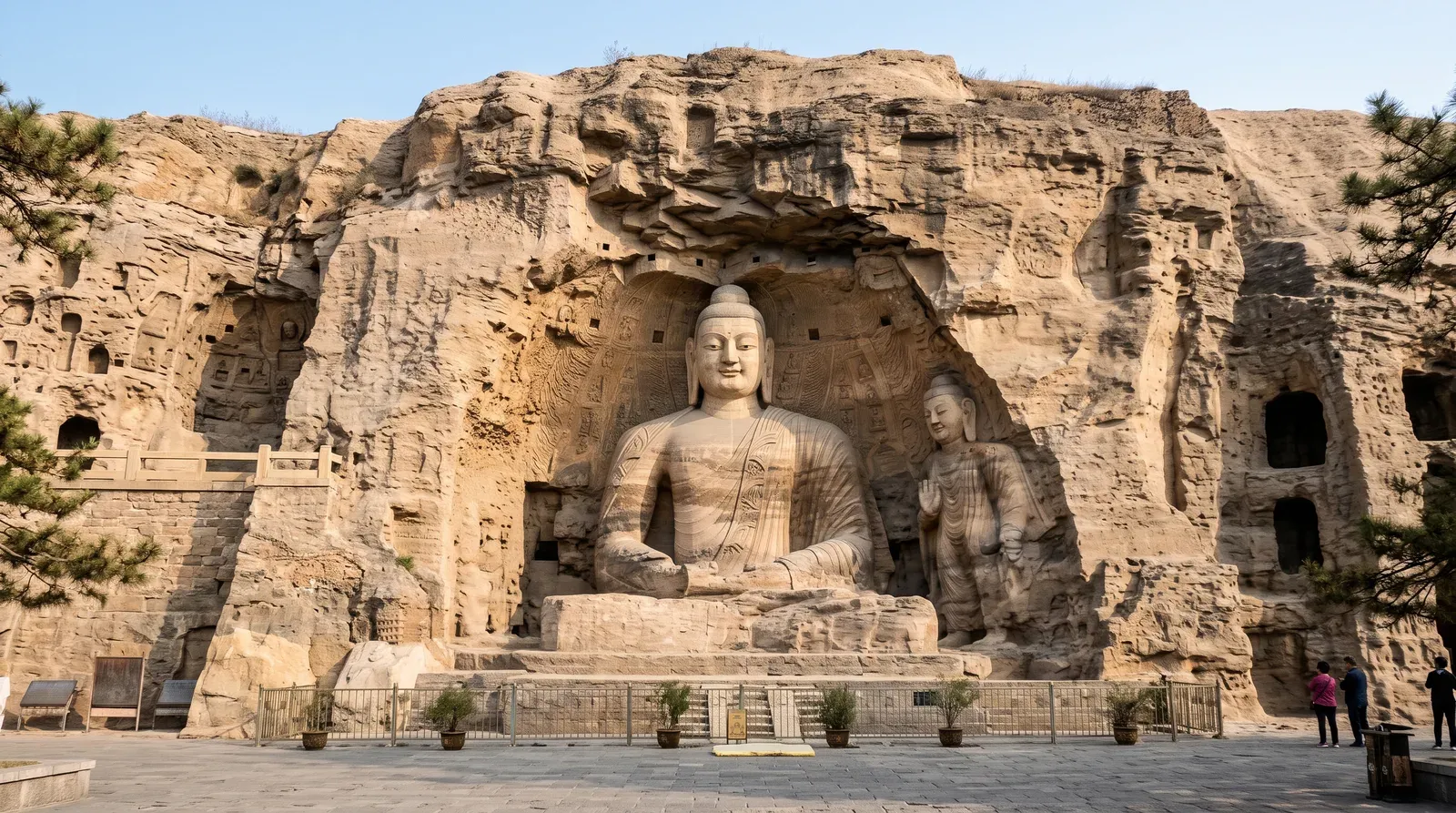
Yungang Grottoes: Inscribed as a UNESCO World Heritage Site in 2001. Located in the Shili River valley at the southern foot of Wuzhou Mountain, about 16 kilometers west of the urban center, the grottoes were carved into sandstone cliffs about 2,600 feet long and 30 to 60 feet high. Today, 252 caves and 51,000 statues remain, among which the five caves created under monk Tan Yao represent the first peak of Chinese Buddhist cave art.
Hanging Temple: Standing on a sheer cliff 75 meters above the ground at the foot of Mount Heng in Hunyuan County, about 64 kilometers southeast of the city center. Founded more than 1,500 years ago during the Northern Wei Dynasty, the temple is supported by crossbeams inserted into chisel holes in the cliff face. The Hall of Three Religions enshrines Sakyamuni Buddha in the center, Laozi on the left, and Confucius on the right, making it a rare temple that brings together Buddhism, Taoism, and Confucianism.
Liao and Jin ancient architecture and the Ming Nine-Dragon Wall: Huayan Temple in the city was founded in 1038 during the Liao Dynasty. Its surviving Main Hall, rebuilt in 1140 during the Jin Dynasty, faces east, measures nine bays wide and five bays deep, and covers a floor area of 1,559 square meters, making it one of the largest surviving Buddhist halls from the Liao and Jin periods in China. Shanhua Temple was founded during the Kaiyuan era of the Tang Dynasty (713 to 741); its Main Hall was built in the 11th century during the Liao Dynasty, measuring seven bays wide and five bays deep (40.5 meters by 25 meters), while the mountain gate and Hall of Three Sages are Jin Dynasty structures. The Nine-Dragon Wall, built during the Hongwu reign of the Ming Dynasty, is 45.5 meters long, 8 meters high, and 2.02 meters thick, making it the earliest and largest surviving nine-dragon screen in China. In addition, the ancient city wall, with a perimeter of 7,270.7 meters and a height of about 14 meters, encloses an urban area of 2.63 square kilometers, bordered by a moat about 10 meters wide.
Local specialties: In addition to seeing the sights, you can also taste the most famous local culinary staples, knife-cut noodles and Shanxi extra aged vinegar.
How to get there and travel locally?
The city is located about 250 kilometers west of Beijing. With the opening of China high-speed rail, train travel time from Beijing has dropped from about 6 hours on regular trains to about 2 hours, making travel between the two cities fast and simple. Locally, Huayan Temple, Shanhua Temple, the Nine-Dragon Wall, and the city wall are close to each other in the old town, so getting around the urban center is easy. For trips to the Yungang Grottoes 16 kilometers to the west and the Hanging Temple about 64 kilometers to the southeast, your travel designer can arrange your driver, sparing you the hassle of public bus transfers and transit delays.
When is the weather most suitable for a visit?
The city experiences a continental monsoon steppe climate, with an annual average temperature of 7.33°C. Summers are cool and comfortable, with an average July temperature of 22.6°C, making it a welcome summer retreat in northern China. Winters are cold and dry, with an average January temperature of -10.5°C. More than three-quarters of the annual precipitation falls between June and September, and the average diurnal temperature range reaches 13.2°C. Regardless of when you visit, temperature swings between morning and night are generally noticeable, so bringing a windproof jacket and keeping skin hydrated are recommended.
How should you pace your visit?
A pace of 2 to 3 days works well to take in the city without rushing. You can dedicate one day to the Yungang Grottoes, then return to the city to visit Huayan Temple, Shanhua Temple, and the Nine-Dragon Wall, followed by an evening stroll on the ancient city wall. You can spend another day heading to the foot of Mount Heng in Hunyuan County to look up at the Hanging Temple 75 meters up the cliff face, enjoying authentic knife-cut noodles with aged vinegar during your travels, balancing the distinct appeal of grottoes, the cliffside temple, and historic wooden architecture.
Sources
Datong - Wikipedia
Yungang Grottoes
Yungang Grottoes - Wikipedia
Hanging Temple - Wikipedia
Huayan Temple - Wikipedia
Shanhua Temple - Wikipedia
Nine-Dragon Wall - Wikipedia
City Wall - Wikipedia
Sources verified on Nov 17, 2026
Related travel tips
Replies 08:30–22:00 your time · Free to ask.