
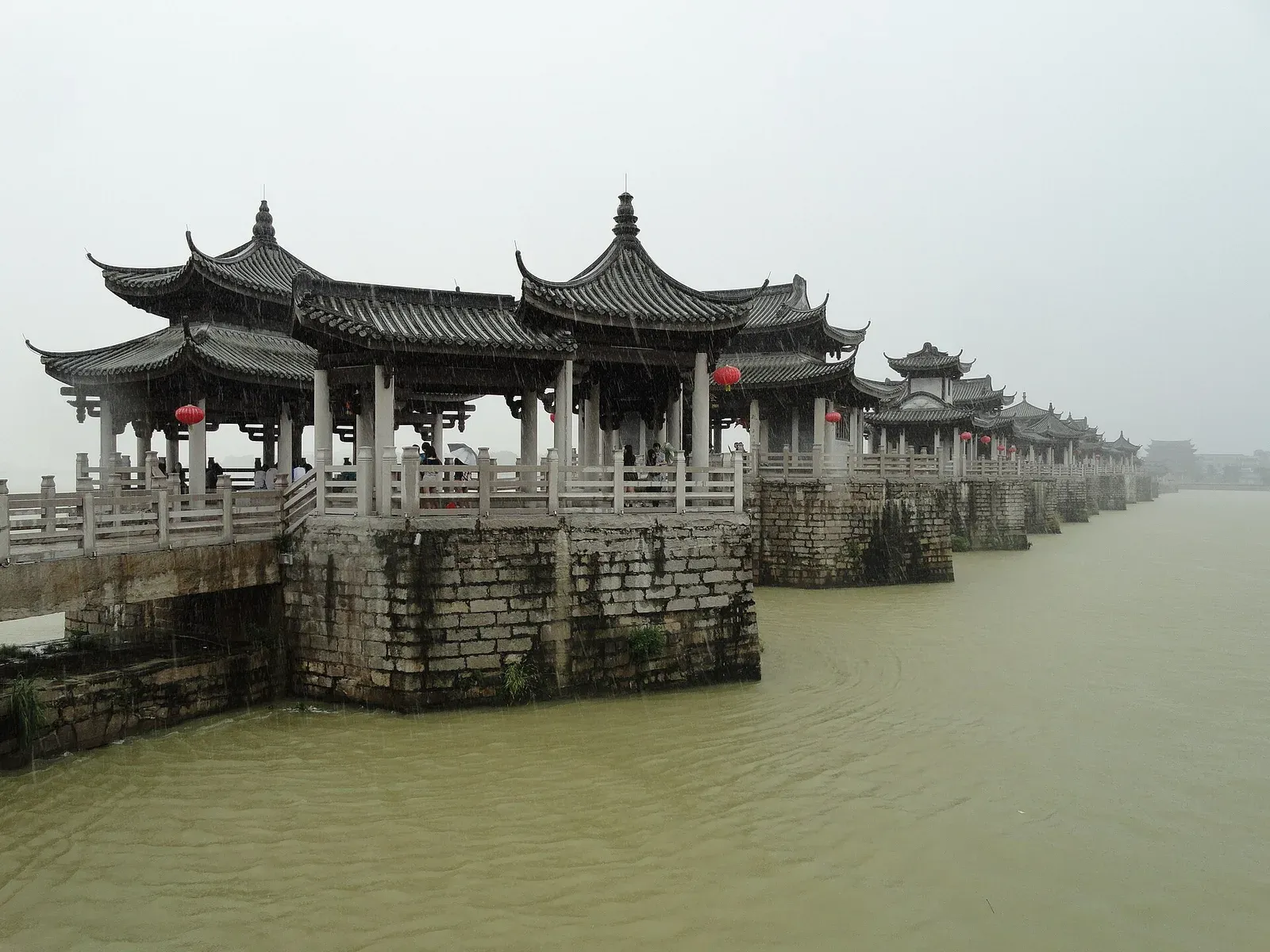
Chaozhou
Photo: Luis Evers / Wikimedia Commons, CC BY-SA 2.0
Chaozhou, China is located in eastern Guangdong along the middle and lower Han River. Recognised by UNESCO as a City of Gastronomy and designated as a National Historical and Cultural City, it holds titles such as the Cultural Land by the Sea and China's Porcelain Capital. Built along the river, the city brings together thousand-year-old temples, an opening pontoon bridge, ritual tea traditions, and a distinct Teochew culinary heritage. It suits travelers who enjoy a relaxed pace exploring historic streets and sampling regional flavors. Touring the core old town and its main surrounding sights usually takes 2 to 3 days.
Key points
Exploring the historic old town and major sights of Chaozhou, China typically takes 2 to 3 days. Entry to the landmark Guangji Bridge costs 20 yuan, with admission stopping daily at 16:30 before pontoon boats detach for river navigation at night. When arriving by high-speed rail, use Chaoshan Station located about 18 kilometers from downtown, as Chaozhou Station serves only regular-speed trains.
Chaozhou, China is located in eastern Guangdong along the middle and lower Han River. Recognised by UNESCO as a City of Gastronomy and designated as a National Historical and Cultural City, it holds titles such as the Cultural Land by the Sea and China's Porcelain Capital. Built along the river, the city brings together thousand-year-old temples, an opening pontoon bridge, ritual tea traditions, and a distinct Teochew culinary heritage. It suits travelers who enjoy a relaxed pace exploring historic streets and sampling regional flavors. Touring the core old town and its main surrounding sights usually takes 2 to 3 days.
| Item | Details |
|---|---|
| Recommended Stay | 2 to 3 days |
| Climate | Subtropical marine monsoon climate, mild winters and moderate summers |
| Arrival Transport | High-speed train to Chaoshan Station (about 18 km from downtown) or flight to Jieyang Chaoshan International Airport |
| City Transport | Yueyun public buses, licensed cycle rickshaws (over 1,700 registered), or walking |
| Key Highlights | Guangji Bridge pontoon, Guangji Gate Tower, Han Yu Temple, Chaozhou cuisine, and Gongfu tea |
When should you visit Chaozhou, China?
Chaozhou has a subtropical marine monsoon climate, with an annual average temperature of 21.4°C, 1,986.1 hours of sunshine per year, and 1,685.8 mm of annual rainfall. The weather remains mild throughout the year, without freezing winters or extreme summer heat. Spring and autumn bring gentle river breezes and comfortable temperatures, making both strolls through old lanes and walks along the Han River pleasant.
Beyond daily weather, Chaozhou hosts rich folk activities during traditional festivals. Qinglong Ancient Temple (also known as Anji Shengwang Temple), founded during the Northern Song Dynasty, holds the annual Qinglong Temple Fair in the second or third month of the lunar calendar. The fair features a procession of the Lords of the Three Mountains (Sanshan Guowang) and rows of massive incense coils called the Thousand Incense Forest. If you are interested in local religious rituals, visiting during the spring fair lets you watch the lively deities' parade.
How should you explore Guangji Bridge and the old town?
Ranked among China's four famous ancient bridges, Guangji Bridge (locally called Xiangzi Bridge) spans about 520 meters across the Han River. It preserves 21 ancient piers and combines arch bridge, beam bridge, and pontoon sections, making it China's first opening and closing pontoon bridge. In 1513, during the Ming Dynasty, it established the layout of 18 shuttle boats and 24 piers. Two iron oxen were cast in 1724 to protect the bridge, though floods washed the eastern ox away in 1842. This inspired the local ballad: "Chaozhou's Xiang Bridge is so fine, eighteen shuttle boats, twenty-four piers, twenty-four pavilions each with its own design, two cast-iron oxen, and one slipped away."
Travelers note in their journals that looking out from the bridgehead during the day, the rushing river carries 18 shuttle boats connected bow to stern like a floating dragon. Entry to Guangji Bridge costs 20 yuan, with admission stopping daily at 16:30. At night, the pontoon boats are pulled back to allow river traffic to pass. Every evening at 20:00, the bridge hosts the Light of the Phoenix City light show, set to rousing Chaozhou grand gongs and drums, locally nicknamed Dang Dang Dang.
Stepping off the west side of the bridge brings you directly in front of Guangji Gate Tower, commonly called East Gate Tower. Standing 18.85 meters tall, this three-story palace-style structure with double-eaved hip-and-gable roofs ranks first among the seven gate towers of the old town. Its first and second floors house an exhibition hall on Guangji Bridge history. A 2.6-kilometer section of Ming Dynasty city walls extends to the north and south. Walking along the wall offers wide views of the Han River and traditional residential quarters inside the town.
Han Yu Temple (Han Wengong Ancestral Hall) sits at the western foot of Bijia Mountain on the east bank of the Han River. Built at its current site in 1189 during the Southern Song Dynasty, it is the oldest and most intact memorial hall dedicated to Tang scholar-official Han Yu in mainland China. The temple features 56 stone steps divided into three flights of 51, 1, and 4 steps. These numbers symbolize Han Yu's age of 51 when demoted to Chaozhou, his 1 year of governing the prefecture, and his life span of 56 years.
| Place | Founded or Location | Key Features and Highlights |
|---|---|---|
| Kaiyuan Temple | 738 AD (26th year of Tang Emperor Xuanzong's Kaiyuan era) | Renamed Kaiyuan Zhengguo Zen Temple in the Ming Dynasty and still used today, an ancient temple over a thousand years old |
| Xu Consort Mansion | Putao Lane along Zhongshan Road | Private residence of Northern Song official Xu Jue, recognized as one of the three treasures of Chaozhou ancient city |
| Jilue Huang Ancestral Hall | Built in 1887 | Displays Chaozhou wood and stone carvings, with gold-lacquered wood carvings depicting classic stories such as General and Prime Minister Make Peace and Three Visits to the Thatched Cottage |
| Chaozhou West Lake | Formed by damming a Han River tributary | Features West Lake Hill at 73 meters above sea level, originating from a lake formed when Han Yu dammed a tributary in the Tang Dynasty |
Routing suggestion: If you have two days to explore, spend your first day within the old town visiting Guangji Gate Tower, Kaiyuan Temple, and the Xu Consort Mansion, wandering historic streets to take in daily street life. On the second day, head to Bijia Mountain on the east bank in the morning to climb the steps of Han Yu Temple, walk across Guangji Bridge in the afternoon before the pontoon disconnects, and watch the Han River light show in the evening.
What should you eat in the City of Gastronomy? From set meals to midnight porridge and Gongfu tea
Chaozhou cuisine has a long history. In 819 AD, Han Yu recorded eating oysters, clams, dried scallops, octopus, rays, and horseshoe crabs seasoned with salt, vinegar, pepper, and bitter oranges in his poem on southern food. Local banquet tradition holds that no feast is complete without goose, with braised goose serving as the centerpiece dish. A formal banquet usually includes ten main courses with two or three soups, alternating between savory and sweet, meat and vegetable, with special emphasis on cooking vegetables in rich meat stocks so that vegetables taste savory without visible meat.
Teochew dining strictly pairs one sauce dish with each course. Common condiments include Puning soybean paste, galangal paste, plum sauce, fish sauce, red soy sauce, and shacha sauce. After dark, open-air food stalls serving late-night rice porridge become the focus of street life. Open displays showcase cold cooked fish (yufan), raw marinated blood clams, shrimp, and crab, braised platters, oyster omelets, and assorted salty side dishes. The city offers around 230 traditional snacks, including beef meatballs, yamunian sweet dumplings, guozhi rice noodle soup, spring rolls, sugar-frosted taro, crisp sugar scallion wraps, and fermented bean curd pastries.
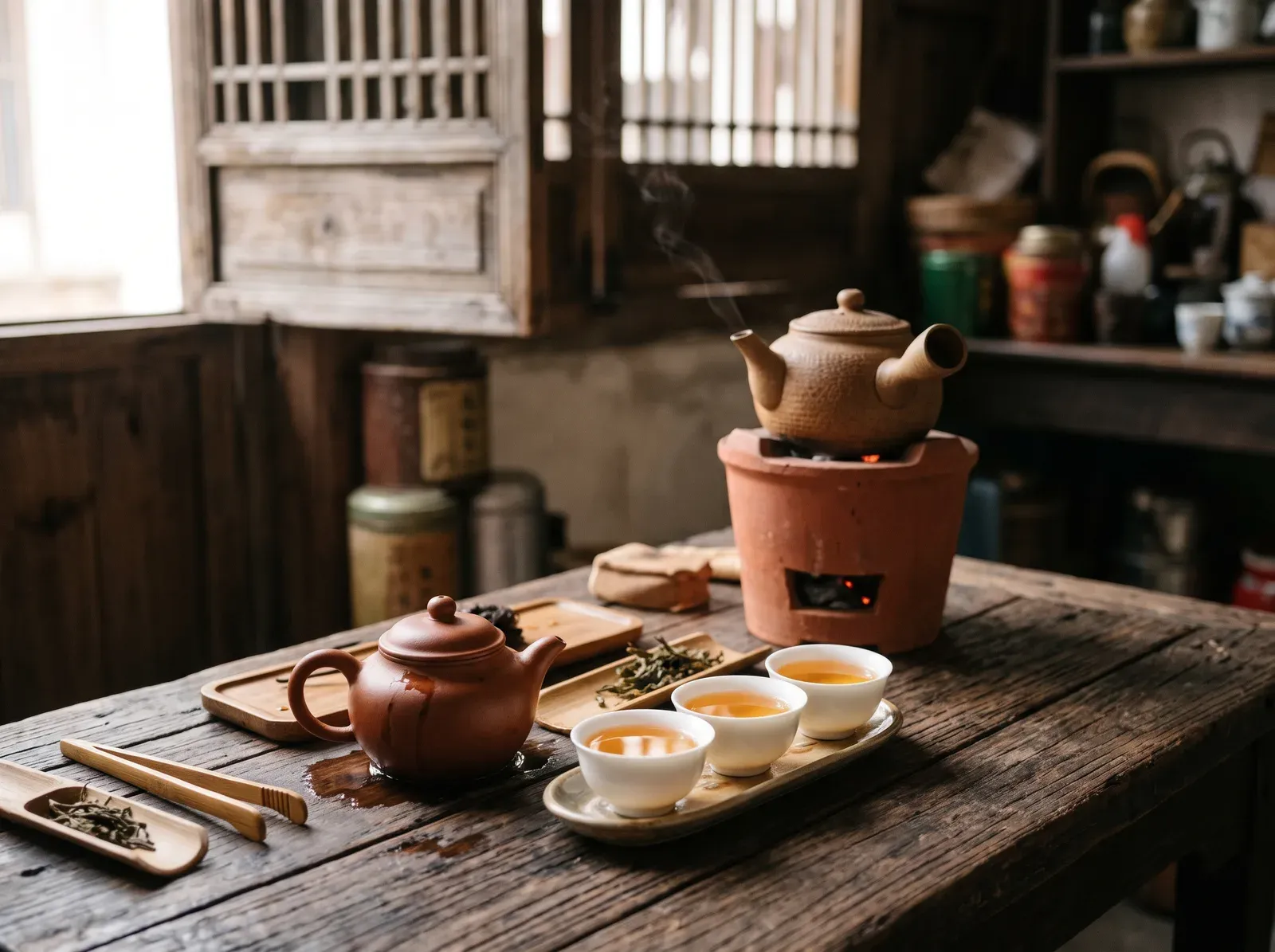
Chaozhou Gongfu tea ceremony was designated as Chinese national intangible cultural heritage in June 2008. In the Teochew dialect, gongfu means meticulous and refined. Brewing relies heavily on the four treasures of the tea room: the clay kettle (sha diao), tea stove, small teapot, and tiny cups. Pouring techniques include Guan Yu Patrols the City, moving the teapot quickly in circles over each cup, and Han Xin Counts Soldiers, distributing the final concentrated drops evenly, filling cups about eighty percent. The tea of choice is Phoenix Dancong, an oolong produced in Fenghuang Town of Chao'an District, with Yinhuaxiang Dancong (also known as Ya Shi Xiang or Duck Shit Aroma) being the most well known.
Tip: Locals refer to drinking tea as "eating tea" (jia de). When the host pours tea and says "eat," guests should receive the cup with both hands and reply "eat" to show respect. To learn more about traditional dining customs and dining etiquette, check our guides to Chinese food and Chinese customs and etiquette.
How do you reach Chaozhou and get around the city?
When traveling by high-speed rail, both the Xiamen-Shenzhen Railway and Meizhou-Shantou High-Speed Railway stop at Chaoshan Station (潮汕站) in Shaxi Town, Chao'an District. Serving as the regional high-speed hub, this station is about 18 kilometers from downtown Chaozhou. A taxi ride downtown takes about 30 minutes, while local buses take roughly 1.5 hours. Regular-speed trains on the Guangzhou-Meizhou-Shantou line stop at Chaozhou Station (潮州站) in Fengxi District. For air travel, flights land at Jieyang Chaoshan International Airport (SWA) on the border of Denggang and Paotai towns in Jieyang, which operates airport express buses to nearby city centers. For luggage allowances and station procedures on trains, you can check our guide to train travel in China.
For getting around downtown Chaozhou, Chaozhou Yueyun public buses operate daily with first departures at 06:40 and last departures at 18:30. Riders can pay with cash, swipe a Lingnan Pass Chaozhou Pass card, or scan with Alipay. Inside the old town, over 1,700 licensed cycle rickshaws operate along the narrow lanes. Taking a rickshaw through the old quarters is a distinctive local way to explore, and fares can usually be agreed upon beforehand. To set up international mobile payments for scanning bus fares, see our guide on paying with Alipay in China.
First time in Chaozhou? Common mistakes to avoid
Chaozhou has deep cultural roots, with its own distinct dialect, rail hubs, and ancient customs. First-time visitors can easily mix up train stations, opening times, or tea terms. Here are key practical points based on current local rules and traditional etiquette:
| Common Mistake | What to Do |
|---|---|
| Mixing up high-speed and regular train stations | High-speed trains serve Chaoshan Station in Shaxi Town, Chao'an District. Chaozhou Station in Fengxi District serves only regular-speed trains, so do not mix them up when booking tickets or hailing taxis |
| Guangji Bridge opening hours and pontoon removal | Bridge admission stops daily at 16:30, and the middle pontoon boats are removed at night for navigation, so do not arrive late in the afternoon |
| Misspelling Gongfu tea and Dancong tea in Chinese | The standard characters are 工夫 for Gongfu tea (meaning meticulous) and 丛 for Fenghuang Dancong; in August 2004 the municipal government issued an official notice prohibiting the misspelled character 枞 in promotional materials |
Tip: The Chaoshan region observes a unique coming-of-age custom called Coming Out of the Garden (Chu Hua Yuan). Parents hold a ceremony to lead children out of the garden when they turn 15 by nominal age, signifying adulthood and independence. If you encounter folk celebrations while touring the old town, respect local customs, or contact our travel designers to arrange personal cultural commentary. If you plan to connect with other major cities in Guangdong, you can read our Guangzhou city guide or browse our destinations list.
Sources
Guangji Bridge (Chaozhou) - Wikipedia
Gongfu tea - Wikipedia
Fenghuang Dancong - Wikipedia
Han Yu Temple - Wikipedia
Kaiyuan Temple (Chaozhou) - Wikipedia
Guangji Gate Tower - Wikipedia
Xu Consort Mansion - Wikipedia
Jilue Huang Ancestral Hall - Wikipedia
Teochew cuisine - Wikipedia
Chaoshan railway station - Wikipedia
Jieyang Chaoshan International Airport - Wikipedia
Chaozhou West Lake - Wikipedia
Chaozhou - Wikipedia
Guangji Bridge (Chaozhou) - Wikipedia
Chaozhou - Wikipedia
Sources verified on 19 November 2026.
Related travel tips
Replies 08:30–22:00 your time · Free to ask.