
Chinese Currency Guide: RMB Denominations and Cash Rules

Key points
The current fifth series of Chinese currency features 6 banknote denominations and 3 coin denominations, and Chinese regulations prohibit any entity or individual from refusing cash payments except in statutory situations. You are advised to carry 500 to 1,000 yuan per person as daily backup cash, which is widely accepted in restaurants, taxis, and shops, where spoken Mandarin commonly replaces yuan and jiao with kuai and mao.
The renminbi is the legal tender of the People's Republic of China, issued by the People's Bank of China. Its official ISO currency code is CNY, its symbol is ¥, and it is commonly abbreviated in English as RMB. When traveling in China, Uncle Panda Travel suggests carrying about 500 to 1,000 yuan in cash per person as daily backup money. The basic unit of this Chinese currency is the yuan (元), which is divided into 10 jiao (角), and 1 jiao is divided into 10 fen (分), meaning 1 yuan equals 100 fen.
What Official Codes and Spoken Terms Exist for Chinese Currency?
In daily spoken Mandarin, people usually say kuai instead of yuan and mao instead of jiao when discussing money. The code for onshore renminbi used in transactions within mainland China is CNY, while the code for offshore renminbi traded in international markets outside mainland China is CNH.
According to data from the International Monetary Fund, on October 1, 2016, the renminbi became the first emerging market currency included in the Special Drawing Rights (SDR) basket, with an initial weighting of 10.9%.
What Are the Denominations and Landmark Designs of the Fifth Series RMB?
The fifth series of Chinese currency (renminbi) currently in circulation includes 6 banknote denominations and 3 coin denominations. According to issuance regulations of the People's Bank of China, banknotes include 100 yuan, 50 yuan, 20 yuan, 10 yuan, 5 yuan, and 1 yuan, with the 20 yuan banknote being a newly added denomination for this series. Coins include 1 yuan, 5 jiao (0.5 yuan), and 1 jiao (0.1 yuan).
| Denomination | Format | Main Reverse Design |
|---|---|---|
| 100 yuan | Banknote | Great Hall of the People |
| 50 yuan | Banknote | Potala Palace |
| 20 yuan | Banknote | Guilin Scenery |
| 10 yuan | Banknote | Three Gorges of the Yangtze River |
| 5 yuan | Banknote | Mount Tai |
| 1 yuan | Banknote | West Lake in Hangzhou |
| 1 yuan | Coin | Chrysanthemum |
| 5 jiao (0.5 yuan) | Coin | Lotus |
| 1 jiao (0.1 yuan) | Coin | Orchid |
The reverse center of all fifth series renminbi coins features a floral design. In the 2019 edition of the fifth series renminbi, the diameter of the 1 yuan coin was reduced to 22.25 millimeters (a reduction of 2.75 millimeters). The inner rim of the 5 jiao coin was adjusted from circular to polygonal, and its material appears nickel-white.
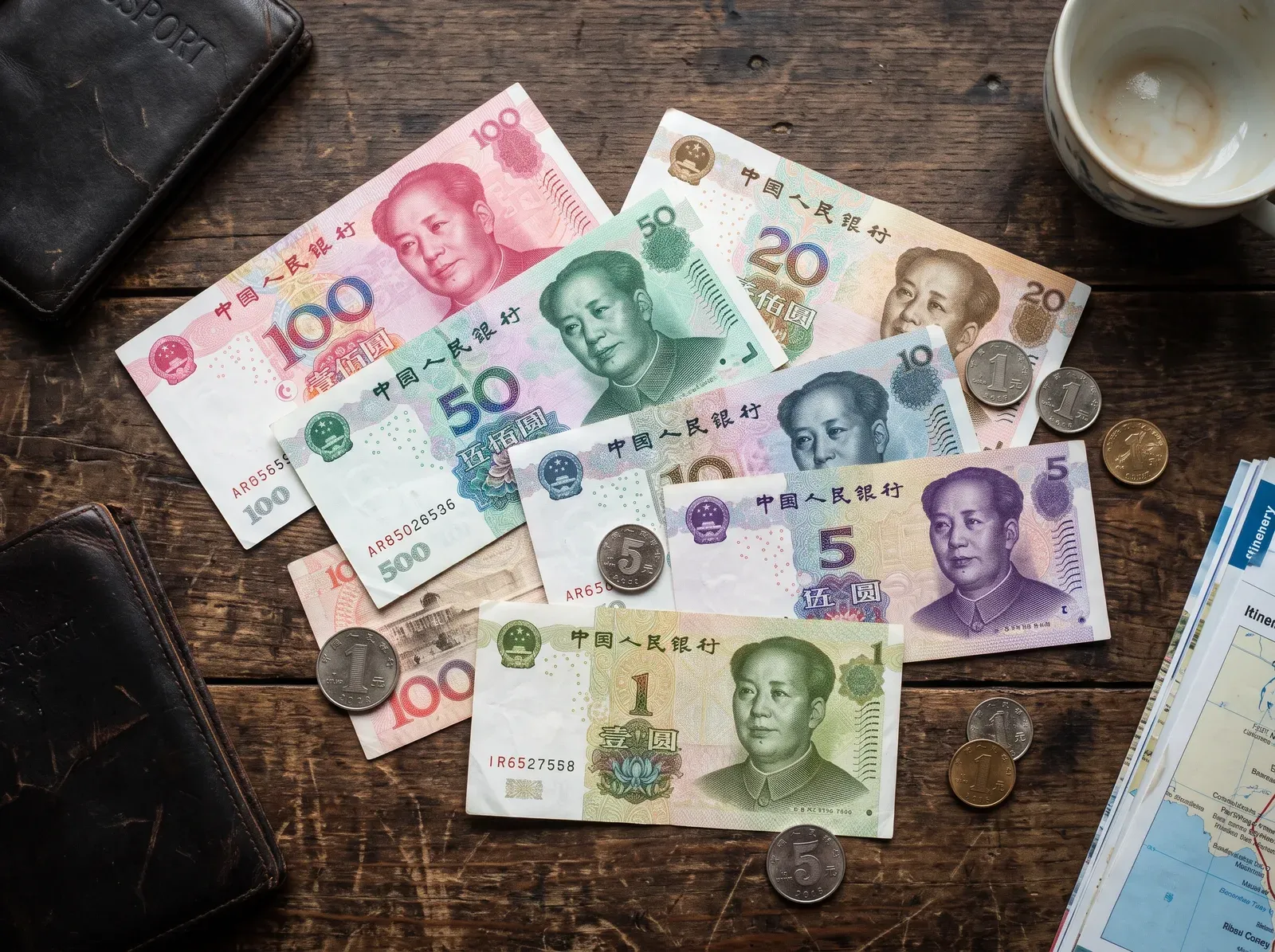
Can Merchants in China Refuse Cash Payments in Renminbi?
Except for statutory situations, no entity or individual within the People's Republic of China may refuse cash payments in renminbi. According to the Regulations of the People's Republic of China on the Administration of Renminbi issued by the State Council, no entity or individual may refuse payment in renminbi for any public or private debt within the People's Republic of China.
The Provisions on Cash Receipt and Payment and Services formulated by the People's Bank of China and other authorities took effect on February 1, 2026, with violators facing penalties and public disclosure. In actual travel, restaurants, taxis, and shops generally accept cash, and some rural stalls still prefer cash.
Sources
Renminbi - Wikipedia
Fifth series of the renminbi - Wikipedia
Fifth series of the renminbi (Chinese) - Wikipedia
Renminbi (Chinese) - Wikipedia
How to pay in China: Alipay & WeChat Pay for visitors
Verified against sources on November 17, 2026
FAQ
What do spoken terms like kuai and mao mean when shopping?
In daily spoken Mandarin, people usually say kuai instead of yuan and mao instead of jiao when discussing money. For example, a price tag of 5 yuan is typically spoken as 5 kuai, and 5 jiao as 5 mao.
How much cash should foreign travelers carry when visiting China?
Uncle Panda Travel suggests carrying about 500 to 1,000 yuan in cash per person as daily backup money. Restaurants, taxis, and shops generally accept it, and some rural stalls still prefer cash.
What is the difference between onshore and offshore renminbi codes?
The code for onshore renminbi used in transactions within mainland China is CNY, while the code for offshore renminbi traded in international markets outside mainland China is CNH. On October 1, 2016, the renminbi was included in the International Monetary Fund Special Drawing Rights (SDR) currency basket.
What design and size changes were made to the 2019 edition coins?
In the 2019 edition of the fifth series renminbi, the diameter of the 1 yuan coin was reduced to 22.25 millimeters (a reduction of 2.75 millimeters). The inner rim of the 5 jiao coin was adjusted from circular to polygonal, and its material appears nickel-white.