
Wuhan Yellow Crane Tower Guide: Highlights and Poetry
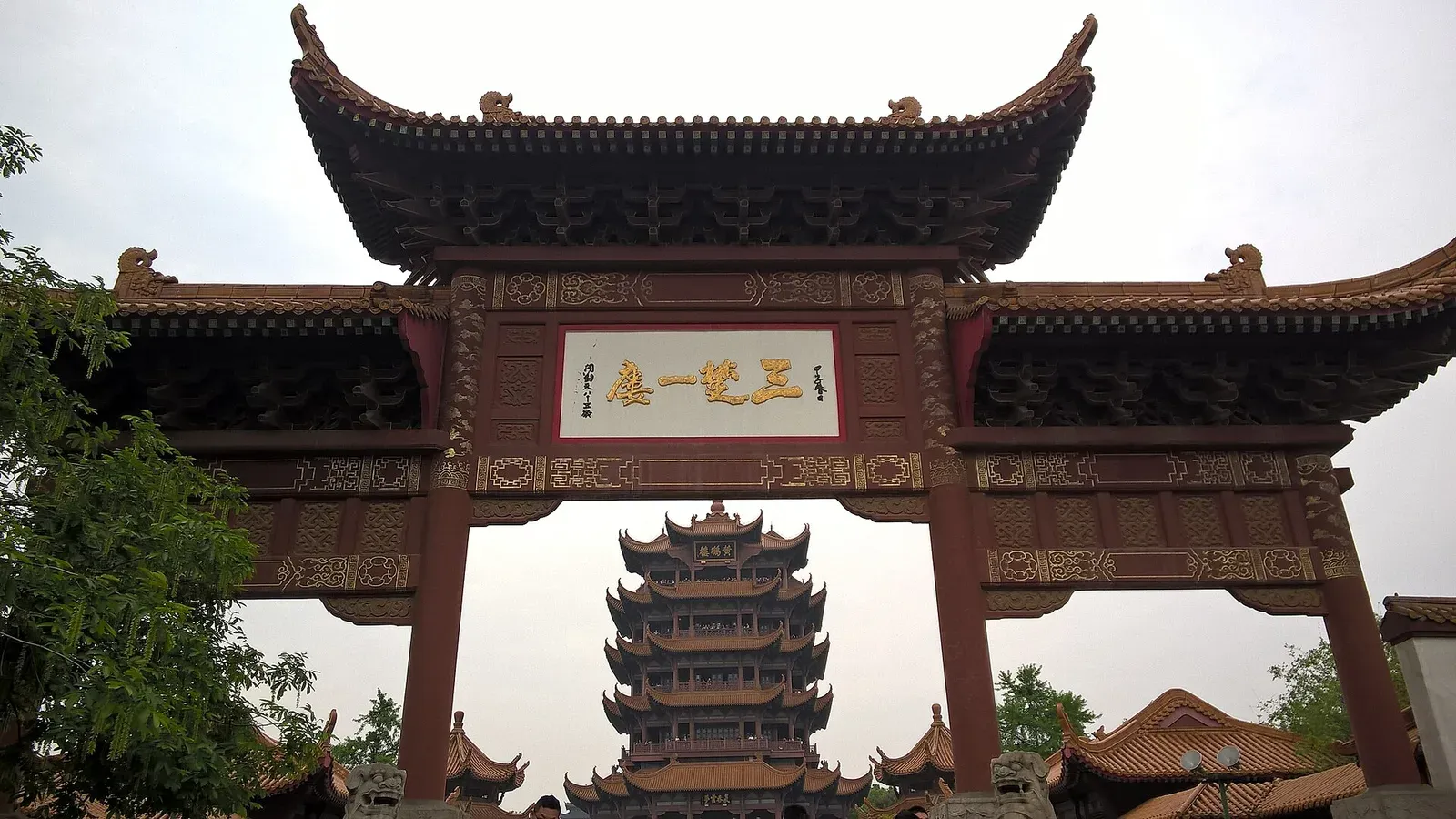
Photo: Nature42 / Wikimedia Commons, CC0
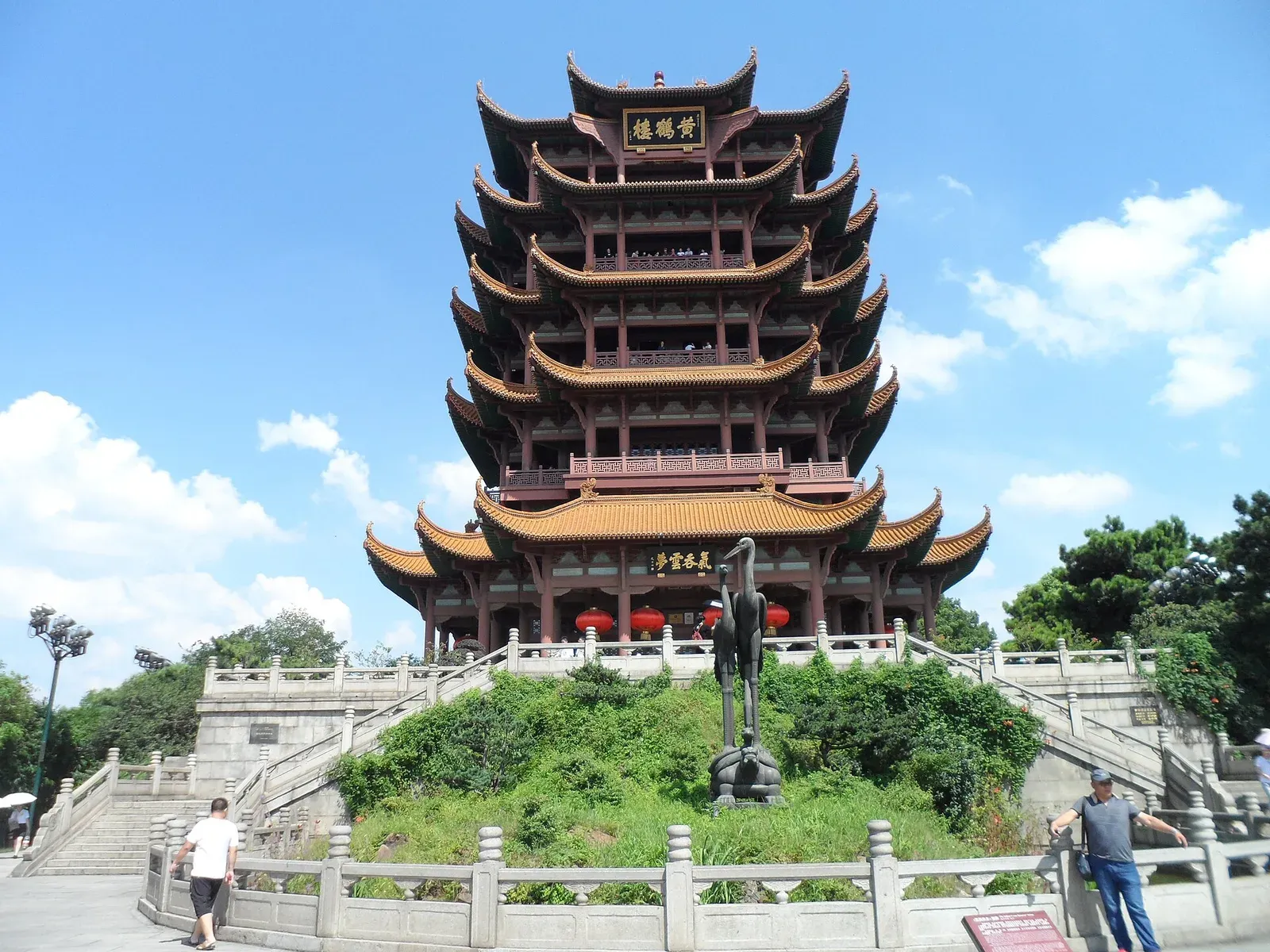
Yellow Crane Tower sits atop Snake Hill (Sheshan) in Wuchang District, Wuhan, Hubei Province. Its main tower rises 51.4 meters and is celebrated alongside Yueyang Tower in Hunan and Tengwang Pavilion in Nanchang, Jiangxi, as one of the Three Great Towers of Jiangnan. Combining historic renown with sweeping river vistas, the site invites you to explore floor-by-floor exhibits, from the 'White Clouds and Yellow Crane' ceramic mural to poetry inscriptions from past dynasties, before taking in views of the Yangtze River and the rail-and-road bridge from the top deck.
| Item | Details and Regulations |
|---|---|
| Main tower size | Height of 51.4 meters and floor area of 3,219 square meters |
| Adult ticket | 70 yuan (65 yuan if booked on mobile one day in advance) |
| Discount ticket | Half price at 35 yuan for students, seniors aged 60 to 65, and children aged 6 to 18 |
| Free admission | Free for seniors over 65 and children under 6 |
| Public transport | Steps from Simenkou-Huanghelou Station on Wuhan Metro Line 5 |
| Visitor facilities | Elevators inside the modern main tower for seniors and visitors with limited mobility |
How do you buy tickets and reach Yellow Crane Tower by metro?
Standard adult admission to the park costs 70 yuan, or 65 yuan if you buy tickets on your phone a day in advance. Students, seniors aged 60 to 65, and children aged 6 to 18 pay half price at 35 yuan with valid ID. Seniors over 65 and children under 6 enter for free.
For public transit, take Wuhan Metro Line 5 to Simenkou-Huanghelou Station (司门口黄鹤楼站), located near the intersection of Minzhu Road and Hengjie in Wuchang District. The park entrance sits right outside the station. The Wuhan metro uses distance-based fares, starting at 2 yuan for up to 4 kilometers, 3 yuan for up to 8 kilometers, and 4 yuan for up to 12 kilometers, with each additional 1 yuan covering 20 kilometers once trips exceed 50 kilometers. Passengers can spend up to 240 minutes between tapping in and out. Gates accept transit QR codes from Alipay and WeChat, QuickPass-enabled UnionPay cards, China T-Union cards, or the local Wuhan Tong card, which offers a 10 percent discount.
Tip: If you plan to ride the metro often, you can buy period passes at station customer service counters: 18 yuan for a 1-day pass, 45 yuan for a 3-day pass, or 90 yuan for a 7-day pass. Physical passes require a 20 yuan deposit per card, which is refundable at customer service after use. Anyone using half-price or free admission must carry original valid ID for verification at entry.
Is the current tower an original ancient building?
The current tower is not an ancient timber original, but a reinforced-concrete reconstruction completed in June 1985. The site dates back to 223 AD, the second year of the Huangwu era of Eastern Wu during the Three Kingdoms period. According to the Yuanhe Maps and Records of Prefectures and Counties, Sun Quan built Xiakou City and erected a tower on Yellow Crane Shoal facing the river to serve as a military lookout. Through the centuries, the tower was repeatedly destroyed and rebuilt. During the Ming and Qing dynasties alone, it was destroyed 7 times and rebuilt or repaired 10 times, until a fire razed the Qing-era building in 1884.
In 1957, construction of the Wuchang approach for the Wuhan Yangtze River Bridge used the old tower site as a pier foundation. In 1981, the Wuhan municipal government decided to rebuild the landmark on a new site atop Snake Hill, about 1 kilometer from the original location. The modern structure spans 30 meters wide on each side at the base and is crowned with a 5-meter-tall gourd-shaped finial.
If you want to trace the original historical foundation, head to the viewing platform at the Wuchang bridgehead of the Wuhan Yangtze River Bridge, where five Chinese characters for 'Former Site of the Tower' (黄鹤楼故址) are carved into the stonework. If you want to climb up for views over the river and city, head to the summit of Snake Hill to tour the modern reconstructed tower.
What architectural features and art exhibits can you see floor by floor?
While the exterior shows five tiers of flying eaves, the interior actually houses nine levels, echoing the traditional cultural symbolism of nine and five as emblems of supreme dignity. The spacious interior features dedicated elevators, making it easy for older travelers or families with young children to move between floors.
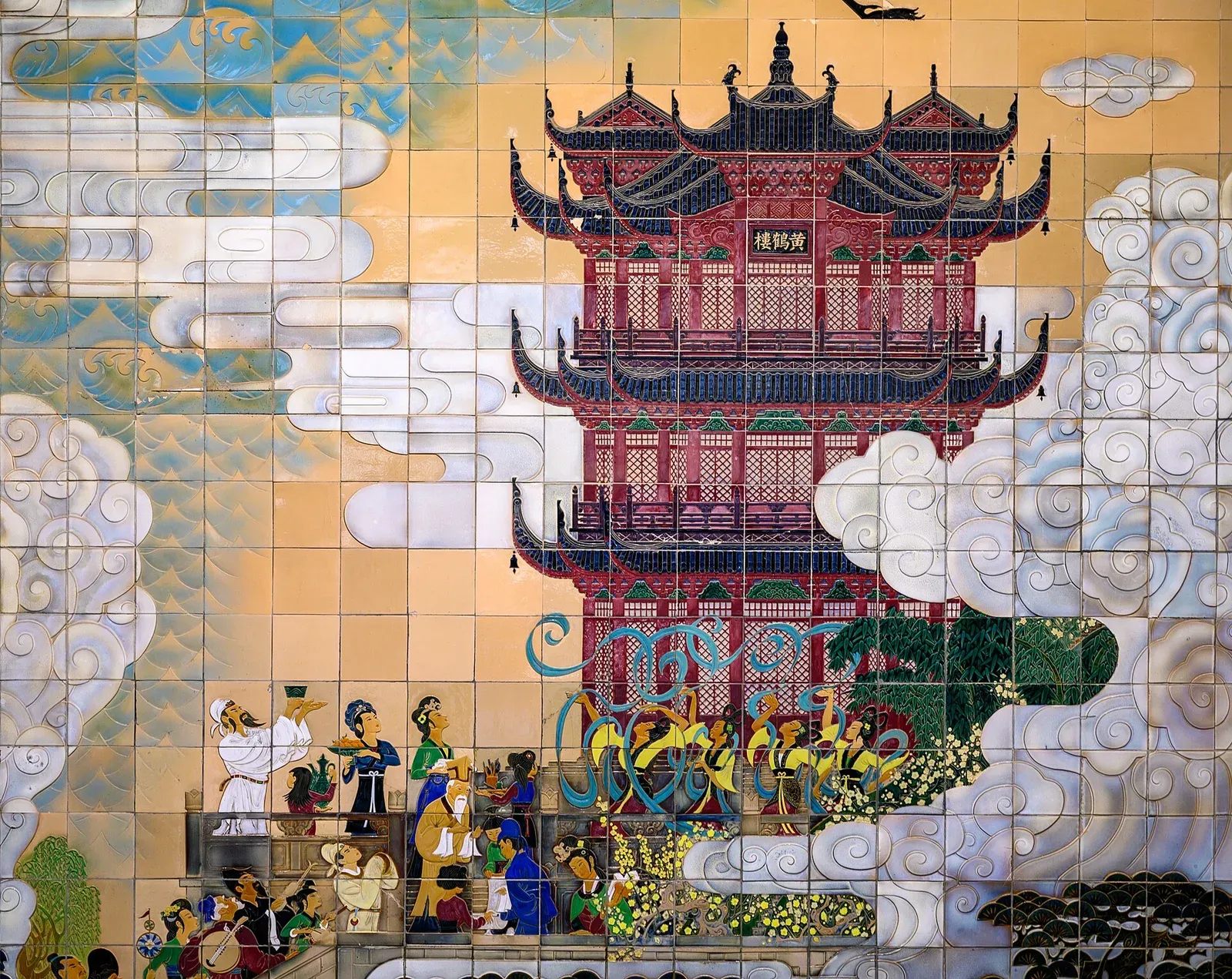
Each level showcases a distinct cultural theme. In the ground-floor hall, the central caisson ceiling rises over 10 meters, and the main wall features a large ceramic mural of 'White Clouds and Yellow Crane'. Flanking pillars display 7-meter-tall couplets reflecting on the sweeping river and clearing skies. On the second floor, Tang dynasty scholar Yan Boli's Record of the Tower is engraved on marble, flanked by murals depicting Sun Quan building the city and Zhou Yu hosting a banquet. The third floor displays embroidered portrait murals of famous historical figures, including Li Bai, Bai Juyi, Lu You, and Yue Fei, alongside their verses about the tower. The fourth floor is partitioned by screens into smaller galleries displaying and selling traditional calligraphy and paintings by modern masters.
Stepping out onto the top-floor exterior corridor opens up expansive vistas. Leaning against the railing, you can gaze across the broad Yangtze River and take in the panorama of Wuhan's three towns on both banks. On the slope to the east of the main building stands the Millennium Auspicious Bell, where visitors can pay on site to ring the bell for good fortune.
| Floor | Architecture and Exhibition Highlights |
|---|---|
| First floor | The caisson ceiling in the central hall rises over 10 meters high, the main wall features a large "White Clouds and Yellow Crane" ceramic mural, and the side pillars hold 7-meter-long couplets |
| Second floor | The front wall is engraved with Yan Boli's Record of the Tower in marble, flanked by murals depicting "Sun Quan Building the City" and "Zhou Yu Hosting a Banquet" |
| Third floor | The hall features embroidered portrait murals depicting historical figures such as Li Bai, Bai Juyi, Lu You, and Yue Fei alongside their famous lines praising the tower |
| Fourth floor | Screen partitions divide the floor into small halls displaying and selling calligraphy and paintings by modern masters |
| Top floor | Overlooks the Yangtze River and surrounding landscape, with the Millennium Auspicious Bell on the eastern slope |
How did Cui Hao's poem and Li Bai's pause enrich the tower's literary legacy?
Tang dynasty poet Cui Hao climbed the tower and wrote his seven-character regulated verse Yellow Crane Tower, later hailed by Song dynasty critic Yan Yu in Canglang's Poetry Remarks as the finest seven-character regulated poem of the Tang era. Famous lines include 'The ancient sage rode off on a yellow crane, leaving only this empty tower behind' and 'Clear rivers reveal every tree in Hanyang, fragrant grass blankets Parrot Island'. Qingchuan Pavilion, rising 17.5 meters on the eastern foot of Tortoise Hill in Hanyang, takes its name from Cui's line about Hanyang's trees and gazes across the Yangtze directly toward the tower. The ancient Parrot Island described in the poem was once a sandbar visible mid-river, but floodwaters submerged it in the late Ming dynasty before a new island re-formed near Hanyang during the Qing dynasty.
According to the Chronicle of Tang Poetry, when Li Bai climbed the tower and read Cui Hao's poem, he remarked that the scene before him was beyond description because Cui's verse stood above it, setting down his brush in deference. The park maintains the Li Bai Brush-Pausing Pavilion to commemorate this legend. In the third lunar month of 730 AD (the 18th year of Kaiyuan), Li Bai spent several days with his friend Meng Haoran at the tower in Wuchang. As Meng boarded a boat eastbound for Yangzhou, Li composed the renowned poem Seeing Meng Haoran Off to Guangling ('My old friend takes leave in the west, heading down to Yangzhou amid misty March flowers'). Li Bai also penned 'A jade flute plays in the pavilion, in River City May blossoms fall like snow', giving Wuhan its enduring moniker, River City.
| Famous Verse | Poet and Title | Allusion or Cultural Impact |
|---|---|---|
| The ancient sage rode off on a yellow crane, leaving only this empty tower behind | Cui Hao, Yellow Crane Tower | Yan Yu praised this poem in Canglang's Poetry Remarks as the finest seven-character regulated verse of the Tang era |
| The scenery before me is beyond words, for Cui Hao's poem stands above | Li Bai | According to Chronicle of Tang Poetry, Li Bai set down his brush after reading Cui Hao's poem, and the scenic area includes the Li Bai Brush-Pausing Pavilion |
| My old friend takes leave in the west, heading down to Yangzhou amid misty March blossoms | Li Bai, Seeing Meng Haoran Off to Guangling | Written in March of the 18th year of the Tang Kaiyuan era after Li Bai met with Meng Haoran for several days and Meng boarded a boat eastbound for Yangzhou |
| A jade flute plays in the tower, in River City May plum blossoms fall | Li Bai | Gave Wuhan its enduring city nickname of "River City" |
What other historic relics can you explore around the park grounds?
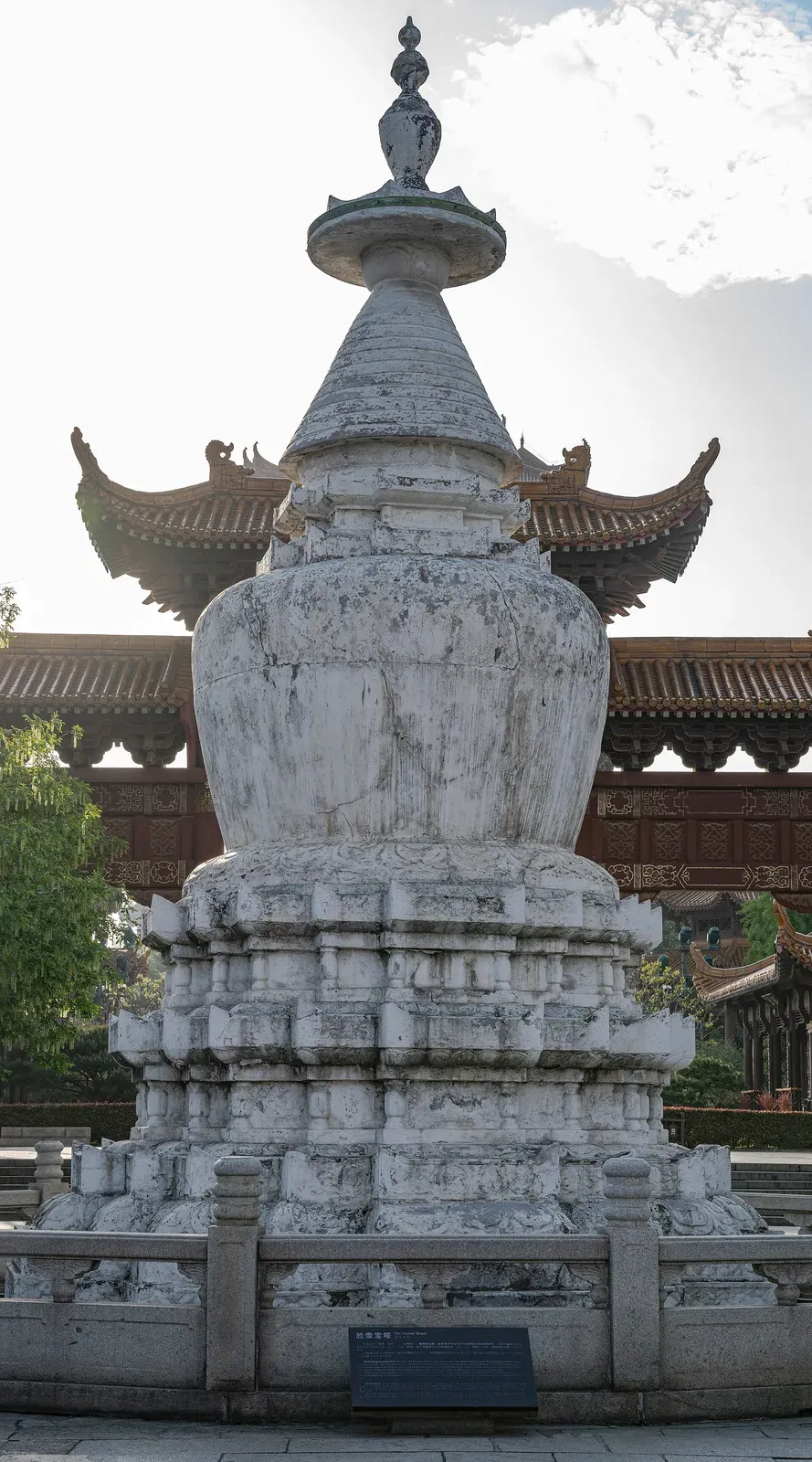
Beyond the modern main tower, the grounds preserve the Shengxiang Stupa, a Major Historical and Cultural Site Protected at the National Level. Originally built in 1343 (the third year of the Zhizheng era in the Yuan dynasty), the stupa stands 9.36 meters tall with a base diameter of 5.86 meters. Carved from white stone, its base consists of a circular platform beneath three tiers that each feature 12 corners. It is the only surviving Yuan dynasty bell-shaped stupa in Wuhan and received national protection status in 2013.
South of the tower stands a bronze statue of Yue Fei, the famed Southern Song dynasty military general who fought against the Jin. Yue Fei was garrisoned in Ezhou (present-day Wuchang) for 8 years, using it as his headquarters for northern expeditions, and was later posthumously titled Prince of E. Later generations erected the statue to commemorate his military service in the area.
Tip: Shengxiang Stupa sits a short walk west of the main tower, where you can look closely at its three-tiered angular base and white stone carving. The stupa originally stood alongside the Qing-era tower on the riverbank before workers moved it to its current spot to make way for the bridge approach.
Where are the classic spots to photograph the tower and the Yangtze River Bridge together?
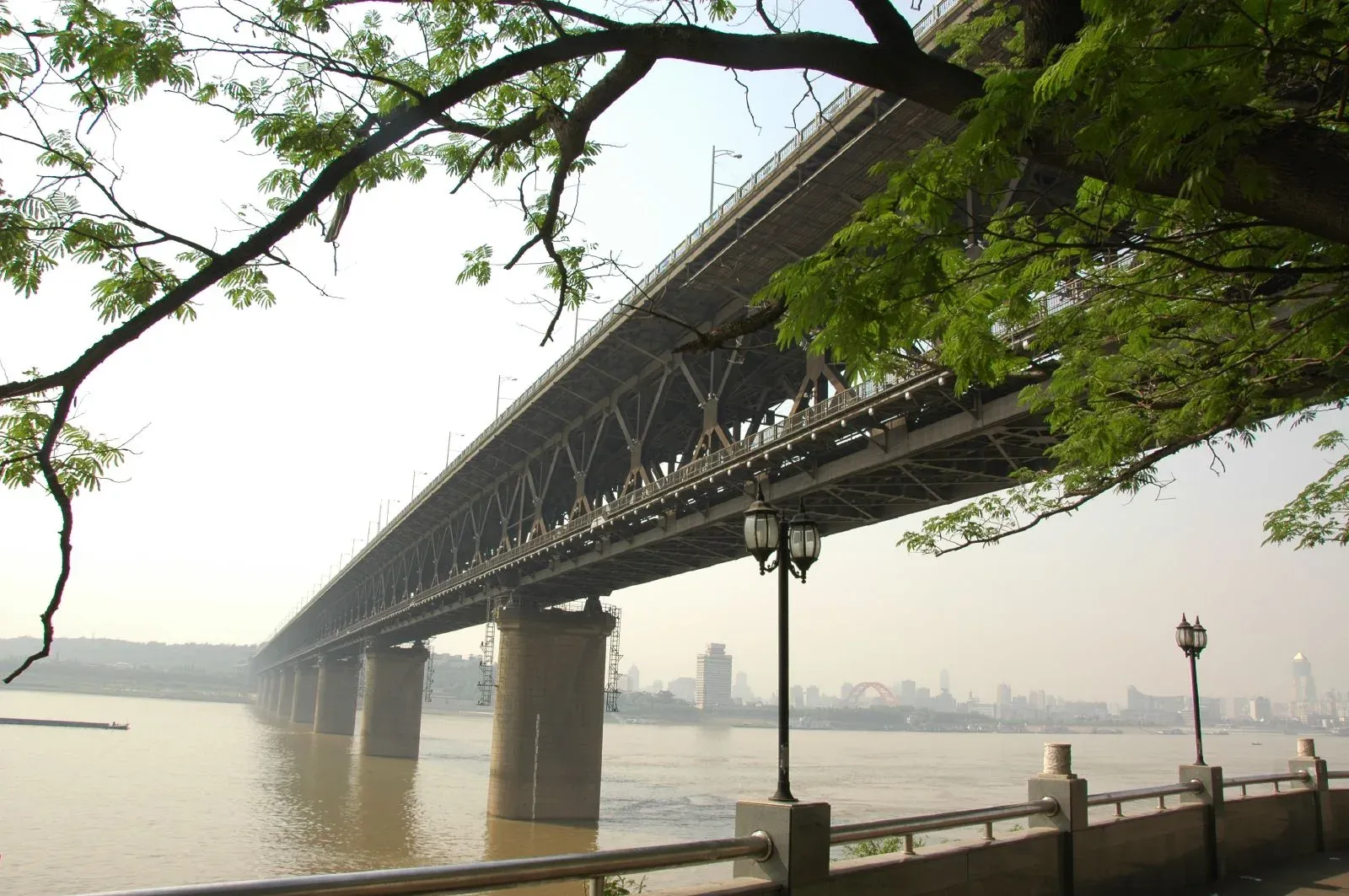
If you want to capture the tower alongside the Yangtze River, the Wuhan Yangtze River Bridge offers an open, free vantage point. Completed in October 1957 and celebrated as the First Bridge of the Ten-Thousand-Li Yangtze River, it spans 1.6 kilometers from Tortoise Hill in Hanyang south to Snake Hill in Wuchang as a double-deck rail-and-road bridge. The upper road deck includes a 2.25-meter-wide sidewalk on each side. You can walk onto the bridge for free and look back toward Snake Hill to frame the tower standing above the tree line.
If you prefer classic red-wall compositions, the exit of Simenkou-Huanghelou Station on Metro Line 5 is a popular photo spot, where crimson perimeter walls frame the upturned eaves in the background. To taste everyday Wuhan life before or after your visit, try the local breakfast ritual called guozao. Its most iconic dish is hot dry noodles (regangmian), made with alkalized noodles tossed in sesame paste, scallions, and spicy pickled radish, with Cai Lin Ji standing as a well-known heritage brand.
If you want to capture the distant tower framed by river water and bridge girders, walk along the 2.25-meter-wide pedestrian sidewalk on the bridge. If you want a traditional scene framed by red courtyard walls, take your shot right outside the exit of Simenkou-Huanghelou Station on Metro Line 5.
What are the most common mistakes for first-time visitors?
First-time visitors to the park most often misjudge the age of the building, the weather seasons, and public transit schedules. Planning your timing and transit in advance keeps your visit straightforward.
| Common Misconceptions | Facts and Regulations |
|---|---|
| Assuming the standing tower is an ancient timber pavilion | The modern tower is a reinforced-concrete reconstruction completed in 1985, while the ancient one was burned down in 1884 |
| Climbing the tower under midday summer heat | Summer in Wuhan lasts 135 days with an average July temperature of 29.2°C, while spring and autumn each offer about 60 days suitable for outdoor travel |
| Assuming all visitors can enter for free | Adult tickets cost 70 yuan; students and seniors aged 60 to 65 receive half-price admission at 35 yuan, while seniors over 65 enter for free |
| Missing the last metro train during evening sightseeing | The last trains on main Wuhan Metro lines (Lines 1 to 8 and Line 11) depart uniformly at 23:00 |
Sources
Wuhan Yangtze River Bridge - Wikipedia
Huanghelou (Chinese) - Wikipedia
Yellow Crane Tower - Wikipedia
Wuhan Metro - Wikipedia
Hot Dry Noodles - Wikipedia
Wuhan - Wikipedia
Huanghelou Poem - Wikipedia
Seeing Meng Haoran Off to Guangling - Wikipedia
Shengxiang Stupa - Wikipedia
Simenkou-Huanghelou Station - Wikipedia
Wuhan Yangtze River Bridge (Chinese) - Wikipedia
Qingchuan Pavilion - Wikipedia
Parrot Island - Wikipedia
Three Great Towers of Jiangnan - Wikipedia
Sources verified on Nov 19, 2026
FAQ
How much are tickets to the park, and are there discounts for seniors and students?
Standard adult admission costs 70 yuan, or 65 yuan if purchased on a mobile phone one day in advance. Students, seniors aged 60 to 65, and children aged 6 to 18 enter at half price for 35 yuan. Seniors over 65 and children under 6 receive free admission. Visitors using discount or free tickets must show original valid ID at entry.
Are there elevators inside the tower for visitors with limited mobility?
Yes, the tower has elevators designed for seniors and visitors needing physical assistance. Although the exterior shows five roof tiers, the building contains nine internal floors. Families with strollers or travelers with limited mobility can ride the elevator between levels.
Why is Wuhan nicknamed River City, and does it come from Li Bai's poem at the tower?
Tang dynasty poet Li Bai composed a famous poem while visiting the tower, writing the line 'A jade flute plays in the pavilion, in River City May blossoms fall like snow.' Ever since, Wuhan has been widely known by its nickname, River City.
Why did Li Bai set down his brush at the tower, and where is the pavilion named after this story?
According to the Chronicle of Tang Poetry, when Li Bai climbed the tower and read Cui Hao's poem, he remarked that the scene was beyond description because Cui's poem stood above it, setting down his brush without writing. The park built the Li Bai Brush-Pausing Pavilion to commemorate this literary tale.
How do you take the metro to the park, and which station is closest?
Take Wuhan Metro Line 5 and get off at Simenkou-Huanghelou Station (司门口黄鹤楼站). The station sits near the junction of Minzhu Road and Hengjie in Wuchang District, and the park entrance is right outside the exit.
How do you walk across the Wuhan Yangtze River Bridge for free views of the tower?
The bridge measures 1,670 meters in total length, and both sides of the roadway deck feature 2.25-meter-wide pedestrian walkways. You can walk onto the bridge for free to enjoy views of the tower atop Snake Hill and the expanse of the Yangtze River.