How to Tailor and Choose a Cheongsam Dress
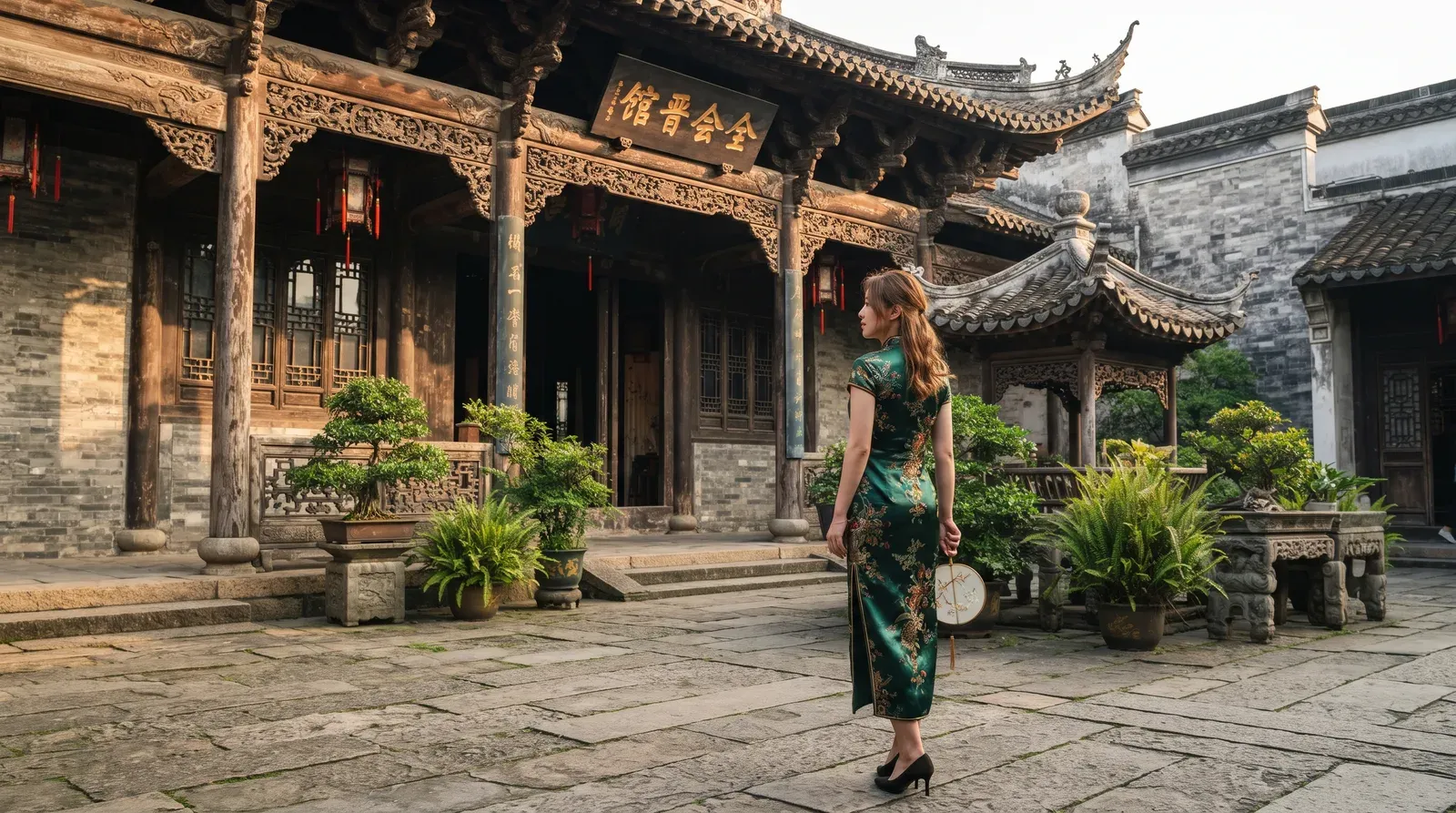
The traditional Chinese cheongsam dress took shape in the 1910s and 1920s. Its classic features include a right diagonal front closure, decorative frog buttons, side slits on both sides or the right side, a mandarin collar, a fitted waist, and short or sleeveless cuts. When choosing or tailoring a qipao, you will find three main styles: Shanghai, Suzhou, and Beijing. Bespoke tailoring requires an in-person fitting by a skilled tailor. If you choose handcrafted frog buttons, making them involves up to 26 separate steps.
| Item | Key Information |
|---|---|
| Origins | Formed in the 1910s and 1920s, popularized during the Republic of China era by Shanghai socialites and upper-class women |
| Three Main Styles | Shanghai style (incorporates Western 3D tailoring and curved waist fitting), Suzhou style (silk fabrics and floral embroidery), Beijing style (straight or A-line handmade cuts) |
| Classic Fabrics | Natural silk (such as soft satin and crepe satin), Suzhou Song brocade (one of China's three famous brocades) |
| Core Handcrafts | Handcrafted frog buttons (including copper wire shaping steps), edge trimming (piping, wide borders, narrow inlays, parallel ribbon bands) |
| Key Tailoring Spots in Shanghai | The junction of Changle Road and South Maoming Road in the former French Concession, time-honored brands on North Shaanxi Road (Longfeng Cheongsam, Hongxiang Atelier) |
| Classic Pairing Etiquette | Paired with Western high heels since the 1930s, accompanied by nude or black stockings for formal occasions |
What is a cheongsam dress, and how do you choose among the three styles?
The traditional garment was widely worn across China from the 1920s to the 1960s during the Republic of China era, popularized by Shanghai socialites and elite women. Typical features include a right diagonal front closure, decorative frog buttons, side slits on both sides or the right side, a standing collar, a fitted waist, and short sleeves or a sleeveless cut. Its designs fall into three major schools: Shanghai, Suzhou, and Beijing.
Shanghai style originated in Shanghai, blending Western three-dimensional tailoring, curved waist shaping, and waist darts to highlight natural curves, paired with higher side slits and very narrow edge piping. Suzhou style comes from the Jiangnan water towns and incorporates Chinese calligraphy, traditional painting, and hand-painted art from the Wu School, reflecting a gentle, refined cultural feel. It often uses fine silks like soft satin and crepe satin, with collars and cuffs embroidered in floral patterns such as plum blossoms, orchids, bamboo, chrysanthemums, peonies, and roses. Beijing style is more traditional and conservative, maintaining a straight or A-line silhouette, mostly made entirely by hand, and marked by wide borders and elaborate embroidery.
If you prefer Western-style 3D tailoring, a body-hugging waist, and higher slits, the Shanghai style is a good fit. If you appreciate gentle water-town elegance and floral embroidery on crepe satin, the Suzhou style is a better match. For a traditional straight or A-line cut with wide borders, look to the Beijing style.
| Style | Origin and Silhouette | Tailoring and Edging | Common Fabrics and Patterns |
|---|---|---|---|
| Shanghai Style | Originated in Shanghai, emphasizes natural feminine curves | Western 3D tailoring, curved waist shaping, waist darts, higher slits, and very narrow piping | Modern contoured silhouette |
| Suzhou Style | Originated in Jiangnan water towns, reflects refined and gentle water-town culture | Integrates Chinese calligraphy, painting, and Wu School hand-painted art | High-quality silk like soft satin and crepe satin, collar and cuffs embroidered with plum blossom, orchid, bamboo, chrysanthemum, peony, rose |
| Beijing Style | More traditional and conservative, mostly straight or A-line silhouette | Mostly made by hand, characterized by wide borders | Elaborate embroidery decoration |
Where can visitors tailor a qipao in Shanghai? Famous streets and shops
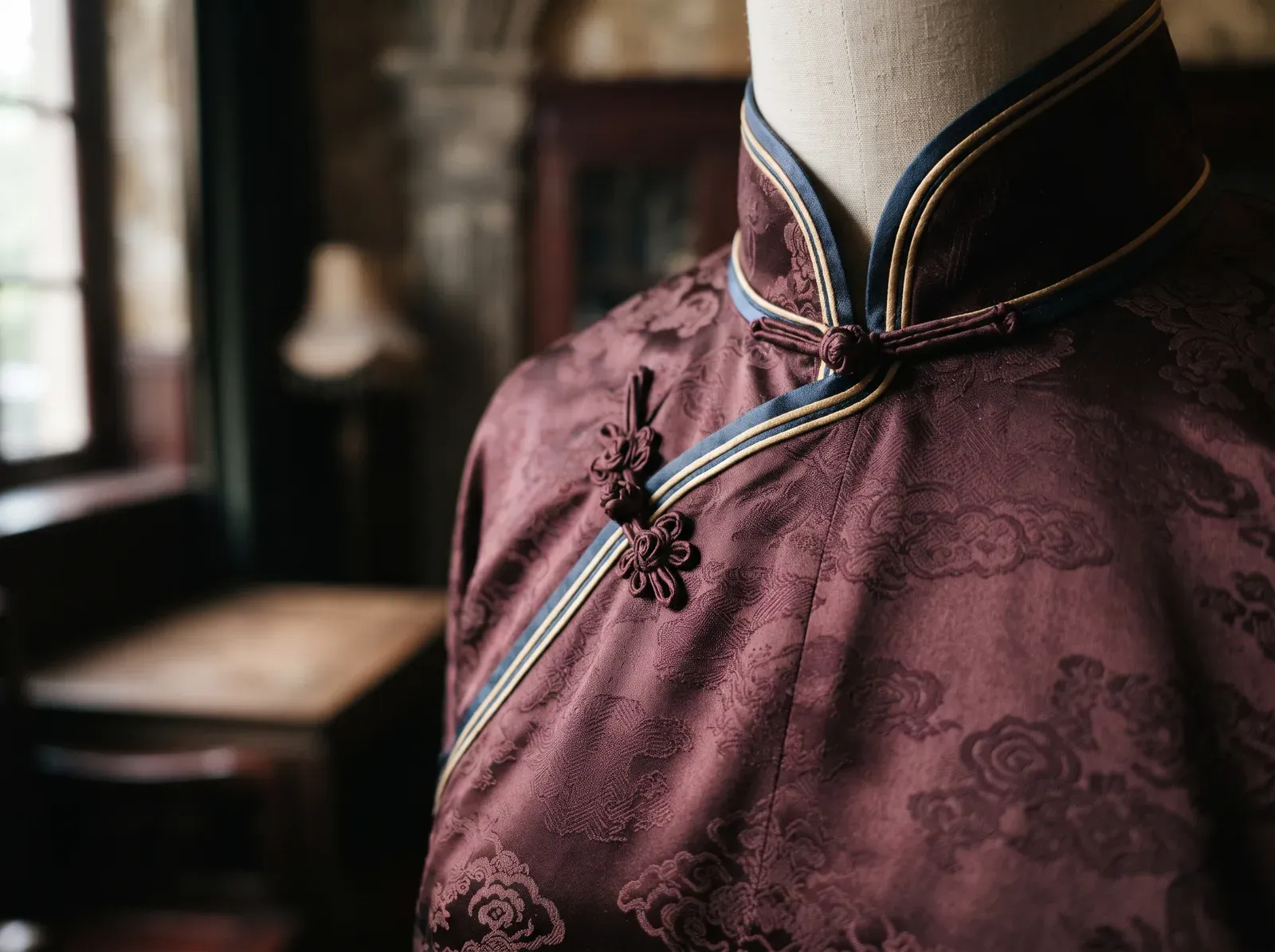
Where Changle Road (长乐路) meets South Maoming Road (茂名南路) in Shanghai's former French Concession, international travelers can follow a standard process to tailor a cheongsam dress. First, bring reference photos to discuss the style, pick your fabric and pattern, and pay a deposit (Alipay is accepted). Second, get measured for your bust, waist, hips, shoulder width, sleeve length, and total garment length. Third, wait 3 to 5 days for the workshop to make it (if you need to catch a flight home, you can negotiate a rush order finished in about 48 hours). Fourth, visit the shop for a fitting, let the tailor alter it until you are satisfied, pay the remaining balance, and take it home.
If you want time-honored heritage brands, North Shaanxi Road (陕西北路) brings together key names. The China Time-Honored Brand Longfeng Cheongsam (龙凤旗袍) is located on North Shaanxi Road in Shanghai. Its handmade craft was listed as national intangible cultural heritage in 2011, preserving the full suite of hand techniques across fabric selection, cutting, sewing, and frog button making. The Shanghai-style womenswear heritage brand Hongxiang was added to Shanghai's intangible cultural heritage list in 2009, and founded the Hongxiang Atelier in 2017 to maintain its bespoke handmade tailoring.

Tip: When ordering at Hongxiang Atelier on North Shaanxi Road, professional tailors measure you in person before sending the measurements to the workshop, so visit the shop yourself for your fitting.
| Location | Area | Craft Heritage and Custom Process |
|---|---|---|
| Junction of Changle Road and South Maoming Road | Former French Concession core area (Changle Road is 3,327 meters long, South Maoming Road is 1,275 meters long) | Shanghai's densest cluster of qipao boutiques and bespoke Chinese tailors |
| Longfeng Cheongsam | North Shaanxi Road, Shanghai | China Time-Honored Brand, handmade craft listed as national intangible cultural heritage in 2011, preserving full hand techniques of fabric selection, cutting, sewing, and frog button crafting |
| Hongxiang Atelier | North Shaanxi Road store, Shanghai | Shanghai-style womenswear heritage brand (listed as Shanghai intangible cultural heritage in 2009), measured in person by professional tailors in store before production in the workshop |
How do you choose fabrics? Silk, Song brocade, and Suzhou embroidery
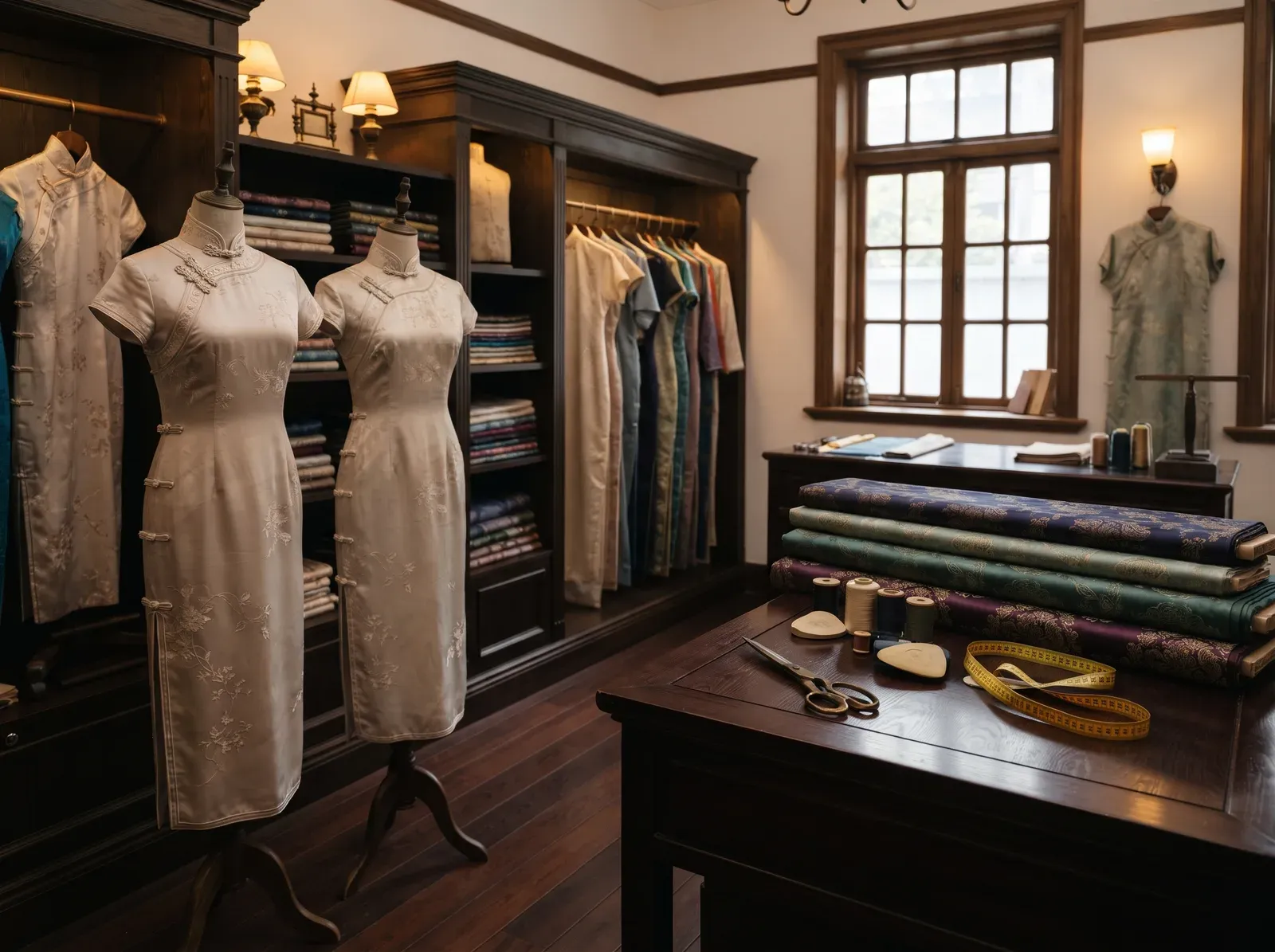
When picking fabrics, quality silk is the core material for Suzhou-style and traditional garments. Natural silk is a protein fiber composed of 75% to 80% fibroin and 20% to 25% sericin. Among China's three famous brocades (Nanjing Yunjin brocade, Suzhou Song brocade, and Chengdu Shu brocade), Suzhou Song brocade is soft and lustrous, making it a frequent choice for qipao and fine traditional Chinese garments.
If you choose a style with embroidered patterns, Suzhou embroidery has strict demands for needles and silk thread. Embroiderers typically split a single hair-thin silk thread into 2 to 16 fine strands, stitching with different thread thicknesses across different parts of the design. Suzhou embroidery was inscribed on China's first national intangible cultural heritage list on May 20, 2006, and joined the first national traditional crafts revitalization catalog in 2018.
Tip: Suzhou embroidery is very time-consuming, taking 3 to 5 months for small pieces, 1 year for medium works, and 2 to 3 years for large pieces. If your time in China is limited, choose a style with small floral embroidery on the collar or sleeves.
What handcrafted details should you look for? Frog buttons and edging
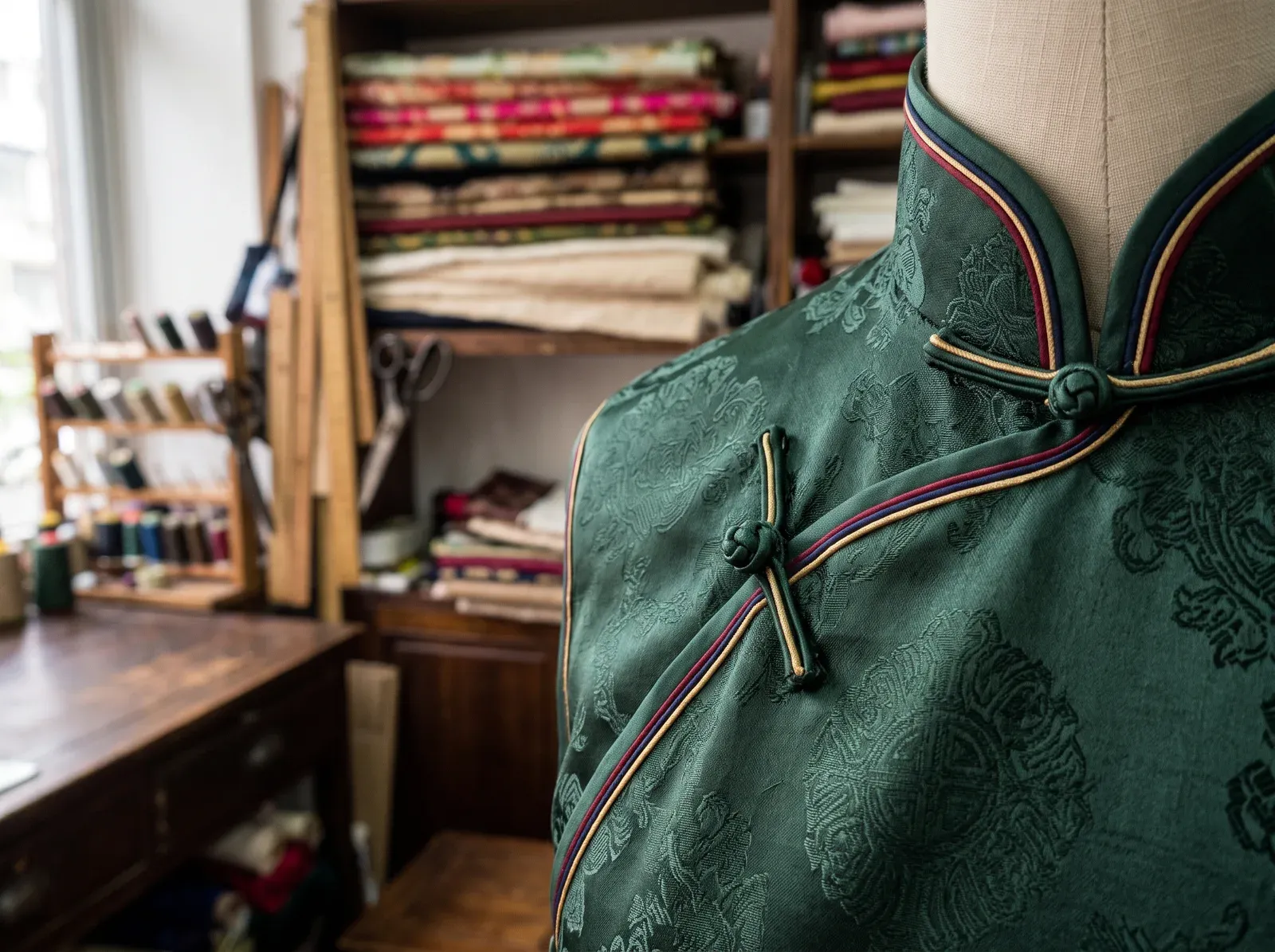
Handmade frog buttons and edge trims are key markers of tailoring quality. A frog button consists of two symmetrical parts: a knotted button (the fastener, traditionally symbolizing yang) and a loop (the catch, traditionally symbolizing yin). Buttons can be made from matching fabric for a subtle, coordinated look, or from contrasting fabric to stand out as a decorative feature.
Fine handcrafted frog buttons require many steps, including sizing (applying paste 4 times to stiffen the silk), cutting strips, sewing sized strips, inserting copper wire cores for shaping, and high-heat ironing. Complex button designs can take several days. For edges, traditional tailoring uses four decorative techniques: gun (narrow piping, the most common today), xiang (wide border), qian (ultra-narrow inlaid piping), and dang (parallel decorative strips stitched onto the garment). Edges are often combined into double or multi-layer effects, such as one pipe and one inlay, two pipes and one inlay, or two pipes and two inlays.
| Technique | Definition and Method | Common Combinations |
|---|---|---|
| Gun (Piping) | Narrow fabric binding, most common today | Often combined with inlay as one pipe and one inlay, two pipes and one inlay, or two pipes and two inlays |
| Xiang (Wide border) | Wide decorative border | Wide edge ornamentation |
| Qian (Inlay) | Ultra-narrow piped cord inserted along edges | Creates fine layered cord lines |
| Dang (Parallel trim) | Narrow fabric strips stitched parallel to the body of the garment | Parallel strip embellishment on the garment |
How do you style hem slits, shoes, and stockings appropriately?
Hem lengths fall anywhere between just above the knee and the top of the foot, with slit heights ranging from the knee up to the upper thigh. For formal occasions, pairing the dress with nude or black stockings is considered tasteful.
Since the 1930s, Western high heels became popular with the gown in Shanghai, joining stockings as the classic ensemble.
Sources
Qipao - Wikipedia
Qipao (Chinese) - Wikipedia
Frog (fastening) - Wikipedia
Suzhou embroidery - Wikipedia
Brocade - Wikipedia
Suzhou Silk Museum - Wikipedia
Silk - Wikipedia
Hongxiang Fashion Company (East Branch) - Wikipedia
Longfeng Cheongsam - Wikipedia
Changle Road (Shanghai) - Wikipedia
South Maoming Road - Wikipedia
Sources verified on November 17, 2026
FAQ
Why does making handcrafted frog buttons take several days?
Crafting fine handmade frog buttons involves up to 26 separate steps, including sizing (applying paste 4 times to stiffen the silk), cutting strips, sewing sized strips, inserting copper wire cores for shaping, and high-heat ironing, with complex designs taking multiple days. Why does Suzhou embroidery on a qipao take so long?