
How to Visit the Lama Temple in Beijing
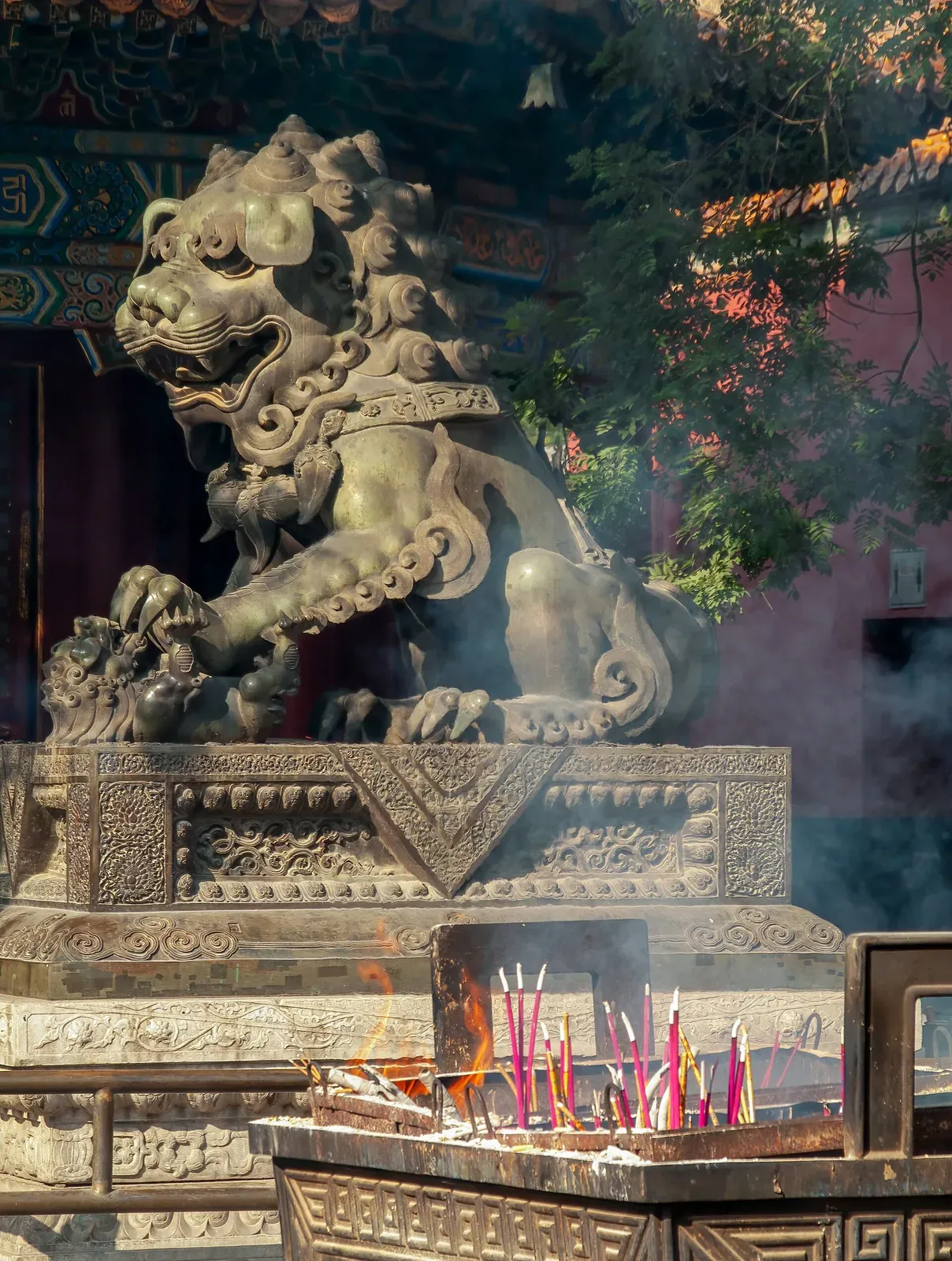
Photo: Ermell / Wikimedia Commons, CC BY-SA 4.0
Lama Temple is the largest Gelug Tibetan Buddhist monastery still standing in Beijing. It runs along a north-south axis 480 meters long, from the three archways and the imperial ramp at the south end all the way to Wanfu Pavilion in the north. Since January 12, 2022, every ticket has been sold online under your real name, and the winter-spring and summer-autumn seasons keep different opening and last-ticket times. Fix those two things first, then work out which halls to walk through once you are inside.
A few things to settle before you set off, laid out in one table.
| Item | Details |
|---|---|
| Address | 12 Yonghegong Dajie, Dongcheng District, Beijing |
| Tickets | Since January 12, 2022, all tickets are booked online under your real name; 20,000 people in the morning and 20,000 in the afternoon; one ticket per person per day |
| Subway | Line 2 or Line 5 to Yonghegong station; Exit C, then about 100 meters south to the entrance on Yonghegong Dajie |
| Central axis | 480 meters long |
| Status | The largest Gelug Tibetan Buddhist monastery still standing in Beijing; both a working monastery and a busy Beijing sight today |
What is Lama Temple, and what will you see inside?
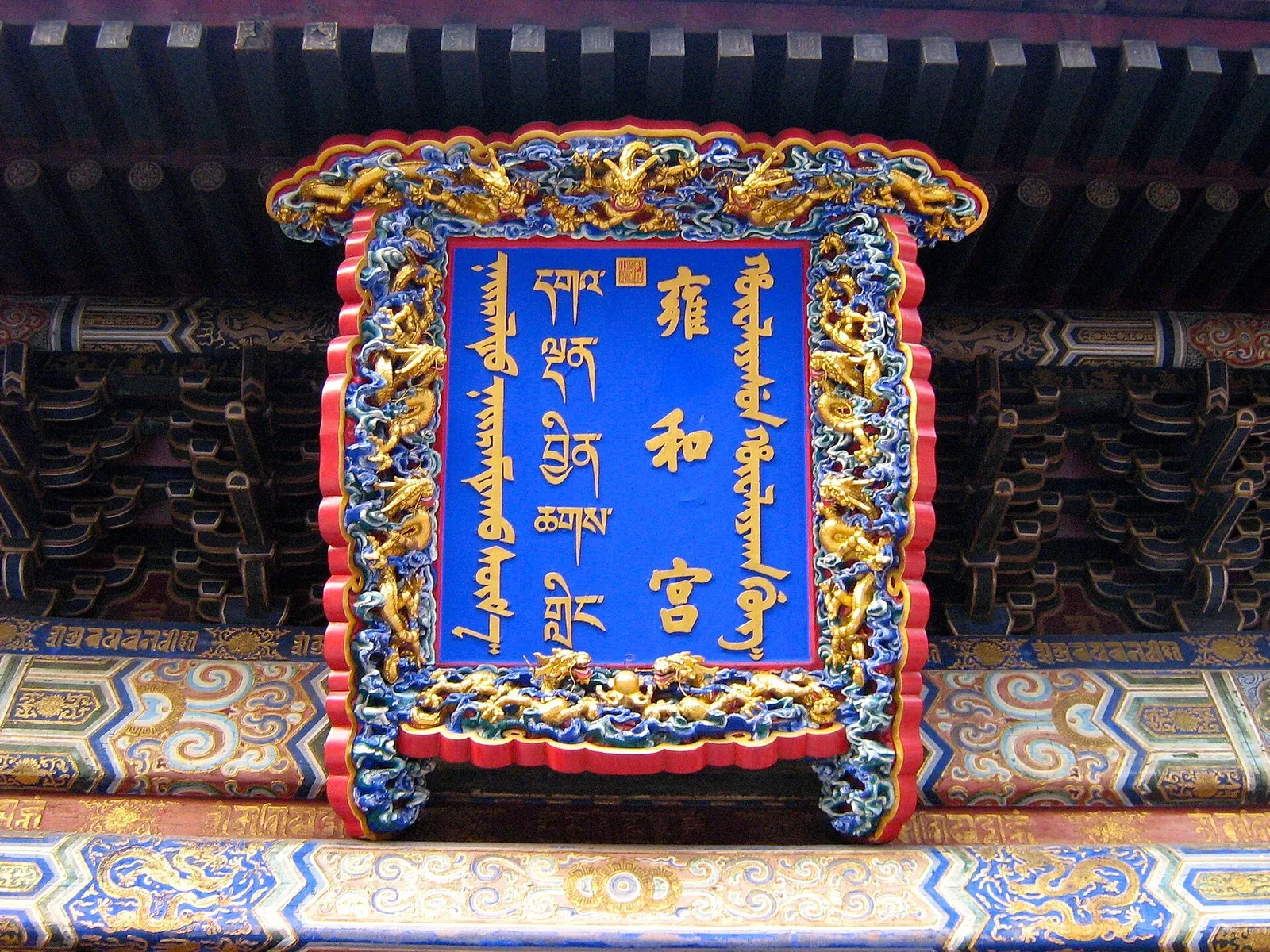
The site began in 1694, the 33rd year of the Kangxi reign, as the mansion of the fourth prince, Yinzhen. In 1725, the third year of the Yongzheng reign, it became a temporary palace named Yonghegong, and in 1744, the ninth year of the Qianlong reign, it was converted into a lamasery. Its base is therefore a prince's residence, and after the conversion it served as the imperial Gelug monastery.
It opened to the public as a place of religious practice in February 1981, was listed in the first batch of key national heritage sites in 1961, and in 1995 became the Yonghe Temple Museum of Tibetan Buddhist Art. Today the place is both a working monastery and a busy sight, so at the gate you see worshippers burning incense and visitors looking at the buildings at the same time.
How do I book a ticket, and when does ticket sales stop?
Since January 12, 2022, tickets for the Lama Temple in Beijing have been sold only online, by real-name reservation. The daily cap is 40,000 visitors, and each person can buy one ticket per day. Buying a ticket at the gate on the day no longer works. Tickets cost 25 yuan, according to the temple's entry on Wikivoyage. Once inside, most halls take an hour or less, according to English Wikivoyage, so allow about an hour.
Opening hours follow two seasons. Winter-spring, from November 1 to March 31, runs 09:00 to 16:30. Summer-autumn, from April 1 to October 31, runs 09:00 to 17:00. Ticket sales stop 30 minutes before closing, so once last-ticket time passes you cannot get a ticket for that day.

| Season | Opening hours | Last ticket | Site cleared |
|---|---|---|---|
| Winter-spring (November 1 to March 31) | 09:00 to 16:30 | 16:00 | 16:30 |
| Summer-autumn (April 1 to October 31) | 09:00 to 17:00 | 16:30 | 17:00 |
Tip: Bookings are split into a morning slot and an afternoon slot of 20,000 each. Decide which half of the day you enter first, then build the rest of that day around it.
Subway or bus, and how do I walk from the station to the gate?
The temple is at 12 Yonghegong Dajie in Dongcheng District, Beijing. Subway Line 2 and Line 5 both stop at Yonghegong station; the walk from each exit is in the table below. Fares are distance based and start at 3 yuan per person for the first 6 km.
| Way | Where to get off | How to reach the entrance |
|---|---|---|
| Subway | Line 2 or Line 5, Yonghegong station | Exit C, about 100 meters south to the entrance on Yonghegong Dajie |
| Bus | 13 and 684, Guozijian station; 116 and 117, Yonghegong station; T2, 18, 62, 606, 909, 44, 800 and 858, Yonghegong Qiaodong station | Walk to 12 Yonghegong Dajie after you get off |
By bus the routes split into three stops: 13 and 684 stop at Guozijian, 116 and 117 at Yonghegong, and the other lines at Yonghegong Qiaodong. Check which stop name your bus announces before you get off.
Tip: If you ride Line 2, the Beijing municipal government's English website describes getting off at Andingmen station as another way to reach the temple; Baidu Baike's route notes put both Line 2 and Line 5 at Yonghegong station. Either works, so choose the one closer to where you are.
Which order should I walk in, and what should I not skip?
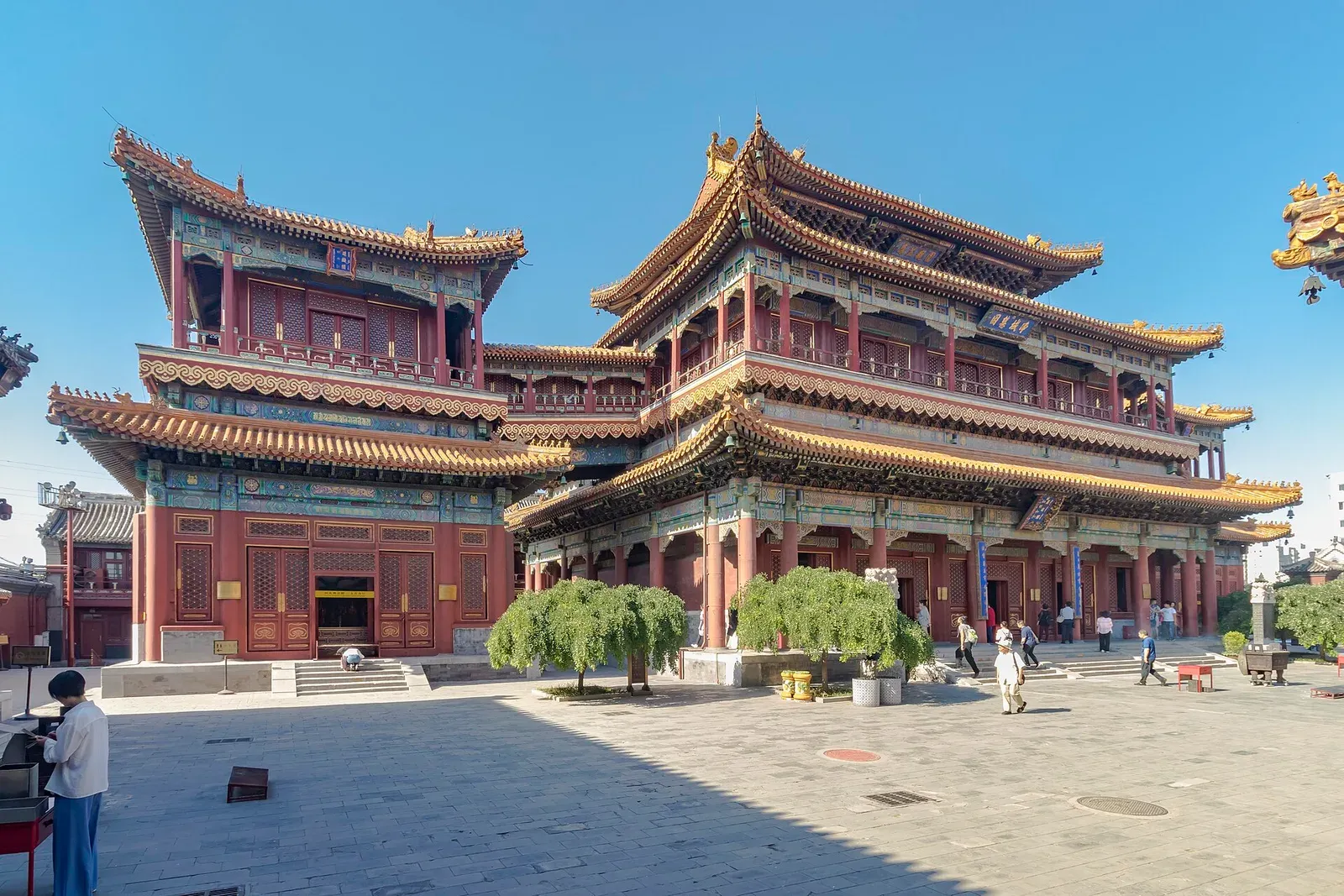
At the south end of the axis you first pass the three archways and a spirit screen, and the imperial ramp north of them leads to the main gate, Zhaotai Gate. Inside, the order runs: stele pavilion and bell and drum towers, Tianwang Hall, the main hall, Yongyou Hall, Falun Hall, and finally Wanfu Pavilion at the north end. On both sides of the axis are the east and west side halls, plus the four study halls: Jiangjing, Mizong, Shuxue and Yaoshi.
The three treasures of the temple, as they are known here, are the bronze Zhao Buddha in the east wing of Wanfu Pavilion, the sandalwood carving of 500 arhats in Falun Hall, and the white sandalwood Maitreya in Wanfu Pavilion. All three sit in the northern half of the axis, so you only see them when you reach Falun Hall and Wanfu Pavilion.
The standing Maitreya in Wanfu Pavilion is 18 meters tall and 8 meters wide, carved from a single white sandalwood trunk 26 meters long, with 8 meters of it buried underground. In 1993, it entered the Guinness World Records.
According to Baidu Baike, Wanfu Pavilion itself is 25 meters tall, the highest building on the north route through the temple, and the Qianlong Emperor spent more than 80,000 taels of silver to have the great Buddha carved.
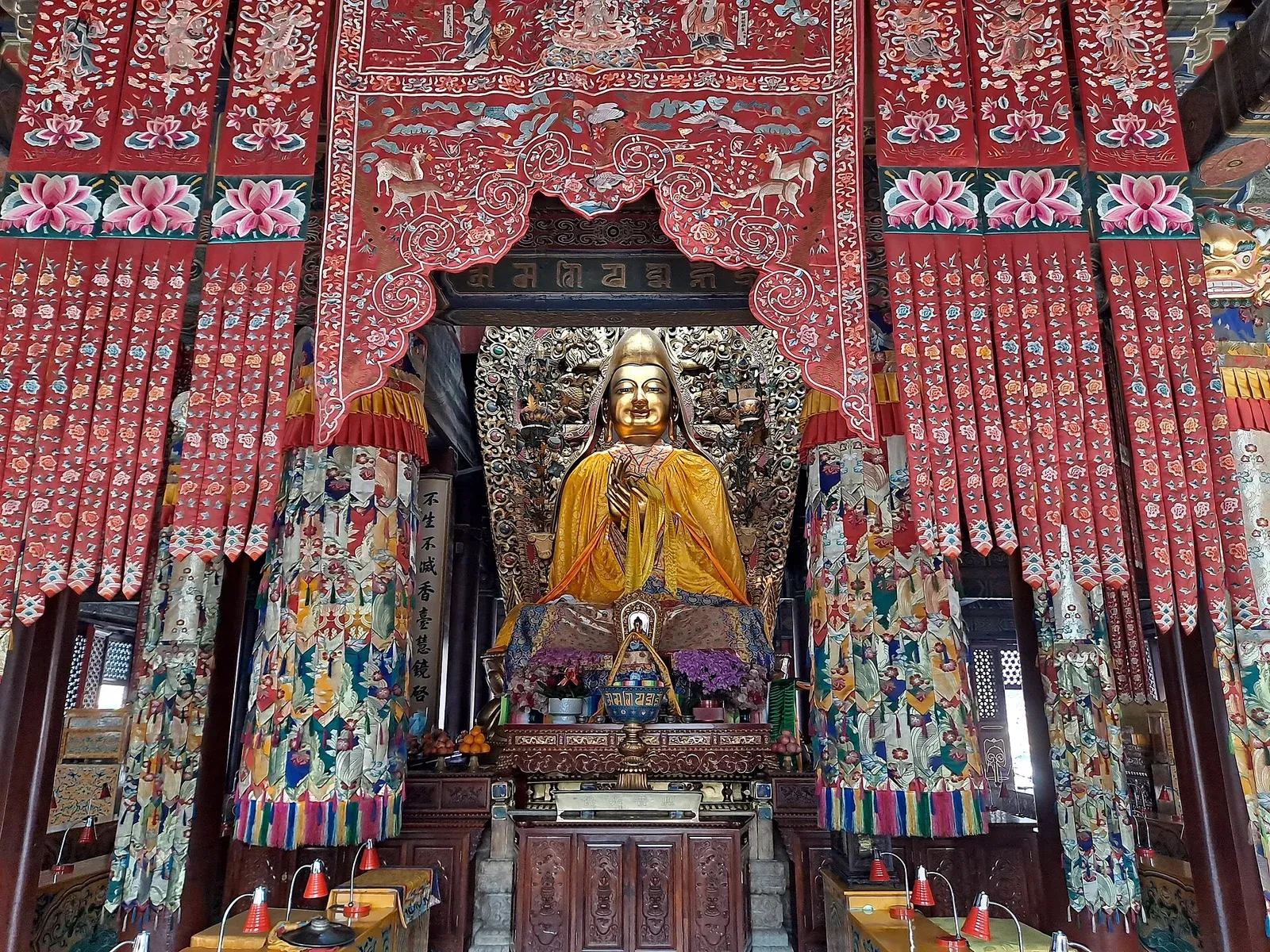
In the center of Falun Hall sits a bronze seated statue of Tsongkhapa 6.1 meters tall, made in 1924 at a cost of 200,000 silver dollars over two years. Behind the statue is the sandalwood carving of 500 arhats, nearly 5 meters high, 3.5 meters long and 30 cm thick.
| Hall | Main things to see |
|---|---|
| Tianwang Hall (former front gate of the mansion) | Maitreya, the Four Heavenly Kings and Weituo |
| Main hall (former Yin'an Hall) | The Buddhas of the Three Times and the 18 arhats |
| Falun Hall | Bronze Tsongkhapa, with the sandalwood 500 arhats carving behind it |
| Wanfu Pavilion | The white sandalwood Maitreya, and the bronze Zhao Buddha in the east wing |
If you want all three treasures in one go, follow the axis to the north end. The bronze Zhao Buddha in the east wing of Wanfu Pavilion and the white sandalwood Maitreya are at the far north, and the third one, the 500 arhats carving, is in Falun Hall just before them. See Falun Hall first, then walk up to Wanfu Pavilion, and you never backtrack.
Which days bring ceremonies and the porridge giveaway?
The first day of the first lunar month is one of the busiest days of the year here. According to Baidu Baike, unusually many people come to worship that day: they bow, burn incense and turn prayer wheels, and monks go into the halls at 2 a.m. to chant until dawn.
| Day | What happens |
|---|---|
| First day of the first lunar month | Very large crowds; worshippers burn incense and turn prayer wheels; monks chant in the halls from 2 a.m. until dawn (according to Baidu Baike) |
| Twelfth lunar month | Laba porridge is simmered in the big bronze cauldron beside the drum tower, with a ceremony to give it out |
| 23rd day of the first lunar month to the 1st day of the second lunar month | Great Vow Prayer Assembly |
| 29th day of the first lunar month (30th in a long month) and the 1st day of the second lunar month | Cham dance to drive out evil spirits |
According to English Wikipedia, the cham dance was extended in the Guangxu reign to run eight days, from the 23rd of the first lunar month to the 1st of the second lunar month. If you want to watch the dance, plan your trip around those two dates.
Half a day or a full day: how do I link it with what is nearby?
The temple sits on its own axis, so walking it from south to north is a straight line. For the other half of the day, the Beijing Confucius Temple and the Guozijian sit on one street to the west.
| Time | Where | How to get there |
|---|---|---|
| Morning | The temple | Subway Line 2 or Line 5, Yonghegong station |
| Afternoon | Beijing Confucius Temple and Guozijian on Guozijian Street | On Guozijian Street, west of the temple |
If you want the Forbidden City in the same day as well: the two are about 5 km apart, roughly 1 hour on foot, so put one at each end of the day and you avoid doubling back. If you would rather see one of them slowly, give the other its own half day.
The Beijing Confucius Temple on Guozijian Street, west of the temple, is the second largest Confucius temple in China after the one in Qufu. It was first built in 1302, the sixth year of the Dade reign, and it stands next to the Guozijian. Walk west from the temple and you are there.
For food, the temple's luohan cai is a monastic vegetarian dish: daylily, wood ear, shiitake, winter bamboo shoots, wheat gluten, dried bamboo shoot slices, water chestnut, tofu, cabbage and carrot stewed together with a little vegetable oil. It is a one-pot dish.
What do first-time visitors most often get wrong?
| Common mistake | What to do instead |
|---|---|
| Treating "open until 16:30 or 17:00" as the last entry time | In both seasons ticket sales stop before closing, so arriving at closing time means you cannot get in |
| Buying a ticket at the gate | Since January 12, 2022 all tickets are booked online under your real name, one per person per day |
| Turning back once you reach Tianwang Hall | The axis continues with the main hall, Yongyou Hall, Falun Hall and Wanfu Pavilion |
| Ending the day at the temple | Guozijian Street to the west has the Beijing Confucius Temple next to the Guozijian, first built in 1302, the sixth year of the Dade reign |
Tip: Booking is by real name, one ticket each. When a family travels together, book every ticket with that person's own ID details, and each of you carries the matching document at the gate.
When would these plans need to change?
The opening hours, last-ticket times and booking rules here were checked around November 2026. Look at the official booking channel once more before you travel. The seasons turn over on April 1 and November 1, and on the other side of those two dates a different set of opening and last-ticket times applies.
Lunar first days, Dharma assembly days and Laba see religious activity. If your date falls on one of them, follow the instructions on site and keep the day loose, leaving time to wait.
Sources
Beijing Life on the Subway
Yonghe Temple - Wikipedia
Yonghe Temple - Baidu Baike
Yonghe Temple - Wikipedia (Chinese)
Beijing Temple of Confucius - Wikipedia
All sources checked on November 18, 2026
FAQ
How many days ahead should I book?
Ticket release times are confirmed on the official booking channel. What is certain: all tickets are booked online under your real name, split into a morning slot and an afternoon slot, one ticket per person per day.
Which exit do I take at Yonghegong station?
Exit C. Walk south from there and you reach the temple entrance on Yonghegong Dajie.
Can I see the temple and the Forbidden City in one day?
The two are about 5 km apart, roughly 1 hour on foot, so one at each end of the day fits. If you want to look at one of them slowly, the other is easier with its own half day.
What else is nearby?
Guozijian Street to the west has the Beijing Confucius Temple, the second largest Confucius temple in China after Qufu's, next to the Guozijian. Walk west from the temple and you are there.