
Huangshan Mountain Travel Guide: Hiking Routes, Sunrise, and Sea of Clouds
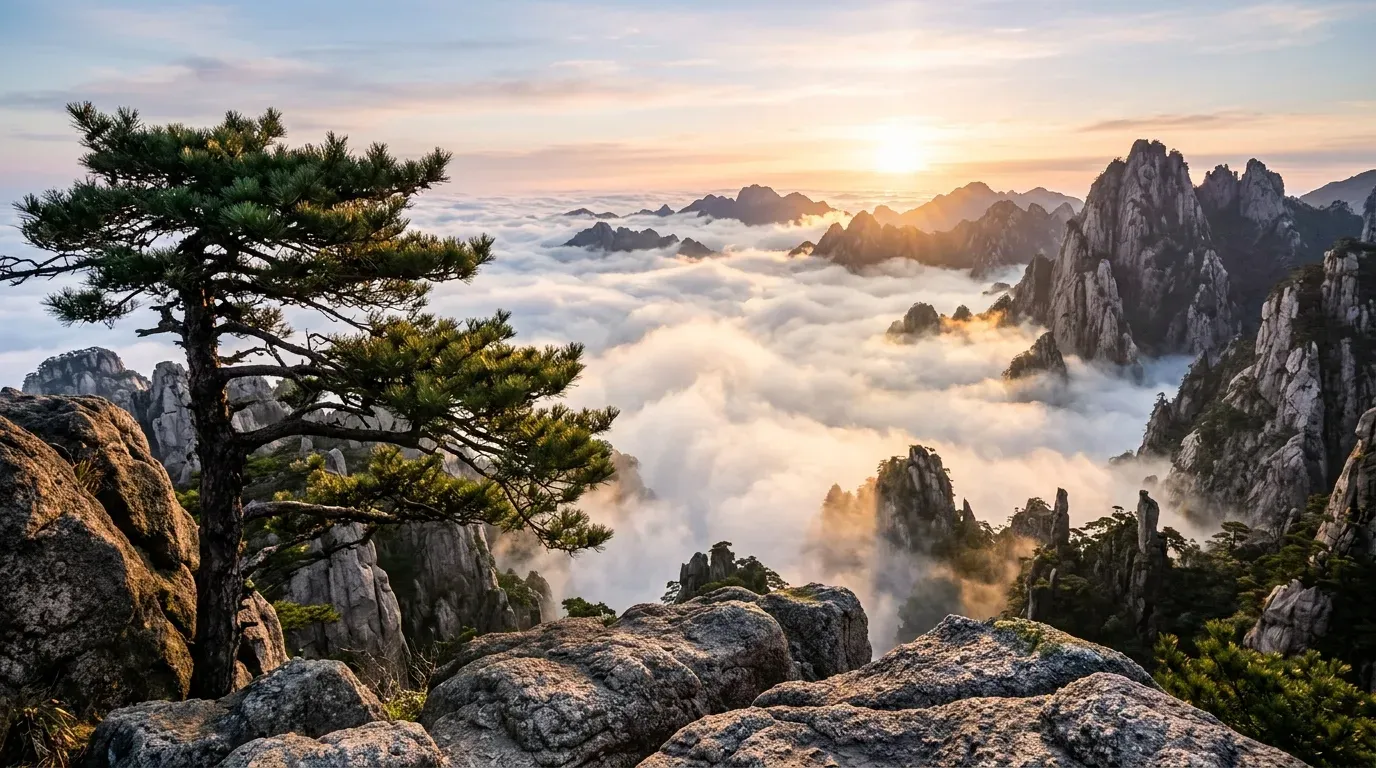
A visit to Huangshan Mountain usually takes two days. Visitors can stay overnight at a hotel on the mountain to watch the sunrise, splitting their ascent and descent across different routes. The core scenic area covers about 160.6 square kilometers, with over 50 kilometers of walking paths and more than 60,000 stone steps carved into the rock. Lotus Peak (Lianhua Feng), the highest peak on the mountain, reaches 1,864 meters, and all three major peaks exceed 1,800 meters.
How to Plan Hiking Routes on Huangshan Mountain
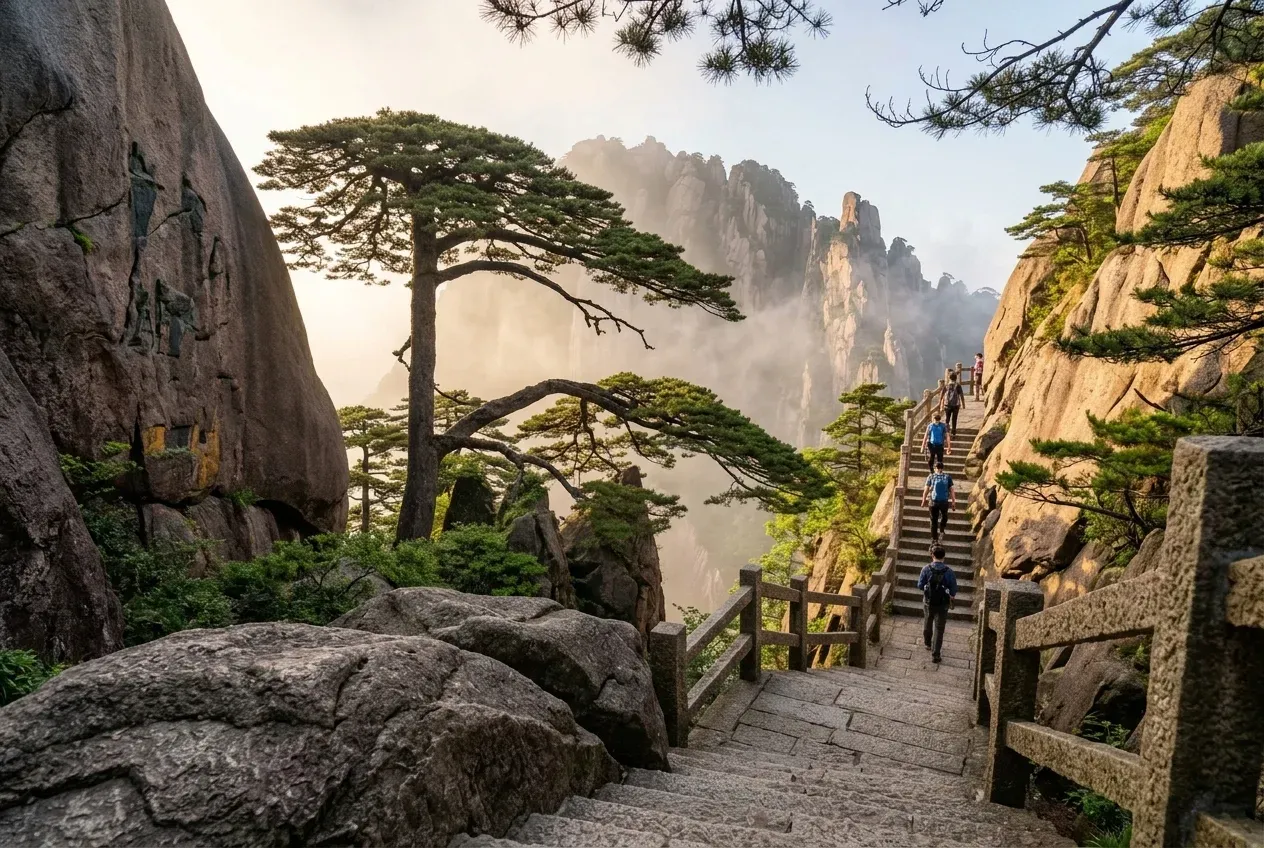
The core scenic area is divided into nine management zones: Hot Spring, Yungu, Yuping, Beihai, Songgu, Diaoqiao, Fuxi, Yanghu, and Fugu. Walking paths within the scenic area stretch for more than 50 kilometers, with over 60,000 stone steps carved into cliffs and mountain ridges. Visitors generally take two days to climb up and down using different routes, staying overnight at summit hotels to see the sunrise.
Distinctive pine trees grow across both the front and back mountains. The iconic Guest-Greeting Pine stands on the east side of Yuping Pavilion and above Wenshu Cave in the front mountain. The Sea-Exploring Pine grows beside Carp's Backbone on Tiandu Peak, while the Black Tiger Pine stands at the junction leading to Shixin Peak in the Beihai area of the back mountain.
What Are the Features of the Three Major Peaks?
All three major peaks rise above 1,800 meters: Lotus Peak, Bright Summit (Guangmingding), and Tiandu Peak. Lotus Peak is the highest at 1,864 meters. Bright Summit reaches 1,860 meters, and Tiandu Peak stands at 1,810 meters.
| Major Peak | Elevation | Geographic Features and Landmarks |
|---|---|---|
| Lotus Peak | 1,864 meters | Highest peak of the mountain |
| Bright Summit | 1,860 meters | Second-highest peak, equipped with a meteorological station |
| Tiandu Peak | 1,810 meters | Steep peak, with the Sea-Exploring Pine near Carp's Backbone |
UNESCO inscribed the mountain as a World Cultural and Natural Heritage site in December 1990. It was later designated a Global Geopark in 2004.
What Weather Conditions Are Needed to See the Sunrise and Cloud Seas?
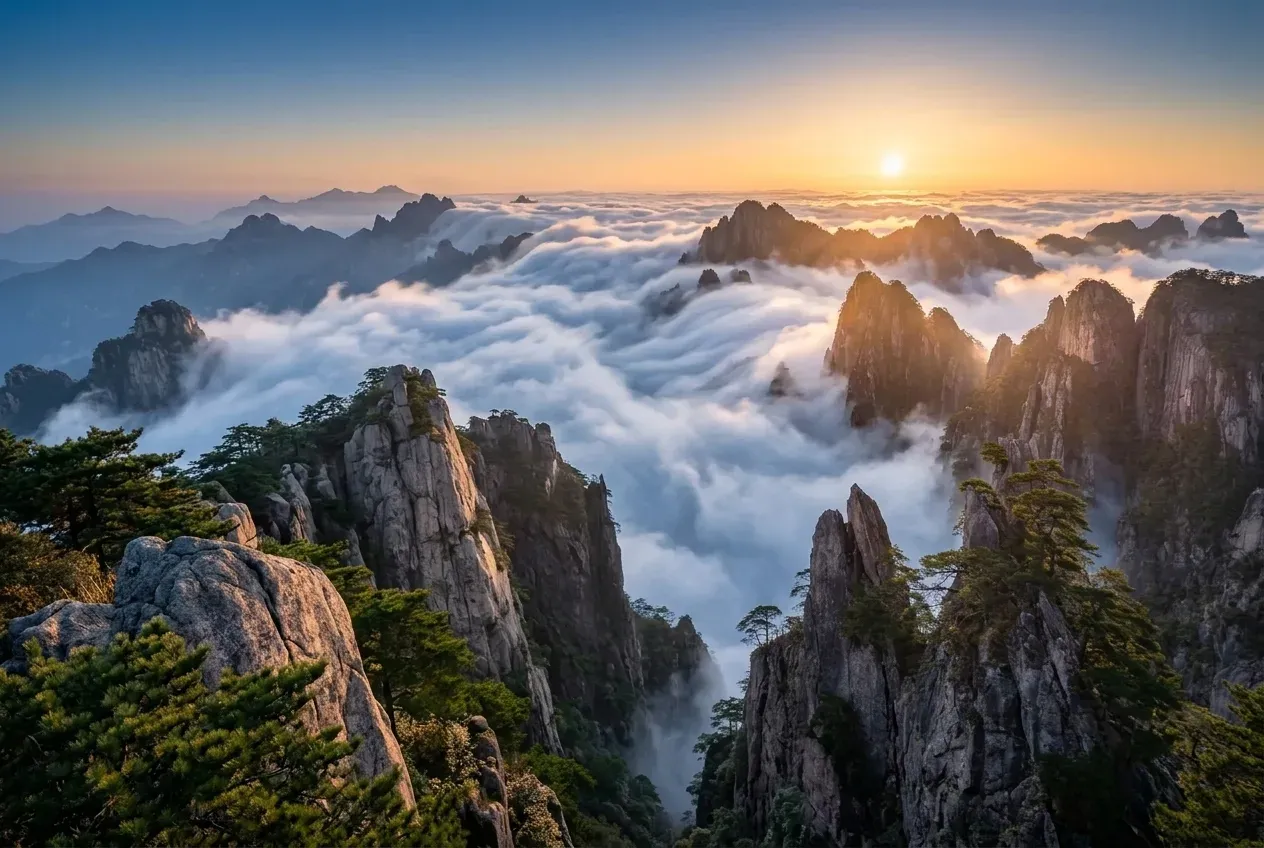
Cloud and fog occur on more than 250 days a year. Meteorological data shows that the sea of clouds forms when low stratocumulus clouds gather, driven by the humid subtropical monsoon climate, deep valleys, dense vegetation, and moisture circulation. Based on geographic direction, the sea of clouds is divided into five viewing areas: East Sea, South Sea, West Sea, North Sea, and Sky Sea.
At 1,860 meters, Bright Summit offers an open view suitable for watching the sunrise and the sea of clouds. In addition to the cloud seas, the famous optical phenomenon known as Buddha's Light appears only a few times a month on average.
How Are Monthly Temperatures and Precipitation Distributed at the Summit?
Observation data from the China Meteorological Administration station at Bright Summit shows that the average daily temperature at the summit is 8.0°C across the year. July is the warmest month with a daily average of 17.5°C, while January is the coldest with a daily average of -2.4°C.
Regarding precipitation, Bright Summit receives an annual average of 2,402.9 millimeters. Rainfall is heaviest in June, reaching 458.5 millimeters, while December is the driest month, with 50.5 millimeters.
| Meteorological Indicator | Period | Observed Value |
|---|---|---|
| Annual daily mean temperature | Full year | 8.0°C |
| Daily mean temperature of the warmest month | July | 17.5°C |
| Daily mean temperature of the coldest month | January | -2.4°C |
| Annual average precipitation | Full year | 2,402.9 mm |
| Precipitation in the wettest month | June | 458.5 mm |
| Precipitation in the driest month | December | 50.5 mm |
Alongside the alpine climate on the peaks, hot springs are located at the foot of the mountain. Huangshan Hot Spring sits below Ziyun Peak at an elevation of 850 meters, with water temperatures staying at 42°C year-round.
What Physical Demands and Exceptions Should You Keep in Mind?
With more than 60,000 stone steps and over 50 kilometers of walking paths, the hike presents a real test of leg strength and endurance. For visitors with limited stamina or during months with heavy rainfall, a single-day round trip can be demanding. Splitting the visit across two days and staying overnight on the mountain is recommended.
Sources
Huangshan - Wikipedia, the free encyclopedia
Huangshan - Wikipedia
Sources verified on November 16, 2026
FAQ
What are the advantages of staying overnight at a summit hotel?
Hotels on the mountain allow visitors to watch the sunrise the next morning and split the ascent and descent across two days on different trails, reducing the physical strain of tackling over 50 kilometers of paths and 60,000 stone steps in a single day.
How many days a year can you see the sea of clouds?
Cloud and fog occur on more than 250 days a year, creating low stratocumulus clouds shaped by moisture circulation. The scenery is divided into five viewing areas: East Sea, South Sea, West Sea, North Sea, and Sky Sea, with visibility depending on local weather conditions.
Where is the hot spring located and what is its water temperature?
Huangshan Hot Spring is situated below Ziyun Peak at an elevation of 850 meters, maintaining a constant water temperature of 42°C throughout the year.
Which months are the coldest and warmest at the summit?
Meteorological data from Bright Summit shows that January is the coldest month with an average daily temperature of -2.4°C, July is the warmest at 17.5°C, and the annual daily average temperature is 8.0°C.