
Lingyin Temple Guide: Feilai Peak, Tickets, and Routes
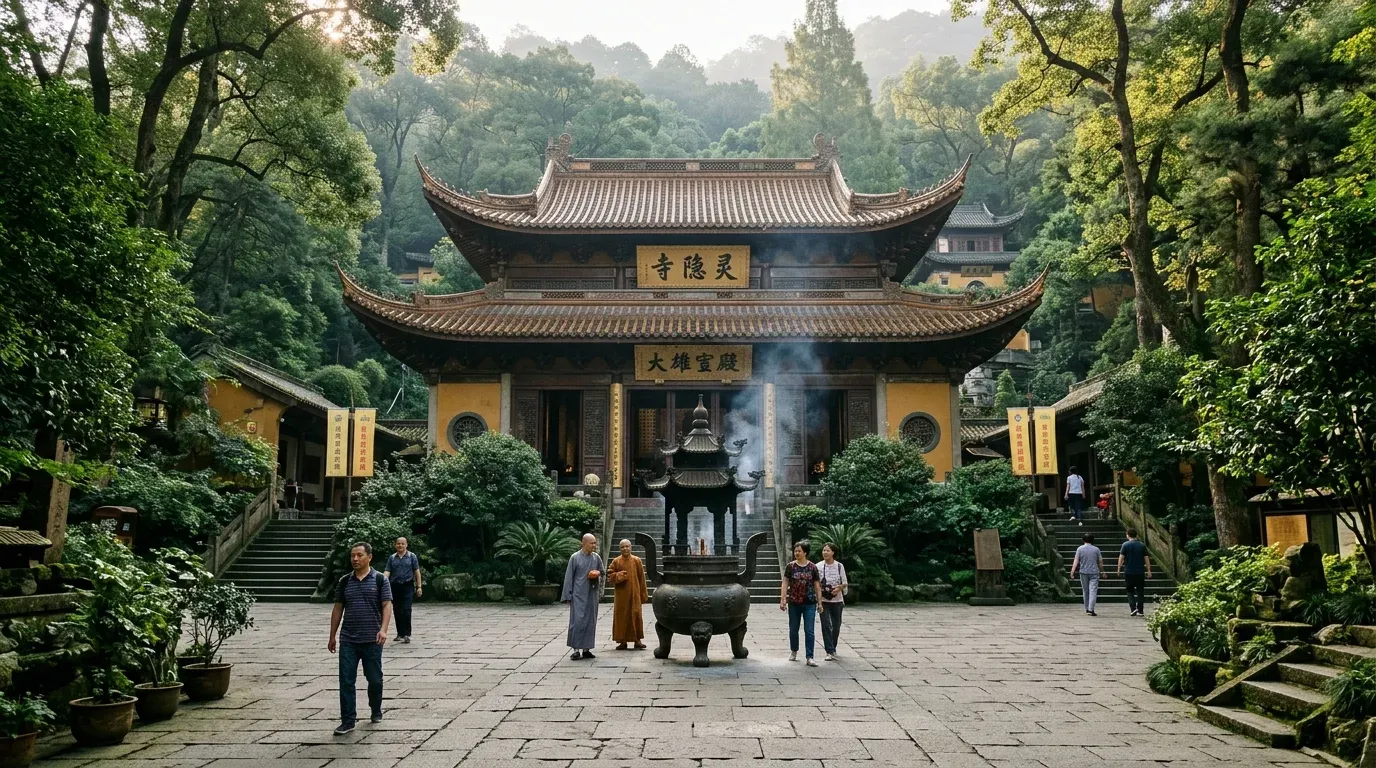
Starting Dec 1, 2025, the Lingyin Feilai Peak Scenic Area in Hangzhou officially introduced free admission. This policy covers the entire scenic area, including Lingyin Temple, Yongfu Temple, and Taoguang Temple, removing the previous combined ticket cost of 75 RMB. Visitors do not need to buy tickets at on-site counters, but need to make a real-name reservation online for a specific entry window in advance and show an original ID at the gate. Once inside, walking along the Lengquan Stream connects the rock carvings of Feilai Peak with the temple halls.
| Item | Policy and Visitor Information |
|---|---|
| Admission | Free entry (the previous 45 RMB Feilai Peak ticket and 30 RMB Lingyin Temple incense ticket, totaling 75 RMB, are waived) |
| Reservation | Advance real-name reservation by time slot, opening daily at 8:00 for morning and afternoon sessions |
| Opening hours | Temple gates open daily at 7:00, staff start clearing the grounds at 18:00, and gates close at 18:15 |
| Entry document | Original valid ID registered during booking for verification against your face; no QR code needed at the gate |
| Temple incense | Three incense sticks are provided inside the temple free of charge; no need to buy overpriced incense outside |
How to Book Free Tickets for Lingyin Temple?
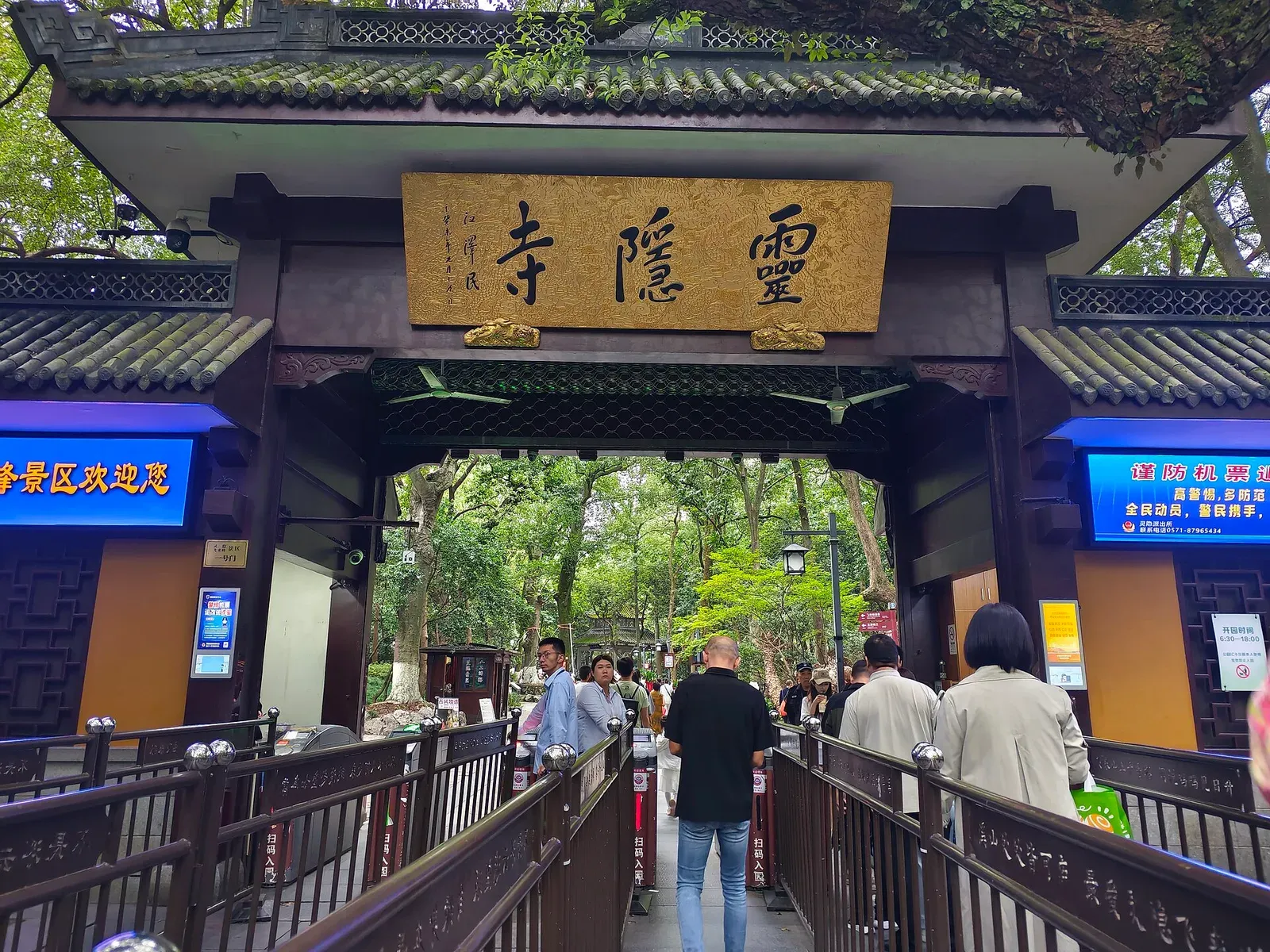
To visit Feilai Peak and Lingyin Temple, visitors complete a real-name reservation in advance through official channels. The official booking tool is the "Hangzhou Lingyin Feilai Peak" mini-program on Alipay or WeChat. You can also find booking links through the "Hangzhou West Lake Scenic Area Consultation" or "West Lake Tourism" WeChat official accounts. Slots open daily at 8:00 up to 7 days in advance for either the morning session (7:30 to 12:00) or the afternoon session (12:00 to 17:00). A reservation for Feilai Peak automatically covers Lingyin Temple, Yongfu Temple, and Taoguang Temple without separate bookings.
Each reservation is tied strictly to the registered visitor. When entering, you show the original valid ID (such as a passport or ID card) used during booking for on-site identity verification; showing a QR code on your phone is not accepted. Minors aged 14 and under need to be booked by an accompanying adult and enter together. One adult can add up to 3 minors by clicking "Add Child Ticket" on the confirmation screen. If plans change, cancellations need to be submitted before 24:00 on the booked date; missing 3 visits within 30 days on one account triggers a 30-day booking restriction. Visitors aged 70 and above, people with disabilities, military personnel, firefighters, and holders of ordained monk certificates or temple conversion certificates can enter without booking.
Tip: On weekdays, morning crowds are heavier while afternoons are quieter; on weekends and holidays, visitor numbers peak around 14:00, so pick your time slot accordingly to avoid peak hours.
What Is the Classic Walking Route Through the Temple?
The classic route starts at the entrance screen wall, follows the stream past the Feilai Peak cliff carvings, and then enters the main front gate to tour the central halls and side compounds. Outside the gate stands a screen wall inscribed with the words "The Western Paradise Is Near" (咫尺西天). Inside, you will see the stone Ligong Pagoda, an octagonal seven-story pagoda about 8 meters high that holds the ashes of Huili, the Indian monk who founded the temple. Following the stream, the cliffside Buddhist grottos sit on your left and the main temple entrance lies on your right. Historical records date the founding of the temple to either 326 or 328 during the Eastern Jin dynasty.
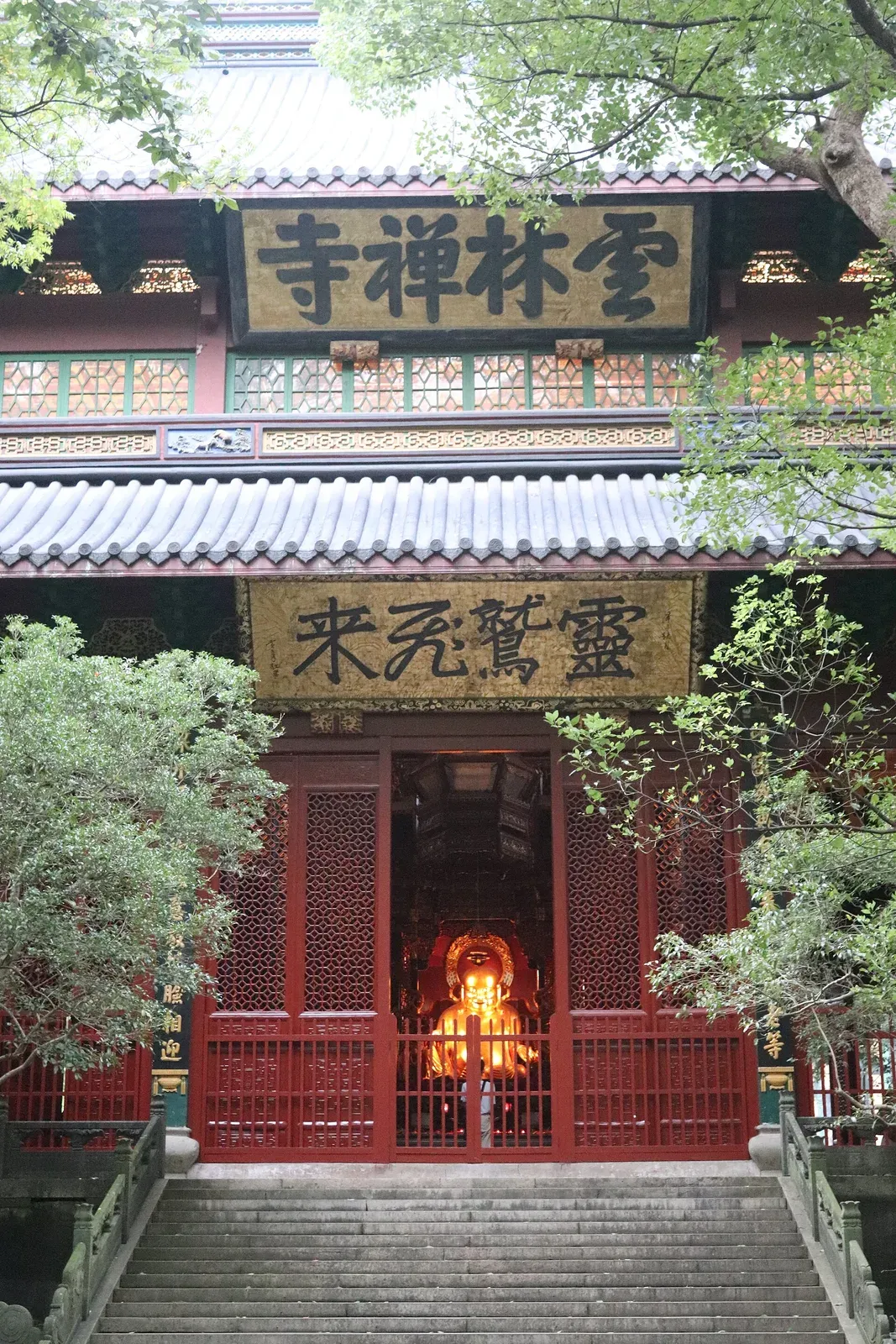
Stepping into the Hall of Heavenly Kings, you will see a horizontal plaque above the entrance reading "Yunlin Zen Temple", written by the Kangxi Emperor of the Qing dynasty. Behind the Maitreya Buddha statue stands a 700-year-old Southern Song wooden carving of Skanda holding a vajra pestle. Beyond this hall, the Grand Hall of the Great Sage rises 33.6 meters high, housing China's largest wooden Buddha: a Shakyamuni statue standing 24.8 meters tall including the lotus base (some records state 24.6 meters). Behind it stands a massive polychrome sculpture depicting the Fifty-three Visits of Sudhana, centered on Guanyin of the South Sea and surrounded by more than 150 figures including Sun Wukong and Monk Jigong. Further along the central axis are the Hall of the Medicine Buddha, the Sutra Library, and the Huayan Hall, which sits at the highest point of the complex and enshrines the Three Sages of Huayan (Vairocana, Manjushri, and Samantabhadra).
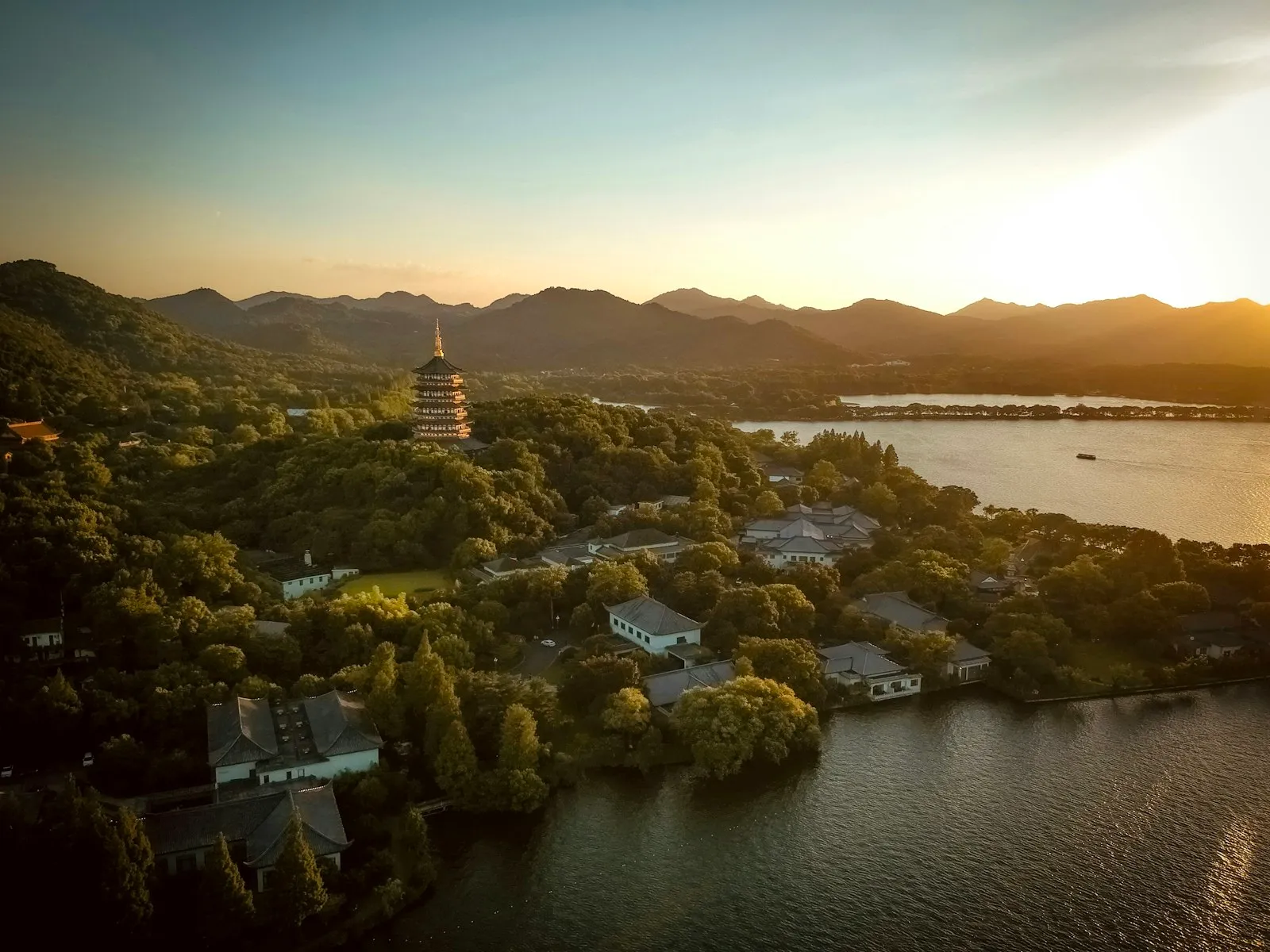
Beyond the main halls on the central axis, the side compounds offer notable highlights as well. The Hall of Five Hundred Arhats at Lingyin Temple is built on a Buddhist swastika floor plan, housing 500 bronze arhat statues that each measure 1.7 meters high, 1.3 meters wide, and weigh about 1 ton. East of the Hall of the Medicine Buddha sits Jigong Hall, which enshrines a bronze statue of Jigong that is 2.3 meters high and weighs 2.5 tons, flanked by 18 murals with a total length of 50 meters depicting his life. Behind Lingyin Temple rises the 314-meter-tall North Peak, where Lingshun Temple stands. Founded during the Eastern Jin dynasty, it has enshrined the Five Manifest Wealth Gods since the Song dynasty. Visitors can climb thousands of steps or take the cable car on the east side up and down the mountain, and the round trip takes about 6 to 7 minutes.
| Building or Site | Highlights and Description |
|---|---|
| Ligong Pagoda | An octagonal, seven-story stone pagoda about 8 meters high near the entrance, housing the ashes of founder Huili |
| Hall of Heavenly Kings | Main front gate of Lingyin Temple, hung with the "Yunlin Zen Temple" plaque inscribed by the Kangxi Emperor, enshrining a Southern Song wooden statue of Skanda |
| Grand Hall of the Great Sage | Standing 33.6 meters high on the central axis, enshrining China's largest wooden Shakyamuni statue and over 150 polychrome figures on the rear wall |
| Huayan Hall | Located at the highest point of the temple grounds, enshrining Vairocana Buddha, Manjushri Bodhisattva, and Samantabhadra Bodhisattva |
| Hall of Five Hundred Arhats | Built on a swastika floor plan, housing 500 bronze arhat statues |
| Jigong Hall | East of the Hall of the Medicine Buddha, enshrining a 2.3-meter-tall, 2.5-ton bronze Jigong statue and 18 life murals |
| Lingshun Temple on North Peak | Sits atop North Peak; reachable by climbing thousands of steps or taking the cable car on the east slope (round trip takes about 6 to 7 minutes) |
Which Rock Carvings on Feilai Peak Should You See?
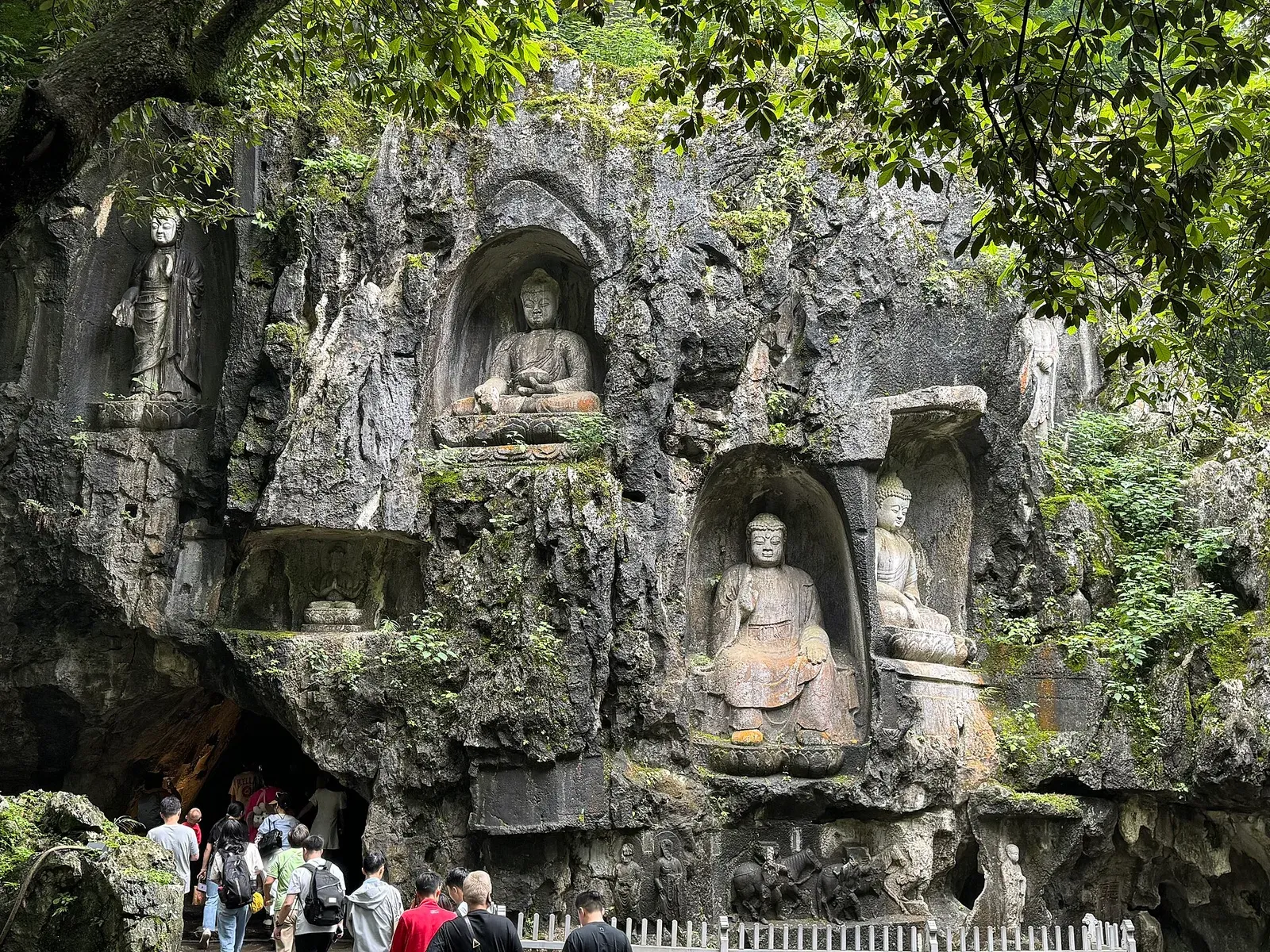
Feilai Peak is a 168-meter-tall limestone hill separated from the temple by a stream, protected as a Major Historical and Cultural Site Protected at the National Level. Its crags and karst caves preserve numerous Buddhist carvings dating from the Tang to the Yuan dynasty. Surveys by cultural heritage scholars record either 115 niches with over 390 statues, or 345 stone Buddhist figures from the Five Dynasties to the Yuan dynasty (with 338 well-preserved figures). Among them, 232 statues date from the Song dynasty, while 67 niches totaling 116 large and small figures date from the Yuan dynasty, making this the largest preserved collection of Yuan stone carvings in China.
Several landmarks stand out along the cliffs and inside the caverns. In the main Guanyin Cave, a crack in the rock ceiling connects directly to the hillside above; standing at a specific angle lets you gaze up at a slim sliver of sky, a sight known as "A Thread of Sky". On the cliff outside, the Northern Song Budai Maitreya and the Eighteen Arhats niche measures 3.6 meters high and 9.9 meters wide, making it the largest niche on the hill, showing a smiling Maitreya with his bare belly. In addition, the Chinese video game Black Myth: Wukong modeled one of its combat settings after Niche No. 32 on the peak, which depicts a crowned, smiling Vajrapani carving in the Indo-Himalayan style from the Yuan dynasty.
If your primary interest is the stone carvings and karst caves, turn left after the gate to walk along the stream path and explore Qinglin Cave, Yuru Cave, and Longhong Cave first. If you prefer to pray and visit the halls while the temple is quieter in the morning, head straight into the main gate first and then spend the afternoon admiring the cliffside carvings along the stream.
How to Reach the Temple from the Train Station and Airport?
To reach the scenic area from major transport hubs in Hangzhou, you can choose public buses, airport shuttle buses, or ride-hailing services. From Hangzhou Railway Station (Chengzhan), take Bus K7 directly to the Lingyin terminus (about 15 stops), or take Bus Y2 directly (about 12 stops). From Hangzhou Xiaoshan International Airport, catch the airport shuttle bus (departing every 30 to 40 minutes) to Hangzhou Railway Station, then transfer to Bus K7 or a taxi to the scenic area.
For navigation within mainland China, Apple Maps on iPhone works reliably in English by using Gaode (Amap) local mapping data directly. On Android, use the international version of Amap, which offers multilingual route planning and ride-hailing. Google Maps is unreliable in China due to a 100-to-700-meter coordinate offset and outdated information. For getting around and ordering rides, foreign travelers can use Didi's English interface linked to an international credit card for automatic password-free payment. Didi includes real-time two-way English-Chinese text translation to communicate pickup points with your driver, and it operates directly as a mini-program inside Alipay without a separate app download. Daily purchases across the city are widely supported by WeChat Pay and Alipay, both of which accept international credit and debit cards.
| Starting Hub | Transport Mode | Route and Stops | Details |
|---|---|---|---|
| Hangzhou Railway Station (Chengzhan) | Bus | Bus K7 (about 15 stops) | Direct to Lingyin terminus |
| Hangzhou Railway Station (Chengzhan) | Bus | Bus Y2 (about 12 stops) | Direct to Lingyin terminus |
| Hangzhou Xiaoshan International Airport | Airport Shuttle Bus | Departs roughly every 30 to 40 minutes | Take the shuttle bus to Hangzhou Railway Station, then transfer to public transit or a taxi directly to the temple |
What Are the Common Mistakes for First-Time Visitors?
First-time visitors often encounter confusion regarding incense, entrance documents, and pacing a multi-day itinerary. According to the Uncle Panda Travel Hangzhou guide, you do not need to buy incense from street sellers outside the gates, as the temple normally provides three incense sticks to visitors free of charge. For entry, the gate monitors strictly check your original physical ID against your face; arriving with only a digital booking confirmation on your phone will prevent you from passing the turnstiles. Furthermore, even with free admission, you need to book your time slot at least 1 day in advance, as same-day slots are frequently full.
A standard visit to Hangzhou works well over 2 to 3 days. You can combine Feilai Peak and Lingyin Temple with Xixi National Wetland Park on Day 2; dedicate Day 1 to the West Lake causeways, Leifeng Pagoda, and Qinghefang Ancient Street; and extend Day 3 to the nearby water town of Wuzhen for a relaxed Jiangnan journey. If you prefer a seamless visit without the stress of transit and reservations, you can contact an Uncle Panda travel designer for a private Hangzhou itinerary, accompanied by your driver throughout the trip, with a separate licensed guide (speaking English or Chinese) arranged by your travel designer on request.
| Common Misconception | Rule and Practical Advice |
|---|---|
| Ticket Policy | Free admission is implemented across the entire Lingyin Feilai Peak Scenic Area (including Lingyin Temple, Yongfu Temple, and Taoguang Temple) |
| Incense for Worship | The temple usually provides three incense sticks for free inside; no need to buy overpriced incense outside the temple |
| On-Site Entry Identification | Entry requires identity verification against the original ID or valid document registered during booking; no booking QR code is needed |
| Advance Booking Window | Real-name, time-slot reservations should be made at least 1 day in advance, with morning or afternoon slots open up to 7 days ahead |
| Trip Length in Hangzhou | The standard recommended trip length is 2 to 3 days, pairing Lingyin Feilai Peak with Xixi National Wetland Park on Day 2 |
Sources
Hangzhou Lingyin Temple Opens for Free
Lingyin Feilai Peak Booking Channel Is Live! How to Book? Practical Guide
Lingyin Temple - Wikipedia
Hangzhou Travel Guide: West Lake, Lingyin Temple and Xixi
Lingyin Temple - Wikipedia
Best Map App for China: Does Google Maps Work & Didi Guide
Lingyinsi Temple
Feilai Peak Carvings - Wikipedia
North Peak - Wikipedia
Sources verified on Nov 18, 2026
FAQ
Is admission to Lingyin Temple and Feilai Peak completely free together?
Yes. Since Dec 1, 2025, free admission covers the entire Lingyin Feilai Peak Scenic Area, including Lingyin Temple, Yongfu Temple, and Taoguang Temple. Once your Feilai Peak reservation is confirmed, no separate booking is needed for Lingyin Temple.
What time do the temple gates open and close each day?
Lingyin Temple opens its mountain gates to the public daily at 7:00, staff begin clearing the grounds at 18:00, and the gates close at 18:15.
What should I do if I cannot visit after booking?
If you need to cancel, submit a cancellation request before 24:00 on the reserved date. Missing 3 bookings within 30 days on the same account results in a 30-day booking restriction.
When was Lingyin Temple originally founded?
Lingyin Temple was founded during the Eastern Jin dynasty by the Indian monk Huili. Historical records cite the founding year as either 326 (the first year of the Xianhe era) or 328.
Do I need to buy incense outside before entering the temple?
No. The temple normally provides three incense sticks to visitors free of charge inside, so there is no need to purchase overpriced incense from vendors outside the gates.